The Significance of a Guide of Green
Monsoon’s Sacred Colour
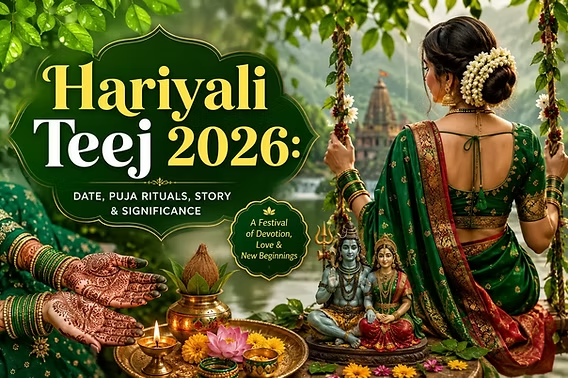
Hariyali Teej is not merely a festival of marital felicity or a ceremonial observance marked by fasting and adornment; it is a many-layered expression of the Indian civilisational imagination in which time, season, fertility, womanhood, devotion and nature are woven into a single sacred continuum. Observed on the Tritiya, the third lunar day of the bright fortnight of Shravana, Hariyali Teej acquires its distinctive character from the monsoon, when the parched earth of northern India is transformed by rain into a landscape of verdure. In 2026, Hariyali Teej falls on August 15. The word Hariyali signifies greenery or verdure, while Teej is conventionally associated with Tritiya, the third lunar day. The festival, therefore, may be understood not merely as a calendrical observance but as a celebration of the third lunar day within the luxuriant season of the rains.
Cosmic Balance in Early Indian Thought
It would, however, be historically imprecise to describe Hariyali Teej in its present form as an explicitly Vedic festival. Its contemporary observance belongs principally to the later Hindu religious and regional tradition. Yet the cultural ideas that give the festival its profound resonance are consonant with the much older Indian conception of the universe as an organic and interdependent order. The Vedic imagination did not regard nature as an inert backdrop to human existence. Rain, rivers, vegetation, cattle, fertility, agriculture, seasons and the rhythms of the heavens were woven into the sacred perception of life. The idea of ṛta—the cosmic order through which the universe maintains its rhythm and balance—provided an enduring philosophical substratum for the later Hindu understanding of seasonal and ritual time. Festivals such as Teej may consequently be viewed as part of a larger civilisational continuity through which the profound relationship between man, nature and the sacred was translated into the idiom of popular religion.
Life-Giver of the Soil
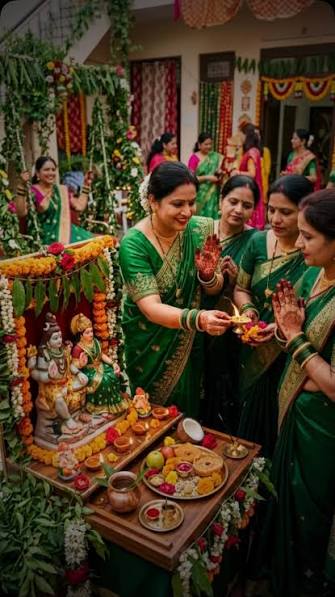
The monsoon is central to this symbolism. For an overwhelmingly agrarian civilisation, rain was never a mere meteorological occurrence. It was the harbinger of life. The first generous showers softened the earth, replenished tanks and wells, revived pastures, nourished crops and restored the landscape to its green abundance. In regions where the uncertainty of the monsoon could determine the fortunes of an entire community, the arrival of rain naturally acquired a sacred and emotional significance. Hariyali Teej thus celebrates the visible resurrection of the earth. The green sari, the green bangles, the mehendi on women’s hands, the swings suspended from rain-laden trees and the songs that accompany the season are not isolated embellishments; together they constitute a cultural vocabulary of renewal.
Pārvatī as the Agent of Destiny
At the heart of the festival stands the divine union of Śiva and Pārvatī, one of the most enduring theological and cultural archetypes of Hindu civilisation. Pārvatī’s story is a narrative of extraordinary perseverance. She undertakes severe tapas, remains unwavering in her devotion and ultimately attains Śiva as her husband. In the popular religious imagination, therefore, her union with Śiva becomes an emblem of fidelity, spiritual determination and the fulfilment of a sacred aspiration. Married women traditionally observe the vrata seeking the well-being, longevity and prosperity of their husbands, while unmarried women invoke Pārvatī in the hope of obtaining a worthy and virtuous life partner. Yet to reduce this observance merely to a prayer for a husband’s longevity would be to diminish its theological depth. The Pārvatī narrative is also a celebration of feminine resolve: the woman is not merely the recipient of destiny but the agent of her own spiritual aspiration.
From Ascetic to Householder
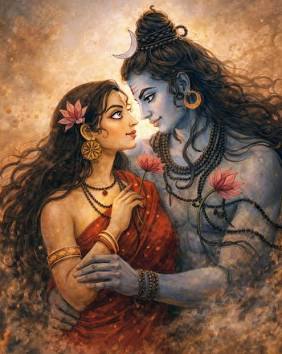
The Śiva–Pārvatī relationship possesses a deeper metaphysical significance within the Hindu imagination. Śiva, the great ascetic, represents transcendence, stillness and the principle of consciousness; Pārvatī, as Śakti, embodies energy, manifestation and the dynamic power of existence. Their union is consequently not merely conjugal. It symbolises the complementarity of Śiva and Śakti, Puruṣa and Prakṛti, consciousness and energy, transcendence and creation. The great paradox of Śiva’s mythology lies in the fact that the supreme ascetic eventually becomes the householder; the deity who withdraws from the world is drawn into the obligations and affections of family life. Hariyali Teej, in remembering this union, therefore sacralises marriage while simultaneously placing it within a much larger cosmological framework.
Expressing the Self
The festival also possesses a distinctly anthropological dimension. Historically, Teej has been a predominantly women-centred institution, providing a socially sanctioned space in which women could gather, sing, adorn themselves, exchange gifts, remember their natal homes and participate collectively in ritual. Such occasions were particularly significant in traditional societies in which women’s everyday existence was closely circumscribed by domestic responsibilities. Through Teej, women became not merely participants in a ritual prescribed by the community but custodians of an oral cultural tradition. Folk songs, legends, ritual gestures, recipes, forms of adornment and seasonal customs were transmitted from mother to daughter and from one generation of women to another.
The relationship between the married woman and her natal home adds another subtle dimension to the festival. The tradition of sending Sindhara and other gifts to married daughters reflects the continuing emotional bond between a woman and the family into which she was born. Marriage may alter her household, but it does not erase her natal identity. Teej periodically renews that bond. The mother, daughter, sister, married woman and daughter-in-law occupy different positions within the social order, yet the festival creates a temporary cultural space in which these identities intersect. The festival is therefore as much about kinship and memory as it is about ritual.
Existential Reassurance
The celebrated swing, or jhula, hanging from the branches of trees during the monsoon, is perhaps the most picturesque emblem of Teej. Its significance is more than recreational. The swing moves between earth and sky, ascent and descent, stillness and motion; it is suspended from a living tree at the very moment when the tree itself has been rejuvenated by rain. Women singing upon the swings beneath the green canopy create an image in which human celebration and the rhythms of nature become inseparable. The swing thus becomes an almost poetic representation of the cyclical character of Indian time.
The agricultural significance of Teej is equally profound. The Indian village historically lived by the rhythm of the monsoon. Sowing, germination, transplantation, pasture, livestock and food security were all dependent upon the timely arrival of rain. The green landscape was therefore not merely beautiful; it was economically and existentially reassuring. Hariyali Teej expresses this agrarian consciousness in symbolic form. The fertility of the woman, the prosperity of the household and the fertility of the earth become interconnected ideas. The festival consequently stands at the meeting point of human fertility, agricultural fertility and cosmic renewal.
Local Expressions of Sacred Time
Its geographical contours are equally revealing. Teej traditions have flourished across large portions of northern and north-western India, particularly in Rajasthan, Haryana, Uttar Pradesh, Bihar and adjoining regions, while Nepal has developed its own powerful and distinctive Teej tradition. The festival, however, assumes different emotional colours according to the landscape in which it is celebrated. In Rajasthan, where the monsoon transforms an otherwise arid or semi-arid environment, greenery possesses an almost miraculous quality. In the agrarian plains of Haryana and Uttar Pradesh, the festival is more intimately associated with cultivation, village life and seasonal rhythms. In the Gangetic region, it becomes intertwined with women’s folk traditions, marital customs and the emotional geography of the natal home. Thus there is no single immutable Teej culture; rather, there exists a broad family of regional traditions shaped by ecology, language, history and social practice.
The various forms of Teej—Hariyali Teej, Kajari Teej and Hartalika Teej—also reveal the richness of this cultural tradition. Hariyali Teej is dominated by the imagery of green nature and the arrival of the monsoon. Kajari Teej acquires a more poignant emotional register through songs of longing, separation and the absent beloved. Hartalika Teej is more explicitly associated with the Puranic narrative of Pārvatī’s determination to obtain Śiva. Their differences notwithstanding, all three are united by the themes of feminine devotion, seasonal transformation, marital aspiration and the sacred imagination of womanhood.
Symbol, Song, and Śṛṅgār
The practice of fasting, or vrata, further reveals the characteristic Hindu understanding of religious discipline. Fasting is not simply abstinence from food. It is an embodied expression of saṅkalpa, śraddhā and tapas—resolve, faith and self-discipline. The body itself becomes an instrument of prayer. In observing the vrata, the devotee transforms an ordinary day into a sacred act of intention. The discipline of the body is thus accompanied by an inward discipline of mind and emotion.
The aesthetic traditions of Teej are equally meaningful. The green sari and bangles symbolise the rejuvenated earth; mehendi evokes fertility, beauty and auspiciousness; solah śṛṅgār situates feminine adornment within the broader cultural vocabulary of marriage and auspiciousness. Food, song, colour, ornament and ritual are not separate compartments of the festival. They constitute a single aesthetic-religious experience in which beauty itself becomes an expression of auspiciousness.
Song as the Archive of Collective Memory
At a deeper philosophical level, Hariyali Teej represents a remarkable confluence of Kāla, Ṛtu, Prakṛti and Śakti—sacred time, season, nature and creative feminine energy. The lunar calendar determines the sacred moment; the monsoon transforms the terrestrial world; agriculture responds to the replenishment of the earth; and Pārvatī provides the mythological embodiment of feminine perseverance and creative power. The festival consequently refuses the modern tendency to compartmentalise religion, society and ecology. In its traditional imagination, the household cannot be wholly separated from the field, the field from the rain, the rain from the season, the season from cosmic time, or human fertility from the fertility of the earth.
This is perhaps the enduring civilisational wisdom of Teej. It reminds us that the Indian festival was never merely a day marked on a calendar. It was a cultural institution through which an entire society interpreted existence. The monsoon was not simply weather; it was renewal. Greenery was not merely colour; it was abundance. Marriage was not merely a social contract; it was dharma. Pārvatī was not merely a mythological consort; she was Śakti. Fasting was not merely deprivation; it was tapas. The swing was not merely amusement; it was an expression of seasonal joy. And the song of women beneath the rain-washed trees was not merely folk entertainment; it was the transmission of collective memory.
Where Nature, Myth, and Community Meet: The Living Legacy of Teej
Hariyali Teej, therefore, survives because it speaks simultaneously to the cosmic, the ecological, the agrarian, the familial, the feminine and the spiritual dimensions of Indian civilisation. It is a festival in which the ancient reverence for nature, the Puranic theology of Śiva and Śakti, the agrarian dependence upon the monsoon, the emotional world of womanhood and the continuity of community converge in a single cultural moment.
When the rains descend upon the parched earth, the earth answers in green; when Pārvatī’s tapas culminates in union with Śiva, devotion answers in fulfilment. Hariyali Teej brings these two renewals—the renewal of nature and the renewal of the sacred household—into one enduring expression of the Indian civilisational imagination.

M. Shiva Prasad, IPS (Rtd.) is a dedicated law enforcement professional who served the combined Andhra Pradesh cadre before opting for the Telangana cadre. Though a native of Andhra Pradesh, he considers himself a true Hyderabadi with an abiding love for the Telugu people. Driven by sincerity, fearlessness, and a lifelong fight against inequality and injustice, his ultimate strengths remain his goodwill and deep affection for the public and the police force. Today, he continues his mission by writing snippets and articles true to his conscience.
Email: Shivareach@yahoo.com
Mobile: 98480 38774