A Sociological Perspective
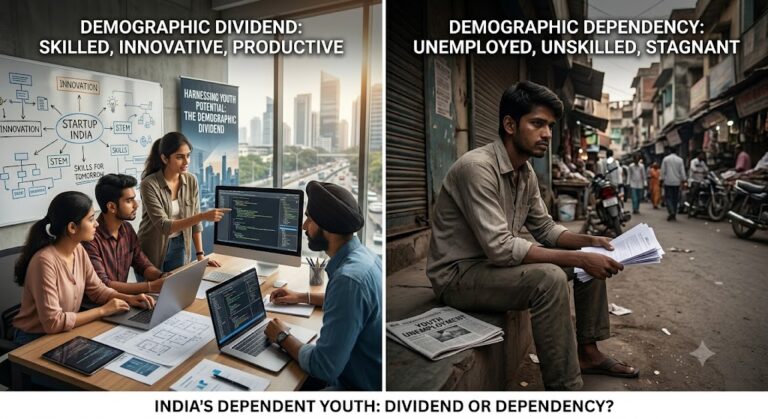
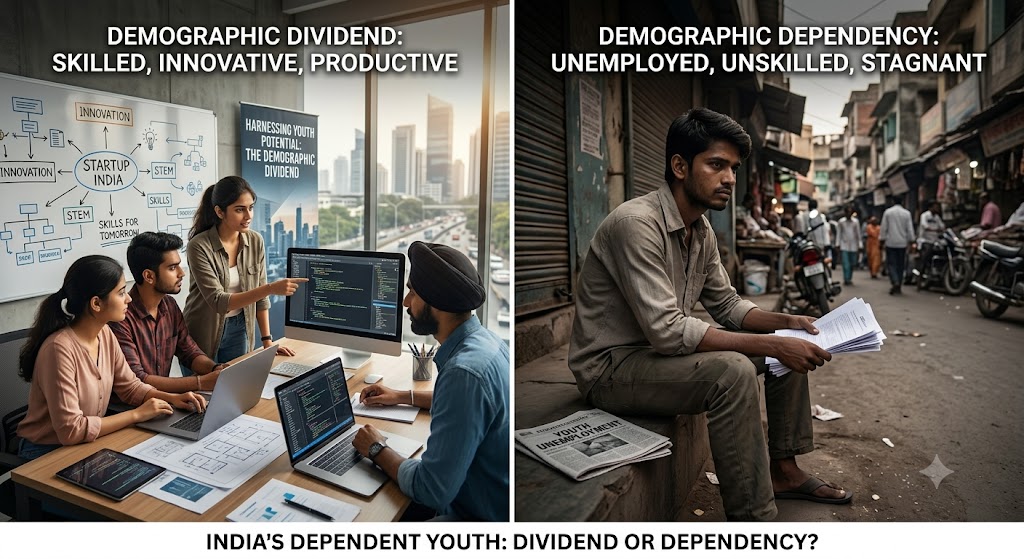
India’s youthful population is routinely described as its greatest demographic advantage. Yet youthfulness by itself is no dividend. A demographic dividend arises only when young people become educated, skilled, productive and economically independent. Otherwise, a favourable age structure can conceal a deeper social problem: the prolongation of dependency into adulthood.
At its core, this is a question of mindset—the expectations with which young people enter adulthood, the value they attach to work and self-reliance, and the extent to which they regard parental resources as support or entitlement.
India’s traditional family has been built upon extraordinary parental sacrifice. Parents educate their children, finance their careers, arrange their marriages, provide housing and accumulate property for them. But this very culture of parental protection can, in sections of society, produce an unintended consequence: adulthood becomes an extension of childhood, with responsibility continually postponed.
Aspiration Without Effort
There is nothing wrong with ambition. The difficulty begins when aspiration becomes entitlement. Social media has created a relentless spectacle of luxury—cars, branded goods, foreign travel, expensive gadgets, fashionable weddings and affluent lifestyles. Young people increasingly compare themselves not with the economic circumstances of their own families but with the most prosperous images presented by their peers and digital influencers. The question consequently changes from What can my family afford? to Why should I have less than others? This is relative deprivation magnified by consumer culture. False comparison creates false prestige, and false prestige encourages expenditure beyond means. Ambition without effort becomes entitlement; entitlement without responsibility becomes dependency.
Marriage as a Vehicle of Status and Wealth
The mindset becomes particularly visible in marriage.
Marriage, which ought to be a partnership, has in some sections become a commercial transaction. Young men and women may participate in expectations of dowry, money, land, jewellery, costly ceremonies and a lifestyle to be financed by their parents.
It would be simplistic to place the entire burden upon either gender. Families on both sides can sustain the same culture of status, wealth and display. What matters sociologically is that parental sacrifice is converted into the financial foundation of adult children.
The recent real-estate boom has intensified this aspiration. Scarcity of prime land and rapid urbanisation have enabled some families to accumulate extraordinary fortunes capable of supporting generations. Sections of the middle class have begun to emulate this sudden prosperity, creating an attraction towards easy money without corresponding effort. The consequence is deeply troubling: the blood, sweat and tears of parents are spent to manufacture the social status of children who have not yet created comparable value themselves. Marriage thus becomes another mechanism of inter-generational wealth transfer—not always for genuine security, but sometimes for social competition and personal gratification.
The Inheritance Mentality
Inheritance is legitimate. Property accumulated by one generation naturally passes to another. But inheritance should provide a foundation for enterprise, not become a substitute for enterprise.
Where substantial land, property and wealth already exist, adult children can remain comfortable without developing comparable productive capacity. For poorer and lower-middle-class families, however, the same expectation can destroy the future of the parents themselves.
Savings are exhausted. Property is sold. Retirement security disappears.
Thus what may be an indulgence for the affluent becomes economic cruelty for the less privileged.
The deeper issue is not property itself. It is the psychology of entitlement to property.
The Caste Card
Another manifestation of this mindset is the continuing grip of caste prestige upon sections of educated youth.
The young should measure themselves by character, scholarship, hard work, competence and conduct. Yet caste identity is still used in some quarters as a badge of inherited status.
The contradiction is particularly stark in schools, colleges and universities. These institutions ought to liberate young minds from inherited hierarchies; instead, caste consciousness sometimes becomes more organised and vocal among educated youth.
India is overwhelmingly composed of Scheduled Castes, Scheduled Tribes, Backward Classes, minorities and other historically disadvantaged sections, while relatively smaller groups belong to traditionally dominant castes. Yet sections of the youth continue to glorify caste identity and its supposed prestige, often at the cost of human fraternity.
Caste pride without personal achievement is borrowed prestige.
To take pride in an accident of birth while neglecting character and hard work is not achievement. It is inherited identity masquerading as merit.
The tragedy is that modern education has not always produced social emancipation. In some cases, it has merely provided sophisticated platforms for preserving ancient prejudices.
The Diminishing Dignity of Labour
The same mindset is visible in attitudes towards work.
Historical caste and occupational hierarchies created unequal notions of prestige. Though their formal foundations have been rejected, their psychological residue remains.
A graduate may consider certain occupations respectable while looking down upon agriculture, skilled trades, construction, technical work, hospitality or other honest employment.
Such attitudes weaken the very foundation of self-reliance.
A skilled electrician, mechanic, carpenter, farmer, technician, nurse or artisan who earns honestly and supports a family is not inferior to an unemployed graduate.
The dignity of labour must cease to be a ceremonial phrase. It must become a social instinct.
The first occupation need not be the final occupation. The first salary need not determine one’s social position. What matters is the willingness to begin, learn, work and build.
Employment: A Supporting, Not Defining, Factor
Employment remains important, but it does not explain the entire phenomenon.
There are young people who genuinely seek work and struggle to find suitable opportunities. Their problem is structural and deserves institutional attention. But there is also another reality: young people who reject available productive work because it is considered insufficiently prestigious, insufficiently lucrative or socially beneath them, while continuing to depend upon their parents.
The distinction is essential.
Unemployment can create dependency; but a culture of dependency can also exist despite opportunity.
The latter is fundamentally a question of values, expectations and social conditioning.
The Culture of Peer Comparison
Peer influence has further strengthened this mindset.
The phone one carries, the vehicle one drives, the clothes one wears, the holiday one takes and the wedding one conducts can become symbols of social acceptance.
The young person does not merely consume for personal satisfaction; consumption becomes a means of maintaining position within the peer group.
The family is then expected to finance the gap between aspiration and affordability.
This creates a peculiar form of selective adulthood: freedom in personal choices, dependence in financial responsibility.
From Parental Sacrifice to Personal Responsibility
The Indian family has always been capable of extraordinary sacrifice. Parents have often deprived themselves to give their children better education, better living conditions and a better future.
That sacrifice deserves gratitude—not perpetual exploitation.
Adulthood means more than freedom. It means responsibility.
It means living within one’s means, respecting honest work, accepting modest beginnings, acquiring competence, rejecting inherited prejudice and eventually becoming capable of supporting those who once supported you.
India’s demographic dividend will therefore not be determined by numbers alone. It will depend upon whether the young move from consumption to contribution, from entitlement to responsibility, from inherited status to earned dignity, and from dependency to self-reliance. The central question is not whether Indian youth should aspire to prosperity. They should. The question is whether prosperity will be demanded from parents or created through personal effort. That is the real sociological question before India. A demographic dividend is ultimately not a matter of age structure alone. It is a matter of social character.

M. Shiva Prasad, IPS (Rtd.) is a dedicated law enforcement professional who served the combined Andhra Pradesh cadre before opting for the Telangana cadre. Though a native of Andhra Pradesh, he considers himself a true Hyderabadi with an abiding love for the Telugu people. Driven by sincerity, fearlessness, and a lifelong fight against inequality and injustice, his ultimate strengths remain his goodwill and deep affection for the public and the police force. Today, he continues his mission by writing snippets and articles true to his conscience.
Email: Shivareach@yahoo.com
Mobile: 98480 38774