Beyond Political Rhetoric
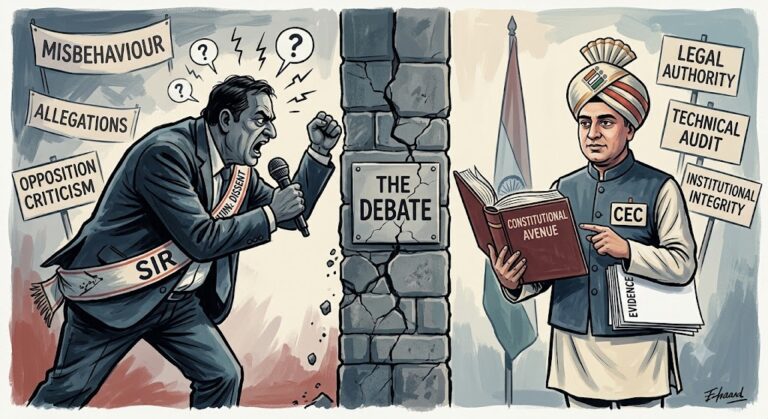
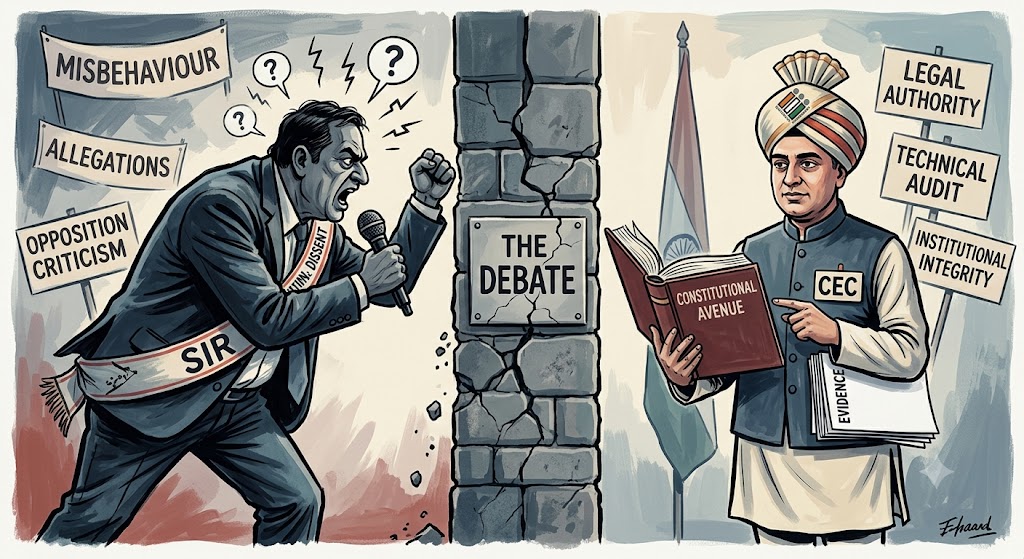
The entire story is about the misbehaviour of two principal parties in Indian politics. The Congress party (or INDIA) and other Opposition parties have criticised the Election Commission and raised questions concerning the SIR exercise. This question deserves to be asked, but motives should not be attributed without evidence. But there is a difference between political criticism and the kind of formal institutional action undertaken by the NDA in 2006, which then used several constitutional and legal avenues simultaneously: a memorandum to the President, parliamentary signatures, demands for the CEC’s intervention, and eventually litigation. If today’s Opposition believes that the internal EC documents reveal a comparable institutional danger, it has constitutional avenues available to it. Basic points are:
- It can demand disclosure.
- It can seek parliamentary scrutiny.
- It can challenge specific administrative actions in court.
- It can ask for an independent technical audit.
- It can seek information concerning the legal authority for changes to statutory forms.
- It can demand an explanation concerning the filing of electoral appeals.
And, where the Constitution provides a particular removal mechanism, it can determine whether the available evidence satisfies that constitutional threshold. The important thing is that the Opposition should not merely make allegations. It should put the evidence and the law together.
Whether BJP or Congress, Governments ignore the value of dissent. The BJP’s own history provides an illuminating precedent. In March 2006, when the Congress-led UPA was in power, NDA leaders submitted a memorandum to President A.P.J. Abdul Kalam seeking the removal of Election Commissioner Navin Chawla. The memorandum was signed by 205 MPs. The NDA alleged, among other things, that Chawla had financial and personal associations with Congress politicians through trusts connected with him and his family and argued that such circumstances raised questions about the impartiality of a constitutional election authority. Why not the Congress question the same? The controversy did not end with the memorandum.
Appear to be impartial, at least!
The fifth Estate, if existed, ignored the ‘impartiality’. The language the NDA used at the time is particularly relevant. The argument was not merely that Chawla had actually acted unfairly. It was that the Election Commission must be impartial and must also appear to be impartial. Contemporary reports recorded the NDA’s insistence that the credibility of elections required confidence in the neutrality of the Commission. BJP leader Jaswant Singh approached the Supreme Court concerning the handling of the representation of the 205 MPs. The Supreme Court issued notice to the Centre, the Election Commission and Chawla.
If Chawla has to be removed, why not Gyan?
The controversy eventually returned to the constitutional arena in 2009, when CEC N. Gopalaswami recommended Chawla’s removal. The recommendation was not accepted by the UPA Government, and Chawla subsequently became Chief Election Commissioner. The legal circumstances surrounding the removal of an Election Commissioner are, of course, different from those concerning the CEC. Article 324(5) provides a special protection to Election Commissioners, under which their removal is linked to the recommendation of the CEC. The important point for today’s debate is therefore not whether the 2006 allegations against Chawla were identical to today’s allegations. They plainly were not. The important point is the institutional principle invoked by the BJP when it was in Opposition. And the BJP also ignores. As if both are almost similar in dealing with the CEC and democracy.
Credibility crisis of BJP in 2026
There is no scarcity among leaders of BJP. It now has an issue of undermining confidence in the Election Commission. The 2006 controversy concerned alleged political proximity and financial associations of an Election Commissioner. The 2026 controversy concerns alleged internal disagreement about how electoral administration itself was being conducted. The two situations should not be equated. But they can be compared at the level of constitutional principle. In 2006, the BJP argued that perceived political influence could undermine confidence in the Election Commission.
In the present regime, in a situation akin to a national emergency, though not declared, in 2026, two serving Election Commissioners have reportedly recorded objections concerning particular administrative and technological actions within the Commission itself. The present issue is therefore potentially more institutional than personal. It asks whether the machinery through which the citizen becomes a voter is itself operating transparently and within statutory authority.
Now, what should the BJP do?
The RSS and other friends, the BJP, in the name of a political party, know what to do. Nobody needs to teach them. It is vigilant about how to remain in power. The BJP is now in the position of government rather than Opposition. That change in political position should not mean a change in constitutional principle. This is perhaps the most important question. If the BJP believed in 2006 that the independence of the Election Commission required vigilance even when its allegations concerned an institution functioning under a Congress-led government, the same principle should apply today. The morally consistent position for the ruling party would be:
Facts, not truth, records should reveal.
The Government should not obstruct an examination of the allegations merely because the examination could create political embarrassment. It should ask the ECI to publish the relevant decisions and authorisations.
- It should permit an independent technical audit of electoral databases where credible concerns have been raised.
- It should ensure that statutory Electoral Registration Officers retain the powers Parliament has given them.
- It should insist that statutory forms cannot be changed without the authority required by law.
- It should require every major electoral intervention to have an identifiable legal basis.
If an unauthorised act is established, the Government should support its correction, even if it has political consequences. That is what constitutional morality requires. Who is bothered by constitutional morality?
Suffering from ‘Lack of Standards’ and full of scams
There is an even broader lesson. The BJP is the ruling party today. The INDIA parties are in Opposition. Their institutional roles may change in the future. The constitutional principle should not change with the occupant of the Treasury benches. If the BJP demands independence of the Election Commission when it is in Opposition but defends executive control when it is in government, its constitutional argument becomes partisan. Again, an RTI issue. If Congress or other Opposition parties demand transparency today but remain silent when similar concerns arise under a future government in which they participate, their argument suffers the same weakness. Whether Congress or BJP, transparency is needed. The Election Commission cannot become independent only when a particular party loses an election. It must be independent before the election, during the election, and after the election.
| Acts of killing democracy: Culprits are all three ECs The answer need not begin with removal of anyone. There is a hierarchy of institutional remedies.First, identify the act.Second, identify the statutory authority.Third, identify who authorised it.Fourth, determine whether the prescribed procedure was followed.Fifth, correct the consequences of any unauthorised action.Sixth, fix the institutional mechanism that allowed the error to occur. If voters were wrongly excluded, they must have an effective opportunity for restoration.If a form was unlawfully altered, it must be restored or lawfully prescribed.If a database bypassed statutory officials, the system must be corrected.If appeals were filed without proper authorisation, the authority for those appeals must be established.If an officer acted without authority, responsibility must be determined according to law.This is more constructive than simply demanding the resignation of the CEC. |
Gyanesh Kumar, long back forgot values
He has a very good name, Gyanesh, meaning wisdom. The controversy should ultimately not be reduced to one individual, whether Gyanesh Kumar or any other Commissioner. The real crisis is the institutional design. Again, significant questions. As a former CIC, this author has some questions.
- Who appoints Election Commissioners?
- Who controls their functioning?
- How does the three-member Commission take decisions?
- How are dissenting opinions recorded?
- When does a dissent become a majority decision?
- Who controls the electoral database?
- Who can alter voter information?
- Who can instruct field officials?
- Who can file appeals?
- Who audits the software?
- Who is accountable when a statutory authority is bypassed?
- These questions will survive the tenure of the present CEC.
- They will survive the BJP Government.
- They will survive Congress or any other Opposition party.
At least one state or central Commissioner can raise and answer under the Right to Information Act. Why not a citizen question as at least information. That is why the present controversy should be used to strengthen the institution rather than merely weaken a particular office-holder.
Shame: No question to answer
The entire controversy can be reduced to five basic constitutional questions:
Authority: Who authorised each disputed action?
Statutory power: Under which provision was it authorised?
Commission participation: Was the full Commission informed and allowed to deliberate?
Decision-making: Was the applicable unanimity or majority procedure followed and recorded?
Implementation: Did any officer, database administrator or software system override a statutory electoral authority?
If the Election Commission answers these questions transparently, much of the present controversy can be settled. If it does not, suspicion will naturally persist.
Who bothers the Constitution of India?
The 2006 Navin Chawla episode provides a useful lesson for every political party. The BJP then argued that an Election Commissioner must be impartial and must be seen to be impartial. Today, Justice Dipankar Datta’s discussion of the “perception test” places the same principle in a broader constitutional framework. The lesson is not that the BJP was right in 2006 or that its present critics are necessarily right in 2026.
The lesson is simpler: The standard applied to a constitutional institution should not depend upon which party controls the Government. An Election Commission trusted only by the winning party is not enough. An Election Commission trusted only by the Opposition is not enough.
It must be an institution whose procedures, records and decisions are sufficiently transparent that both the winner and the loser can accept the electoral verdict because they trust the process that produced it.
The recent internal objections therefore deserve more than political counter-allegations. The ECI should answer them point by point. The Government should facilitate transparency rather than resist it. Parliament and the courts should exercise their respective constitutional roles. And political parties should be willing to accept the same institutional standards when they move from Opposition to Government and from Government to Opposition.
The ultimate question is not whether the Election Commission is on the side of the BJP, Congress, INDIA bloc or any other political formation. The question is whether the Election Commission is demonstrably on the side of the Constitution. That is the standard by which the institution must be judged, and it is a standard that should remain unchanged regardless of who occupies power. The answers, if any, generate more questions.

Law professor and eminent columnist
Madabhushi Sridhar Acharyulu, author of 63 books (in Telugu and English), Formerly Central Information Commissioner, Professor of NALSAR University, Bennett University (near Delhi), presently Professor and Advisor, Mahindra University, Hyderabad. Studied in Masoom Ali High School, AVV Junior College, CKM College, and Kakatiya University in Warangal. Madabhushi did LL.M., MCJ., and the highest law degree, LL.D. He won 4 Gold Medals at Kakatiya University and Osmania University.
Email: cicsridhar@gmail.com
Mobile: 8447651505