Why did SEBI and LIC fail?
SEBI Questions Massive Revenue Discrepancy at Rajesh Exports
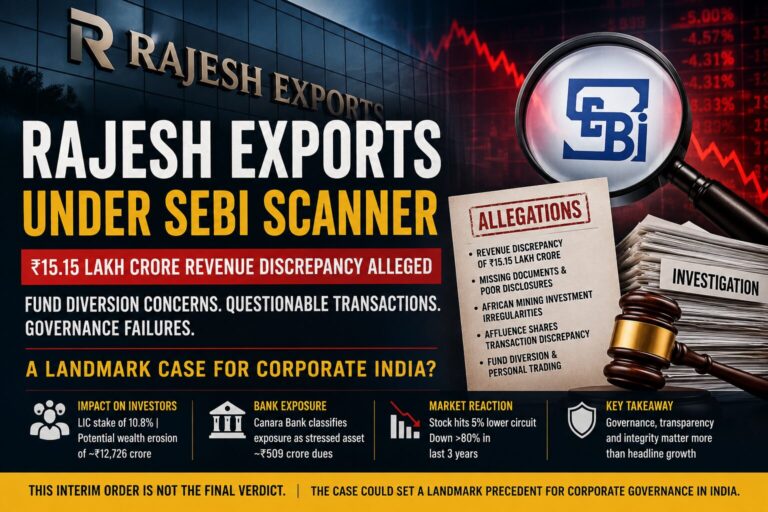
It is about an extraordinary mystery, and the controversy surrounding Bengaluru-based Rajesh Exports Limited, promoted by Rajesh Mehta, raises many shades of scam. Rajesh Exports is a major Indian gold and jewellery company with international operations, and one of its important international entities is Valcambi SA, a Swiss gold refinery acquired by the group in 2015. The regulator’s October 2026 confirmatory order referred to consolidated revenue of approximately ₹15.45 lakh crore for FY2020–21 to FY2024–25, while Valcambi’s standalone revenue for the corresponding period was approximately ₹3,027 crore. SEBI questioned the enormous difference and rejected the company’s explanation that different financial reporting periods accounted for it. The discrepancy was approximately 99 per cent. The regulator considered the explanation inadequate because the company had not demonstrated, through underlying records, how the difference in reporting periods could account for such an extraordinary gap. The question is not simply whether the company had a large turnover, but whether that turnover represented genuine economic activity and was transparently disclosed.
What did SEBI actually discover?
The June 2026 interim order contains several serious observations. SEBI’s examination of the company’s standalone accounts for FY2021–22 to FY2023–24 found that sales and purchase transactions aggregating approximately ₹11,486.60 crore and ₹11,488.42 crore, respectively appeared to be non-genuine. If established, such accounting would have serious implications for the reliability of the company’s reported business performance. More troubling were transactions involving company funds routed through the personal bank account of Rajesh Mehta for derivative trading activities. The regulator observed that these transactions had not been adequately disclosed as related-party transactions or placed before the company’s Board and Audit Committee for approval. Without proper authorisation and disclosure, the integrity of corporate governance is seriously compromised.
The Securities and Exchange Board of India (SEBI), in its interim order dated 3 June 2026, made serious preliminary findings concerning the company’s financial disclosures, alleged fictitious transactions, routing of funds and inability to substantiate significant business claims. The figure attracting national and international attention is approximately ₹15.15 lakh crore, representing the alleged scale of revenue overstatement or misrepresentation during the five-year period examined by SEBI. It is the scale of the alleged financial misrepresentation that requires examination, explanation and adjudication.
The larger question is why such serious concerns about a major listed company remained unresolved for years, and what the country’s largest institutional investor did to protect the money entrusted to it by policyholders. Another allegation concerns investments of approximately ₹1,035.27 crore in African gold mines. SEBI found that adequate supporting documents had not been furnished to establish the genuineness and economic substance of these investments. The regulator also questioned the authenticity and adequacy of documents submitted to explain certain commodity-trading transactions involving Mehta.
What about LIC’s responsibility?
It’s a question of credibility and accountability of Life Insurance Corporation of India (LIC), an institution entrusted with the savings and financial security of millions of families; the issue goes beyond an ordinary stock-market loss. It becomes a question of public accountability, institutional supervision and fiduciary responsibility. It’s a mystery to be resolved. LIC is not an ordinary private investor. It manages enormous funds collected through insurance premiums and savings products. Its investment decisions affect the financial interests of millions of policyholders. LIC’s shareholding in Rajesh Exports reportedly increased from about 1.99 per cent in March 2016 to 11.22 per cent in March 2022. It subsequently stood at approximately 10.8 per cent as of 31 March 2026. This made LIC one of the company’s most important shareholders and its largest domestic institutional investor.
Interestingly, LIC’s own voting disclosures provide an important part of the answer. An investigation published by Mint on 6 June 2026 examined LIC‘s voting record and found that the corporation had repeatedly expressed reservations about Rajesh Exports’ financial statements. In December 2021, LIC opposed the adoption of the company’s financial statements, citing lack of transparency and incorrect classification of interest income. In 2022, it again opposed the financial statements, specifically referring to the improper inclusion of interest income in revenue from operations and non-disclosure of subsidiary financial statements.
LIC nevertheless voted in favour of adopting the financial statements in 2023, before returning to its earlier opposition in subsequent years. The disclosures indicate that LIC had identified concerns about accounting practices and transparency well before SEBI issued its June 2026 order. This is perhaps the most significant institutional aspect of the controversy. If LIC had identified such irregularities, what action did it take beyond voting against resolutions? Did it demand an independent examination of subsidiary accounts? Did it seek a special audit? Did it formally communicate its concerns to SEBI or the stock exchanges? Did it use its substantial shareholding to demand corrective measures?
Why did the investigation continue?

The developments of 14 October 2026 are significant. SEBI issued a confirmatory order continuing the restrictions imposed through its June interim order. The company had argued that differences in the reporting periods of its Indian and overseas subsidiaries explained the revenue discrepancy. SEBI was not satisfied. It observed that even when the figures were considered over the corresponding five-year period, the enormous difference remained unexplained.
The regulator also questioned a document titled Agreement for Nominee Facilitation of MCX Trading and Banking Transactions, which was submitted to support the company’s explanation of Rajesh Mehta’s involvement in commodity trading. The document’s authenticity required further examination after questions arose about the signature attributed to Managing Director Prashant Mehta. The company had cited confidentiality obligations, data-protection requirements, foreign laws and contractual arrangements to explain the difficulties in furnishing information. SEBI was not convinced that all reasonable steps had been taken to obtain the required records. The confirmatory order continued restrictions on Rajesh Mehta from dealing in the company’s securities, directly or indirectly, until further orders. SEBI also directed cooperation with the investigation and the newly appointed forensic auditor, and called for the investigation to be completed expeditiously.
Where did the auditors fail?
A company’s financial statements are not merely documents prepared by its management. They are subject to independent audit, scrutiny by the audit committee and disclosure obligations under securities law. SEBI’s findings raise questions about whether these safeguards operated effectively in Rajesh Exports. The conduct of the statutory auditors has also attracted regulatory attention. SEBI referred the relevant auditors’ conduct to the National Financial Reporting Authority (NFRA) for examination. An audit certificate cannot become a shield against regulatory scrutiny. The investigation should therefore establish individual responsibility wherever the evidence warrants it.
Is this a failure of SEBI, LIC or the system?
The relevant financial years began in 2020–21, while the regulatory proceedings became publicly prominent in 2026. The question is whether earlier warning signs could have triggered a more comprehensive investigation. SEBI, meanwhile, must complete its investigation in a time-bound manner, establish the authenticity of the relevant records, examine the responsibility of the management and auditors, and initiate appropriate proceedings wherever violations are proved. The public also deserves clarity about whether any actual financial loss has occurred and, if so, who suffered it. The alleged revenue misrepresentation of ₹15.15 lakh crore must not be casually described as an equivalent amount of money stolen or lost.
Accountability beyond the accused company
The Rajesh Exports case is not merely about one business house or one promoter. It concerns the credibility of corporate disclosures, the effectiveness of statutory audits, the enforcement capacity of market regulators and the responsibility of public financial institutions. The real test of India’s financial regulatory system will be whether this investigation establishes the truth, identifies those responsible, recovers any established wrongful gains or losses wherever legally possible, and prevents similar failures in the future. Public money demands public accountability. The savings of millions of policyholders cannot be left to the mercy of corporate assurances, delayed investigations or institutional silence.

Law professor and eminent columnist
Madabhushi Sridhar Acharyulu, author of 63 books (in Telugu and English), Formerly Central Information Commissioner, Professor of NALSAR University, Bennett University (near Delhi), presently Professor and Advisor, Mahindra University, Hyderabad. Studied in Masoom Ali High School, AVV Junior College, CKM College, and Kakatiya University in Warangal. Madabhushi did LL.M., MCJ., and the highest law degree, LL.D. He won 4 Gold Medals at Kakatiya University and Osmania University.
Email: cicsridhar@gmail.com
Mobile: 8447651505