Wayanad: The Political Economy of Ecological Murder
“The earth is not inherited from our ancestors; it is borrowed from our children.” This timeless wisdom, echoed by environmental philosophers across the world, has become a haunting reminder every time the fragile hills of Wayanad collapse under relentless monsoon rains. The recurring landslide disasters in Kerala are no longer isolated geological events; they are the cumulative verdict of decades of political complacency, ecological vandalism, administrative negligence and commercial greed. To dismiss these recurring tragedies as “natural disasters” is to absolve those who have systematically weakened nature’s own defence mechanisms. Rainfall may trigger the catastrophe, but human actions manufacture the disaster.
Beyond the Cloudburst
The Western Ghats, recognised as one of the world’s richest biodiversity hotspots, are geological formations that evolved over millions of years through delicate ecological equilibrium. Every mountain slope, every forest canopy and every stream forms part of an interconnected environmental architecture. Scientists have repeatedly warned that these ancient hills possess fragile lateritic soils, highly susceptible to saturation during intense rainfall. Climate change has undoubtedly intensified cloudbursts and erratic monsoon behaviour. Yet climate merely provides the stress; human intervention creates the vulnerability. It is this distinction that public discourse often ignores.
Why Loose Debris and Rain Turn Into Deadly Landslides
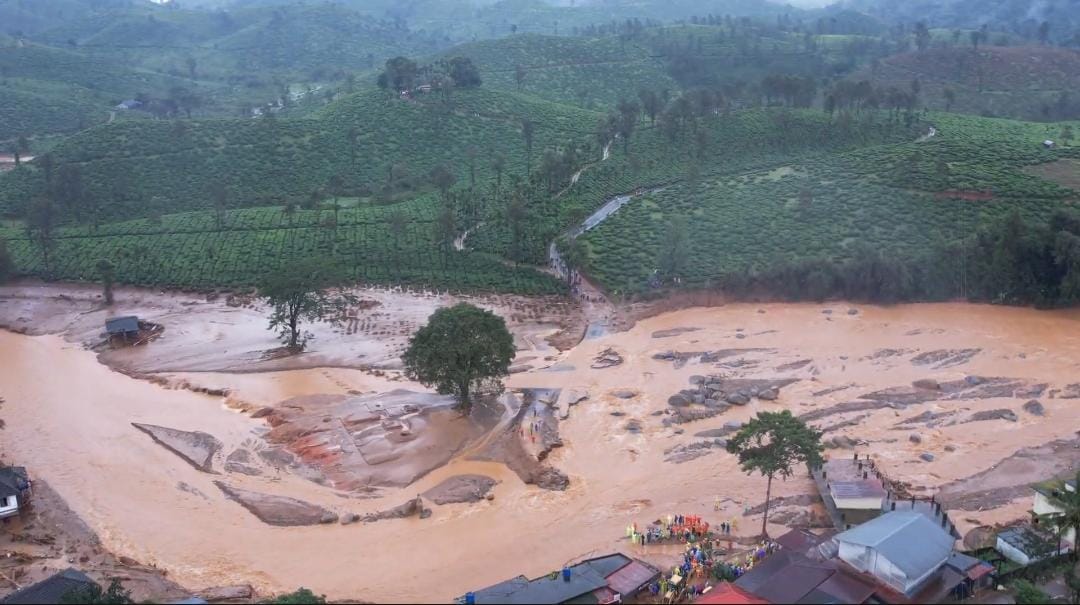
The empirical evidence is overwhelming. Geologists have consistently pointed out that indiscriminate hill cutting, unscientific road widening, extensive quarrying and deep tunnel excavations destroy the natural lateral support of mountain slopes. Excavated earth is frequently dumped illegally along steep gradients without scientific stabilisation. During prolonged rainfall, these loose debris deposits absorb enormous quantities of water, increasing pore-water pressure until the soil liquefies into devastating debris flows. Entire villages disappear within minutes, not because nature became unusually hostile, but because human beings systematically dismantled nature’s resilience.
Amartya Sen’s Lens on Wayanad’s Infrastructure Illusion
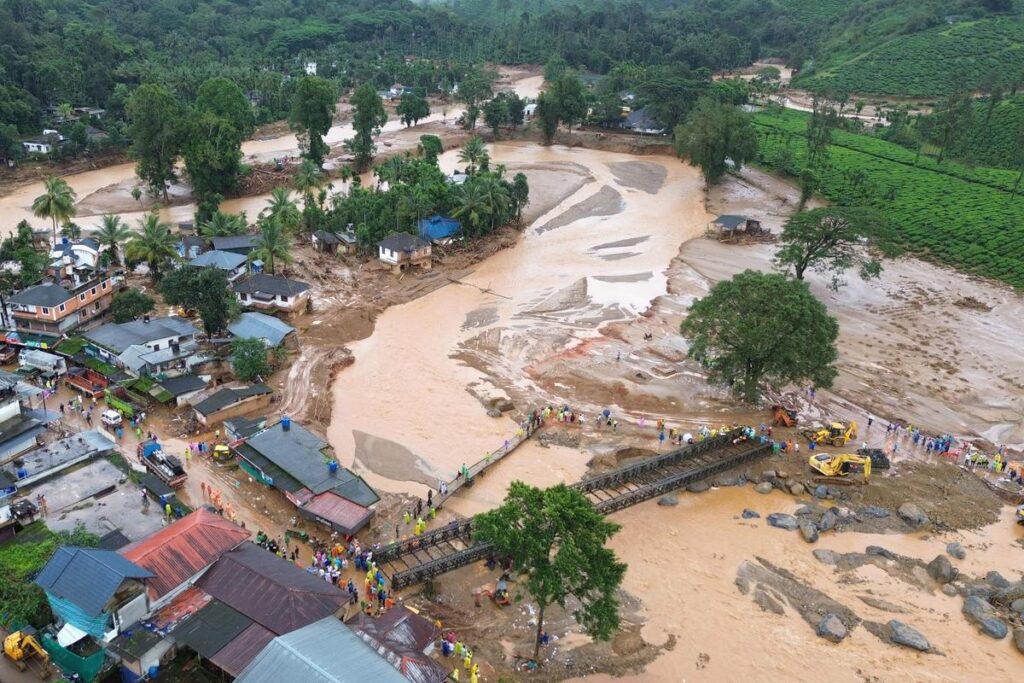
The ongoing infrastructure expansion in Wayanad illustrates this dangerous contradiction. Roads, tunnels and tourism projects are projected as symbols of progress and engines of economic development. Governments justify these projects by invoking regional connectivity, employment generation, tourism promotion and Gross Domestic Product. These arguments possess undeniable economic appeal. Better transport improves commerce; tourism creates livelihoods; infrastructure stimulates investment. No responsible society can reject development altogether.
Yet development ceases to be progress when it ignores scientific evidence and ecological limits. Nobel laureate economist Amartya Sen observed that genuine development expands human freedoms rather than merely increasing economic statistics. If development ultimately deprives communities of life, shelter and security, it defeats its own moral purpose. The benefits of aggressive infrastructure remain concentrated among contractors, commercial developers and politically connected business interests. The burdens, however, fall disproportionately upon plantation workers, indigenous tribal communities, marginal farmers and economically vulnerable households. Their homes are buried beneath debris while the beneficiaries of ecological destruction remain geographically and financially insulated from its consequences.
Nature as Expendable Inventory
The environmental economist Herman Daly argued that unlimited economic growth within a finite ecological system is fundamentally impossible. Wayanad illustrates this principle with devastating clarity. Forests are viewed as obstacles to investment. Mountains become commercial real estate. Rivers become dumping grounds for construction waste. Nature is treated not as capital requiring preservation but as expendable inventory awaiting extraction. The result is ecological bankruptcy disguised as economic success.
The tragedy is compounded by institutional failure. Decades ago, the Western Ghats Ecology Expert Panel, chaired by the distinguished ecologist Madhav Gadgil, produced a comprehensive scientific assessment recommending strict ecological safeguards across environmentally sensitive zones of the Western Ghats. The report did not advocate halting development; rather, it proposed scientifically regulated development that respected geological realities. Successive governments, however, diluted, delayed or ignored many of its recommendations under sustained political and commercial pressure. Scientific evidence yielded to electoral arithmetic. Ecological prudence surrendered to immediate economic expediency.
Formalities vs. Reality
This pattern reflects a deeper crisis in governance. Administrative systems continue to function reactively rather than preventively. Building permissions are granted in vulnerable zones despite repeated geological warnings. Illegal encroachments receive regularisation. Environmental Impact Assessments become procedural formalities rather than rigorous scientific evaluations. Disaster management begins only after disaster has already struck. Helicopter surveys replace ground-level preparedness. Compensation packages replace preventive governance. Relief camps substitute for long-term planning.
Former United Nations Secretary-General Kofi Annan aptly remarked that “We may have different religions, different languages, different coloured skin, but we all belong to one human race.” That shared humanity imposes an obligation upon governments to protect the most vulnerable citizens rather than expose them to avoidable risks. In Wayanad, however, environmental injustice has become a form of social inequality. The wealthy construct luxury resorts overlooking picturesque valleys. The poor inhabit unstable slopes because they possess no alternative. Rain falls equally upon both, but disaster does not.
Climate change undoubtedly magnifies these risks. The Intergovernmental Panel on Climate Change has repeatedly warned that South Asia will experience increasingly intense precipitation events, greater hydrological instability and more frequent extreme weather episodes. These scientific projections demand stronger environmental regulation rather than weaker oversight. Instead, policy often responds by accelerating construction while postponing conservation. The contradiction could not be more dangerous.
“Mātā Bhūmiḥ”: Ancient Wisdom vs. Commercial Greed in Wayanad
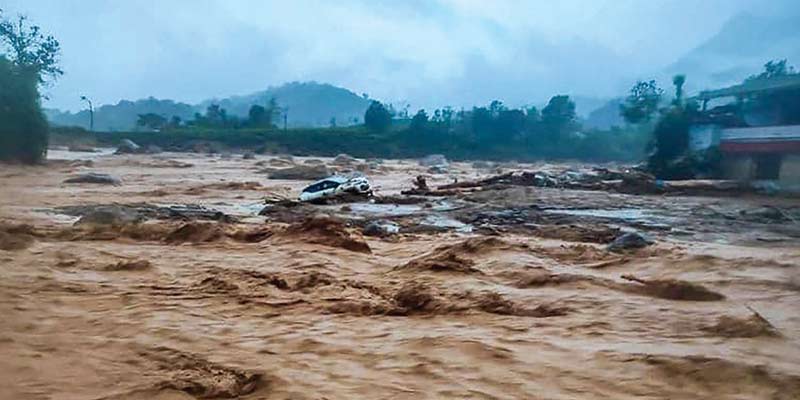
The ethical dimension of this crisis extends beyond environmental science. Mahatma Gandhi warned that “The Earth provides enough to satisfy every man’s need, but not every man’s greed.” Wayanad embodies that warning with heartbreaking precision. Mountains that sustained generations have been converted into commodities. Forests that protected human settlements have been sacrificed for commercial expansion. Rivers that nourished agriculture have become channels carrying destruction.
Ancient Indian wisdom articulated this environmental ethic centuries before the emergence of modern ecological science. The Atharva Veda reverentially declares: “Mātā Bhūmiḥ Putro’ham Pṛthivyāḥ” — “The Earth is my mother, and I am her son.” The Īśā Upaniṣad counsels humanity: “Tena tyaktena bhuñjīthāḥ”—enjoy the world’s resources with restraint, never through possessive greed. These philosophical insights recognise what contemporary environmental science now confirms: humanity is not the owner of nature but merely its temporary trustee.
The great conservationist Aldo Leopold wrote that “A thing is right when it tends to preserve the integrity, stability and beauty of the biotic community.” Judged against this moral benchmark, indiscriminate hill cutting, deforestation and ecologically blind infrastructure cannot be described as development. They represent organised environmental degradation.
The Price of Growth: Rebuilding Infrastructure vs. Preserving Ecosystems
Equally disturbing is the political economy underlying recurring disasters. Every catastrophe generates reconstruction contracts, rehabilitation funds and renewed infrastructure projects. Public money finances recovery from damages caused largely by private commercial gains. The profits remain privatised while the losses become socialised. This represents not merely administrative inefficiency but a profound distortion of democratic accountability.
The law cannot remain a passive spectator. Where scientific warnings were knowingly ignored, where illegal construction destabilised vulnerable slopes, where environmental clearances were manipulated or violated, accountability must follow established legal processes. Responsibility should extend beyond junior officials to include all decision-makers whose actions or omissions materially contributed to preventable loss of life. Environmental regulation cannot remain a paper exercise if constitutional guarantees of life and dignity are to retain substantive meaning.
Ultimately, Wayanad poses a question that transcends Kerala. It asks whether India seeks merely faster economic growth or genuinely sustainable civilisation. Civilisations are remembered not for the speed with which they extracted natural wealth but for the wisdom with which they preserved it. Roads can be rebuilt. Bridges can be reconstructed. Houses can be relocated. But an ancient mountain ecosystem, once irreversibly destabilised, cannot be recreated within human timescales.
A Tragedy of Governance, Not Just Nature
The landslides of Wayanad therefore stand not merely as geological failures but as political failures, administrative failures, economic failures and moral failures. They expose the tragic consequences of treating ecological safeguards as obstacles rather than foundations of development. Unless governance is guided by scientific evidence, constitutional responsibility and ecological humility, the monsoon will continue to transform from a life-giving blessing into a season of recurring mourning.
When history records the tragedy of Wayanad, it should not conclude that nature became cruel. It should conclude that society ignored its scientists, sidelined its environmental guardians, forgot the wisdom of its sages, and mistook commercial greed for national progress. The mountains have spoken through their collapse. Whether the Republic chooses to listen will determine not merely the future of Wayanad, but the environmental destiny of India itself.

M. Shiva Prasad, IPS (Rtd.) is a dedicated law enforcement professional who served the combined Andhra Pradesh cadre before opting for the Telangana cadre. Though a native of Andhra Pradesh, he considers himself a true Hyderabadi with an abiding love for the Telugu people. Driven by sincerity, fearlessness, and a lifelong fight against inequality and injustice, his ultimate strengths remain his goodwill and deep affection for the public and the police force. Today, he continues his mission by writing snippets and articles true to his conscience.
Email: Shivareach@yahoo.com
Mobile: 98480 38774