Skyroot’s Vikram-1 Triumph
The Arrival of Indian Entrepreneurship in Global Deep-Tech Space
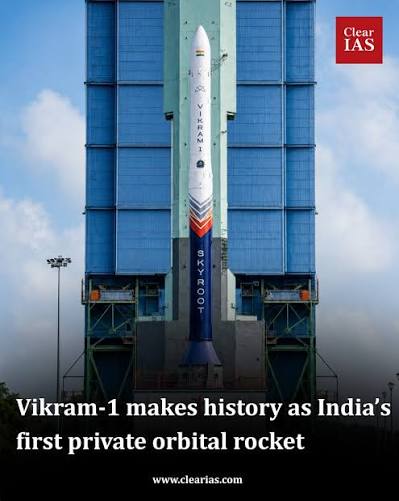
It is a proud moment for Hyderabad, South India and the whole of India. The Skyroot, a private company based in Hyderabad has successfully launched a rocket from Sriharikota on Saturday. Thus, India became only the third country in the world –after the US and China – with ability to launch a satellite by a private sector agency. There is a private space company in Chennai also which has been making strides in launching orbital rockets. But a Hyderabad company has achieved the distinction of making privately developed orbital rocket to successfully place multiple technology demonstration payloads and postcards- including from Prime Minister Narendra Modi on which he had written Vande Mataram – into a Low Earth Orbit (LEO) at an altitude of 450 km.
Accessing the Cosmos
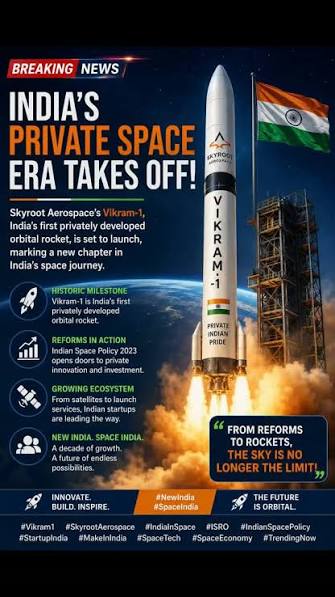
Ushering in a new era in Indian Space Programme, Vikram-1 on Saturday became the first launching vehicle built in private sector to achieve orbit around the Earth and successfully deploy a diverse set of technology demonstration satellites in the space. Built by Hyderabad based company Skyroot Aerospace, Vikram-1 marks the launch of private space flights in India. The company was very actively supported by ISRO and the Union Government. The launching mission was named ‘Aagama’ meaning arrival. It signified the arrival of new era in Indian space research in providing access to the orbit.
Pawan Kumar Chandana, co-founder and CEO of Skyroot Aerospace, and his partner Naga Bharath Daka, the young innovators, had a conversation with Prime Minister Modi soon after the launch. Pawan said during the flight Vikram-1 behaved ideally. It completed every principal mission milestone. The PM said the launch is a defining moment in India’s space journey. The Central government had opened the space sector to private companies in 2020 and formalized it space policy accommodating private companies in 2023.
The Leap Beyond the Sub-Orbital
There were attempts earlier to launch private vehicles in the space. Skyroot itself had flown Vikram-S rocket, an earlier version of Vikram-1, to sub-orbital space in 2022. Chennai – based Agnikul, another private company, had also carried out a sub-orbital flights of its Agniban rockets in 2024. It had the world’s first 3-D printed engine powering the rocket. The experimental rockets fly without satellites, enter into space and then fall off on to the Earth due to gravity. They do not plan to attain an orbit around the Earth. It is meant to demonstrate the capability of the organization to the world and to themselves. Vikram-1, on the other hand, has become the perfect vehicle to launch the payloads in the LEO.
What does LEO mean? It is the zone immediately surrounding our planet. It is defined as the region between 160 km and 2000 km above the Earth’s surface. The satellites in LEO take 90 to 120 minutes to circulate around the Earth once. As the zone is nearer to Earth, LEO is preferred for communication. That is why there is tremendous demand for a place in the zone. The only obligation for any country entering the zone is that it should not disturb the satellites that are already there. Under 1967 Outer Space Treaty no nation would have absolute ownership in the zone.
India’s Upstream Battle Against Global Space Mega-Constellations
That is why countries compete to have their satellites encircle as much space as possible like China’s Guowang and Qianfan satellites. Much has been said about China’s state-backed achievements like the Long March 10 rocket. But even the Chinese private companies such as Land Space and Space Pioneer are developing medium-lift reusable vehicles. India does not have reusable vehicles, yet.
India is still behind in the LEO race. To make some progress Indian private companies have to launch frequently. ISRO’s partially reusable vehicle will be operational in mid-2030s. It is for the private firms in Hyderabad and Chennai to bridge the gap. Building the private ecosystems means a lot of capital investment. While the Union Government had recently arranged for a venture capital of Rs 1,000 crore, private investments have to be mobilized in a big way.
The 35-Minute Drama That Saved Mission Aagaman
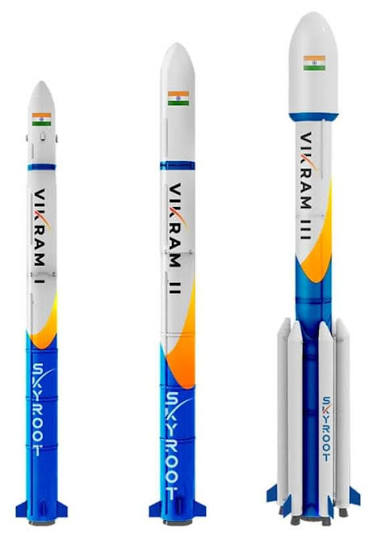
The payloads placed in the LEO by Vikram-1 include Embrace by Cosmoserve Space Embrace (a robotic debris-capture arm), solaras satellite by Grahaa Space and Scope Satellite by Skyroot Aerospace. It is designed to carry small satellites weighing up to 350 kg to LEO. The rocket has three solid stages and one liquid orbital adjustment module.
The organizers had tension for some minutes before the launch forcing them to stop the countdown at five. Then they quickly recovered and launched the vehicle successfully from the Satish Dhawan Space Centre from Sriharikota at 12.05 pm instead of originally planned 11.30 am. As orbital congestion becomes acute with the super powers enhancing their concentration on occupying the LEO, countries like India with small investment have to work under a lot of constraints. This is sure to become an international crisis very soon.
Sarabhai, Kalam, and Raman: The Indian Legacies Powering Vikram-1’s Engines
ISRO has been facing a lot of issues including the exodus of scientists. ISRO’s first launch of this year on Monday, 12 January 2026 ended in failure. The PSLV-C62 mission – carrying 16 satellites, including seven from foreign countries- did not reach the intended orbit. This is the second straight failure for a rocket that has served as ISRO’s main launch vehicle for more than three decades. The previous failure happened in May 2025. On both the occasions the rockets took off successfully and completed the first two stages before developing trouble in the third stage. It is very difficult for ISRO to recover from these failures and be in a position to help private companies. In this background the success of Hyderabad based company Skyroot Aerospace is a ray of hope
While the name of the rocket, Vikram-1, pays homage to the father of India’s space programme, Dr. Vikram Sarabhai, the solid engines have been named ‘Kalam’ for the rocketman and former President Dr. Abdul Kalam and the liquid engine was named after Nobel prize winning physicist Dr. CV Raman.
ISRO Astronaut Subhanshu Rally Behind India’s First Private Orbital Success
Commending the company on its success, Modi said his government’s decision to open up the space sector to private players was seen by many to be risky, and thanked the Skyroot founders for proving him right “….because of you, my decision has been proven right. Now my team will also accept that we should trust the youth of the country, we should give them work and they will do it. And, you have done it” said Modi. ISRO chairman V. Narayanan, former chairpersons S. Somanath, A.S. Kiran Kumar, K. Radhakrishnan, astronaut Subhansu Sukla and other scientists were present at the mission control in Bengaluru. The Union Minister for space and technology Jitendra Singh witnessed the launch live from Delhi.
Prominent Journalist
Dr. K. Ramachandra Murthy is a versatile journalist with a distinguished career. Dr. Murthy began his extensive career with Andhra Prabha of The Indian Express group in Bengaluru. He was editor of Udayam, Vaartha and Andhra Jyothy. Dr. Murthy founded and edited HMTV news channel and The Hans India, an English newspaper. He was also editorial director of the Telugu newspaper, Saakshi. He was awarded Ph. D for his research work in rural reporting. Dr. Murthy’s five decades in journalism showcases his influential roles across both print and electronic media. He wrote the political biography of NTR published by Harper Collins.
Email: murthykondubhatla@gmail.com
Mobile: 9908002211