The Threshold
Today is Vijayadashami.
You can hear it before you see it. The drums from the pandal two streets away. The crowd on the road. The smell of camphor and burnt wood drifting in through the windows.
Your mother has been up since before dawn.
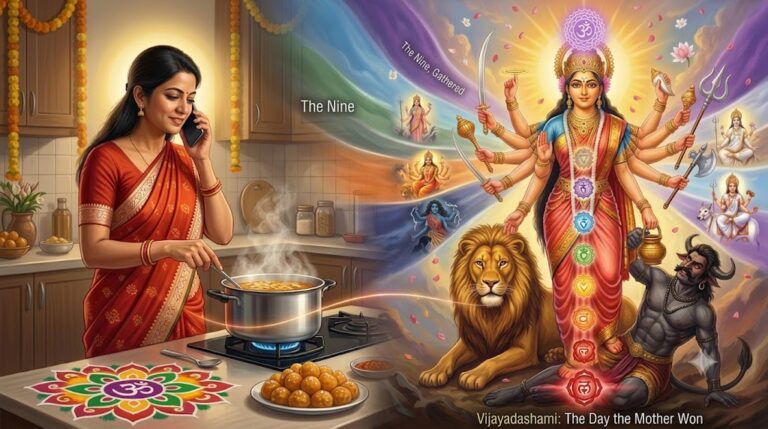
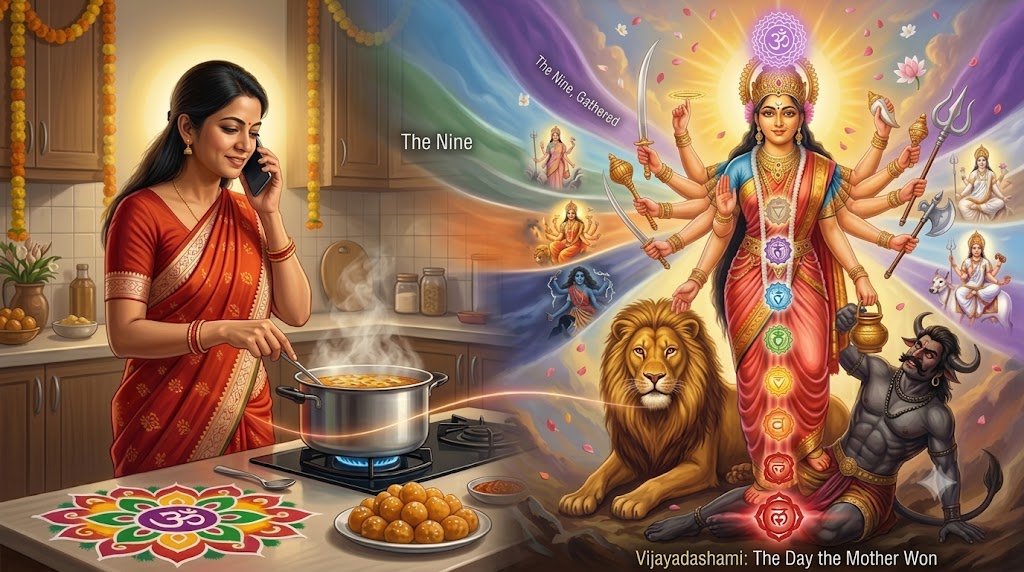
By the time you came out of your room, she had already swept the house. The rangoli at the threshold was fresh. The sweets were in the tin. She had a phone pressed to her ear with one hand and was stirring something with the other. Both of them handled.
You watched her that morning. She was doing twelve things at the same time. And she was not tired. She was glowing. Something in her had settled, after the nine nights. And today she was standing in the middle of it, and she knew it.
Today, the Mother wins.
And your mother has been walking toward this day all along.
The Victory
Today, the Mother wins.
She wins the way a mother wins. Quietly. Completely. And for good.
There are no trumpets. No victory march. There is simply a woman who stayed, until the thing that was harming her children was finished. The story is old. It has been told for thousands of years, in temples, in villages, in the courtyards of houses where grandmothers tell it to children who are half asleep. There was a demon called Mahishasura. He had been given a boon. No man could kill him. No god could kill him. He could change his shape at will. A buffalo. A lion. An elephant. A man. Whenever he was cornered, he became something else. He could not be pinned down. The gods had tried everything. Every weapon. Every warrior. Every strategy. Nothing worked. Because he always came back, in a different form.
So the gods did the only thing left. They took everything they had. All their power. All their fire. All their light. And they poured it into one being.
And that being was her.
She rose out of their offering. And she rode into battle on a lion. And the battle lasted nine days.
Read that again. Nine days. The same nine nights we have just walked.
For nine days, she fought him. And for nine days, he kept changing. He became a buffalo. He became a lion. He became an elephant. He became a man. And each time, she met him exactly as he was. Not as he had been. Not as he might be. As he was, in that moment.
And on the tenth day, he finally stood still. Because he had run out of forms. There was nothing left for him to become. And in that stillness, in the only shape he could not escape, she ended him.
That is Vijayadashami. The day the fight ended.
And here is what matters. She won because she did not stop. She did not tire. She did not doubt. She did not change into something she was not. She simply remained herself, for nine days, until the thing that kept changing finally ran out of ways to hide.
That is how a mother wins. By staying. The way your mother stayed.
The Nine, Gathered
Look at what we have walked.
Nine nights ago, the Mother came as a daughter. She stood alone on the mountain. She had not walked yet. She had not spoken yet. She simply stood, and the ground beneath her became holy.
And on the tenth day, she ended the demon.
Nine nights ago, she did not know how to move. And today, she rides a lion.
Nine nights ago, she was learning to stand. And today, she stands at the end of a battle, and the whole world has changed because of it. That is what the nine forms were. Not nine separate goddesses. One Mother, becoming. Night by night. Form by form. She learned to stand, so that she could walk. She learned to walk, so that she could find her voice. She found her voice, so that she could create. She created, so that she could hold. She held, so that she would know what she was protecting. She drew her line, so that she could carry the dark. She carried the dark, so that the morning could come. And the morning came, so that she could sit at the centre of everything, and rest.
And today, all of it comes together.
Not nine. One.
The daughter. The seeker. The one who learned courage. The one who laughed. The one who held. The one who drew the line. The one who carried the dark. The one who returned to the light. The one who arrived.
One Mother.
And she did not become one today. She was one all along. We simply met her one face at a time.
The Truth
Now we come to the part that is hardest to say plainly.
We use those words often. We say the Mother defeated evil. We say Vijayadashami is the victory of good over evil. And we say it as if good and evil were two armies, standing on opposite sides of a field, with the Mother on one side and the demon on the other.
That is not what the story says.
Mahishasura was not a stranger. He was not an outsider. He was a being who had been given a gift. A boon. Something he had earned through years of devotion. And the gift was this. He could not be killed by any man or god.
The gods themselves had granted it. They had blessed him, before he became what he became.
And that is the truth of evil. It rarely arrives as a stranger. It usually arrives as something that was once good, and then grew. A devotion that became pride. A confidence that became arrogance. A gift that the receiver decided to use for himself.
Mahishasura did not set out to become a demon. He became one, one step at a time, by taking his blessing and turning it into a weapon.
And his greatest power was not his strength. It was that he could change shape. Whenever he was cornered, he became something else. A buffalo. A lion. An elephant. A man. He could not be pinned down.
You have met this demon.
You have met him in yourself. He arrives as a bad habit and becomes a way of life. He arrives as a small resentment and becomes a bitterness you cannot let go of. He arrives as a defence and becomes a wall you cannot climb. Every time you corner him, he changes shape. He becomes something else, and you lose him again.
And you have met him in the world. In an institution that once served something good and now only serves itself. In a relationship that once held love and now only holds habit. In a fear you have carried for so long that you no longer remember what you were originally afraid of.
That is Mahishasura. Not a demon with a thousand arms. A thing that keeps changing so that you cannot end it.
And the Mother’s method is the only method that works.
She did not chase every form. She did not try to fix each disguise. She simply stayed. For nine days. Without tiring. Without doubting. Without changing into something she was not. Until the thing that kept changing ran out of shapes to become.
And then she ended it. Not with a great blow. Just one clean act, in the stillness, when it finally stood still.
That is the victory of good over evil.
Good does not fight evil. Good outlasts it.
The Mother at Home
And now, back to the house.
Back to the noise. Back to the drums from the pandal two streets away. Back to the crowd on the road, in new clothes, laughing too loudly.
Your mother is still in the kitchen.
The sweets are out of the tin and onto a plate. The phone is still going. Someone has arrived at the door and she is greeting them, and stirring something, and telling you to change your shirt, all at the same time.
She is doing twelve things at once. And she is still glowing.
You watch her from the doorway. And something you did not understand this morning is beginning to make sense.
Because she has been fighting her own Mahishasura. For years. And you did not know.
Something in her life went wrong, and stayed wrong. Something kept changing shape. A worry. A loss. A person she loved who could not be helped. And every time she cornered it, it became something else. And she did not stop. She did not tire. She did not change into someone she was not.
She simply stayed.
She stayed through the dark year. She stayed through the months you did not call. She stayed through every fight, every disappointment, every long night when you did not know what she was carrying.
And this morning, she was up before dawn. Doing twelve things at once. Glowing.
That is her Vijayadashami.
Not a battle. Not a lion. A kitchen. A phone. A plate of sweets. And a woman who stayed until the thing that was harming her children had nowhere left to hide.
She won.
Quietly. Completely. And for good.
And the thing is, nobody told her so. Nobody put a garland around her neck. Nobody lit a fire in her honour. She simply carried on, doing what she had always done, while the whole country celebrated a victory that looked a lot like hers.
A Blessing
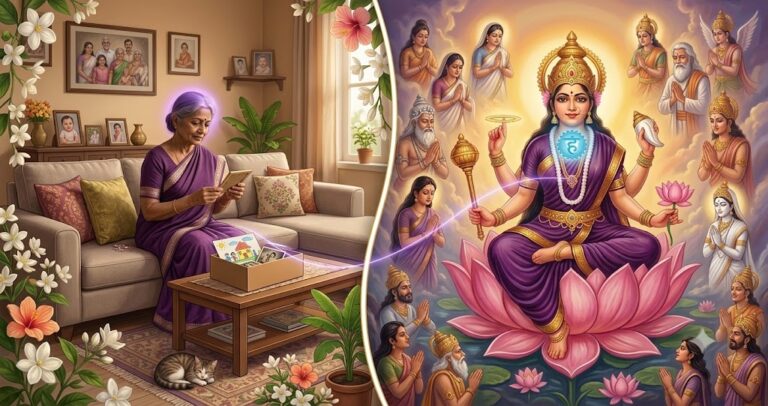
We began these ten days with a child at a door, waiting for his mother to come home.
And we end them with a mother in a kitchen, doing twelve things at once, unaware that anyone is watching.
That is the whole story, really. Somebody was always watching. And somebody is watching still.
So here is what I want to leave you with. Not a lesson. Not a practice. A blessing.
May you see her while she is still here. May you notice the glass of water before it becomes a memory. May you thank her for one thing, out loud, before the chance passes.
And if she is no longer here, may you find her in the ordinary places. In the way you fold a shirt. In the way you say a certain word. In the way you stay, when leaving would be easier.
Because that is where she lives now. Not in a photograph. Not in an urn. In your hands, and in your habits, and in the way you carry what you have been given. She gave you nine forms. You are using all of them, every day, and most of the time you do not even notice. And if you have a daughter, or a son, or anyone who looks up at you the way you once looked up at her, then you are already becoming what she was. You are the ground beneath someone. The one they stand on when everything else shakes. You are the light in someone’s dark year. The one who stays, quietly, while they find their way back.
And one day, they will stand in a doorway and watch you. Doing twelve things at once. Not knowing that you have been fighting something they cannot see. And they will not understand it then.
But they will. Years later. Standing in their own kitchen, on their own tenth morning.
And when they do, they will think of you.
That is the last thing I want to say.
Vijayadashami is the day the Mother won.
And she won for you. So that you could become her.
Jai Mata Di.
Author Biography: – R Srinivasa Murthy, the author, is a corporate leader, an independent writer, and a student of Hindhu Philosophy. He Identifies as a Demystic, committed to removing unnecessary mysticism from traditions to offer practical systems for the next generation. His upcoming book, Logic of And: Sanatana Dharma as a Toolkit for the Contemporary Seeker, aims to bridge ancient wisdom with modern life to foster an inclusive, living civilisation.

With a journalistic long journey, we bring you https://primepost.news, a dynamic platform committed to unraveling the intricate tapestry of Indian politics, particularly delving deep into the heart of Telangana and Andhra Pradesh. Our blog is not just a source of news; it’s a reservoir of insights, analysis, and thought-provoking reviews.