Democracy without equality and transparency
Ultimately, the evolving scenario in Telangana transforms the very definition of citizenship. A citizen who has cast their ballot 11 times in successive elections over two decades should possess an undeniable, institutionalized right to vote. Forcing such individuals to produce documentation from 2002 to prove they are still eligible voters is a severe systemic failure. When technology like the DSA software is deployed without transparent guidelines, and when the physical infrastructure of BLOs fails to bridge the gap, democracy ceases to be inclusive. The current system forces the voter into an unfair position: the burden of proving life, residency, and political existence rests entirely on their own shoulders. If the institutions responsible for safeguarding democracy continue to prioritize bureaucratic exclusion over active facilitation, the trust that binds the citizen to the state will be permanently broken.
The administrative panic in Telangana cannot be decoupled from its intense political ramifications. The targeted contraction of the urban electorate in the GHMC region triggers immediate calculations regarding partisan benefit. Historically, dramatic shifts in urban voter density alter electoral outcomes in favor of parties with highly organized, micro-targeted voter mobilization strategies.
Deduplication!
Critics argue that if hundreds of thousands of urban votes are wiped out under the guise of deduplication, it alters the competitive equilibrium of the state. It opens the door to political engineering where reduced margins allow wealthier political entities to dominate the landscape, rendering conventional democratic mandates vulnerable to post-poll horse-trading and financial manipulation.
Asymmetry of State Responses
Furthermore, a stark contrast appears when comparing the frantic, high-stress atmosphere of Telangana’s voter drive with neighboring Andhra Pradesh. The text raises a vital question: Why is this frantic pressure absent in Andhra Pradesh? The answer lies in the alignment of political regimes. In states where the local ruling dispensations (such as the Telugu Desam Party and Jana Sena coalition in Andhra Pradesh)maintain systemic alliances or structural understanding with the central ruling coalition, the implementation of administrative machinery tends to follow a smoother, less disruptive trajectory. Conversely, in regions or periods where non-aligned political forces hold ground, the deployment of rigid bureaucratic tools like retroactive data verification often becomes highly aggressive.
This asymmetry suggests that dual-voter populations (citizens holding registration slips in both Telangana and Andhra Pradesh) face selective scrutiny. Thousands of voters regularly travel across the borders via buses and cars to exercise their franchise in both states during staggered election timelines. Yet, the software filters and rigid document demands appear to fall heavily on Telangana’s urban clusters, raising valid questions about the impartial execution of the Election Commission’s mandate.
Eroding Confidence of the Common Voter
In a robust democracy, equality and transparency form the bedrock of the electoral exercise. However, the contemporary political landscape increasingly suggests that power resides not with the citizenry or the spirit of the Constitution, but within the complex labyrinths of the Election Commission and its rigid administrative machinery. Across the nation, public trust in central institutions is facing a noticeable decline. When a state’s electoral credibility depends entirely on centralized dictates, the confidence of the common voter begins to erode.
A glaring manifestation of this institutional friction is currently unfolding in Telangana, centered on the implementation of the Summary Internal Review (SIR) and related specialized enumeration drives. The core question dominating public discourse is both simple and alarming: Whose responsibility is it to ensure a clean voter list, the institutional machinery paid to maintain it, or the individual citizen who must repeatedly prove their right to exist in the eyes of the state?
Enumeration Forms: Data, Discrepancies, and Delays
Recent developments regarding the distribution of enumeration and verification forms have sparked widespread panic. While official channels boldly claim that nearly 99.99% of these forms have been distributed, ground realities present a starkly different narrative. Reports indicate that by mid-July, barely 50% of the target population had successfully received or submitted their documentation.
VOTER FORM DISTRIBUTION DATA
Region Reported Distribution Rate
+———————— —————–+
Rural Telangana 80% – 85%
Urban Centers (Averages) 35% – 49%
Malkajgiri District 13.71%
Yadadri District (Highest) 75.44%
+———————- ——————+
With strict deadlines looming—even after an extension granted by the Commission until August 3—the feasibility of covering the remaining population is highly questionable. Urban centers and towns are bearing the brunt of this logistical failure, with an estimated 35% to 50% of urban residents cut out from the direct distribution loop.
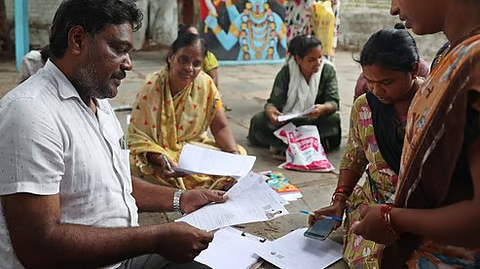
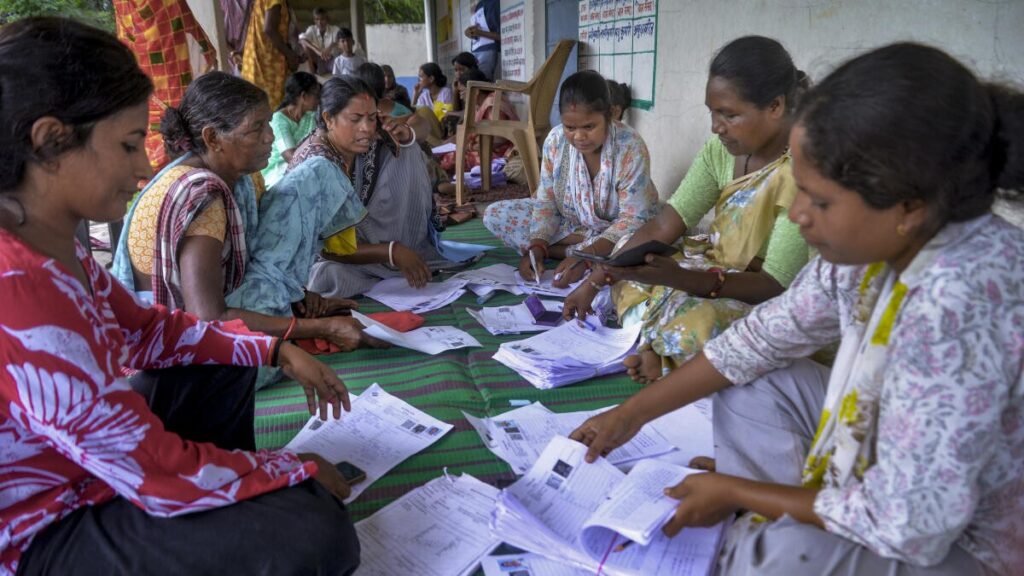
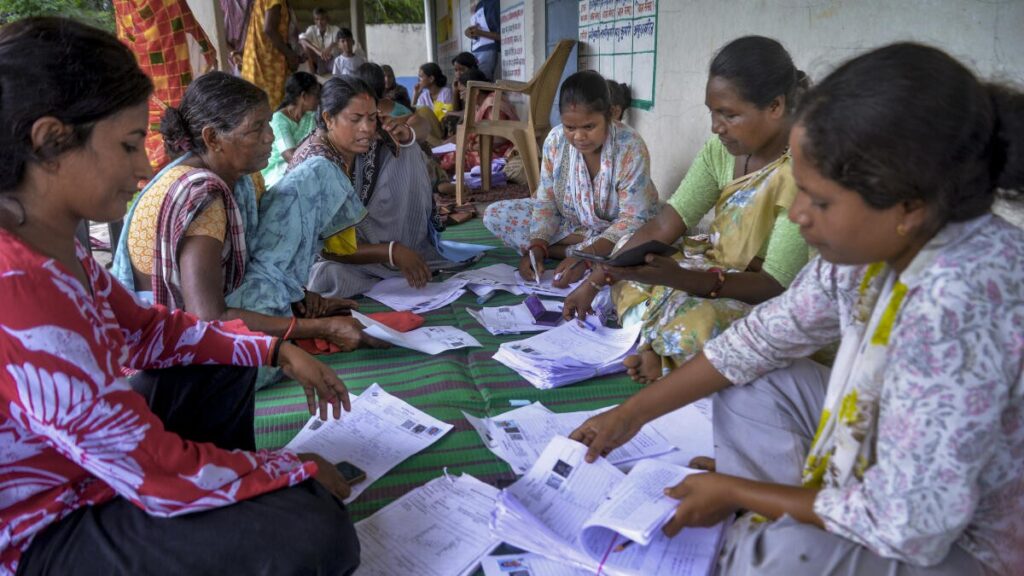
The chaos is amplified by the absence or inefficiency of Booth Level Officers (BLOs). Instead of conducting door-to-door verifications, many BLOs are reportedly operating from centralized community halls, indiscriminately handing out forms without verifying whether the recipients belong to that specific polling booth. This systemic failure forces voters to hunt down officials simply to protect their right to vote.
A Retroactive Burden of Proof
The most controversial element of the current review process in Telangana is the administrative reliance on the historical 2002 SIR dataset. Citizens who have actively voted in multiple consecutive elections over the past two decades are suddenly being asked to establish continuity by proving their names existed on the rolls in 2002. If a voter cannot produce records linking them to the 2002 list, they are forced to re-verify their identity as if they were new applicants. This requires navigating a demanding documentation process:
- Filing fresh applications (such as Form-6 or correction templates).
- Submitting physical copies of Ration Cards, Aadhaar Cards, and Voter IDs.
- Navigating digital validations like mobile number linking and Aadhaar One-Time Passwords (OTPs).
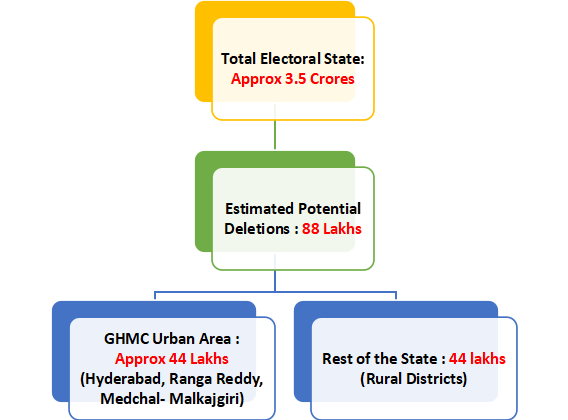
For millions of economically marginalized voters, elderly citizens, or individuals lacking tech literacy, missing even one of these 11 mandated documents or failing an OTP verification means instant disenfranchisement. This retrospective burden assumes that a citizen is “guilty of duplication or fraud until proven innocent.” In an era where data entry errors involving family names, age, and addresses are notoriously common—faults introduced by the state’s own data entry operators—the entire burden of correction has been shifted onto the voter. Observers fear this will result in the definitive deletion of an estimated 8.8 million (88 lakh) votes across the state.
Bureaucratic issues
To understand the deeper anxieties underlying Telangana’s current situation, one must examine the template set during recent elections in West Bengal. The socio-political friction observed in Bengal provides an excellent mirror to the vulnerabilities of Telangana’s electoral roll cleansing.
Telangana’s reliance on the 2002 benchmarks
In West Bengal, recent electoral cycles saw intense scrutiny over voter identities, driven by cross-border migration narratives and demographic anxieties. Much like Telangana’s reliance on the 2002 benchmarks, institutional drives in Bengal heavily prioritized demographic verification software and physical documentation audits. The consequence was widespread panic among rural and minority populations, who spent months scrambling to align legacy land documents and old identity slips with modern digitized databases.
Failure of Localized Machinery
During the Bengal elections, the structural weakness of the BLO system became a focal point of conflict. In highly contested urban pockets of Kolkata and rapidly growing suburban districts like North 24 Parganas, voters frequently complained that deletion notices were served without adequate physical verification. When institutional machinery fails to do its groundwork, it creates an environment ripe for mass deletions, disproportionately affecting migratory laborers and daily wage earners who cannot afford to miss work to stand in administrative queues.
Enabler or Barrier
The transition toward digital-first validation (Aadhaar linkages, online tracking) in West Bengal exposed a massive digital divide. When the state mandates tech-heavy verification in regions with poor connectivity or low literacy, the system acts as a filter that excludes the vulnerable. Telangana is witnessing a replication of this flaw: forcing a population to prove their living status via digital tools while simultaneously failing to deploy physical personnel to their doorsteps.
“Voter list purification” & Demographic Surveillance Agency (DSA) software
The statistical projections for Telangana are staggering. With a total voter base of over 3.38 to 3.5 crore (35 million), the potential erasure of 88 lakh voters constitutes nearly a quarter of the electorate. The epicenter of this crisis sits within the Greater Hyderabad Municipal Corporation (GHMC) limits, spanning Hyderabad, Rangareddy, and Medchal-Malkajgiri districts. Together, these urbanized zones hold a massive concentration of over 1.66 crore (16.6 million) voters.
Officials informally acknowledge that the highest volume of “voter list purification” will happen here. In Hyderabad district alone, the voter count is projected to shrink by 8 to 12 lakh (0.8 to 1.2 million) names. The justification offered by authorities rests on filtering out “Demographically Similar Entries” (DSEs) and duplicate listings across dual residencies using specialized Demographic Surveillance Agency (DSA) software. However, the lack of human oversight in running these algorithmic purges means that genuine citizens living in slums, high-rise apartments, and gated communities alike are being wiped from the rolls without their knowledge.
Law professor and eminent columnist
Madabhushi Sridhar Acharyulu, author of 63 books (in Telugu and English), Formerly Central Information Commissioner, Professor of NALSAR University, Bennett University (near Delhi), presently Professor and Advisor, Mahindra University, Hyderabad. Studied in Masoom Ali High School, AVV Junior College, CKM College, and Kakatiya University in Warangal. Madabhushi did LL.M., MCJ., and the highest law degree, LL.D. He won 4 Gold Medals at Kakatiya University and Osmania University.
Email: cicsridhar@gmail.com
Mobile: 8447651505