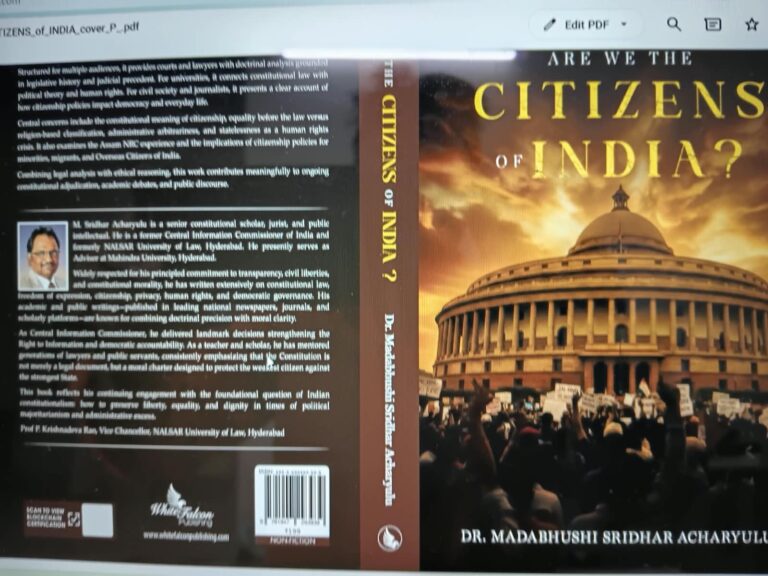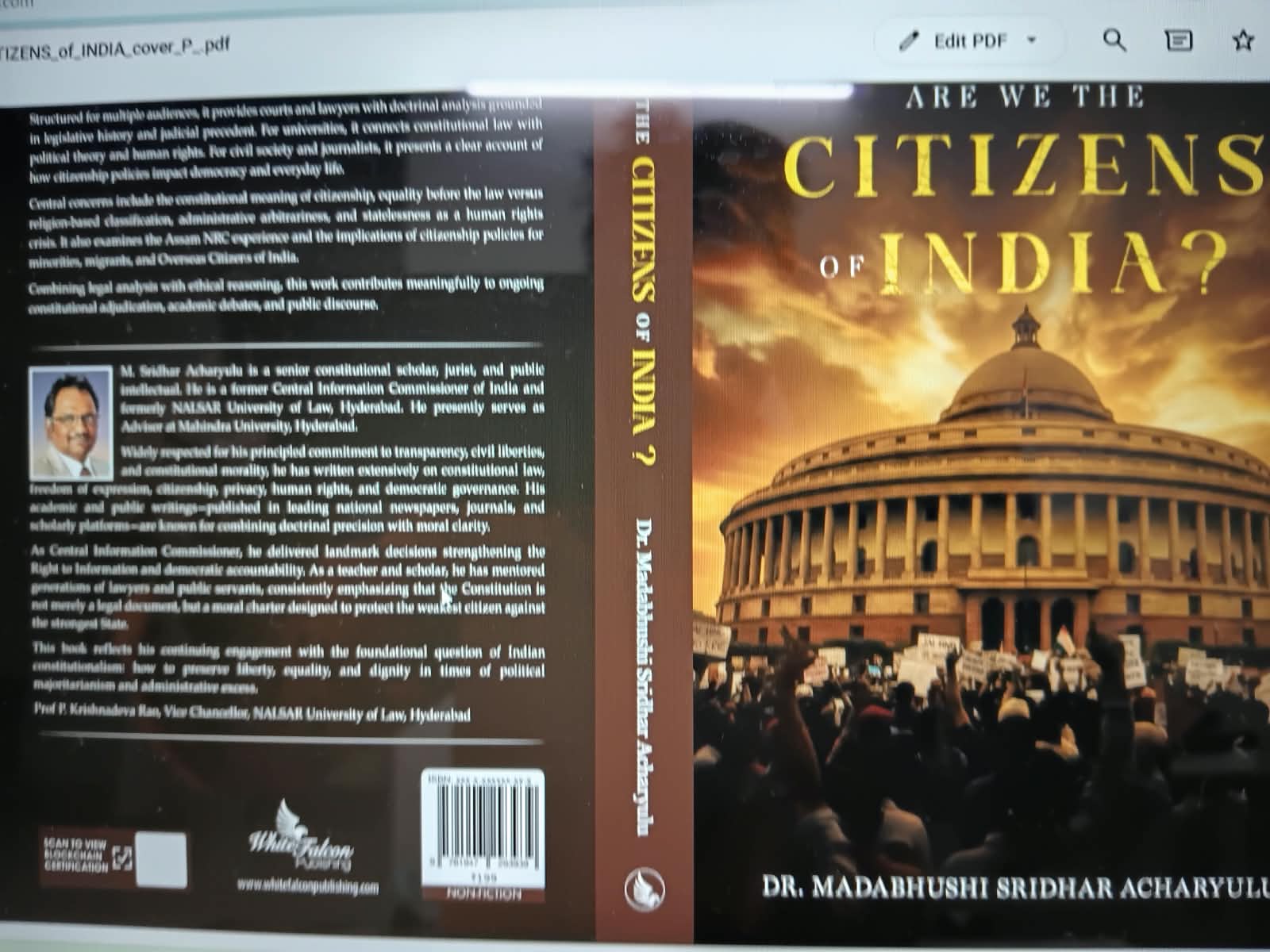
A great book on citizenship
The democratic right to question government-Are we the citizens of India?
Name of the author: Dr. Madabhushi Sridhar Acharyulu
Publisher: White Falcon Publishing
Refugee, Infiltrator, or Citizen?
Citizenship, the NRC, and the Right to Question
Gaurav Gogoi of the Congress said that the Citizenship Amendment Bill cannot be delinked from the National Register of Citizens and that it was brought to nullify the impact of the NRC on non-Muslims. Badrudin Ajmal of AIUDF also reiterated the same point: the Citizenship Amendment Bill was to provide relief to Hindus who were excluded from the NRC. He said that Muslims will be the most evident casualty of the Bill.
Refugee vs. Infiltrator: Shah drew a sharp distinction between “refugees” (those fleeing to save their faith and honour) and “infiltrators” (illegal economic migrants). He argued that the former deserved compassion, while the latter must be stopped.
Dr. Madabhushi Sridhar Acharyulu, a distinguished constitutional scholar, eminent jurist, extraordinary journalist and a highly respected public intellectual, is a consummate writer. His latest book, “We, the citizens of India,” is outstanding.
Prof Sridhar has been a close friend of mine for more than three decades from the days we worked together for Udayam daily. He was a brilliant journalist. After Udayam was closed in 1995, he left journalism profession to prosecute law studies and did his LLM and PhD in law. He was a professor in NALSAR University, he became Central Information Commissioner in Delhi where he did wonders to strengthen the RTI regime. He worked as a professor at Bennet University in Delhi and returned to Hyderabad to serve Mahendra University’s law faculty where he is presently an advisor.
Demystifying the Citizenship Debate
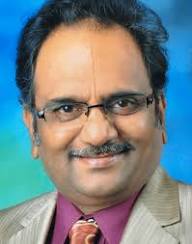
Prof Sridhar has written extensively on law, jurisprudence, privacy, democracy, citizenship, human rights, Right to Information (RTI), political personalities and political developments. As a true journalist and a great teacher, he has the rare ability to explain difficult issues in an uncomplicated manner.
His latest book on citizenship gives the clarity on what has been going on in Assam and in Delhi. It is mostly on Assam where the issue of infiltrators from Bangladesh was a burning problem in 1970s and early 80s to solve which Rajiv Gandhi as Prime Minister had signed the Assam Accord with the students of Assam in 1985. The Election Commission of India (ECI) which has been conducting SIR (Special Intensive Revision), to reportedly find out the foreigners who had illegally migrated into the country, has omitted Assam from its revision for reasons unknown to the people.
The Modi government has brought Citizenship Amendment Bill (CAB) in Parliament which was stoutly opposed by the opposition parties. The Home Minister Amit Shah responded to many criticisms of the Bill saying that the opposition’s claims were false. The Bill does not violate Article 14 of the Indian Constitution in which the right to equality is assured. “We could have agreed it violated Article 14 had we named just Hindus, or just Parsis, or just Sikhs, and so on. But when we talked of the protection of persecuted communities, Article 14 does not come in the way,” he said. Pakistan, Bangladesh and Afghanistan had declared themselves Islamic countries and minorities were not being treated well there. India, Shah said, had the duty to take in those who were being persecuted. The minorities from these three countries are already living in India in very poor conditions and the amendment is being brought to accommodate them.
From Policy to Exclusions: How the CAA, NPR, and NRC Intersect
Shah said the Rohingyas would never be allowed to become citizens of India as they came via Bangladesh. As India has an agreement with Nepal, its inclusion is not necessary. CAB and NRC are not a trap but will appear like a trap to those who want to use ‘ghuspaithiye’ (infiltrators) for vote bank politics. “Don’t you want Bengali Hindus to get citizenship?” he countered. He said “the minority population in the three countries had declined over the years, while in India it has risen. The minorities in these three countries were either converted, killed or forced to migrate to India.” In India, in 1991, there were 84 % Hindus while by 2011, their percentage went down to 79. In the same period, the population of Muslims rose from 9.8% to 14%. ”We did not discriminate on the basis of religion, and we won’t in the future” he said.
The author quotes politicians from treasury benches and opposition as well. He also writes about the editorials, mostly from The Indian Express, and news analysis by noted journalists. Sridhar Acharya says the debate surrounding the Citizenship (Amendment) Act, 2019 (CAA), the National Population Register (NPR) and the National Register of Citizens (NRC) cannot be understood as isolated policy instruments. When examined together, they reveal a tightly interconnected legal and administrative architecture capable of transforming settled citizens into doubtful citizens. They are ultimately branded as foreigners through procedural mechanism rather than overt legislative exclusion.
Statutory Exclusion and the Shifted Burden
The Modi government chose to amend the Citizenship Act, 1955 to statutorily exclude Muslims who migrated from Pakistan, Bangladesh and Afghanistan before 31 December 2014, irrespective of the length of their residence in India. At the same time migrants belonging to six specific non-Muslim religions are now eligible for citizenship while similarly situated Muslims are excluded by law. The government also justifies nationwide identification and registration of citizens on the ground of eliminating infiltrators despite the fact that registering the entire population of about 140 crore people is neither necessary nor proportionate to identify a limited number of illegal migrants.
In the ongoing SIR exercise undertaken by the Election Commission of India (ECI), the Supreme Court told the ECI that if they come across anyone whose citizenship is doubtful, they should notify their names to the concerned authority to establish citizenship or lack of it. Till the end of September 2026, the ECI has not sent a single name of persons of doubtful citizenship to the authorities although it has earmarked more than 13 crores of people whose names are being removed from voters list as they failed to prove their citizenship. The burden of proof was shifted to the people by the ECI.
Linguistic Fault Lines and Historical Tragedies
The citizen issue in Assam is peculiar and complex due to historic animosities between Assamese and Bengali communities. Tensions between the Assamese and Bengali linguistic communities in Assam date back to 1826 when the Ahom kingdom fell under Burmese rule. The ancient history of Assam was traced by the author in this book. Assam was part of Bengal when it entered the British domain.
Who is a foreigner and who is a citizen in Assam? This question has been burning since 1935. Paradoxically, in independent India this principle now applies nationwide; every person in the country has been burdened to prove that he or she is not a foreigner but a citizen of India.
Around 1983 elections in Assam, the unrest in society had escalated into severe violence as socio-political tensions culminated. Consequently, thousands of Bengali-speaking Muslims along with hundreds of indigenous Assamese and Tribals were killed in the clashes. The deadliest single episode widely documented was the ‘Nellie massacre’ that took place on 18 February 1983, resulting in the death of approximately 1800 persons, predominantly Bengali Muslims. After that incident, the students of Assam had built a movement and Rajiv Gandhi who became prime minister after the assassination of Indira Gandhi at the end of October 1984 signed Assam Accord with the student leaders on 15 August 1985.
Constitutional Violations and Human Costs: Insights from We, the Citizens of India
Sridhar Acharya quotes the editorial of Indian Express of 06 December 2019 titled “Two-nation Citizen.” The editorial argued that the Citizenship (Amendment) Bill, 2019, fundamentally alters the secular and plural character of the Indian Republic by introducing religion as a basis of granting citizenship. By excluding the Muslims, the bill is seen as violating the constitutional guarantee of equality and the prohibition of religious discrimination.
The author writes about the miserable lives of the inmates of the detention camps meant for the foreigners. They are not given rights enjoyed even by the convicted criminals in jails.
A Kargil war hero was branded as a foreigner. The members of former President Fakhruddin Ahmed were not included in NRC list. The author quotes Gandhi who underwent sedition trial during the British rule.
The book is very informative. Youngsters who are preparing for civils examinations should not miss the book. It is important for all the law students, journalists and politicians to read the book thoroughly. To know about the current affairs also this book will certainly help.
Prominent Journalist
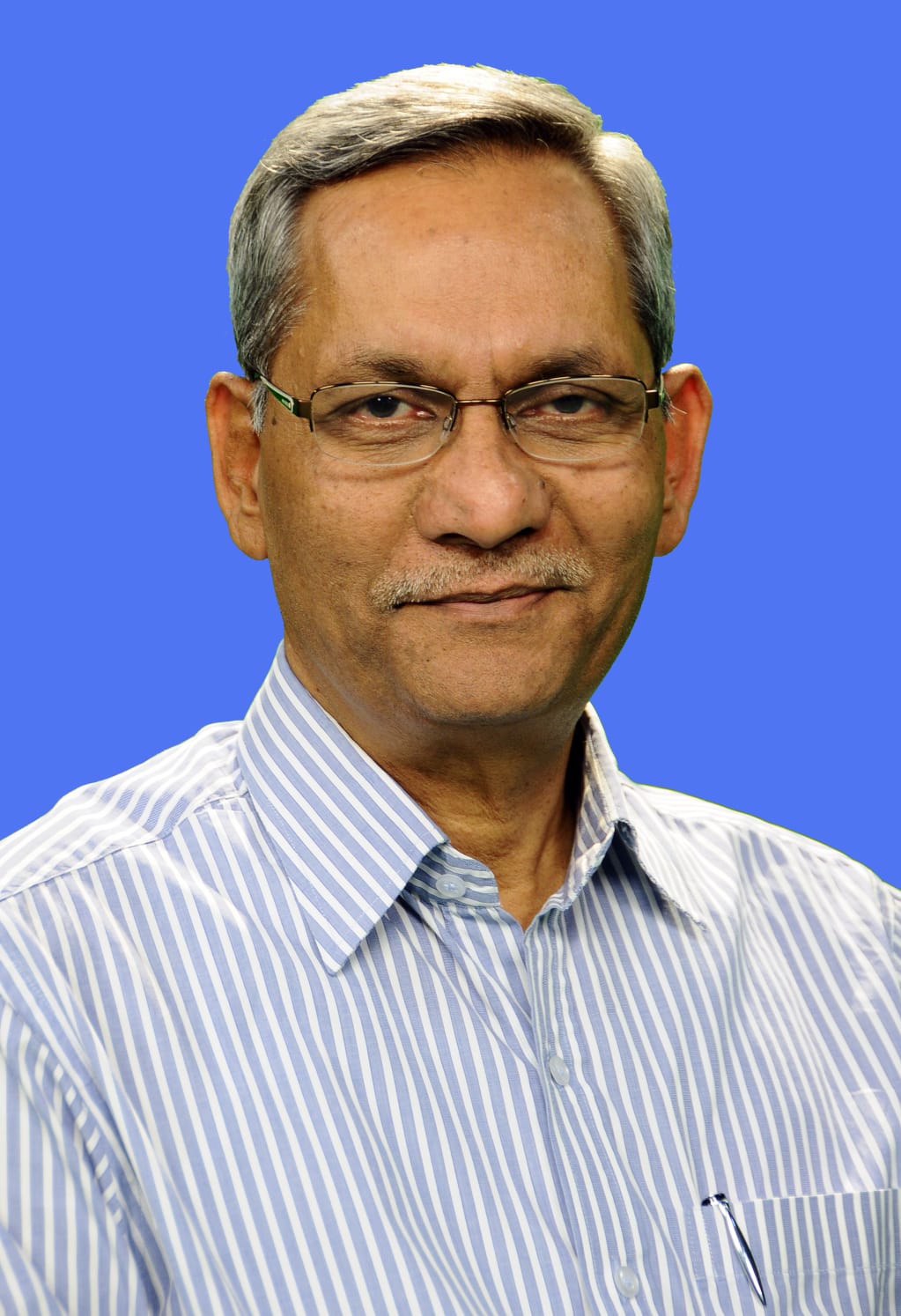
Dr. K. Ramachandra Murthy is a versatile journalist with a distinguished career. Dr. Murthy began his extensive career with Andhra Prabha of The Indian Express group in Bengaluru. He was editor of Udayam, Vaartha and Andhra Jyothy. Dr. Murthy founded and edited HMTV news channel and The Hans India, an English newspaper. He was also editorial director of the Telugu newspaper, Saakshi. He was awarded Ph. D for his research work in rural reporting. Dr. Murthy’s five decades in journalism showcases his influential roles across both print and electronic media. He wrote the political biography of NTR published by Harper Collins.
Email: murthykondubhatla@gmail.com
Mobile: 9908002211