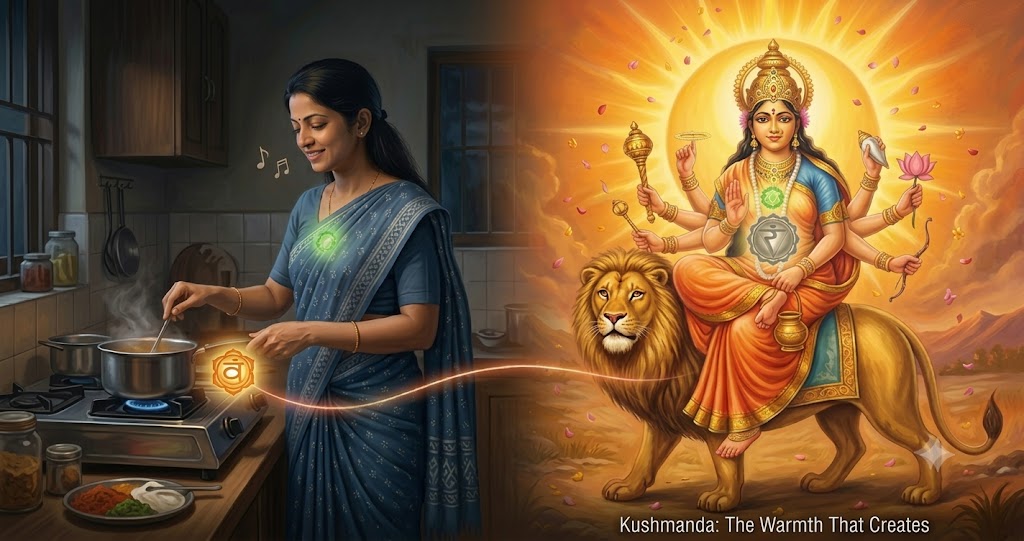
The Threshold
Do you remember the evenings when there was almost nothing in the kitchen?
Three days before payday. Half an onion. Some rice. Whatever was hiding at the back of the shelf. Nothing dramatic. Just an ordinary Tuesday that had run out of food before it ran out of evening.
You remember waiting for your mother’s face to fall.
It did not fall.
She started humming. Something half-remembered from her own childhood. She opened the fridge again, as if something new might have appeared. And then she made something out of nothing.
By the time she was done, the kitchen smelled like a festival. And the table looked like more than enough.
You asked her once how she did that. How she made a feast out of almost nothing.
She laughed. “I didn’t make it out of nothing, dear. I made it out of wanting to see you happy. That’s never nothing.”
You did not understand it then. You understand it a little more now.
That was creation. Not the grand kind. The ordinary kind. A mother who was tired, and short of money, and turned an empty fridge into a memory you still carry.
The Turn
On the fourth night of Navaratri, the Mother comes as Kushmanda.
Her name tells you most of the story. Ku means little. Ushma means warmth. Anda means the cosmic egg. She is the one who, sitting in the darkness before anything existed, made the whole universe out of a small warmth inside herself.
Before there was a sun. Before there was a sky. Before there was anything at all.
Just her. And a little warmth. And a universe that did not exist yet.
That is what your mother did that evening. The kitchen had nothing. She had something. And she gave it away.
This is the fourth night. Shailaputri taught us to stand. Brahmacharini taught us to walk. Chandraghanta taught us to stay steady. Tonight, the Mother teaches us that joy is not the reward at the end of effort. It is where the effort begins.
Meeting the Mother
Her name is Kushmanda. She sits inside the sun, the only one of the nine who could bear to sit that close to something so bright. It is her energy that lets the sun give light at all.
She has eight arms. Most of what she holds is gentle. A rosary. A small pot of nectar. A lotus. Two hands carry a mace and a discus. A reminder that warmth and strength can live in the same woman.
She rides a lion. The same fierce animal Chandraghanta rode. But here, he simply walks beside her. Calm. Because there is nothing left to fight.
And she says one thing, to you, today.
“I did not need a reason to create. I only needed enough warmth in me to share.”
What She Carries
Look at what she holds. Everything is a teaching.
The cosmic egg. Everything not yet grown, folded up small enough to hold in one hand. Our own beginnings usually look unimpressive at first. They start small and folded. Waiting for a little warmth to open them.
Your mother had this too. Every meal she made from almost nothing. Every festival she celebrated on a small budget. Every year that looked empty from the outside, and was full on the inside.
She is the Anahata. The heart chakra. The place where warmth is stored, and then given away. The centre from which everything she makes begins.
The rosary. Even a goddess who could birth an entire universe reaches first for gentleness. She does not create through force. She creates through patience, repeated without complaint.
Your mother was like this. She did not make dinner by banging pots. She made it slowly, humming, one small step after another, until the table was ready.
The pot of nectar. It holds what sustains. Not excess. Not luxury. Just enough. This is the thing about Kushmanda. She does not give abundance. She gives sufficiency.
Your mother gave you sufficiency too. It never felt like plenty. It always felt like enough. And looking back, you realise it was always more than enough.
The lotus. The same flower Shailaputri carried without offering it outward. Here, it is simply held. Not offered. Not displayed. Just carried. Because beauty does not need to be presented. It simply needs to be present.
Your mother’s beauty was like this. Quiet. Unannounced. Just there.
What She Teaches
Three lessons. Each one gentle. None of them small.
Not everything good has to come from struggle.
Some of the best things in your life will come to you easily. Let yourself trust the ones that come easily. They are worth just as much.
Your mother did not struggle to love you. It was the easiest thing she ever did. And it was also the most important.
Joy is where creation starts.
We are told to earn happiness by achieving something first. Kushmanda turns that around. The smile came first. Everything else followed after.
Your mother hummed while she cooked. Not after. During. The humming was not a reward for the cooking. It was the cooking.
A small bit of warmth can become something enormous.
She did not start with much. Just enough light in her to share. You do not need to feel full or ready before you give something good to someone today. You need a little warmth, and the honesty to offer it.
Your mother had almost nothing in the kitchen that night. She had something in herself. And she gave it away. And you still remember it, years later. The warmth was small. The memory is enormous.
The Offering
For those who follow the daily traditions, Kushmanda is honoured with the colour orange. Warm without being harsh. Like a sunrise rather than a fire.
Her offering is malpua, or any sweet made with a little care. Offer it with the thought, Mother, I offer you what warmth I have today, and ask you to help it be enough.
Place a small diya near your altar today. Or something shaped like the sun. A quiet echo of the light she carries inside her.
If you wish, whisper her name. Om Kushmandayai Namah. Or simply, Kushmanda, let me create from joy, not from lack.
A Quiet Moment
If you light a lamp today, do not ask her for more than you already have. Ask her to help you notice the warmth that is already there.
Sit quietly. Let her look at you. Feel her hand on your head, and on your heart.
You do not need to explain anything. You do not need to ask for anything. Being seen is enough.
She smiles. The way a sunrise smiles without needing anyone to watch it.
And in that quiet, you understand. You were never as empty as you thought.
Walking with Her Today
Where is your mother’s warmth needed in you today?
Make something today without needing a good reason. A meal. A small gift. A kind message. A note left somewhere it will be found.
Do it the way your mother did it. She did not wait until she was in the mood. She did not wait until it was convenient. She simply began. And the mood arrived while she was cooking.
Do one thing today that you would normally save for a special occasion. Use the good cup. Wear the good shirt. Make the good tea. Your mother did this too. She never made a distinction between ordinary days and days worth celebrating.
Give someone warmth today without expecting anything back. Not a favour. Not a trade. Just warmth, the way sunlight gives itself away without keeping count.
When you feel like you have nothing left to give, remember the half onion and the humming.
Say to yourself, I do not need to feel abundant to begin. I just need a little warmth.
Let the emptiness settle. Let the tiredness settle.
Beneath all of it, you are still here. Warm. Held in her blessings.
That is the warmth she carried. That is the warmth you carry too.
The Return
And now, back to your mother.
Think of that evening again. The empty fridge. The humming. The table that somehow looked full.
You did not understand it then. You thought she was just making the best of a bad situation. You thought it was a small thing. A meal on a difficult day.
But she was doing something else.
She was showing you that joy does not wait for circumstances to improve. It begins where you are, with whatever you have. And it makes the thing that comes next.
She never told you to be joyful. She simply hummed while she cooked. And the kitchen became a place you still remember.
That is the fourth night.
Not a goddess inside the sun. A woman at a stove, humming.
The same love, in two forms.
Jai Kushmanda.
Author Biography: – R Srinivasa Murthy, the author, is a corporate leader, an independent writer, and a student of Hindhu Philosophy. He Identifies as a Demystic, committed to removing unnecessary mysticism from traditions to offer practical systems for the next generation. His upcoming book, Logic of And: Sanatana Dharma as a Toolkit for the Contemporary Seeker, aims to bridge ancient wisdom with modern life to foster an inclusive, living civilisation.

With a journalistic long journey, we bring you https://primepost.news, a dynamic platform committed to unraveling the intricate tapestry of Indian politics, particularly delving deep into the heart of Telangana and Andhra Pradesh. Our blog is not just a source of news; it’s a reservoir of insights, analysis, and thought-provoking reviews.

Superb sir
Wonderful Explanation 🤩😍
Upto Navratri i learn Many things about mother.
Thanks sir🙏👍
Superb sir
Wonderful Explanation 🤩😍
Upto Navratri i learn Many things about mother.
Thanks sir🙏👍
The Same love in Two Forms😍🤩
Look around the Home…look for your mother, if she is around..touch her feet thanking for the world she has created for you
Very well written Sir
Beautiful and inspiring thoughts, sir! 🙏 A wonderful message about divine warmth, love, and positivity. Jai Mata Di! 🌸
Look around the Home…look for your mother, if she is around..touch her feet thanking for the world she has created for you
Very informative. Most appreciate depiction of Devi as our Mother.
Thank you sir
Excellent write-up, Murthy garu. I have read four as of today. True devotion is not merely expressed through prayers and rituals, but through faith, humility, compassion, and righteous living. Our spiritual traditions remind us that when devotion guides our actions, life itself becomes a path towards inner peace and wisdom.
Very well connected to our mothers at home. “A mother is a goddess to her children, and her love, sacrifices, and blessings are beyond measure. We can never repay the debt we owe our mother.” 🙏
Thank you for your continued readership and appreciation sir
5 more to come