
People Need Decentralized and Distributed Data Centres
Not Hyperscale -Centralized Ones
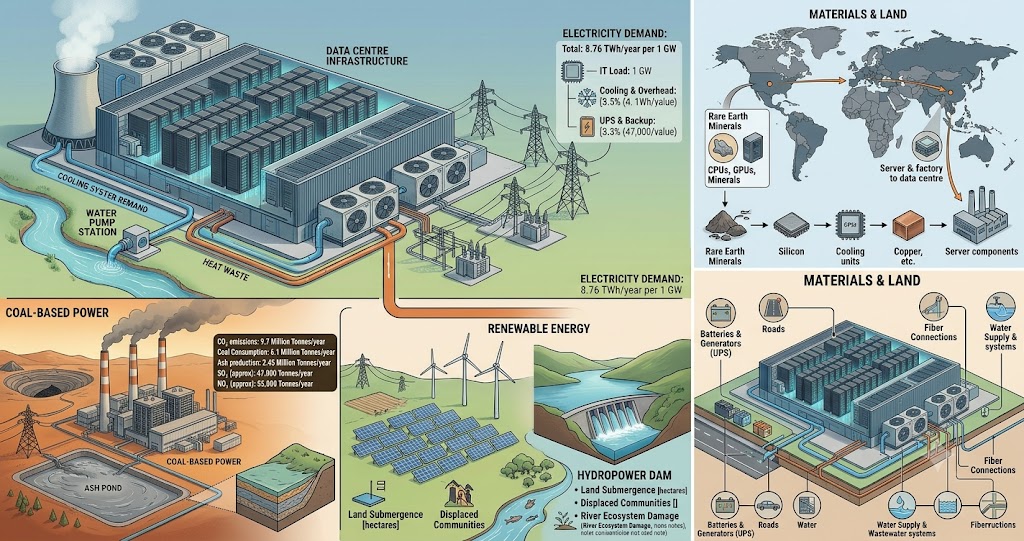
India’s rapidly expanding data-centre industry raises fundamental questions about energy, ecology, economic development and public interest. Data centres must be assessed as large industrial facilities that consume electricity, water, land, minerals and public infrastructure, while generating heat, waste and environmental burdens. All sources from which data centres – setting up in Hyderabad and Vizag -may draw power environmental impacts. Coal-fired generation entails significant carbon emissions, air pollution, ash and water requirements.
Renewable energy can reduce operational emissions, but it is not impact-free: solar panels and wind turbines require energy-intensive manufacturing, metals, minerals, land and transmission infrastructure, while large dams can submerge forests and agricultural land, displace communities, disrupt rivers and damage ecosystems. A data centre’s environmental footprint extends beyond its electricity source. Buildings, servers, cooling systems, substations, backup generators, batteries, roads, water supply, wastewater management and transmission lines all have material and environmental costs. AI can intensify these demands through energy-intensive computing hardware and rapidly growing workloads.
Cooling Hot Climates, Questioning Scale
Cooling matters most in hot climates. Data centres can support valuable applications in science, medicine, education, environmental monitoring and public services, but they tend to serve advertising, algorithmic targeting, automated content generation, financial trading and surveillance. Their social value should therefore be evaluated against their resource requirements, ownership structures and distribution of benefits. Distributed data infrastructure for public-information functions: interconnected local, district, state and national systems, with appropriate storage, caching and computing, and scope for public or community ownership is an alternative to the proposed hyperscale data centres. Public disclosure of project documents, environmental impact assessments for both hyperscale and decentralised alternatives, transparent comparative cost-benefit analyses, and public participation is required. Who benefits, who pays, what ecological costs are imposed by the proposed hyperscale data centres, and whether the same resources could serve the public better elsewhere are central questions that need to be answered.
WHAT IS A DATA CENTRE?
Data centres process, store and transmit data; run applications and digital services; provide cloud computing; host websites and databases; and increasingly train and run AI models. Physically, a data centre is far more than a building full of computers. It includes servers and accelerators (CPUs/GPUs), storage and networking equipment; grid connections, substations, transformers, UPS systems, batteries and backup generators; cooling systems such as chillers, cooling towers, pumps, air handling, direct-tochip liquid cooling and, in some high-density systems, immersion cooling; and buildings, roads, security, fire protection, fiber connections, water supply and wastewater systems. A 1 GW data centre will require 8.76 TWh/year (1 GW x 8,760 hr/year) of steady energy per year. If 1 GW refers to IT load alone, total facility consumption will be higher because of cooling and other overheads.
DATA CENTRES IN INDIA AND THE WORLD
India’s data-centre industry is expanding rapidly. Government data released in August 2026 put installed capacity at about 1,575 MW, up from about 375 MW in 2020. The 2026 Stanford AI Index, using Cloudscene data, counted 153 data centres in India in 2025 [1,2]. In a February 2025 Rajya Sabha answer, the Ministry of Power reported that upcoming data centres were expected to require 5,640 MW by FY 2031–32: 3,535 MW by FY 2027–28 and the remaining 2,105 MW by FY 2031–32 [3]. Proposed data centres in India.
Sifting Fact from Projection in South India’s Data Centre Boom
The Google–Adani -ConneX–Airtel AI hub in Visakhapatnam is now under construction. Google describes it as a gigawatt-scale AI hub, and Adani describes the data-centre component as nearly 1 GW in a single location, within a broader $15 billion investment over 2026–30.
TCS subsidiary Hyper-Vault has separately secured 264 acres in Hyderabad for a phased AI data-centre campus of up to 1 GW; HyperVault and its partners expect to invest up to Rs 700 billion. “Up to 1 GW” is a maximum planned build-out, not 1 GW of operating load today [4,5]. These announcements should not be added mechanically to the 5.64 GW pipeline; the 2025 government list is a snapshot of expected power demand, while later projects may replace, expand or overlap with earlier plans. The latest announcements indicate that Andhra Pradesh alone is to get new data centres of a capacity of 6.5 GW. A list of data centres in selected countries indicates that the maximum number of data centres are located in North America, Europe, China, Australia and Japan.
ENVIRONMENTAL IMPACTS OF DATA CENTRES
A data centre requires electricity, water, land, materials and infrastructure. The environmental consequences depend on where it is located, how it is powered and cooled, what workloads it runs, and how the supporting infrastructure is built. The following comparison uses coal, solar, wind and large hydropower to illustrate different parts of the resource chain. While some of the important environmental impacts, land requirements, and NPP loss have been mentioned for each of these energy sources, a more detailed appraisal of the environmental impacts of each energy source must be made after knowing the energy sources for the data centres.
COAL-BASED POWER
For a consistent comparison with a data centre drawing 1 GW continuously, assume a net coal-plant capacity of about 1.18 GW operating at an 85% capacity factor. Annual generation is about 8.76 TWh. At a screening coal-consumption factor of 0.70 kg/kWh, coal use is approximately 6.1 million tonnes per year. At 40% ash, this produces about 2.45 million tonnes of ash. Assuming a coal sulphur content of 0.4%, the cited screening factors imply roughly 47,000 tonnes of SO₂ per year before flue-gas desulphurization (FGD), and about 55,000 tonnes of NOₓ per year before controls. NOₓ can contribute to ground-level ozone formation when it reacts with other pollutants in sunlight; the amount formed depends on local atmospheric chemistry.
Using the cited particulate screening method and an illustrative 99.8% electrostatic-precipitator efficiency gives about 3,900 tonnes of particulate matter per year. CO₂ emissions are approximately 9.7 million tonnes per year under these assumptions. These are screening estimates, not a plant-specific emissions inventory; actual emissions depend on fuel composition, plant design and controls.
The Author of the Article -Sagar Dara-
Researcher and writer in energetics of human society.

With a journalistic long journey, we bring you https://primepost.news, a dynamic platform committed to unraveling the intricate tapestry of Indian politics, particularly delving deep into the heart of Telangana and Andhra Pradesh. Our blog is not just a source of news; it’s a reservoir of insights, analysis, and thought-provoking reviews.