The Threshold
Do you remember being ill as a child?
The kind where the night stretches on and the fever will not break. Where the room feels strange, and nothing is safe, and you hold on to her hand and do not let go.
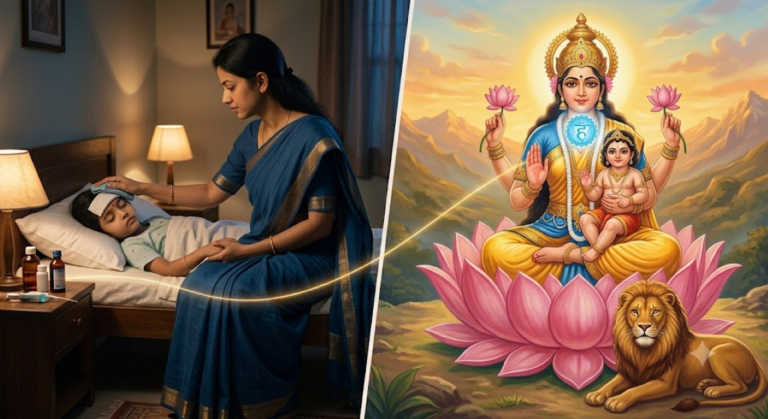
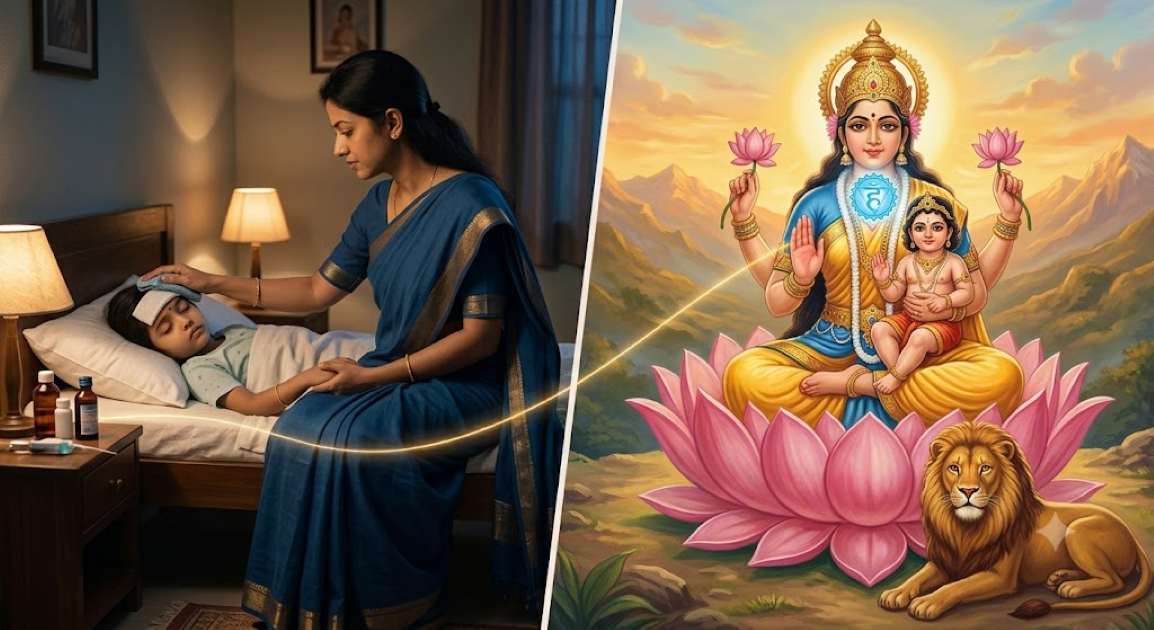
Your mother sat beside your bed. She did not sleep. She kept changing the wet cloth on your forehead. She kept checking your temperature with the back of her hand. Again and again. Long after you had stopped noticing she was doing it.
Your father was away on a tour that week. There was no one to take over. No one to say, you sleep, I will watch. Just her.
At some point, you fell asleep on her lap. She did not move you. She did not shift to a more comfortable position. She did not put you down.
You woke up once, in the middle of the night. She was still there. Eyes tired. Back aching. She had not moved an inch.
You asked her once, years later, how she stayed awake like that. Night after night. Without ever once looking like it cost her anything.
She said, “It never felt like staying awake, dear. How would I sleep, anyway?”
You did not understand it then. You understand it a little more now.
That was compassion. The kind that holds a weight for years and never once calls it a burden.
The Turn
On the fifth night of Navaratri, the Mother comes as Skandamata.
Skanda is the name of her son. Mata means mother. She is the mother of Skanda, also known as Kartikeya, the commander of the divine armies.
Think of what she was before this.
She was the daughter of the mountain, standing alone. She was the seeker, walking a long path toward the one she loved. She was the one who learned courage. She was the one who laughed, and the cosmos was created.
And now, she holds the world she created.
And yet, on this night, she is not commanding anything. She is seated. She holds her child on her lap. She is calm. Her face carries no strain at all, though you know, somehow, that she has been holding him a long time.
She does not know yet what he will become. Or perhaps she does. Either way, she holds him.
This is the mother who is raising a warrior. And she is doing it with her arms, not with a sword. She is doing it through presence, not instruction. She is doing it in the small, unglamorous hours that no one will ever see. That is what your mother did that night. She did not fight anything. She did not solve anything. She simply held you, until the fever broke, and the morning came. And in that holding, she was shaping the person you would become. This is the fifth night. Shailaputri taught us to stand. Brahmacharini taught us to walk. Chandraghanta taught us to stay steady. Kushmanda taught us to create from joy. Tonight, the Mother teaches us that love can carry weight for years and still call itself light.
Meeting the Mother
Her name is Skandamata. She is Parvati, and she is now a mother.
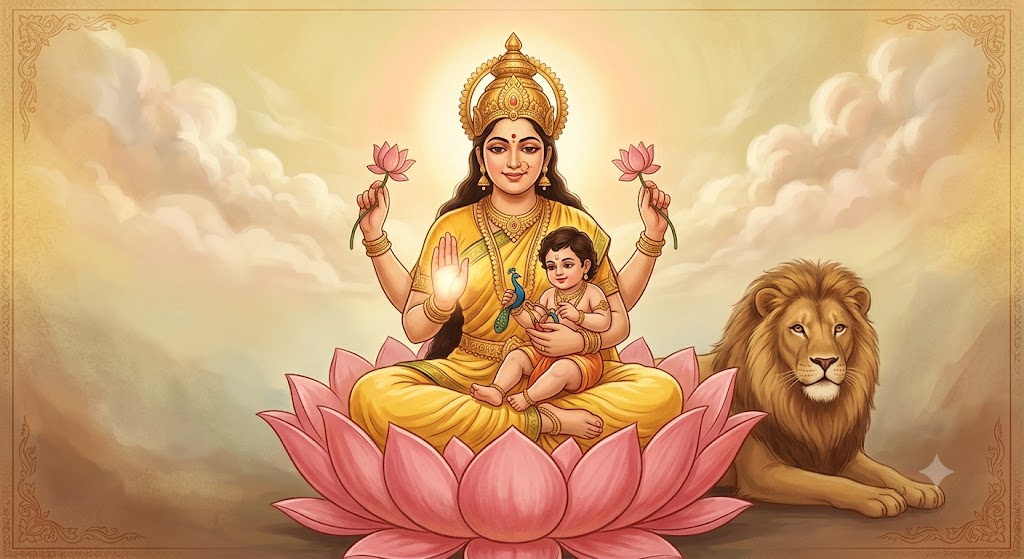
She has four arms. Two hold lotuses. One rests in a gesture of reassurance, palm open, saying without words, you are safe. And one holds her son, her creation.
She sits on a lotus. Which is why she is also called Padmasana Devi, the one seated on the lotus. She rides a lion, the same fierce animal Chandraghanta rode. But here, he simply waits. Patient. The way strength does when it is not needed yet.
The old texts tell us that the universe needed one more thing from Parvati. A son strong enough to defeat the demon Tarakasura. A son who could only be born of Shiva. She gave birth to Kartikeya. And in doing so, she became something new. Not only the daughter who had endured. Not only the wife who had won her place. A mother now, holding in her arms the very weapon the universe had been waiting for.
She did not raise him by making herself hard. She raised him the way any mother raises a child. With patience. With softness. With nights that asked more of her than anyone saw. And when Kartikeya finally rode into battle, it was this same gentleness, quietly, that had made him strong enough to win.
And she says one thing, to you, today.
“I am not tired of holding you. I never was.”
What She Carries
Look at what she holds. Everything is a teaching.
The child in her arms. He is not a symbol of vulnerability. He is the reason her strength exists at all. Everything else she carries only makes sense once you notice what she is actually holding.
Your mother was like this. Everything she did, she did for someone. The job she kept when she wanted to leave it. The years she stayed in a city she did not love. The sacrifices she never mentioned. All of it pointed at one thing. You.
She is the Vishuddha. The throat chakra. The place where a mother’s voice lives. The lullabies. The warnings. The quiet reassurance that everything will be all right.
Her open palm. Raised in blessing. It tells us that protection does not always look like armour. Sometimes it looks like a hand held out. Saying, quietly, that you do not have to be afraid tonight.
Your mother’s hand was like this. You felt it on your forehead when you were ill. You felt it on your shoulder when you were nervous. You did not need her to say anything. The hand said it.
Her lotus seat. It holds her above the noise. Calm, even while carrying the weight of a child who will change the fate of the world. Steadiness does not always need solid ground beneath it. Sometimes it only needs the willingness to stay calm anyway.
Your mother sat like this. In the middle of a noisy house, a difficult year, a family that did not always agree. And somehow, she stayed calm. Not because the ground was steady. Because she was.
The lion beneath her. Waiting without impatience. Real strength does not need to prove itself while it is busy holding someone close. It can rest. Because it knows exactly where it stands.
Your mother rested too, in her own way. She did not need to remind anyone of what she had done. She simply sat, and held, and let her presence do the work.
What She Teaches
Three lessons. Each one soft. Each one demanding.
Strength does not have to be loud to be real.
Some of the strongest things anyone has ever done for you probably looked, from the outside, like nothing at all. A quiet night. A patient answer. A hand that did not let go.
Your mother did not shout. She did not make speeches. She simply stayed. And that staying held the whole house together.
You can hold someone and still stay soft.
Raising a warrior did not require Skandamata to become hard. Protecting the people you love does not mean giving up your gentleness. Often, the gentleness is the protection.
Your mother was soft with you, and fierce for you. She did not confuse the two. She did not become cold to keep you safe. She stayed warm, and the warmth was what kept you safe.
Love that lasts rarely announces itself.
The people who show up for you again and again are usually not the ones telling you how much it costs them. They are simply there. Notice them. Thank them, while you still can.
Your mother never told you what she gave up. She never once mentioned the nights she did not sleep. You know now, because you are older. But she never said it.
And that is the thing about her love. It was never meant to be noticed. It was meant to be received.
The Offering
For those who follow the daily traditions, Skandamata is honoured with the colours white and yellow. Purity and brightness, held gently together.
Her offering is bananas, or kheer. Something soft. Something given without hurry. Offer it with the thought, Mother, I offer you what I have been quietly carrying, and ask you to help me carry it with grace.
Place a lotus near your altar today. Real, or drawn, or simply a picture. A quiet echo of the lap you once fell asleep on.
If you wish, whisper her name. Om Skandamatayai Namah. Or simply, Skandamata, help me hold what I love without growing hard.
A Quiet Moment
If you light a lamp today, do not ask her to lighten your load. Ask her to help you hold it without losing yourself in the holding.
Sit quietly. Let her look at you. Feel her hand on your head, and on your heart.
You do not need to explain anything. You do not need to ask for anything. Being seen is enough.
She smiles. Her child settled against her. She does not move.
And in that quiet, you understand. All those nights she said how would I sleep, anyway, she meant this. She was holding you. And those arms have never once asked to be thanked.
Walking with Her Today
Where is your mother’s holding needed in you today?
Think of one person who has held you up without ever making a show of it. Call them today. Or write them a message. Say it plainly. I don’t think I have ever properly thanked you.
If you are carrying something heavy right now, and most of us are, notice how you are holding it. You come home tired. You do not say so. You sit with a junior at work and go through their mistake patiently, long after you could have gone home. You listen to a friend who is struggling, again, for the third time this month. You lie awake doing sums in your head, and in the morning, you are up before everyone else, and no one knows.
Your mother did the same. Not because the weight was light. Because her holding was full of love.
Notice, if you can, one moment today where you are tempted to make your effort visible. To let someone know how hard you are working for them. Try, instead, to just do it quietly, and see how it feels.
When you feel unseen for the quiet things you carry, whisper to yourself, This still matters, even if no one is watching.
Let the tiredness settle. Let the weight settle.
Beneath all of it, you are still here. Holding. Held in her blessings.
That is the weight she carried. That is the weight you carry too.
The Return
And now, back to your mother.
Think of that night again. The fever. The wet cloth. The back of her hand on your forehead. Your father away. No one to take over.
You did not understand it then. You thought she was simply there. You did not think about what it cost her to be there.
But she was tired. She was worried. She may have been frightened. And she stayed anyway, because there was nowhere else she wanted to be.
She did the thing that Skandamata does. She did not fight anything. She did not solve anything. She simply held you, until the fever broke, and the morning came.
And she has been holding you ever since. Through every year. Every mistake. Every long night. She has never once put you down.
You will do the same for someone. You may already be doing it. Holding them quietly. Carrying them without saying so. Wondering, sometimes, whether anyone notices.
She noticed. That is why she held you the way she did.
That is the fifth night.
Not a goddess on a lotus. A woman in a dark room, with a wet cloth and a hand on your forehead.
The same love, in two forms.
Jai Skandamata.
Author Biography: – R Srinivasa Murthy, the author, is a corporate leader, an independent writer, and a student of Hindhu Philosophy. He Identifies as a Demystic, committed to removing unnecessary mysticism from traditions to offer practical systems for the next generation. His upcoming book, Logic of And: Sanatana Dharma as a Toolkit for the Contemporary Seeker, aims to bridge ancient wisdom with modern life to foster an inclusive, living civilisation.

With a journalistic long journey, we bring you https://primepost.news, a dynamic platform committed to unraveling the intricate tapestry of Indian politics, particularly delving deep into the heart of Telangana and Andhra Pradesh. Our blog is not just a source of news; it’s a reservoir of insights, analysis, and thought-provoking reviews.