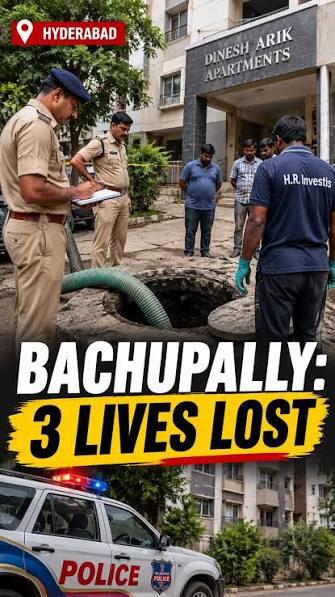
Bachupally’s Septic Tank Tragedy
: Governmental Apathy, Enforcement Failure and the Constitutional Denial of Human Dignity
“నేను సైతం
ప్రపంచాగ్నికి
సమిధ నొక్కటి ఆహుతిచ్చాను!”
— శ్రీశ్రీ (Srirangam Srinivasa Rao)
“I too have offered my little piece of wood to the world’s consuming fire.”
The immortal words of Sri Sri, the revolutionary Telugu poet, remind us that an individual’s suffering is inseparable from the collective conscience of society. Yet, when three young sanitation workers lost their lives in a septic tank at Bachupally, Hyderabad, the tragedy exposed how little our society values those whose labour sustains its everyday conveniences.
THREE LIVES EXTINGUISHED: A LIVELIHOOD BECOMES A DEATH SENTENCE
Three young men entered a septic tank at Dinesh Auric Apartments in APR Enclave, Bachupally, on November 24, 2026, to earn their livelihood. None emerged alive. K. Shanmukha Rao alias Suman (26), Y. Pavan (20) and Suresh Gajiki (24), all natives of Srikakulam district in Andhra Pradesh, died after allegedly inhaling toxic gases while cleaning an underground septic tank. When Shanmukha Rao reportedly lost consciousness, Pavan and subsequently Suresh entered in desperate attempts to help their colleague. All three succumbed.
Rescue personnel from HYDRAA and the Fire Department retrieved their bodies and shifted them to Gandhi Hospital. Bachupally police registered a case under Section 105 of the Bharatiya Nyaya Sanhita, relating to culpable homicide not amounting to murder, against the contractor. The investigation is examining alleged failures in protective equipment, gas detection and supervision. These young men were not engaged in an adventurous or unpredictable occupation. They were performing essential sanitation work under conditions that demanded stringent safety arrangements. Their aspiration to earn an honest living ended in a preventable tragedy.
A CHRONOLOGY OF DEATHS: HYDERABAD HAS NOT LEARNT ITS LESSONS
Bachupally is part of a disturbing pattern of occupational fatalities.
November 28, 2021 – Kondapur: Two workers died after inhaling poisonous gases while cleaning a septic tank at Gautami Enclave.
August 3, 2021 – LB Nagar: Two workers died during sewerage pipeline cleaning at Padmavathi Colony.
March 2024 – Kulsumpura: Three sanitation workers died after entering a manhole containing toxic gases. The circumstances are painfully repetitive. A worker enters a confined underground space, collapses after inhaling poisonous gases, and another enters in an attempt to rescue him. The rescue itself becomes another fatality. How many such incidents must occur before the administration recognises that this is a systemic occupational safety crisis rather than a succession of isolated accidents?
GOVERNMENTAL APATHY: THE FAILURE OF ADMINISTRATIVE CONSCIENCE
The most disturbing aspect of these deaths is the apparent indifference of the administrative machinery towards an occupational hazard that is both foreseeable and preventable. Municipal authorities, the Water Board, urban local bodies and labour enforcement agencies have statutory responsibilities. They cannot remain passive spectators while private contractors undertake dangerous sanitation operations without adequate safeguards.
Outsourcing municipal work does not outsource governmental responsibility. The Telangana Government must explain why hazardous cleaning continues without effective monitoring, why unregulated private agencies are allowed to operate, and why mechanisation has not eliminated the need for dangerous human entry. The Greater Hyderabad Municipal Corporation and Hyderabad Metropolitan Water Supply and Sewerage Board must establish whether their contractor-registration, inspection and safety-monitoring mechanisms are functioning effectively. The argument that a septic tank belongs to a private apartment cannot become an administrative excuse. Public authorities retain regulatory responsibilities even when the premises and the contractor are private. Governmental apathy is measured not merely by what officials fail to do after a tragedy, but by what they repeatedly fail to prevent before one occurs.
THE INVISIBLE KILLER: TOXIC GASES AND THE ABSENCE OF BASIC PRECAUTIONS
Septic tanks and underground sewerage systems can accumulate hydrogen sulphide, methane and other hazardous gases. Oxygen deficiency can cause sudden unconsciousness and death. Entry into such confined spaces requires atmospheric testing, appropriate breathing apparatus, ventilation, retrieval equipment and trained supervision. An ordinary face mask offers no protection against an oxygen-deficient atmosphere. Mechanical suction, high-pressure jetting, robotic cleaning and remote inspection technologies must replace human entry as the normal operating procedure. The technology exists. The hazards are known. The legal safeguards are prescribed. What is missing is the institutional determination to make safety non-negotiable.
THE LAW EXISTS: ENFORCEMENT IS THE CASUALTY
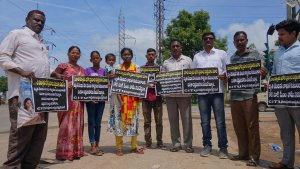
The Prohibition of Employment as Manual Scavengers and their Rehabilitation Act, 2013, expressly addresses hazardous cleaning of sewers and septic tanks under Section 7. It prohibits engaging or employing persons for hazardous cleaning and provides penal consequences under Section 9.
The Supreme Court’s judgment in Dr. Balram Singh v. Union of India, delivered on October 20, 2023, strengthened the framework for eliminating hazardous manual sewer cleaning. It directed the Union and State governments to ensure mechanisation, prevent outsourced contracts from requiring human entry into sewers, and provide rehabilitation to affected workers and their families. The Court enhanced compensation for sewer deaths to ₹30 lakh and directed measures including employment for eligible next of kin, education for children and skill development.
Yet, Bachupally demonstrates the distance between judicial directions and administrative implementation. There is a critical distinction between statutory prohibition and effective enforcement. The Act’s provisions must be translated into functioning inspection systems, identifiable enforcement authorities, contractor regulation and credible prosecution. The legal framework also needs closer scrutiny where informal workers, subcontracting arrangements and privately commissioned septic tank cleaning create uncertainty about the respective responsibilities of employers, occupiers, contractors and public authorities. The law cannot remain confined to government notifications and court judgments. It must protect the worker standing at the mouth of a septic tank.
LEGAL LACUNAE AND CONSTITUTIONAL REMEDIES
The tragedy demands a more comprehensive constitutional and legal response. Article 21 guarantees the right to life and human dignity. Article 14 guarantees equality before the law. Article 23 prohibits forced labour. Articles 39(e) and 42 further reinforce the State’s obligation to protect workers’ health and ensure humane conditions of work. In Francis Coralie Mullin v. Administrator, Union Territory of Delhi (1981), the Supreme Court articulated the principle that the right to life includes the right to live with human dignity. More significantly, in Dr. Balram Singh, the Supreme Court recognised that compelling sanitation workers to undertake hazardous cleaning without minimum protective equipment and devices can amount to forced labour under Article 23. These constitutional protections must be converted into enforceable remedies.
The following measures deserve immediate consideration:
1. JUDICIAL INTERVENTION: The Telangana High Court can be approached under Article 226 for appropriate writs and directions to enforce statutory obligations, investigate systemic failures and ensure compliance with Supreme Court directions. Public-interest litigation may also seek a comprehensive mechanism to prevent hazardous sanitation deaths.
2. CRIMINAL ACCOUNTABILITY: Investigations must examine the conduct of contractors, commissioning agencies and other responsible persons wherever negligence or statutory violations are established.
3. STATUTORY ENFORCEMENT: Labour inspectors, district authorities and designated implementing agencies must undertake independent inspections and initiate prosecution for violations of the 2013 Act.
4. COMPENSATION AND REHABILITATION: The families must receive the applicable ₹30 lakh compensation under the Supreme Court’s directions, together with appropriate employment, educational and rehabilitation assistance.
5. INSTITUTIONAL OVERSIGHT: The National Commission for Safai Karamcharis, human rights institutions and appropriate labour authorities must monitor compliance and seek accountability.
6. LEGISLATIVE CLARITY: The Union and State governments should review gaps in implementation, clarify responsibilities across private and public sanitation operations, strengthen monitoring and ensure that informal and contract workers are not excluded from protection. The constitutional promise of equality is meaningless if the most vulnerable citizens remain unprotected in the performance of essential public services.
MEDIA AND PUBLIC INDIFFERENCE: THE SILENCE SURROUNDING INVISIBLE LIVES
Another disturbing dimension is society’s selective sensitivity. The deaths of three sanitation workers briefly occupy newspaper headlines, television bulletins and social media discussions. Political statements follow. Compensation is announced or demanded. An investigation is initiated. Then public attention moves elsewhere. The media must do more than report the immediate tragedy. It must investigate the contractor network, municipal oversight, safety violations, compensation payments and the implementation of judicial directions. Sustained investigative journalism is essential to prevent these deaths from becoming disposable news cycles.
Public indifference is equally consequential. Residents of apartment complexes demand clean surroundings, functioning drainage and uninterrupted sanitation. Yet the conditions under which these services are maintained rarely attract their attention. Apartment associations sometimes choose contractors primarily on the basis of cost, without adequately examining technical competence and safety arrangements. Civic convenience cannot be purchased at the cost of another human being’s life. The responsibility of society is not merely to sympathise with bereaved families after a tragedy. It is to insist upon safe working conditions before the next worker enters a tank.
THE HUMAN COST OF URBAN PROSPERITY
Hyderabad aspires to become a global city. Its skyline reflects real-estate expansion, commercial investment and modern residential development. Yet the sanitation systems supporting this urban prosperity continue to expose economically vulnerable workers to lethal occupational hazards. The three young men from Srikakulam came seeking employment and a dignified livelihood. Their families have lost their breadwinners. Their dependants face an uncertain future. Their tragedy raises a fundamental question about the moral foundations of development. Can a city legitimately celebrate its infrastructure, investment and technological advancement while the workers maintaining its essential civic services remain vulnerable to preventable death? A society that values cleanliness but disregards the lives of those who provide sanitation has misunderstood the very meaning of civilisation.
CONCLUSION: FROM SYMBOLIC SYMPATHY TO CONSTITUTIONAL RESPONSIBILITY
Bachupally must not become another forgotten entry in Hyderabad’s chronology of occupational fatalities. It must compel a fundamental reassessment of municipal governance, labour protection, contractor accountability and the enforcement of constitutional rights. The issue is not merely the negligence of an individual contractor. It is the failure of a system that has not translated legislation, judicial pronouncements and available technology into effective protection for vulnerable workers. Sri Sri’s poetic invocation of collective participation acquires a profound contemporary relevance. The suffering of these labourers cannot remain somebody else’s problem. Government, judiciary, municipal institutions, private establishments, media and civil society must recognise their collective responsibility. The dignity of labour is not a ceremonial slogan. It is a constitutional obligation. The right to life cannot be diluted by poverty, occupation or social status.
NO HUMAN BEING SHOULD HAVE TO ENTER A DEATH TRAP TO EARN A LIVING. THE GOVERNMENT MUST ACT, THE LAW MUST BE ENFORCED, SOCIETY MUST RESPOND AND EVERY LIFE MUST COUNT.

M. Shiva Prasad, IPS (Rtd.) is a dedicated law enforcement professional who served the combined Andhra Pradesh cadre before opting for the Telangana cadre. Though a native of Andhra Pradesh, he considers himself a true Hyderabadi with an abiding love for the Telugu people. Driven by sincerity, fearlessness, and a lifelong fight against inequality and injustice, his ultimate strengths remain his goodwill and deep affection for the public and the police force. Today, he continues his mission by writing snippets and articles true to his conscience.
Email: Shivareach@yahoo.com
Mobile: 98480 38774