El Niño and the Indian Monsoon
The annual arrival of the southwest monsoon has, for millennia, constituted the economic heartbeat of the Indian subcontinent. Nearly half of India’s cultivated land continues to depend directly upon seasonal rainfall, while the livelihoods of hundreds of millions remain intertwined with the rhythm of the monsoon. Consequently, any disturbance to this climatic phenomenon transcends meteorology; it becomes an economic, ecological, political, and civilisational event.
Among the most formidable disruptors of the Indian monsoon is El Niño, a naturally occurring ocean-atmosphere phenomenon originating thousands of kilometres away in the equatorial Pacific Ocean. Although geographically distant, its consequences reverberate across the Indian landscape with astonishing force, influencing agriculture, water security, inflation, migration, ecology, public health, and ultimately national stability.
Today, however, El Niño no longer operates in isolation. Its natural variability increasingly interacts with anthropogenic climate change, rampant environmental degradation, indiscriminate urbanisation, reckless deforestation, and unsustainable patterns of governance. The result is not merely climatic uncertainty but a systemic ecological crisis.
The Science and Teleconnections of El Niño
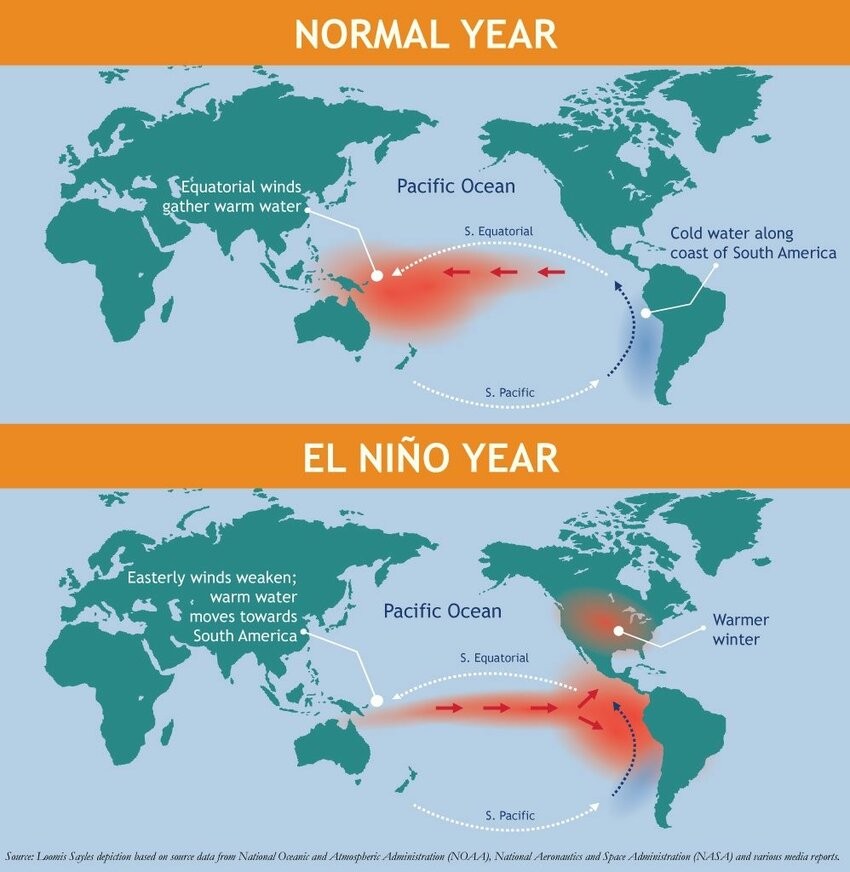
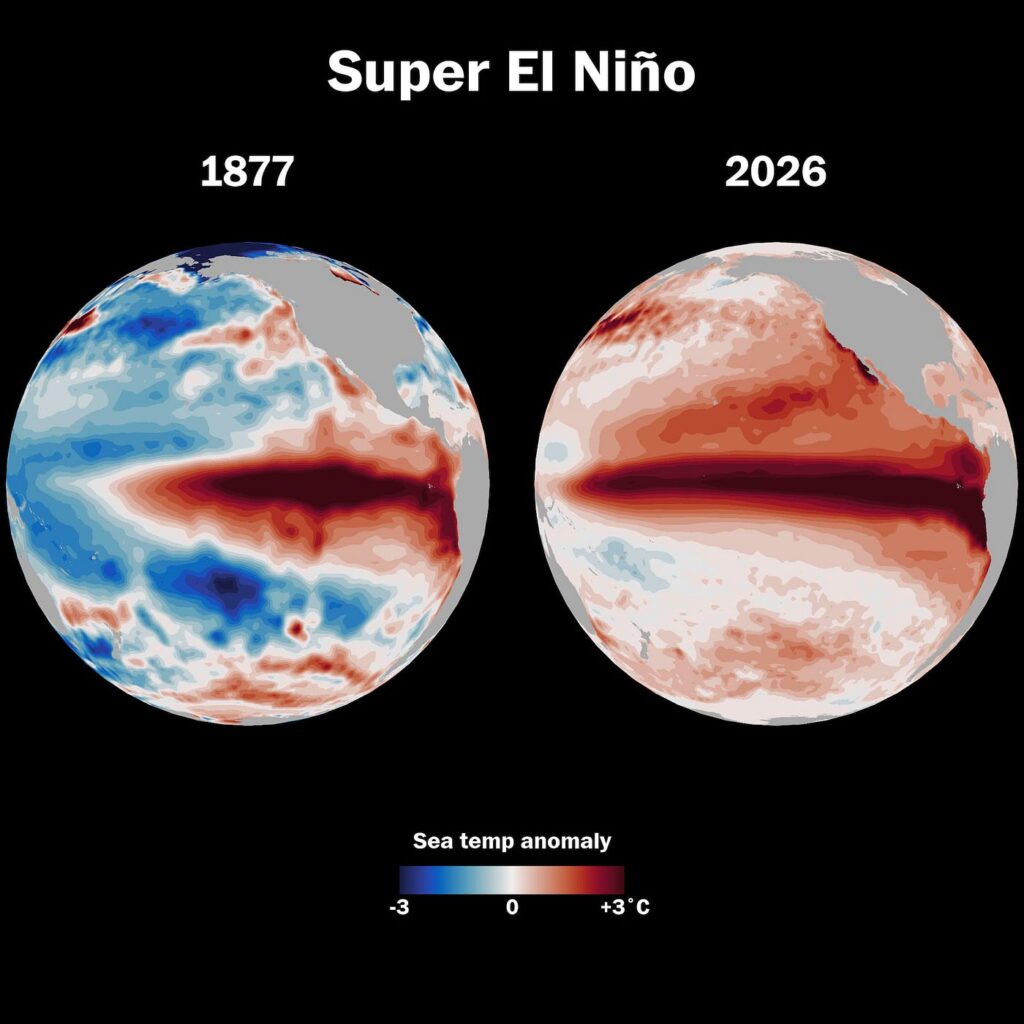
El Niño forms part of the El Niño–Southern Oscillation (ENSO), the Earth’s largest naturally occurring climate oscillation. Under normal conditions, trade winds push warm Pacific waters westward towards Indonesia and Australia. This accumulation of warm water strengthens atmospheric convection, thereby assisting the Walker Circulation, one of the principal drivers of the Indian southwest monsoon.
During El Niño years, however, these trade winds weaken dramatically. Warm surface waters migrate eastwards towards Peru and Ecuador. Consequently, atmospheric convection shifts away from the Indian Ocean, the Walker Circulation weakens, moisture transport towards India diminishes, and southwest monsoon currents lose strength. The inevitable result is a rainfall pattern that becomes deficient, erratic, and spatially uneven.
Modern satellite observations, coupled with ocean buoy networks operated by the National Oceanic and Atmospheric Administration (NOAA), the India Meteorological Department (IMD), and international climate centres, have established this teleconnection beyond reasonable scientific doubt. Furthermore, leading atmospheric institutions note that other regional climate patterns, such as a positive Indian Ocean Dipole (IOD)—often referred to as the “Indian Niño”—can occasionally counteract and partially offset El Niño’s drying influence by warming the western Indian Ocean.
The Historical Legacy of Monsoon Failures
History bears eloquent testimony to El Niño’s destructive potential. Major droughts associated with strong El Niño episodes include 1877, 1899, 1918, 1972, 1982–83, 1987, 2002, 2009, and 2015. Several of these droughts witnessed agricultural collapse, drinking water scarcity, soaring food inflation, livestock mortality, chronic farmer indebtedness, mass rural migration, and acute political instability.
The catastrophic Great Madras Famine of 1876–78, aggravated by an exceptionally intense El Niño, claimed millions of lives across British India, making it among the deadliest climate-linked humanitarian disasters in recorded history and illustrating how structural administrative failures turn meteorological deficits into human apocalypses.
Microcosms of Vulnerability: The Telugu States
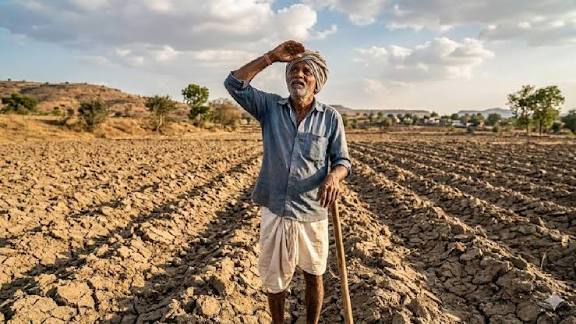
For Andhra Pradesh and Telangana, the structural vulnerabilities exposed by El Niño assume particular significance, showcasing how macro-climatic shifts disrupt localized agrarian frameworks.
Telangana
Rain-fed agriculture dominates large tracts of districts such as Adilabad, Nirmal, Mahabubnagar, Nagarkurnool, Vikarabad, and Nalgonda. Reduced rainfall directly hampers groundwater recharge and tank irrigation, crippling the yields of essential crops like cotton, maize, pulses, and paddy. Compounding this, hydrological stress intensifies the concentration of geogenic contaminants, severely worsening fluoride contamination in groundwater across vulnerable rural tracts.
Andhra Pradesh
Although canal irrigation networks mitigate certain risks along the deltaic coast, El Niño severely impacts the arid hinterlands of Rayalaseema, alongside Prakasam, Nellore, Anantapur, Kurnool, and Chittoor. During these cycles, reservoir storage drops precipitously, hydroelectric generation declines, and acute drinking water scarcity grips the population. Livestock health suffers, and agriculture becomes increasingly dependent upon expensive, energy-intensive groundwater extraction.
The Political Economy of Environmental Decline
Paradoxically, despite repeated drought warnings and clear signs of aquifer depletion, paddy cultivation continues to expand across these water-stressed states. This reflects a deeper structural problem: farmers respond primarily to short-term market signals rather than long-term ecological ones. Assured state procurement, the Minimum Support Price (MSP) framework, heavy irrigation subsidies, free electricity, and established cultivation traditions create a dangerous mismatch between climatic reality and agricultural practice. Rice remains among the most water-intensive crops in the world; during El Niño years, the continued expansion of paddy accelerates the structural collapse of aquifers
Climate disasters seldom arise solely from nature; public policy profoundly shapes vulnerability. Political systems frequently prioritise electoral cycles, short-term subsidies, immediate consumption, and infrastructure symbolism over long-term environmental planning. Consequently, structural investments in watershed management, afforestation, climate adaptation, scientific agricultural extension services, and crop diversification receive comparatively limited attention.
While subsidies possess undeniable social value when targeted toward genuine vulnerability, indiscriminate populism often discourages structural reform. Free electricity encourages unrestricted borewell drilling, pushing the water table down to irreversible depths, while procurement incentives favour water-heavy monoculture even in historically drought-prone landscapes. The ecological costs remain hidden until a climate crisis erupts.
Anthropogenic Amplification: Forests and Concrete
Scientific literature from the Intergovernmental Panel on Climate Change (IPCC) increasingly demonstrates that anthropogenic global warming amplifies the impacts of El Niño. Higher atmospheric temperatures produce accelerated evaporation, longer dry spells, sudden cloudbursts, increased rainfall variability, and more frequent heat waves. Thus, seasonal rainfall may remain statistically “normal” at the end of the year, while agriculture still suffers because the precipitation arrives in fewer, highly intense episodes rather than through steady, seasonal distribution.
Deforestation
India’s vulnerability is systematically self-inflicted. Forests regulate evapotranspiration, maintain soil moisture, assist groundwater recharge, and foster local rainfall recycling. Yet, millions of trees have disappeared owing to mining, highway expansion, real estate speculation, and industrial encroachments. The disappearance of these natural canopies transforms regional microclimates—surface temperatures rise, humidity declines, topsoil runoff increases, and aquifers fail to recharge.
Urban Heat Islands
Simultaneously, urban India increasingly resembles a vast thermal laboratory. Cities replace natural lakes with apartment complexes, wetlands with commercial districts, and forests with concrete. Concrete absorbs enormous quantities of solar radiation, intensifying the urban heat island effect and altering local convective rainfall. Because storm-water escapes rapidly through concrete drainage systems instead of infiltrating the soil, catastrophic flash floods and severe summer water shortages now routinely coexist within the same metropolitan regions.
The city of Hyderabad offers a vivid illustration of this dichotomy, where episodes of devastating urban flooding alternate predictably with severe seasonal water scarcity. This broader ecological decline extends further, manifesting as shrinking wetlands, polluted river basins, degraded topsoils, biodiversity loss, disappearing community tanks, and indiscriminate riverbed sand mining—each undermining the natural cushions that protect human civilisations from climatic shocks.
Cultural Dynamics, Literacy, and Anthropological Impacts
Agriculture in India is not merely an economic activity; it is a cornerstone of cultural identity. Communities often continue cultivating ancestral crops despite changing climatic realities. Rice cultivation, for instance, possesses profound social and ritual significance across southern India. Yet, ecological realities increasingly demand a transition toward climate-smart alternatives:
Millets: Sorghum (jowar), pearl millet (bajra), and finger millet (ragi) require a fraction of the water needed for rice.
Pulses and Oilseeds: Crops that naturally fix nitrogen, improving soil health while surviving lower rainfall.
Horticulture: Deep-rooting fruit trees that offer higher economic resilience against delayed monsoons.
Tradition must find a way to adapt without losing its historical identity. However, despite unprecedented scientific capabilities, climate literacy among the public remains remarkably weak. Media attention frequently shifts toward electoral controversies, sensationalism, and political theatre, while robust scientific communication seldom receives equivalent prominence. Social media platforms further compound the crisis, offering oversimplified narratives or algorithmic misinformation that obscures the systemic nature of climate risk.
The anthropological consequences of this collective ignorance are severe. Repeated droughts produce deep rural indebtedness, declining nutritional standards, educational discontinuity as families relocate, and escalating social conflicts over dwindling resources. Entire rural communities are undergoing a painful transformation: traditional ecological knowledge is dying out, younger populations are abandoning agriculture entirely, and desperate urban migration is accelerating. The Indian village itself, historically the foundational unit of the subcontinent’s civilisational endurance, is beginning to dissolve.
Macroeconomic Ramifications and Structural Consensus
Weak monsoons triggered by El Niño have cascading macroeconomic effects. When agricultural production declines, food inflation rises, forcing central banking institutions to maintain higher interest rates, which tightens credit across the economy. Simultaneously, low reservoir levels weaken hydroelectric generation and create industrial water shortages, while a drop in agricultural income causes rural consumption to contract sharply.
As GDP growth moderates and financial stress spreads through the banking sector via agricultural non-performing assets (NPAs), El Niño reveals its true nature: it is not merely a passing weather disturbance, but a critical macroeconomic variable capable of destabilising national financial forecasts.
The scientific consensus across the IMD, the Indian Institute of Tropical Meteorology (IITM), the IPCC, and NOAA is unified on several key points:
Increased Probability: El Niño significantly increases the probability of below-normal Indian monsoon rainfall, though it does not guarantee a total drought every time.
Variability: Climate change is increasing rainfall variability and the frequency of extreme weather events, making traditional almanacs and historical models less reliable.
Amplification: Local land-use changes, deforestation, and poorly planned urbanisation amplify the destructive impacts of regional climate shifts.
Resilience: Sustainable water management, ecosystem restoration, and climate-resilient agriculture are non-negotiable prerequisites for national adaptation.
The Way Forward
India’s response to this gathering storm must be scientific, institutional, and systematic rather than rhetorical or reactive. National priorities must be reoriented around a comprehensive framework of ecological governance. These measures require institutional continuity that transcends short-term electoral cycles.
Conclusion
El Niño is neither an adversary nor an anomaly; it is an enduring, indifferent feature of the Earth’s climate system. The true question facing the Indian republic is not whether El Niño will recur, but whether the nation will continue to magnify its effects through ecological neglect, short-term governance, and institutional complacency.
Nature has always tested civilisations. History reveals that societies decline not because the climate changes, but because their institutions fail to adapt. In modern India, forests have yielded to concrete, rivers to sewage, historical tanks to real estate encroachments, and scientific foresight to political expediency. If these trajectories persist, the gravest threat to India’s future will not be the warm waters of the equatorial Pacific, but the cumulative consequences of its own unsustainable development.
The warning signs are unmistakable. A republic that ignores its ecological foundations imperils not merely its seasonal harvests, but its economy, its social cohesion, and the welfare of generations yet unborn. Climate change may be global, but resilience is built locally—and the silence of governance in the face of mounting environmental evidence is itself the profoundest risk. The choice before India is therefore stark: adapt through rigorous science, strict conservation, and long-term policy, or confront increasingly severe climatic shocks with a steadily diminishing reserve of natural and institutional resilience.

M. Shiva Prasad, IPS (Rtd.) is a dedicated law enforcement professional who served the combined Andhra Pradesh cadre before opting for the Telangana cadre. Though a native of Andhra Pradesh, he considers himself a true Hyderabadi with an abiding love for the Telugu people. Driven by sincerity, fearlessness, and a lifelong fight against inequality and injustice, his ultimate strengths remain his goodwill and deep affection for the public and the police force. Today, he continues his mission by writing snippets and articles true to his conscience.
Email: Shivareach@yahoo.com
Mobile: 98480 38774