The Historical Roots of Human Exploitation
From Nature, Mystery and Sacred Authority to Sanskritisation, Caste, Class, Urbanisation and Westernisation
The history of civilisation may be read as a long and unfinished passage from fear to explanation, from explanation to institution, and from institution to power. What began as humanity’s humble attempt to comprehend an incomprehensible natural world gradually became a vast architecture of gods, rituals, customs, hierarchies, institutions and ideologies. The sacred did not merely explain the unknown; in many historical circumstances, it also came to organise society, legitimise authority and regulate human conduct.
This is where the insight associated with Rahul Sankrityayan’s Volga to Ganga becomes particularly illuminating. Across the immense sweep of human history, the movement is not simply from primitive belief to modern rationality. It is a movement from tribe to settlement, settlement to agrarian society, agrarian society to city, city to state, and state to complex systems of class, caste, religion and political authority.
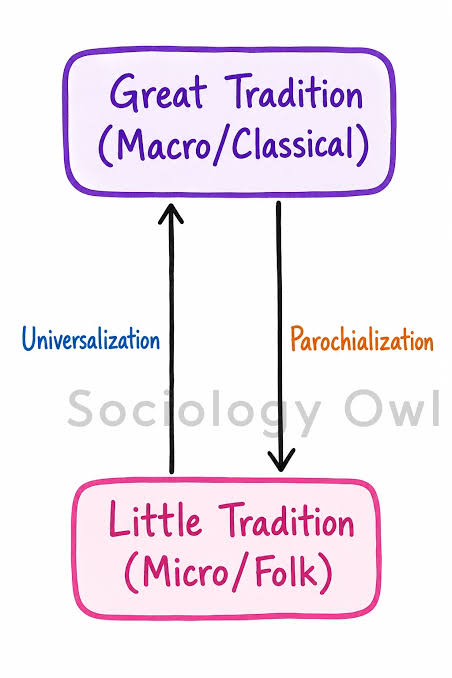
The distinction between Great Tradition and Little Tradition provides another indispensable lens. The Great Tradition represents the textual, philosophical, priestly, institutional and elite civilisation—the Sanskritic, scholastic, courtly and eventually urbanised order. The Little Tradition represents the innumerable local worlds of village deities, ancestral cults, folk practices, oral traditions, occupational customs and regional cosmologies.
These two traditions did not exist in isolation. They constantly interpenetrated, negotiated, absorbed and transformed one another.
That interaction is one of the great secrets of Indian civilisation.
The Central Crux
The fundamental question is therefore not merely:
Why did human beings create gods to explain the unknown?
It is the more profound question:
How did explanations of nature become systems of social authority—and how did those systems come to legitimise the unequal distribution of knowledge, status, resources and power?
Here lies the historical bridge between the God of the Gaps and the exploitation of human beings.
When the causes of disease, drought, flood, fertility, death, thunder, famine or natural catastrophe were unknown, supernatural explanations offered psychological security. But once such explanations became institutionalised, the person who claimed privileged access to the sacred could acquire privileged access to social power.
The interpreter of the mysterious could become the custodian of truth.
The custodian of truth could become the guardian of ritual.
The guardian of ritual could become the arbiter of status.
And the arbiter of status could become an instrument of hierarchy.
Thus, an innocent human response to mystery could, under particular historical conditions, become a mechanism of hegemony.
I. From the Little Tradition to the Great Tradition
The village did not initially require a sophisticated theology.
It required rain.
It required water.
It required fertile soil.
It required protection from disease.
It required the preservation of cattle, crops, forests and communal boundaries.
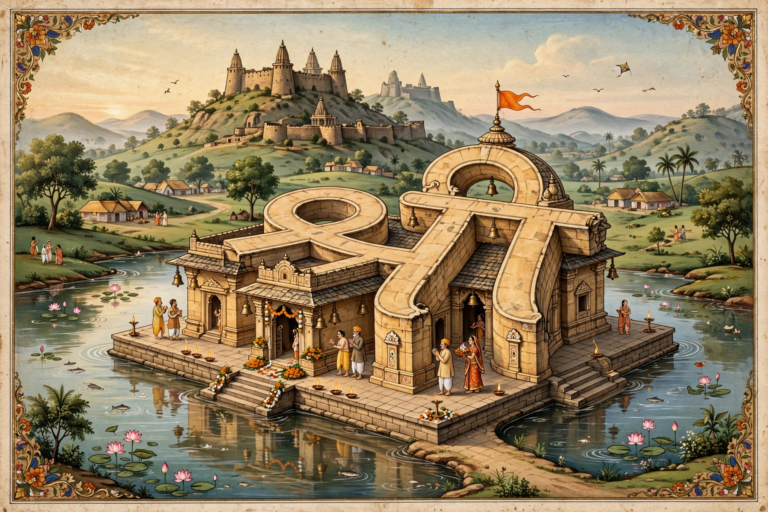
Hence emerged local sacred worlds—village goddesses, sacred trees, sacred groves, boundary deities, ancestral spirits and protective rituals.
The Little Tradition was therefore not merely “primitive religion.” It was often a social technology of survival.
A village deity could simultaneously represent:
* protection from epidemic disease;
* fertility of land;
* community identity;
* territorial boundaries;
* collective memory;
* social solidarity.
The later Great Tradition did not simply destroy these local worlds. Frequently, it absorbed and reinterpreted them.
A local deity could be incorporated into a wider Sanskritic pantheon.
A village goddess could acquire a Puranic identity.
A local shrine could become associated with a major deity.
A folk ritual could be given a classical theological interpretation.
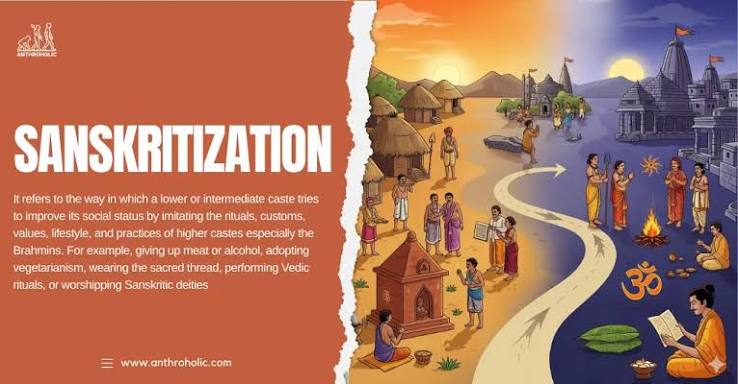
This process is closely related to what sociology came to describe as Sanskritisation.
But Sanskritisation was never merely religious.
It could also be a social strategy for acquiring prestige, legitimacy and upward mobility.
II. Sanskritisation: Cultural Mobility and Cultural Hegemony
Sanskritisation possesses a double historical character.
On one side, it represents cultural aspiration.
Communities historically located lower in the social hierarchy could adopt practices associated with prestigious groups in an attempt to acquire higher status.
On the other side, the very possibility of upward movement through imitation reveals the existence of a hierarchy whose standards were already unequally distributed.
Thus Sanskritisation can be read simultaneously as:
mobility and conformity; aspiration and domination; cultural integration and cultural hierarchy.
The Great Tradition established models of purity, ritual authority, social propriety and prestige. The Little Tradition adapted itself to these models while also preserving its own local identity.
Indian civilisation therefore cannot be understood either as a monolithic Sanskritic civilisation or as a collection of isolated village cultures.
It is better understood as a continuous negotiation between the Great and the Little Traditions.
III. Caste: When Social Difference Becomes Hereditary
The most consequential transformation occurs when occupational and social distinctions become hereditary, ranked and sanctified.
Division of labour is a universal feature of civilisation.
But the historical problem begins when:
division of labour becomes division of human worth.
And the problem becomes still deeper when social status is:
* inherited by birth;
* enforced through custom;
* protected through endogamy;
* reinforced through ritual;
* legitimised through religious authority;
* reproduced across generations.
At this point, social hierarchy ceases to be merely economic.
It becomes ontological.
A person is not simply poor or rich; he is classified as belonging to a particular social order.
He is not merely performing an occupation; the occupation itself becomes attached to inherited status.
He is not merely excluded from power; exclusion becomes normalised as tradition.
This is one of the most enduring mechanisms of human exploitation:
The conversion of historically created inequalities into apparently natural or sacred inequalities.
IV. Class: The Economic Architecture of Exploitation
Caste alone does not explain exploitation.
Nor does religion.
The economic structure is equally fundamental.
Once settled agriculture produced surplus, society acquired something that earlier hunter-gatherer communities possessed in much smaller measure: the possibility of systematic accumulation.
Surplus generated:
property → ownership → inheritance → taxation → administration → political authority → class differentiation.
The emergence of cities intensified the process.
The peasant produced.
The artisan manufactured.
The merchant exchanged.
The soldier protected or conquered.
The ruler appropriated taxation.
The priest legitimised the moral and cosmic order.
Thus civilisation generated extraordinary achievements—but also extraordinary asymmetries.
The temple, palace, granary, market and fort became not merely physical structures but institutions through which surplus and authority were organised.
The history of civilisation is therefore simultaneously the history of human creativity and the history of the appropriation of human labour.
V. Religion: Liberation and Legitimation
Religion cannot be reduced to exploitation.
That would itself be a historical distortion.
Religions have inspired:
* compassion;
* charity;
* social service;
* renunciation;
* equality;
* resistance to oppression;
* moral reform;
* spiritual liberation.
The same religious civilisation could produce both hierarchy and protest against hierarchy.
This contradiction is crucial.
The Upanishadic quest challenged superficial distinctions through the search for ultimate unity.
Buddhism challenged ritual privilege and offered an alternative ethical and monastic order.
Bhakti movements repeatedly questioned inherited status through devotion.
Sufi traditions generated alternative forms of spiritual community.
Thus the Great Tradition contained within itself both structures of authority and resources for resistance.
Civilisation is rarely one-dimensional.
VI. Urbanisation: The Great Tradition Becomes Institutional
The movement from village to city changed everything.
The village is governed substantially through:
kinship, custom, locality and oral memory.
The city requires:
Law, writing, taxation, administration, markets, bureaucracy and formal authority.
Urbanisation therefore transforms culture from predominantly local tradition into institutional civilisation.
The temple becomes an economic institution.
The court becomes a political institution.
The market becomes an economic institution.
The school becomes an intellectual institution.
The bureaucracy becomes an administrative institution.
Knowledge itself becomes specialised.
And specialised knowledge creates another hierarchy:
Those who possess knowledge acquire the capacity to govern those who do not.
This is one of the deepest recurring patterns in human history.
VII. Westernisation: A New Great Tradition
Modernity does not abolish hierarchy.
It changes its vocabulary.
Westernisation introduces:
* modern science;
* industrial production;
* capitalism;
* constitutional government;
* modern education;
* individual rights;
* bureaucratic administration;
* nation-state institutions;
* modern law.
These developments profoundly weaken many traditional forms of authority.
But they simultaneously generate new forms of domination.
The old hierarchy may say:
“You are inferior by birth.”
The modern hierarchy may say:
“You are unequal because of wealth, education, property, productivity or institutional power.”
The vocabulary changes.
The underlying struggle over knowledge, resources and power remains.
Colonialism makes this especially clear.
The colonial state did not merely conquer territory. It classified populations, reorganised land, extracted revenue, reorganised labour and imposed new epistemic categories.
Thus Westernisation was simultaneously:
modernisation, transformation, liberation—and domination.
VIII. From Sacred Hegemony to Secular Hegemony
The great historical transformation is therefore not necessarily from religion to non-religion.
It is from one form of authority to another.
The priest may lose authority to the bureaucrat.
The scripture may lose authority to the statute.
The hereditary aristocrat may lose authority to the industrial capitalist.
The village elder may lose authority to the administrative state.
The sacred text may lose authority to the scientific institution.
But every society continues to confront the same fundamental question:
Who possesses knowledge, who controls resources, who defines legitimacy, and who has the power to enforce it?
This is the deeper meaning of hegemony.
Hegemony does not operate only through physical coercion.
Its greatest achievement is to make a historically constructed order appear natural, inevitable and morally legitimate.
IX. The God of the Gaps Revisited
The original idea of the God of the Gaps therefore acquires a much richer meaning.
At first:
unknown nature → supernatural explanation.
Then:
supernatural explanation → ritual.
Then:
ritual → institutional authority.
Then:
institutional authority → social hierarchy.
Then:
social hierarchy → inherited privilege.
Finally:
privilege → ideology and hegemony.
But modern science progressively closes many empirical gaps.
Thunder becomes meteorology.
Disease becomes microbiology.
Famine becomes an object of agricultural and economic analysis.
Flood becomes hydrology and engineering.
The stars become astrophysics.
Yet the disappearance of supernatural explanations does not automatically eliminate exploitation.
Because the deepest gaps are no longer merely gaps in our knowledge of nature.
They are gaps in our understanding of:
power, consciousness, inequality, desire, institutions and human behaviour.
X. The Great Insight of Volga to Ganga
The great historical sweep suggested by Rahul Sankrityayan is valuable precisely because it refuses to view civilisation as static.
Humanity moves.
Populations migrate.
Technologies transform.
Economic systems evolve.
Political institutions rise and fall.
Religions encounter one another.
Cultures assimilate and resist.
The hunter becomes the cultivator.
The cultivator becomes the taxpayer.
The village becomes the city.
The city becomes the state.
The state becomes empire.
The empire becomes nation.
And the human being, throughout this enormous historical journey, remains caught between freedom and authority, cooperation and exploitation, reason and belief.
That is the great drama.
The Final Crux
The most profound lesson is therefore not that God was invented because human beings were ignorant.
That formulation is too simple.
The deeper historical proposition is this:
Human beings first created sacred explanations to make an incomprehensible world intelligible; societies subsequently created institutions around those explanations; institutions generated authority; authority produced hierarchy; and hierarchy, when made hereditary and unquestionable, became one of the enduring foundations of human exploitation.
Yet the story does not end there.
The Little Tradition continuously challenged, modified and enriched the Great Tradition.
The Great Tradition repeatedly absorbed the Little Tradition.
Sanskritisation transformed social identities.
Urbanisation transformed institutions.
Westernisation transformed knowledge and political authority.
Science progressively displaced supernatural explanations of natural phenomena.
Modern constitutionalism challenged inherited privilege.
Democracy challenged absolutism.
Human rights challenged the legitimacy of inherited hierarchy.
And yet exploitation survives because human beings continue to compete for control over knowledge, wealth, status and power.
Thus the entire history—from the sacred grove to the temple, from the temple to the palace, from the palace to the bureaucracy, from the bureaucracy to the corporation and from mythology to modern science—may ultimately be read as one immense human experiment:
Who shall define truth?
Who shall possess knowledge?
Who shall control the surplus?
Who shall determine status?
Who shall command obedience?
And, above all, who shall have the power to decide the worth of another human being?
That is the real historical journey from Volga to Ganga—and from the Little Tradition to the Great Tradition.
And that, ultimately, is where the history of caste, class, creed, religion, Sanskritisation, urbanisation, Westernisation and human exploitation converges: not merely in the history of belief, but in the eternal human struggle between knowledge and ignorance, authority and freedom, hierarchy and equality, domination and dignity.
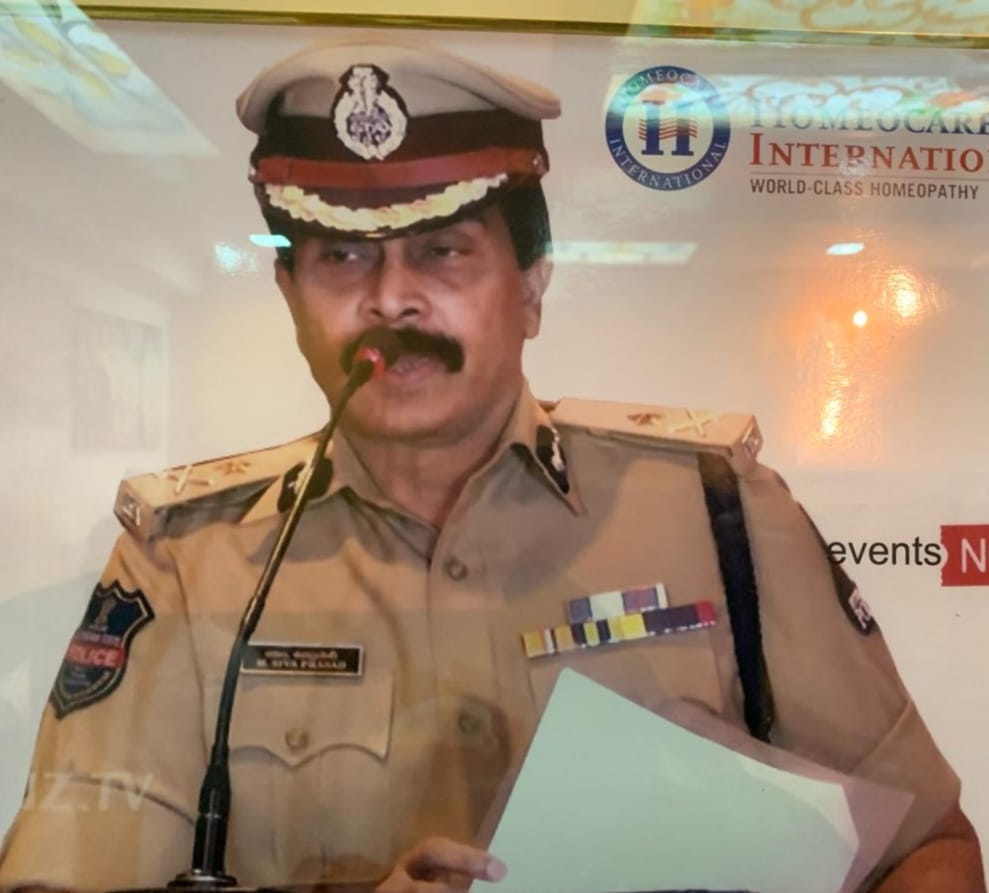
M. Shiva Prasad, IPS (Rtd.) is a dedicated law enforcement professional who served the combined Andhra Pradesh cadre before opting for the Telangana cadre. Though a native of Andhra Pradesh, he considers himself a true Hyderabadi with an abiding love for the Telugu people. Driven by sincerity, fearlessness, and a lifelong fight against inequality and injustice, his ultimate strengths remain his goodwill and deep affection for the public and the police force. Today, he continues his mission by writing snippets and articles true to his conscience.
Email: Shivareach@yahoo.com
Mobile: 98480 38774