The critical question is the burden of proof!
Dr. B.R. Ambedkar championed: One person, One vote, One value
Under Article 326 of the Indian Constitution, the right to vote is established as a fundamental constitutional right for every citizen aged 18 or older, subject only to legally defined disqualifications such as unsoundness of mind or statutory bars. Although jurisprudence traditionally classifies the franchise as a constitutional or statutory right rather than an unalterable fundamental right, its practical denial triggers a severe socio-economic domino effect.
Without an active entry on the electoral roll, a citizen faces immense friction when securing secondary identity markers like ration cards or Aadhaar updates. In a state where administrative access dictates survival, losing a vote can inadvertently jeopardize welfare access, indirectly squeezing the protections of Article 21 (The Right to Life and Personal Liberty). Combined with anxieties surrounding the Citizenship Amendment Act (CAA), any flawed or non-transparent deletion from a voter list amplifies the fear of structural statelessness.
The Burden of Proof
“Janani Janmabhoomi Swargadapi Gariyasi” is a beautiful, timeless Sanskrit verse meaning “Mother and motherland are superior even to heaven”. Should a person born on Indian soil be forced to repeatedly defend their right to exist as a stakeholder in their own nation? In a robust democratic framework, the burden of proof rests strictly with the accuser. Under standard criminal and civil jurisprudence, if the state levels a severe allegation or alters a citizen’s fundamental standing, it is the government’s absolute duty to substantiate that claim. This universal principle separates constitutional democracies from authoritarian regimes where the burden of proof is arbitrarily flipped onto the individual. “In a democracy, the government does not choose the people; the people choose the government.”
This foundational maxim underpins the Indian Republic. The architects of our Constitution envisioned democracy not merely as a periodic, mechanical polling ritual, but as an institutional reflection of popular sovereignty. This equalizing force ensures that a vote holds identical value whether it belongs to a billionaire industrialist or a destitute citizen. As Dr. B.R. Ambedkar famously championed: one person, one vote, one value.
Is this Indian Governance?
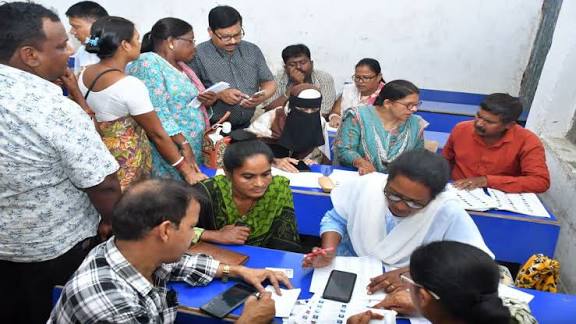
Today, this democratic equilibrium faces unprecedented scrutiny. The Election Commission of India’s (ECI) nationwide Special Intensive Revision (SIR), a sweeping initiative to verify and update electoral rolls via house-to-house enumeration, has ignited a fierce constitutional debate. While administrative circles defend the exercise as a mandatory “cleanup” to eliminate duplicate entries, deceased voters, and undocumented non-citizens, a growing coalition of opposition parties, civil liberty activists, and constitutional experts view it with alarm, warning that the process risks systemic disenfranchisement.
To evaluate this crisis objectively, an editorial perspective must disentangle political rhetoric from statutory mechanisms, analyzing exactly where administrative duty ends and majoritarian overreach begins.
| THE CITIZENSHIP PIPELINE Voter ID——- —-Regulated by Article 326Ration/Aadhaar— -Essential for Socio-Economic Vetting Passport-——- —-Confirms International Nationality (Passports Act, 1967) |
The Passport and Legal Realities
This friction reached a critical juncture when the Ministry of External Affairs (MEA) explicitly reiterated a long-standing statutory fact:
“A passport is a travel document, not a document of citizenship.”
To the layperson, this announcement felt like an unsettling legal loophole. In everyday life, acquiring an Indian passport demands rigorous, multi-tiered vetting—encompassing local police verification, address validation, and strict documentation checks. For the state to conduct such exhaustive background checks to issue a passport, yet state that the same document cannot serve as ultimate legal proof of domestic citizenship under the Citizenship Act, 1955, creates a stark administrative paradox.
Legally, the MEA’s position is entirely consistent with the law; a passport affirms nationality for international travel under the Passports Act, 1967, but does not automatically resolve complex, domestic municipal citizenship disputes. However, this legal distinction places an endangered voter in a difficult position. If an individual is struck off the electoral rolls during an SIR exercise, presenting a valid Indian passport does not automatically restore their status. Bridging this gap between stringent state verification and baseline citizen defense remains a crucial legal challenge that the judiciary and civil society must address.
Internal Cleanliness and Ethical Mobility
Interestingly, while the Indian state intensifies the monitoring of its domestic boundaries, it is simultaneously attempting to clean up its international migration pathways. Recognizing that thousands of Indian youths risk their lives and life savings on illegal, dangerous migration routes to enter European nations like Italy or Greece, the MEA has launched counter-measures.
The Ministry officials expressed concern that many Indians continue to be misled by fraudulent recruitment agents who promise lucrative employment abroad through illegal channels. Some migrants have reportedly been trafficked into conflict zones or dangerous working environments after relying on unauthorised intermediaries.
To maintain public trust in election outcomes, the SIR process must strictly adhere to the Principles of Natural Justice:
Mandatory Written Justification:
No voter entry should be scrubbed from the live database without a formal, written statement of reasons delivered to the individual.
Rigorous Notice and Appeal Windows:
Statutory timelines must be preserved, providing citizens with an unhindered opportunity to challenge a proposed deletion before it becomes final.
Decentralized Public Scrutiny:
Reintroducing the mandatory practice of reading draft electoral lists aloud within Gram Sabhas and urban Ward Sabhas ensures community-wide validation, removing the process from closed digital systems.
Independent External Audits:
The algorithmic and physical datasets of the SIR must be opened to independent, third-party civil and technical oversight to eliminate any suspicion of targeted demographic profiling.
Critics, however – including opposition parties, civil liberties organisations, and several constitutional scholars – warn that if the process lacks adequate transparency, procedural safeguards, and effective opportunities for appeal, it may result in the exclusion of genuine and eligible voters. They argue that the real strength of a democracy lies not merely in maintaining accurate electoral rolls but in ensuring that no eligible citizen is deprived of the constitutional right to participate in the democratic process.
Ultimately, whether the state is regulating the movement of human capital across global borders or managing the sanctity of a local polling booth, the underlying principle must remain identical. The preservation of the democratic state requires that all administrative actions remain fully transparent, legally accountable, and unreservedly anchored to the constitutional promise of equality.
Law professor and eminent columnist
Madabhushi Sridhar Acharyulu, author of 63 books (in Telugu and English), Formerly Central Information Commissioner, Professor of NALSAR University, Bennett University (near Delhi), presently Professor and Advisor, Mahindra University, Hyderabad. Studied in Masoom Ali High School, AVV Junior College, CKM College, and Kakatiya University in Warangal. Madabhushi did LL.M., MCJ., and the highest law degree, LL.D. He won 4 Gold Medals at Kakatiya University and Osmania University.
Email: cicsridhar@gmail.com
Mobile: 8447651505