The Clarity of Intent
1. The Arrival
The journey begins in the quiet village of Moregaon, cradled by the gentle loop of the Karha River, some eighty kilometres from Pune. But you do not measure this distance in kilometres. You measure it in the gradual fading of city noise. The last traffic signal disappears. The billboards thin out. The air changes. It grows drier, scented with sun-baked earth and the faint, sweet dust of the Deccan plateau.
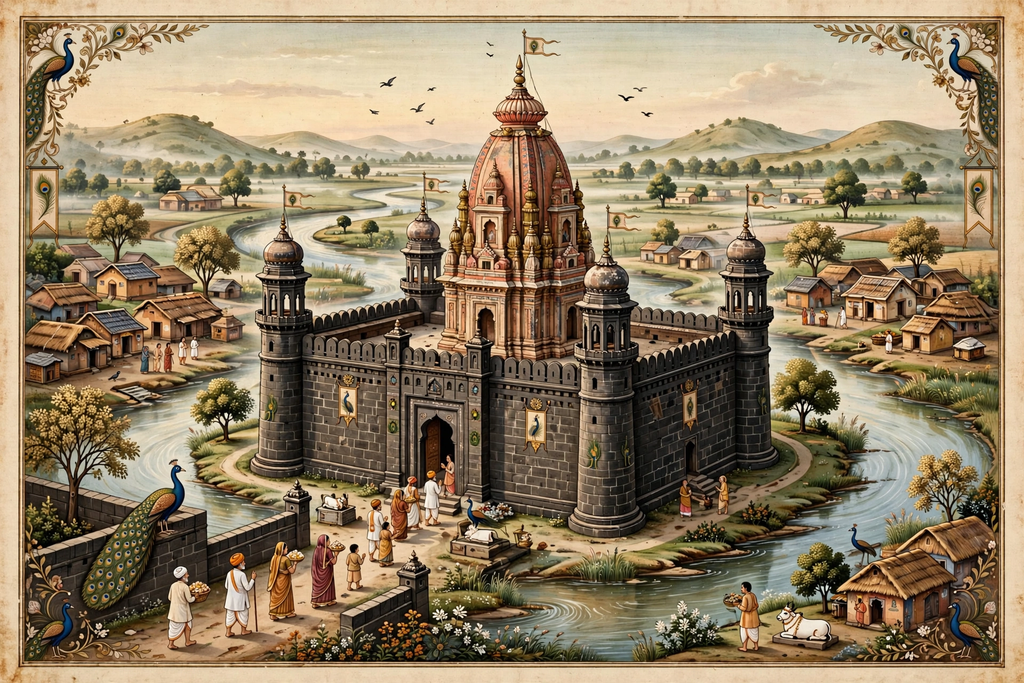
When the Mayureshwar temple finally appears, it does not greet you like a shrine. It greets you like a fortress. Dark stone, high walls, four minarets that have stood guard for centuries. This is not accidental. The temple was built during the Bahmani era, and later fortified by the Peshwas, because this was not just a place of prayer. It was a place that needed protecting. The wisdom it holds is worth defending.
You step through the massive gateway, and the dust of the road falls away. In its place, the cool breath of old stone and the faint, familiar scent of burning camphor. The sound of the outer world dims to a distant hum. A peacock calls once from the temple roof, as if announcing you. You have arrived at the first threshold.
This is where every seeker must begin. Not at the feet of the god, but at the gate of intention. The fortress asks a silent question: Why have you come?
2. The Ancient Legend
The stories of old tell us that this region was once terrorised by a chaotic force. This was a demon named Sindhurasura. His name meant “the red one,” and his power came from a boon that made him nearly invincible. He was not just a monster with fangs. He was distraction incarnate. He scattered focus. He poisoned clarity. Under his reign, sages could not meditate, farmers could not work, and families could not find peace. The land itself seemed restless.
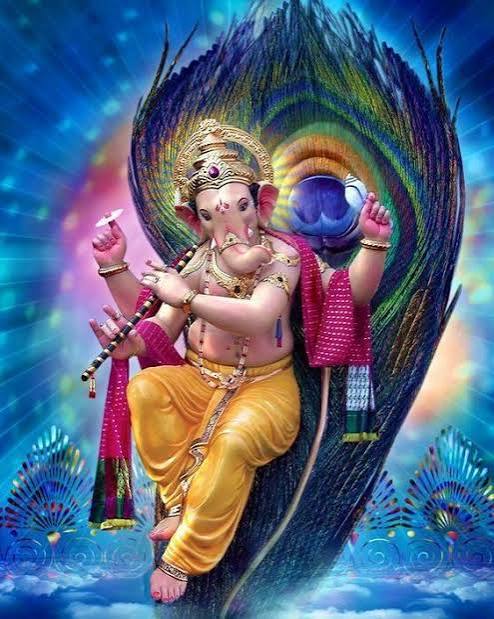
The gods and sages, exhausted by their own efforts, turned their minds inward and prayed to Ganesha. They did not ask for weapons. They asked for wisdom. Ganesha descended into this valley to restore cosmic order. He arrived riding a magnificent peacock. This vehicle is called a Mayura.
A fierce battle followed. But it was not a battle of brute force. Sindhurasura thrived on chaos, so Ganesha gave him clarity. The demon was defeated not by being struck down, but by being seen through. When the poison of distraction was named, it lost its power. After the victory, the Lord chose to bind his energy to this very earth. He took the name Mayureshwar, which means the Lord of the Peacock.
The peacock is not a random choice. In Indian lore, the peacock is known for its ability to consume venomous snakes without being harmed by their poison. It transforms poison into beauty, chaos into colour. This is the first lesson of the Ashta Vinayak: before we can fight the demons outside, we must learn to neutralise the poison within.
Every pilgrim who enters Moregaon is re-enacting this myth. We all arrive with our own Sindhurasura — the emails, the anxieties, the endless scrolling, the half-finished projects. Mayureshwar does not slay our demons for us. He teaches us how to transmute them.
3. The Uniqueness of the Form
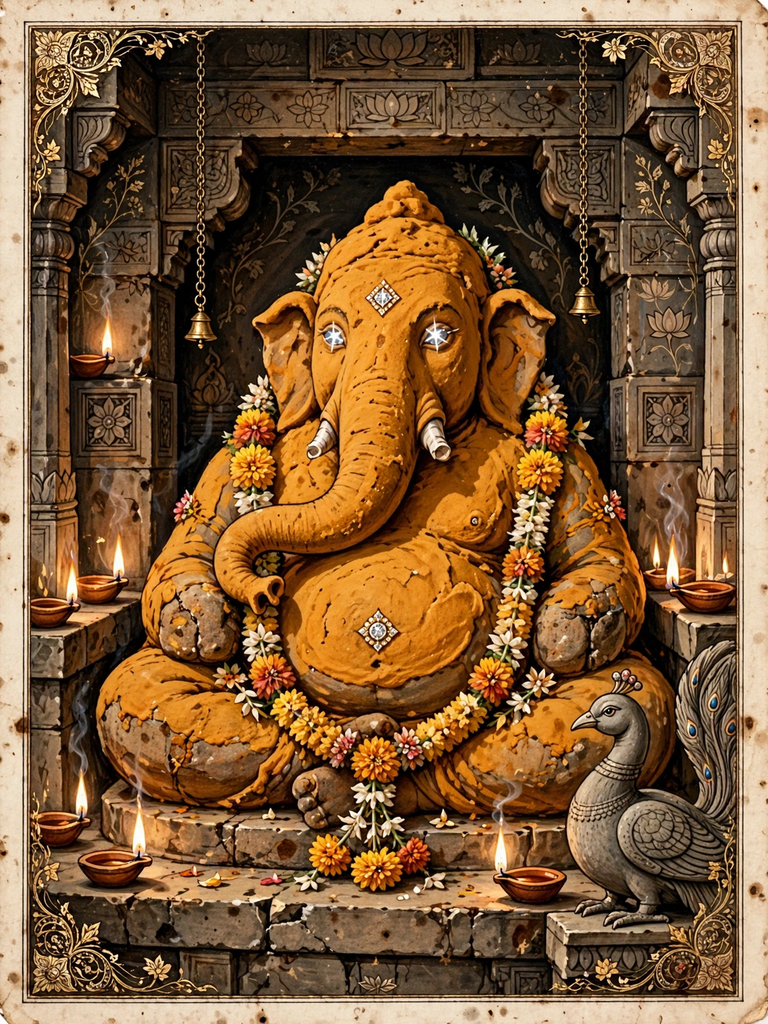
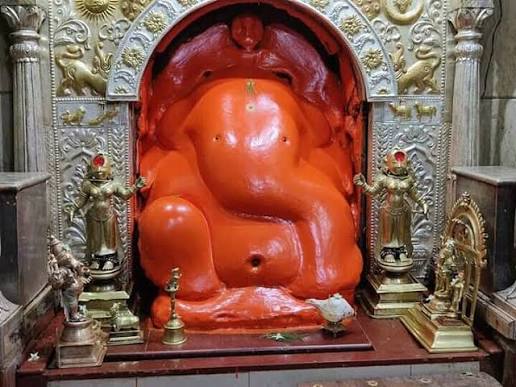
The ancient self-manifested murti sits in the heart of the inner sanctum. The form is modest in size, but its presence fills the chamber. It is traditionally covered in layers of bright saffron paste — sindoor — applied by countless devotees over centuries. The saffron is not decoration. It is the accumulated residue of sankalpa, of vows made and kept.
He faces the east, the direction of the rising sun, the direction of new beginnings. He is seated in a steady, crossed-legged posture — lalitasana — the posture of ease. This is not a god about to leap into battle. This is a god who has already won, by becoming still.
His trunk turns gently to the left. This detail is not accidental. In the iconography of Ganesha, the left-facing trunk, known as the Vamamukhi form, represents the lunar, receptive, and nurturing energy. It is the posture of a god who is approachable, who listens before he acts. This is the Ganesha of beginnings, not battles. He does not demand. He invites. Temples with right-facing trunks require stricter ritual observance. Mayureshwar, with his left turn, says: come as you are, but come with clarity.
His eyes and his navel are set with real diamonds. These diamonds catch the flicker of the oil lamps. They gleam like steady stars in the darkness of the inner chamber. In a world of distraction, they are points of focus. Look here, they seem to say. Not there. Here.
A large stone peacock stands guard directly ahead. It looks back towards its master. This is a perpetual reminder of the vehicle of victory. The peacock does not face outward to fight. It faces inward, toward its Lord. True power is alignment.
4. The Inward Lesson
The legend of Moregaon is a lesson on how we begin things. In our daily lives, we often attempt to start a new project. We try to write a new chapter or build a fresh venture. We open our laptops with enthusiasm. And within minutes, we are surrounded by the poison of distraction — notifications, doubts, the voice that says “you should check the news first.” External noise tries to scatter us.
To ride the peacock is not a symbol of vanity. It is a symbol of alchemy, the ability to consume poison without being poisoned. Mayureshwar teaches us an important truth. Before we take a single practical step, we must establish our pure intent. We call this a Sankalpa. It is a vow so clear that external hurdles lose their power to distract.
A Sankalpa is not a goal. A goal is “I want to finish this book.” A Sankalpa is “I sit here for one hour, and for this hour, I serve only this page.” One is about the future. The other is about now. One is vulnerable to distraction. The other transforms distraction into fuel.
Think of your own Sindhurasura. What is the red, restless energy that scatters your day? For a student, it may be the phone. For a leader, it may be the addiction to urgency. For a parent, it may be the guilt of not being enough. Mayureshwar does not ask you to kill it. He asks you to ride it. To say: “I see you, distraction. You are not my master. You are my peacock. And today, we fly in the direction I choose.”
When our core purpose is completely clear, external hurdles lose their power. They cannot disrupt our focus. The peacock does not fear the snake. It has learned to transform it. So, we, too must we learn to transform our distractions into fuel for our focus. This is the first discipline of the seeker.
5. The Taste of the Temple
Every temple in the Ashta Vinayak circuit offers a unique Naivedya, a sacred offering to the Lord. At Moregaon, the offering is a simple dish called Khichdi, made of wheat and jaggery. It is humble, earthy, and nourishing. There is no elaborate sweetness here, no grand presentation. Just the honest warmth of grain and molasses.
It tastes of the soil, of the village, of beginnings that are rooted in simplicity. The jaggery is not refined sugar. It is raw, dark, with a mineral depth. The wheat is cracked, not polished. This is not festival food. This is foundation food.
When you receive this offering, you understand that the first step of any journey does not require grandeur. It requires only sincerity. The taste stays with you long after you have left the temple. It is the taste of clarity. It is the taste of a vow that can be kept. In a world that sells you complexity, Mayureshwar offers you the courage of the simple.
6. The Closing Reflection
True wisdom does not begin with a sudden action. It begins with a quiet alignment. We often rush to change our outer world before we have settled our inner space. We launch the project before we’ve named the purpose. We post the announcement before we’ve done the work. And then we wonder why the poison of doubt creeps in. But Mayureshwar invites us to pause. He reminds us that when our core purpose is pure and clear, the path ahead clarifies itself. The fortress walls are not there to keep you out. They are there to keep your intent in.
Take a single moment before you step out into the rush of the world today. Sit quietly with your intent. Not your to-do list. Your intent. Why does this matter? What is the pure thread beneath the noise? Let the noise of the day fall away. Name your Sindhurasura, and then name your peacock.
When you find that still centre, you have already crossed the most difficult barrier. You are ready to begin. Not with force, but with focus. Not with noise, but with a vow. The peacock is waiting. The fortress is open. The first face of wisdom is looking at you, trunk turned left, listening.
From here, we walk to Siddhatek, where intent must become capability. But for now, stay here. Breathe in the camphor. Taste the jaggery. And begin.
Author Biography: – R Srinivasa Murthy, the author, is a corporate leader, an independent writer, and a student of Hindhu Philosophy. He Identifies as a Demystic, committed to removing unnecessary mysticism from traditions to offer practical systems for the next generation. His upcoming book, Logic of And: Sanatana Dharma as a Toolkit for the Contemporary Seeker, aims to bridge ancient wisdom with modern life to foster an inclusive, living civilisation.

With a journalistic long journey, we bring you https://primepost.news, a dynamic platform committed to unraveling the intricate tapestry of Indian politics, particularly delving deep into the heart of Telangana and Andhra Pradesh. Our blog is not just a source of news; it’s a reservoir of insights, analysis, and thought-provoking reviews.


It’s nice to learn about Mayureswar Temple which is 80 kilometres away from Pune. Yes. I heard all this when I was staying Pune. But I missed the chance of visiting Mayureswar Temple, having darshan of Lord Ganeshji. It’s nice description about Mayureswar Temple. Nice.
Thank sir for sharing about Mayureshwar vinayak Divine Details.
Superb sir 🌞👏🕊️👍🙏
Very informative article. Well researched and presented.