As the ‘rule of law’ is bleeding: …
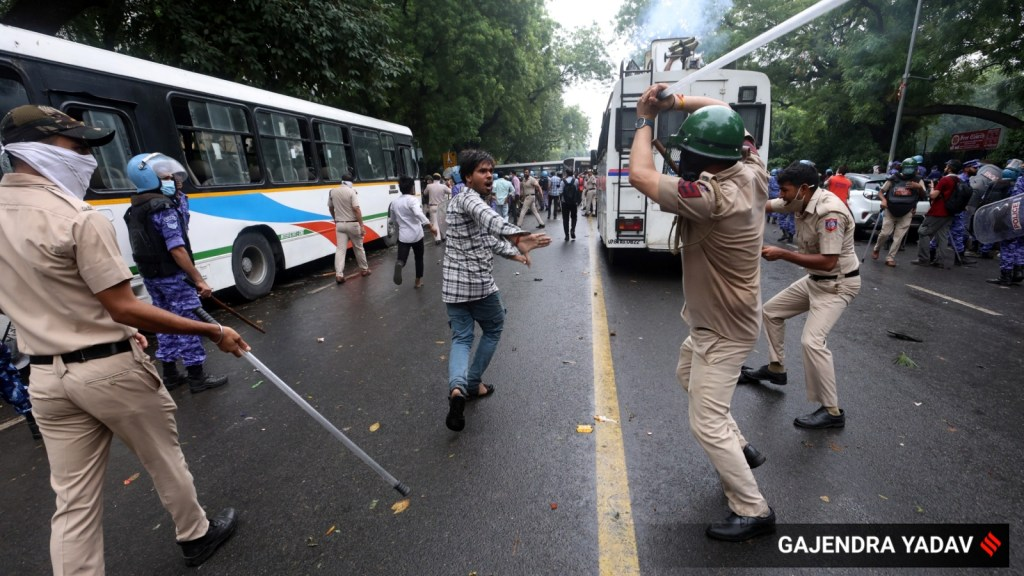
Today (27th July), very important questions were raised before the bench of the Supreme Court, which may continue the hearing tomorrow, or beyond. How to regulate police action during public protests, and a ban on the deployment of plainclothes personnel for crowd-control duties? Who will guide and implement guidelines on the use of prohibitory orders under Section 163 of the BNSS? Will there be any independent probe into the police action during the July 20 student protest in Delhi?
During recent agitation for leakage in Delhi, several terrible incidents were explained by Senior Advocate Gopal Sankaranarayanan last Friday (17 July); the matter was mentioned before a bench led by CJI Kant. (This clip of a small video reflects many terrible issues: https://www.facebook.com/share/v/1CqNZKzFuV/) That video narrates:
A large number of people who purported to be police force were in mufti. They were not wearing their police uniforms. Even those wearing police uniforms didn’t have their badges on them. So, whether they were police people, we don’t know.
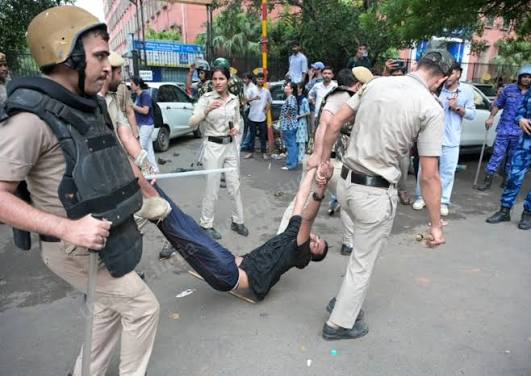
But we do know that they were armed. They were armed with lathis, and they were armed with excessive shock-producing batons, which are not even prescribed for the Delhi Police and the RAF who were deployed there. The second, the video shows specifically DCP Sandip Lamba; that is his name, his badge is captured, slapping a woman who is standing innocently on the side and doing nothing. She’s not moving. I can show you that video right now.
DCP Sandip Lamba is his name. Let’s not be specific: Additional DCP. Let’s not be scared to name our thugs in uniform when they deserve to be named. He should be summoned here, and he should be asked to be accountable for his actions. Third, this is after the crowd was dispersed. There was no heat or fury, no crowds, nothing. Completely unprovoked.
He’s walking past two women. He reaches across and slaps one of them across the face. These are the people that we put in charge of our police force to protect us, and that’s why we are before this court.
The number of injuries that happened were completely and solely because of the actions of the Delhi Police, the RAF, and those who claimed to be Delhi Police and RAF. The videos will also show Your Lordships, as has already been mentioned, that there are lathis with nails.
The kind of bullying and madness which has captured the imagination of these people purporting to be policemen is that they wear helmets. They’re wearing T-shirts and jeans. They trip up a protester who’s trying to run away.
And when he falls down, four of them get up, get after him with batons and start beating him with lathis. This kind of excessive force, if the constitutional courts don’t step in and stem it, is a license to the police to just get away with absolutely anything because they know they have the sanction of the police political masters. It is here, my Lords, that we must be accountable, and we need to have them explain their actions, and which is why our prayers include that apart from an SIT, an FIR against these so-called police officers and administrative disciplinary action taken against them, we need to have a judicial inquiry.
Unfortunately, the CJI refused to take the letter, saying “We do not have time to such things,” but, fortunately, he took up a letter petition raising the issue of police force at the Jantar Mantar protest on July 20 (mentioned by Advocate Narendra Mishra). Later, the CJI clarified that the listing was denied as there was no properly filed petition before the court at the time.
Can police beat, lathi-charge, kick, or lynch literally?
It’s only an observation that evolved from the petition before the bench of the Supreme Court and needs further discussion, debate, and argument. The subject is hearing a petition over the Delhi Police crackdown on the Cockroach Janta Party protest last week: do we have “Right to protest, peaceful protest, lawful protest, is absolutely guaranteed under the constitutional scheme. So long as there is a peaceful agitation, merely because there is an agitation, there can’t be excesses,” as said by the CJI Surya Kant.
Is there a protocol in place?
CJI raised a consequential question: “There should be a protocol in place. If they want to agitate on an issue… They should be provided with proper space… There should be no restriction or impediment in that. But if there is someone else, some anti-social element, or somebody has done anything wrong, that of course can be taken care of.”
| Age-old Question raised Adv. Shakeel for petitioner: “Our petition has comprehensive information along with the use of AK47 in Siwan yesterday. That has all the updated data. ”Defending Police, Senior Advocate Sreedhar Pottaraju asked: “So we would like to participate, present our perspective, protect these police as well in uniform…no question of defending excesses, but the rights of the policemen in uniform, they are subject to discipline”. “Videos are circulating. They have been kicked, lynched literally.” Justice Bagchi asked: “All injuries to individuals, be it a police officer or protestors, are of equal concern…the state to explain why adequate state funds were not given to police to deal with these large demonstrations” |
On July 22, the CJI refused to take up this case
Before that, on July 22, the CJI had refused to take up a letter petition raising the issue of police force at the Jantar Mantar protest on July 20 (mentioned by Advocate Narendra Mishra). Later, the CJI clarified that the listing was denied as there was no properly filed petition before the court at the time.
Last Friday, the matter was mentioned before a bench led by CJI Kant by Senior Advocate Gopal Sankaranarayanan. Citing the ongoing protests and reported incidents of use of excessive force by the police, the senior counsel pressed for urgent listing. In response to the same, the CJI said that the matter would be entertained.
27th Hearing by SC:
The petitioners, Shailendra Mani Tripathi v. Union of India & Ors. Diary no. stated:
- Pray for national guidelines prohibiting police officers from carrying out crowd-control operations or arrests in plain clothes or without displaying visible identity badges. It also seeks an SOP governing the exercise of powers under Section 163 BNSS to prohibit blanket or repetitive prohibitory orders without a recorded threat to public order.
- Sought guidelines restricting the invocation of Section 152 BNS so that it cannot be used against political dissent, academic criticism or peaceful protest unless there is direct and imminent incitement to armed rebellion or secessionist violence.
- Implement the police reforms ordered in Prakash Singh v. Union of India (2006), including the establishment of independent Police Complaints Authorities.
- Constitute an independent Judicial Commission or a Special Investigation Team headed by a retired Supreme Court judge to investigate the alleged police excesses, gender-based violence and arbitrary detentions during the July 20 protest.
- The registration of an FIR against police personnel allegedly involved in assaults and sexual abuse of female protesters, besides their identification, suspension and prosecution.
Excessive ‘Governance’
Physical assaults on protesters, gender-based misconduct against female protesters, and the use of force by unidentified or plainclothes personnel. The petition alleges that at least 60 protesters were injured during the police action,
The closure of metro services and internet shutdowns during the protests disrupted the daily lives of commuters, office-goers, students and patients, and affected access to banking, telemedicine, remote work and emergency services.
The repeated invocation of Section 163 of the BNSS, which replaced Section 144 of the CrPC and empowers executive authorities to issue prohibitory orders in urgent situations. It argues that authorities have converted the constitutional right to assemble peacefully into a system requiring prior police permission and have imposed “rolling prohibitory orders” over long periods.
Section 152 of the BNS, which criminalizes acts endangering the sovereignty, unity and integrity of India. It contends that the provision is vague and overbroad, has the potential to criminalize peaceful political dissent and criticism of the government, and has a chilling effect on free speech.
The deployment of plainclothes or unidentified police personnel during the July 20 protest violated the Supreme Court’s decisions in D.K. Basu v. State of West Bengal and Somnath v. State of Maharashtra, which require officers carrying out arrests or interrogations to wear visible identification.
Cause of Action: because:
- “The current generation of youth is experiencing deprivation, unemployment, expensive education, loneliness, and a sense of alienation and betrayal by their own government within their own country (violating Article 16).
- They are presenting their legitimate demands to the government in a peaceful manner (Article 19).
- However, in return, they are receiving lathi charges, tear gas, pellet guns, and outrage against the modesty of female students peacefully protesting (violating Article 21).
- Day by day, the government is becoming increasingly cruel toward these protests. The atrocities committed on July 20 against students protesting peacefully are no less than the atrocities of the Jallianwala Bagh.”
Rulers or Rule of Law: Which will prevail?:
Enforcement of the fundamental rights guaranteed under Articles 14, 19(1)(a), 19(1)(b), 19(1)(d) and 21 of the Constitution and general criminal laws mentioned above.
The entire country looks for a judgment to protect the rule of law through the Constitution of India.
Law professor and eminent columnist
Madabhushi Sridhar Acharyulu, author of 63 books (in Telugu and English), Formerly Central Information Commissioner, Professor of NALSAR University, Bennett University (near Delhi), presently Professor and Advisor, Mahindra University, Hyderabad. Studied in Masoom Ali High School, AVV Junior College, CKM College, and Kakatiya University in Warangal. Madabhushi did LL.M., MCJ., and the highest law degree, LL.D. He won 4 Gold Medals at Kakatiya University and Osmania University.
Email: cicsridhar@gmail.com
Mobile: 8447651505