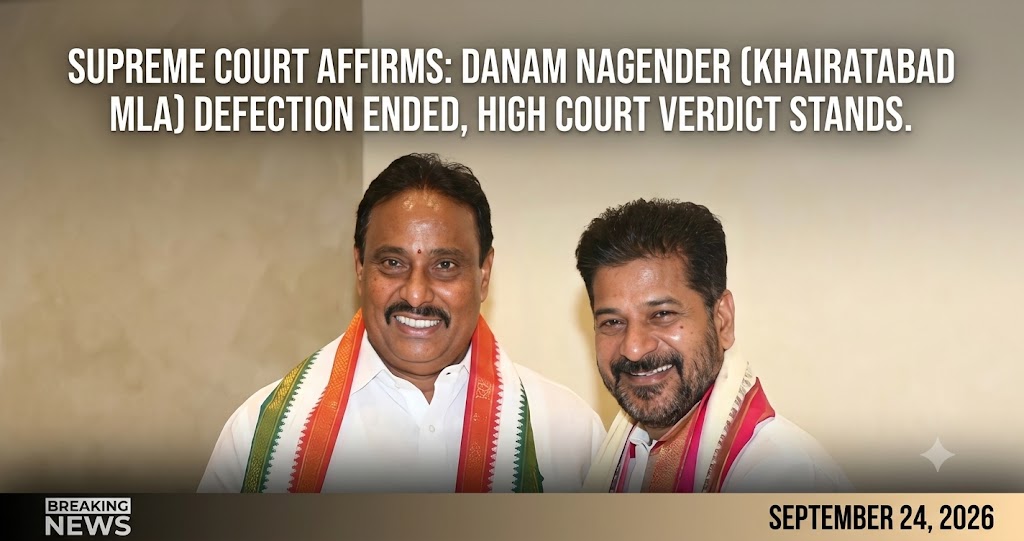
Defection Row Sealed
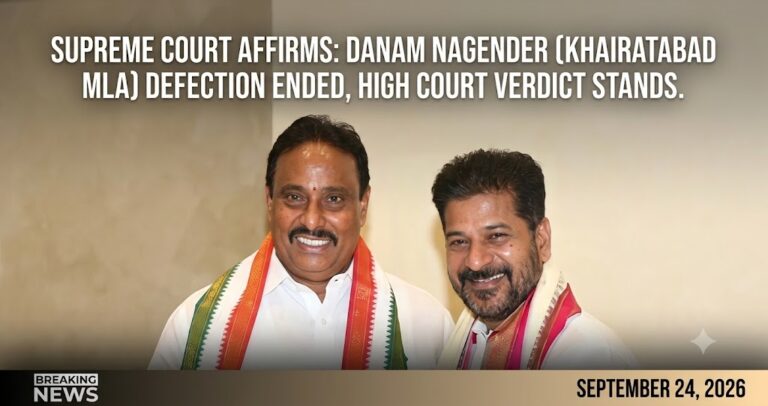
The Supreme Court of India (today, 24.9.2026) gave a definite end to the defection controversy of MLA Danam Nagender (Khairatabad, Telangana) by dismissing his Special Leave Petition challenging the Telangana High Court’s landmark verdict. The Division Bench of the High Court, presided over by Chief Justice Aparesh Kumar Singh and Justice G.M. Mohiuddin, had earlier set aside the disqualification of Nagender, effective from April 23, 2024, on March 11, 2026, on the ground that the disqualification was retrospective.
In making that affirmation, the Supreme Court effectively closed the door on the idea of a party-engineered delay, and revealed the legal and political desperation of trying to defend an open party crossover before a constitutional court.
The Apex Court Exchange: “Aaya Ram, Gaya Ram, Phir Aaya Ram”
The proceedings before the Supreme Court Bench, which included Justice Joymalya Bagchi of the Supreme Court Bench, along with the other judges, busted the defence of the appellant in just a few minutes. Senior Advocate Mukul Rohatgi, acting for Nagender, tried to argue that there is an implicit doctrine of forgiveness in the anti-defection law, as BRS had not formally expelled him and Nagender continued to attend party functions; his actions constituted a political “Ghar Wapsi” (homecoming) that was condoned by inaction.
In a brilliant constitutional analysis, the Bench rejected the premise:
Paragraph 2(1)(b) of the Tenth Schedule:
- Pertains strictly to voting or abstaining contrary to a Party Whip INSIDE the House.
- Expressly permits condonation by the political party within 15 days.
Paragraph 2(1)(a) of the Tenth Schedule:
- Governs “voluntarily giving up membership” through overt conduct OUTSIDE the House.
- Contains ZERO provision for condonation, waiver, or unilateral “Ghar Wapsi”.
When Rohatgi argued that Nagender had returned to his political roots and that the Tenth Schedule accommodates condonation, Justice Bagchi interjected: “Ghar Wapsi? Is your case ‘Aaya Ram, Gaya Ram, phir aaya Ram’?”
The Court noted that the party condonation provision in Paragraph 2(1)(b) only applies to “defying a whip” during a floor vote. It is irrelevant to paragraph 2(1)(a). When an elected member of Parliament signs Form-26, accepts nomination by another party (the Congress “B-Form”) and runs in a Parliamentary election against the party he was elected by, the act of giving up party membership is voluntary and automatic.
A defector may be physically returned to his parent organisation, and that organisation may again send him to the Rajya Sabha, but as the Bench pointed out, the membership of the Assembly cannot be revived by a bogus doctrine of condonation.
The Tactical Faux Pas: Who Pushed Nagender to New Delhi?
The Supreme Court’s dismissal has created acute embarrassment within the ruling establishment in Telangana. After the High Court’s verdict, Danam Nagender, in a public statement, admitted the ground reality and said that he would not appeal to the Supreme Court and was ready to face the voters in a by-election. However, the position was soon abandoned, within 24 hours. An emergency petition was prepared, top-class legal representation was assembled at great cost, and the case was taken up to New Delhi. This tactical error, driven by political counselors wanting to get an interim stay and delay the by-election, backfired: It forced a prominent mass leader into the ignominious posture of having his senior counsel argue before the nation’s highest court that he had “never really left the BRS” even while functioning as a key face of the ruling Congress regime.
- It led to biting judicial observations branding the maneuver as modern-day “Aaya Ram, Gaya Ram” opportunism, destroying any semblance of principled defense.
- It exhausted the defector’s legal runway, making an immediate by-election in Khairatabad an unavoidable constitutional reality.
The Core Constitutional Conundrum: The Shadow of Shrimant Balasaheb Patil
The Supreme Court has affirmed the retrospective disqualification of Danam Nagender, and with that, a central issue is back on the table: Can the same Danam Nagender challenge the by-election called by the Election Commission of India due to his disqualification?
Yes, in light of the constitutional precedent of Shrimant Balasaheb Patil v. Speaker, Karnataka Legislative Assembly (2020), Justice N.V. Ramana.
Unfortunately, it supports unreasonable defections.
Article 191(1) [General Disqualifications]:
- Barred from “being chosen as, and for being, a member.”
- Bars the candidate from contesting fresh elections during the period of disqualification.
Article 191(2) [Tenth Schedule Disqualification]:
- Barred strictly “for being a member.”
- Terminates only CURRENT legislative tenure; leaves the right to contest future polls intact.
In Shrimant Balasaheb Patil, a three-judge Bench ruled that:
- The Speaker Lacks Punitive Sentencing Powers: The Speaker, acting as a Tribunal under Paragraph 6 of the Tenth Schedule, has no jurisdiction to specify the duration of disqualification or bar an MLA from contesting elections until the end of the Assembly term.
- Textual Omission in Article 191(2): Unlike Article 191(1)—which uses the prohibitive phrase “for being chosen as”—Article 191(2) merely says disqualified “for being a member.” The deliberate omission of “for being chosen as” means a defector loses their seat, but does not lose the civil right to contest subsequent elections.
- Articles 75(1B), 164(1B), and 361B as an Open Door: Inserted by the 91st Amendment, these articles bar a disqualified defector from holding a ministerial post or remunerative political post “until he is re-elected.” Justice Ramana’s Bench held that the inclusion of the phrase “till the date on which he is declared elected” explicitly demonstrates that the Constitution contemplates a disqualified member re-contesting during the very same legislative term.
Why the Post-Patil Reality Subverts Democratic Governance
The interplay between the Telangana High Court’s retrospective disqualification, the Supreme Court’s summary dismissal, and the precedent in Shrimant Balasaheb Patil exposes a systemic loophole in Indian electoral democracy: Constitutional Promise (52nd & 91st Amendments) protects the voters’ choice against ideological betrayal and horse-trading; public office is held as a sacred public trust. Disqualification was intended to be an ignominious exit from the legislature. Reality Under Current Precedents: Defectors draw salaries and exercise power for years; when caught, they simply re-contest under the rival party. The state exchequer funds unnecessary, engineered by-elections caused purely by personal opportunism. Turned into an electoral reset button: win the by-election, cure the defect under Art. 164(1B), and re-enter the Cabinet.
The Necessary Constitutional Cure
The Supreme Court’s rejection of the “Ghar Wapsi” plea reaffirms that the judiciary will not entertain bad-faith procedural games played by partisan Speakers and defecting MLAs.
However, so long as Shrimant Balasaheb Patil remains the governing law on immediate re-contestability, the Tenth Schedule remains structurally impaired. If an MLA can defect, draw executive benefits, suffer judicial disqualification, and then immediately file nomination papers on the defector-party’s ticket for the vacant seat, constitutional morality is reduced to an abstract platitude. True institutional deterrence requires what the Law Commission of India (170th and 255th Reports) and the National Commission to Review the Working of the Constitution (NCRWC) have consistently demanded: Parliament must amend the Representation of the People Act, 1951, to stipulate that any member disqualified under Article 191(2) read with the Tenth Schedule shall be legally debarred from contesting any election to the legislative bodies for the remainder of that Assembly’s term. Until that amendment is enacted, judicial strikes, no matter how sharply worded by High Court Benches or Supreme Court judges, will remain half-remedies against the calculated realpolitik of defection.

Law professor and eminent columnist
Madabhushi Sridhar Acharyulu, author of 63 books (in Telugu and English), Formerly Central Information Commissioner, Professor of NALSAR University, Bennett University (near Delhi), presently Professor and Advisor, Mahindra University, Hyderabad. Studied in Masoom Ali High School, AVV Junior College, CKM College, and Kakatiya University in Warangal. Madabhushi did LL.M., MCJ., and the highest law degree, LL.D. He won 4 Gold Medals at Kakatiya University and Osmania University.
Email: cicsridhar@gmail.com
Mobile: 8447651505