The Release of Worry
1. The Arrival
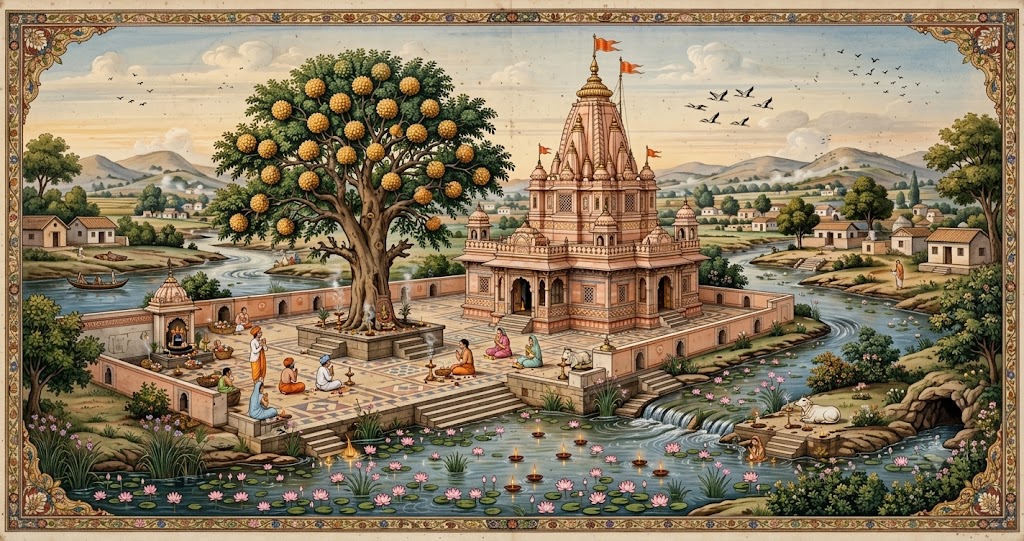
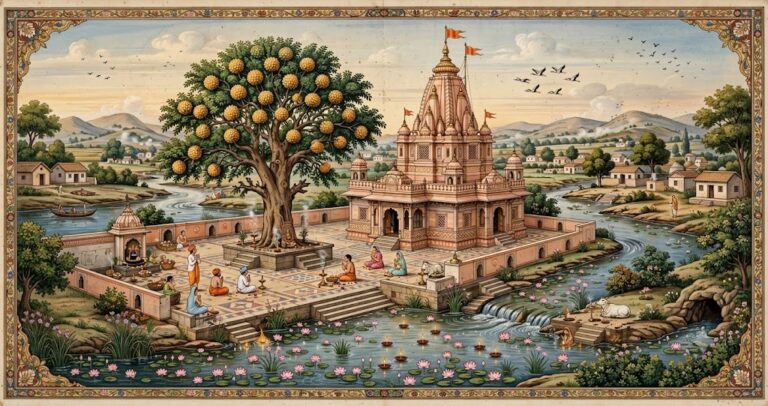
The final approach of the yatra brings you to Theur, where three sacred rivers — the Bhima, the Mula, and the Mutha — meet in quiet confluence. The temple sits on the banks, shaded by an ancient Kadamba tree, its roots drinking from waters that have travelled from distant mountains. Unlike the fortress of Moregaon or the cave of Lenyadri, Theur feels open, spacious, and reconciled. The courtyard is wide. The sky is reflected in the temple tank. The temple bell does not command; it invites. You can hear the confluence before you see it — three rivers becoming one, their separate journeys forgotten in the act of merging.
This is where the circuit turns inward for the last time. After the clarity of Moregaon, the discipline of Siddhatek, the surrender of Pali, the acceptance of Mahad, the silence of Lenyadri, and the integration of Ozar, you arrive at the place of release. Chintamani means “the jewel that removes worry.” Not the jewel that grants wishes. The jewel that removes the need to wish.
2. The Ancient Legend
The lore of Theur is tied to the story of a sage named Kapila and a king named Gana. The sage possessed a precious jewel called the Chintamani, a gem that had the power to grant any wish. The king, consumed by greed, demanded the jewel. When the sage refused, the king attempted to take it by force. In the conflict that followed, the sage called upon Ganesha for protection. The Lord appeared, restored the jewel to the sage, and defeated the king’s forces. But the sage, realizing that the jewel had caused only strife, offered it back to Ganesha. “I do not want the burden of granting wishes,” he said. “I want the peace of having none.”
Ganesha accepted the jewel and placed it around his own neck. From that day, he became known as Chintamani — the Lord who holds the jewel that ends all worry. He did not destroy it. He did not give it away. He wore it, to remind seekers that true peace is not in getting what you want. It is in no longer being ruled by want.
The temple at Theur marks the spot where this exchange took place. The rivers meet here because all seeking ends here.
3. The Uniqueness of the Form
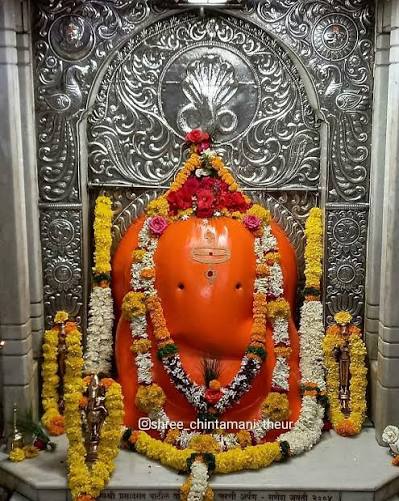
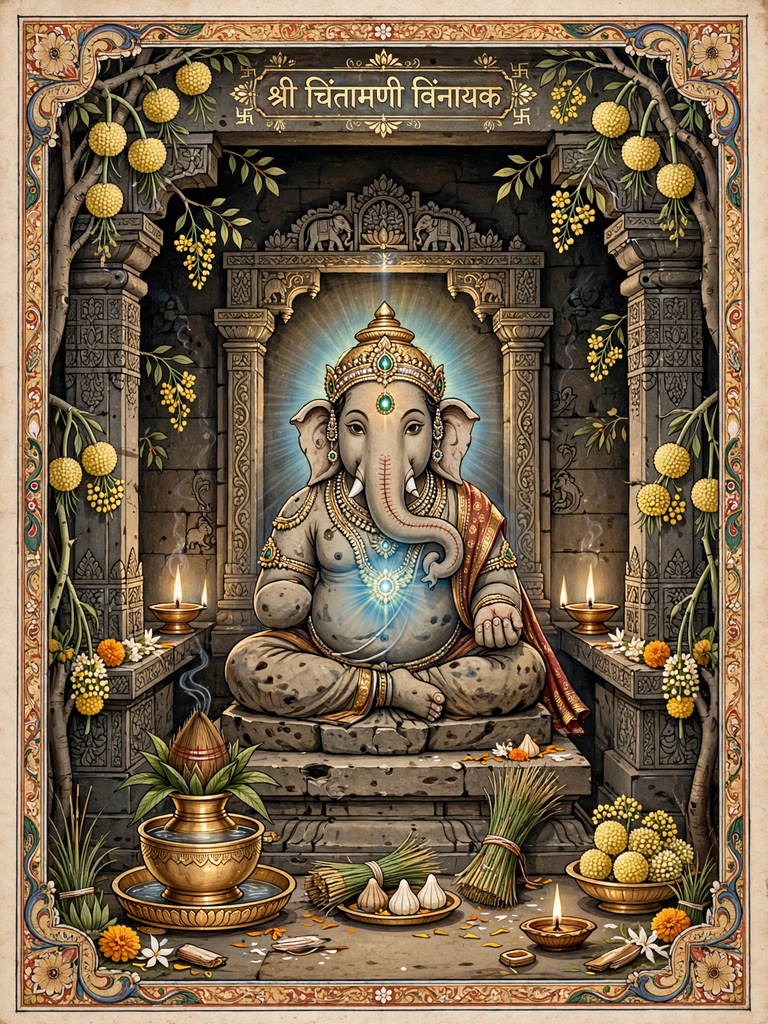
The Swayambhu murti at Theur is modest in size, facing east, with the trunk turned left in the Vamamukhi form — the gentle, approachable aspect. The stone is ancient, worn smooth by centuries of abhisheka. His eyes are calm, not fierce like at Siddhatek, not watchful like at Ozar. They are the eyes of one who has seen the end of seeking. Around his neck, carved into the stone, is the Chintamani jewel. It does not glitter. It does not promise. It simply rests. This is not a god who grants boons. This is a god who shows you that the boon you were chasing was never the point.
The temple itself is built of stone and wood, with a large hall for meditation. The main feature outside is the Kadamba tree, under which devotees sit. The Kadamba is said to bloom when it hears thunder — it responds not to demand, but to the natural rhythm of the sky. So too does peace come: not when you force it, but when you are still enough to hear it.
The confluence of three rivers is called the Triveni Sangam. Pilgrims believe a dip here washes away the anxiety of loss. But the deeper truth is this: the rivers lose their names when they meet. The Bhima is no longer Bhima. The Mula is no longer Mula. They become something larger. So too does the seeker.
4. The Inward Lesson
At Moregaon we named our intent, at Siddhatek we built skill, at Pali we surrendered, at Mahad we accepted, at Lenyadri we became still, and at Ozar obstacles dissolved into gatekeepers. Now at Theur, we release. Worry is not about the future. It is about the illusion that you can control it. Chintamani teaches us that the jewel of peace is not found by collecting more, achieving more, or securing more. It is found by laying down the burden of “more.” The king in the legend did not suffer because he lacked the jewel. He suffered because he believed his peace depended on it. The sage was free not because he had the jewel, but because he was willing to give it away.
In our lives, we carry Chintamani jewels we don’t even see. The job title we think will make us safe. The relationship we think will complete us. The bank balance we think will quiet the fear. We clutch them, and they clutch us back. The worry is not that we might lose them. The worry is that we believe we are them.
Theur asks: What if you laid it down? What if you placed your Chintamani — your deepest attachment — at the feet of the Lord? Not because you don’t care, but because you trust that what is meant for you will not miss you, and what misses you was not meant to stay.
This is not resignation. The sage still meditated. The king still ruled. But the grip loosened. The rivers still flow, but they no longer argue about their names.
At Moregaon we named our intent. At Siddhatek we built skill. At Pali we surrendered. At Mahad we accepted. At Lenyadri we became silent. At Ozar we integrated. Now at Theur, we release. The final worry is the worry that you have not done enough. Chintamani says: You have. Lay it down.
5. The Taste of the Temple
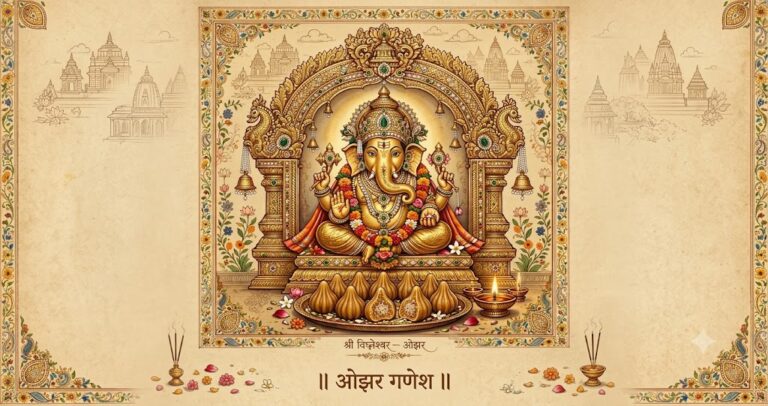
The Naivedya at Theur is Karanji, a crescent-shaped sweet pastry filled with coconut, jaggery, and cardamom, deep-fried until golden. It is similar to a Modak, but it is not the same. The Modak is closed, complete — the sweetness of attainment. The Karanji is folded, like hands in prayer — the sweetness of offering. The outer shell is crisp, made of wheat. The inner filling is soft, yielding. It is the taste of effort and grace together. You bite through the discipline, and you find the blessing. Karanji is shared. You do not eat it alone. After the solitude of Lenyadri and the integration of Ozar, Theur reminds you: peace is not isolation. It is communion. When the worry lifts, you can feed others. The cardamom is fragrant but not overwhelming. Like the lesson of Theur — subtle, lasting, and best noticed in stillness.
6. The Closing Reflection
Take a moment today. Name your Chintamani. What is the one thing you believe you must hold onto to be okay? Write it down. Hold it in your hand. Then, in your heart, place it at the feet of the Lord. Not as a rejection of it, but as a release of your grip on it.
You may still work for it. You may still love it. You may still receive it. But you will no longer be enslaved by the fear of its loss.
The rivers do not worry about reaching the ocean. They simply flow. The Kadamba tree does not worry about the thunder. It simply blooms.
The Chintamani jewel rests on the chest of the Lord, not because he needs it, but because you don’t.
From here, we go to Ranjangaon, where peace becomes sovereignty and the seeker becomes the king. But first, sit by the confluence. Watch the waters merge. And let your worry go with them.
Author Biography: – R Srinivasa Murthy, the author, is a corporate leader, an independent writer, and a student of Hindhu Philosophy. He Identifies as a Demystic, committed to removing unnecessary mysticism from traditions to offer practical systems for the next generation. His upcoming book, Logic of And: Sanatana Dharma as a Toolkit for the Contemporary Seeker, aims to bridge ancient wisdom with modern life to foster an inclusive, living civilisation.

With a journalistic long journey, we bring you https://primepost.news, a dynamic platform committed to unraveling the intricate tapestry of Indian politics, particularly delving deep into the heart of Telangana and Andhra Pradesh. Our blog is not just a source of news; it’s a reservoir of insights, analysis, and thought-provoking reviews.


Beautifully written, Sir. 🙏 The story of Chintamani at Theur carries a deep and timeless message about letting go of worries and finding inner peace. Truly a wonderful read. 🙏✨
Theur, we release. Worry is not about the future. It is about the illusion that you can control it. Chintamani teaches us that the jewel of peace is not found by collecting more, achieving more, or securing more. It is found by laying down the burden of “more.” The king in the legend did not suffer because he lacked the jewel. He suffered because he believed his peace depended on it. The sage was free not because he had the jewel, but because he was willing to give it away.
I like this very much sir.
Life full meaning sentence.Not only sentence.This is life Art and living.
Thanks and superb sir 😍👍👏🕊️👍
A beautifully written and deeply contemplative piece, Mr. R. S. Murthy. Chintamani at Theur goes beyond describing a sacred place and gently takes the reader on an inward journey towards acceptance, detachment and inner peace. Your remarkable ability to weave spirituality with the realities of everyday life makes every thought profound yet relatable. The message of letting go of the burden of “more” is especially powerful and stays with the reader long after finishing the article. A truly thoughtful and soulful piece of writing.