The Sovereign Self
1. The Arrival
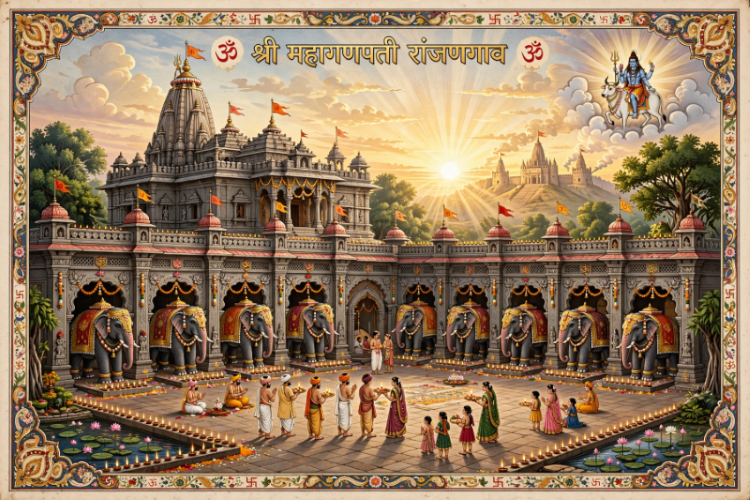
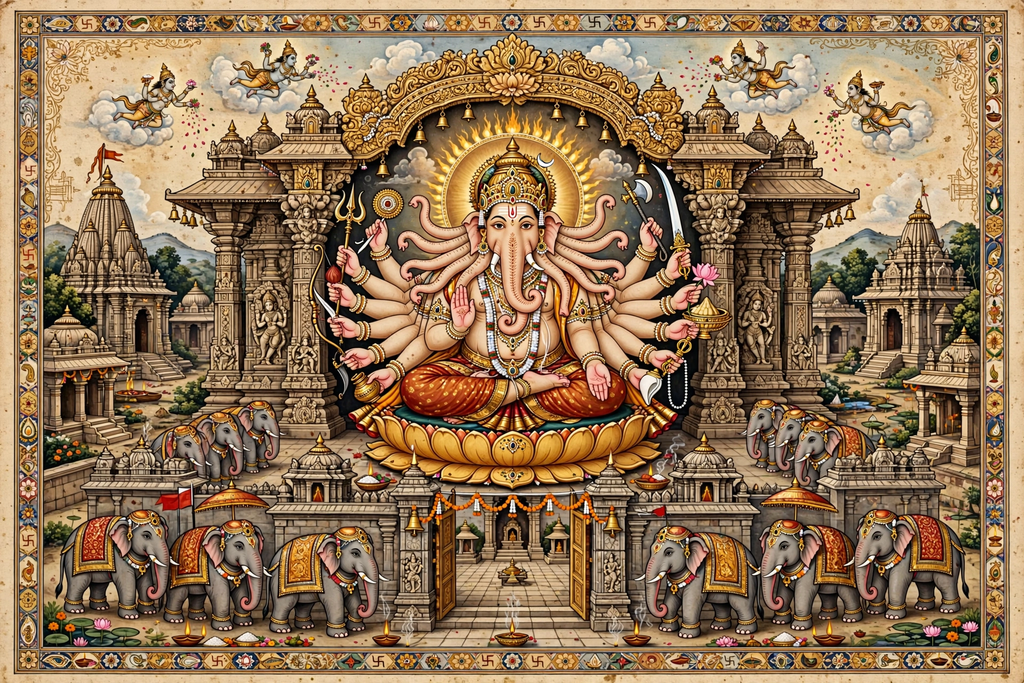
The final leg of the Ashta Vinayak circuit brings you to Ranjangaon, a village that feels like a culmination. After the intimacy of Theur, the silence of Lenyadri, and the order of Ozar, Ranjangaon greets you with grandeur. The temple rises before you, massive and east-facing, surrounded by a high fortification wall and eight gateways, each guarded by an elephant carved in stone.
The courtyard is vast. The spires are golden. The air is charged, not with tension, but with completion. You have walked the circuit. You have faced the fortress, climbed the hill, sat in the cave, and laid down your worry. Now you stand at the threshold of sovereignty.
This is not the beginning. This is the return. You came to Moregaon as a seeker. You arrive at Ranjangaon as a king — not of a territory, but of yourself.
2. The Ancient Legend
The legend of Ranjangaon is the legend of victory before the battle. It is said that Lord Shiva, before setting out to destroy the demon Tripurasura — the demon of the three cities, the demon of illusion — felt a tremor of doubt. Even the Destroyer paused. He came to this spot to invoke Ganesha, to seek the blessing of unobstructed action. Ganesha appeared before him as Mahaganapati — the Great Lord of the Ganas, the Supreme Commander. He blessed Shiva, and with that blessing, Shiva rode out and reduced the three cities to ash with a single arrow. Not because his weapon was stronger, but because his mind was clear.
The temple at Ranjangaon marks this spot. It is the place where even the gods pause to align before they act. Where power bows to wisdom. Where the warrior seeks the blessing of the sage within.
Tripurasura represents the three illusions that bind us: the illusion of the past, the illusion of the future, and the illusion of the separate self. Shiva could not destroy them with force alone. He needed the grace of the One who begins all things.
3. The Uniqueness of the Form
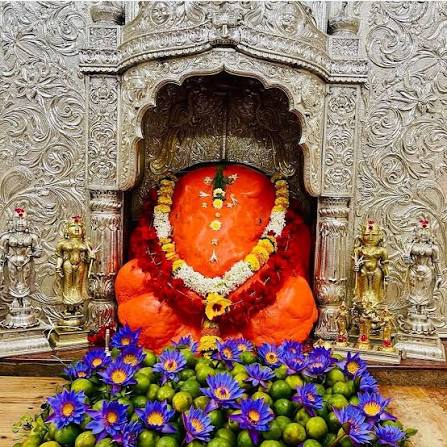
The murti at Ranjangaon is the most majestic of the eight. He is large, seated on a throne, with 10 trunks and 20 hands, though in the main sanctum you see him in his calmer, four-armed form. His trunk turns left, the Vamamukhi blessing of grace, because the warrior has returned to peace. His eyes are not fierce like at Siddhatek. They are wide, sovereign, and utterly still. This is the gaze of one who has seen the entire battlefield and knows it was never outside him. His crown is tall, his ornaments heavy, but he wears them lightly. Sovereignty is not weight. It is recognition.
The temple is built with eight elephant guardians at the gates, representing the eight directions and the eight powers of the Ashta Vinayak now integrated into one. The main idol is flanked by Riddhi and Siddhi, but here they do not serve. They attend. Because when you are sovereign, prosperity and skill are not masters. They are ministers.
The legend says this idol was installed by Shiva himself. Whether history or myth, the message is clear: the highest worship is done by the highest power. The journey ends not when you defeat the world, but when you realize you were never separate from it.
4. The Inward Lesson
You began at Moregaon with a question: Why am I here? You climbed to Siddhatek and learned how. At Pali you learned to surrender when tied. At Mahad you learned to accept what cannot be changed. At Lenyadri you learned to be silent. At Ozar you integrated and obstacles dissolved. At Theur you laid down worry. Now at Ranjangaon, you learn the final truth: You are not the one who walks the path. You are the path. You are not the one who seeks the blessing. You are the blessing. Mahaganapati is not a god you pray to for things. He is the state you arrive at when you no longer need to pray for things. He is the sovereign self — the part of you that does not fluctuate with praise or blame, gain or loss, birth or death.
Shiva paused before battle because even the Destroyer must align. How much more so must we. Before your next meeting, your next decision, your next crisis — pause. Come to your inner Ranjangaon. Sit on the throne of your own awareness. Let the eight elephants of your scattered mind bow to the One.
The three cities of Tripurasura are your three poisons: the past you cannot change, the future you cannot control, and the ego that believes it is separate. The arrow that destroys them is not anger. It is clarity. And clarity comes only when you have walked the full circuit — from intent to silence to surrender to sovereignty.
You are not here to become Ganapati. You are here to remember that you are.
5. The Taste of the Temple
The Naivedya at Ranjangaon is the Maha-Prasad — a complete meal served on a banana leaf. Rice, dal, vegetables, chapati, sweet, and curd. It is not a single taste. It is all tastes. Not one lesson, but the integration of all eight. After the Khichdi of Moregaon, the Sattu of Siddhatek, the Laddu of Pali, the Poha of Mahad, the Khajur of Lenyadri, the Modak of Ozar, and the Karanji of Theur, you now eat the whole. This is not the food of beginning. This is the food of completion. The meal is served to hundreds, together. Because sovereignty is not isolation. The king does not eat alone. When you are full, you feed. When you are clear, you guide. The Ashta Vinayak does not end with you becoming free. It ends with you becoming responsible for the freedom of others.
The taste is balanced — salt, sweet, sour, bitter, pungent, astringent. All six rasas. Because the sovereign self does not reject any experience. It digests all.
6. The Closing Reflection
The circuit is complete. But the yatra is not. You will now return to Moregaon, not because you are lost, but because the end is the beginning. The king returns to the village. The sage returns to the market. The sovereign returns to serve. Take a moment today. Sit as Mahaganapati sits. Straight. Still. Crowned not by gold, but by awareness. Look at your life — your work, your family, your struggles — not as problems to solve, but as a kingdom to steward. You have the clarity of Moregaon. The skill of Siddhatek. The courage of Pali. The acceptance of Mahad. The silence of Lenyadri. The integration of Ozar. The release of Theur. And now, the sovereignty of Ranjangaon.
The eight elephants bow at your gate. The three cities have fallen. The arrow is in your hand. Not to destroy the world, but to rule yourself.
Go now. The yatra was never about the eight temples. It was about the one temple. The one in your chest.
You began as a seeker. You end as the sought.
Jai Ganesha. Jai Mahaganapati.
Author Biography: – R Srinivasa Murthy, the author, is a corporate leader, an independent writer, and a student of Hindhu Philosophy. He Identifies as a Demystic, committed to removing unnecessary mysticism from traditions to offer practical systems for the next generation. His upcoming book, Logic of And: Sanatana Dharma as a Toolkit for the Contemporary Seeker, aims to bridge ancient wisdom with modern life to foster an inclusive, living civilisation.

With a journalistic long journey, we bring you https://primepost.news, a dynamic platform committed to unraveling the intricate tapestry of Indian politics, particularly delving deep into the heart of Telangana and Andhra Pradesh. Our blog is not just a source of news; it’s a reservoir of insights, analysis, and thought-provoking reviews.