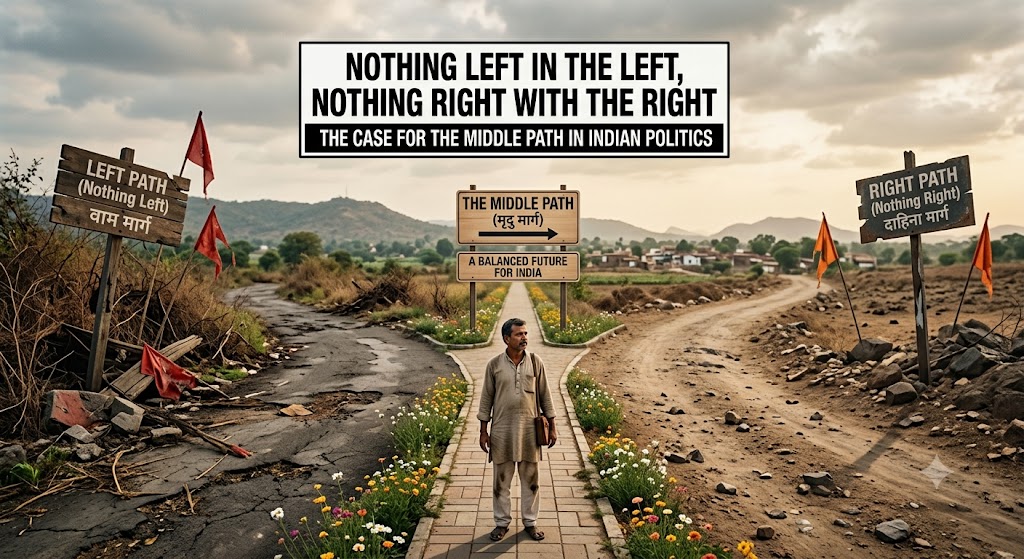
The Case for the Middle Path in Indian Politics
Can a country of 1.4 billion people be effectively governed using political labels borrowed from eighteenth-century Europe?
For decades, Indian political commentary has tried to force complex governance realities into a simple Western binary: the “Left” versus the “Right.” One side claimed the high ground of social justice and state-led economic distribution. The other promised market efficiency, cultural pride, and minimal government intervention.
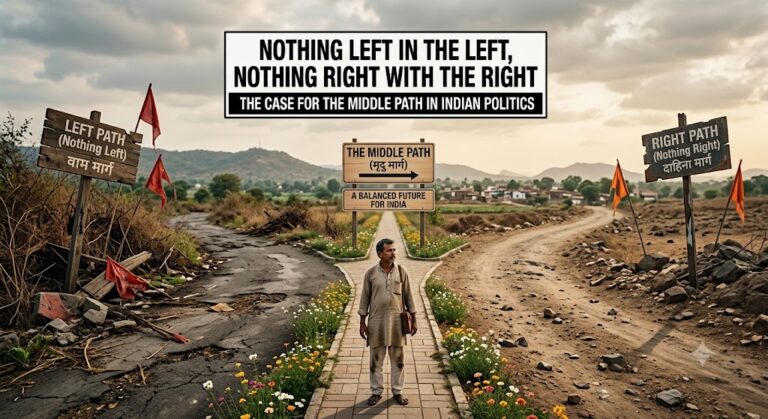
Today, that binary has collapsed into total intellectual exhaustion. In modern Indian politics, there is nothing left in the Left, and nothing right with the Right. Both poles have failed to deliver a coherent philosophy for a modern, aspirational India. The future of Indian statecraft lies not in imported dogma, but in reclaiming the Middle Path (Madhyam Marga)—a pragmatic, result-oriented approach that balances economic dynamism with strong public welfare.
The Exhaustion of the Indian Left
The intellectual decline of the Indian Left is one of the most complete political failures in modern statecraft.
Originally built on genuine agrarian movements, trade unionism, and land reforms, the Indian Left lost touch with a rapidly changing population. As millions of young citizens sought upward mobility, digital access, startup opportunities, and global career paths, the Left remained trapped in mid-twentieth-century anti-capitalist rhetoric. It consistently treated private enterprise with suspicion, failing to understand that wealth creation must happen before wealth distribution is even possible.
The real-world consequences of this ideological rigidity are visible across regional histories:
- West Bengal’s Industrial Stagnation: Under thirty-four years of uninterrupted Left Front rule, West Bengal transformed from a national industrial hub into a state marked by capital flight and labor unrest. Events like the historic exit of the Tata Nano project from Singur in 2008 symbolized a wider political hostility toward private investment. The state saw generations of educated youth migrate elsewhere in search of economic opportunity.
- Kerala’s Structural Paradox: Kerala achieved exceptional metrics in health, literacy, and human development indicators. Yet the state’s rigid labor regulations and anti-business climate strangled local manufacturing and industrial scale. Today, Kerala survives on massive external remittances from its workforce abroad and carries a heavy public debt burden to sustain its social sector spending.
- The Shift to Identity Optics: Having lost its grip on economic policy, the Indian Left largely abandoned economic statecraft. Instead, it retreated into academic culture wars and identity politics. By focusing on endless critique without offering a workable economic model, the Left rendered itself administratively irrelevant.
By treating growth as an enemy rather than an ally, the Left emptied itself of practical answers for modern India.
The Contradictions of the Indian Right
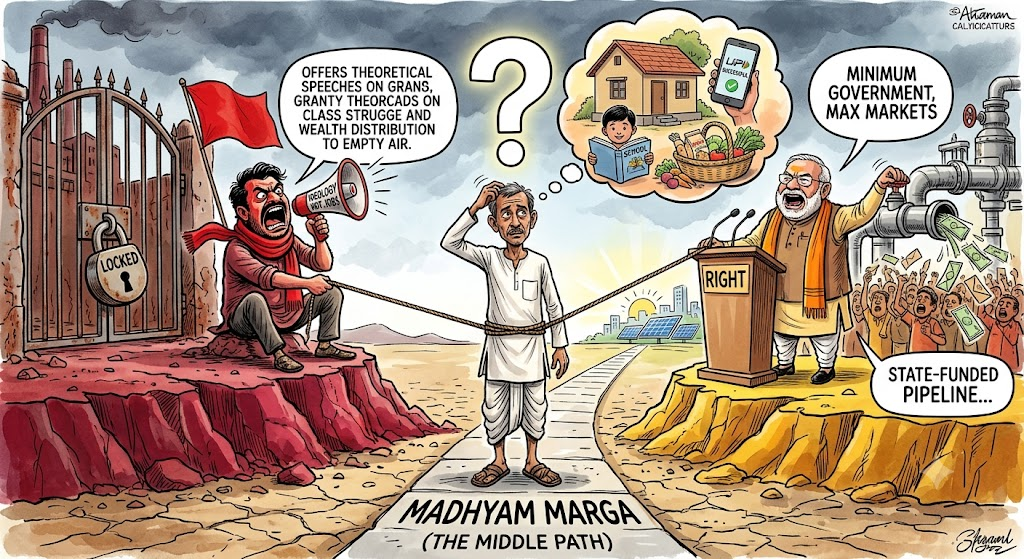
If the Left lost touch with economic reality, the Indian Right has become tangled in its own structural contradictions.
In theoretical discourse, the Indian Right promises economic deregulation, private enterprise, fiscal discipline, and “minimum government.” Yet in practice, governance under the ruling Right has overseen an unprecedented expansion of the central welfare state.
Far from dismantling state intervention, the modern Right has perfected state-driven welfare mechanics:
- Massive Redistribution Networks: Schemes like PM-KISAN (direct income support for farmers), free foodgrain distribution covering over 800 million citizens under PM-GKAY, subsidized housing through PM Awas Yojana, and direct cash transfers for cooking gas are not free-market mechanisms. They represent state-managed redistribution on a scale unparalleled in the democratic world.
- Industrial Policy and State Intervention: Economic policy under the Right frequently swings between market rhetoric and active state control. The heavy reliance on Production Linked Incentive (PLI) schemes—designed to subsidize select manufacturing sectors—means the state actively picks industrial winners rather than allowing pure market forces to allocate capital. Furthermore, sudden trade restrictions, import licensing on electronics, and tariff adjustments show a government comfortable with protectionism.
- Centralization of Administrative Power: Instead of reducing bureaucratic discretion, administrative authority has become increasingly centralized within executive bodies. While the state has improved digital delivery, it has done little to shrink the overall footprint of state oversight in daily business operations.
By pairing free-market rhetoric with heavy-handed state intervention, the Right regularly breaks the very conservative principles of economic liberty it claims to uphold.
The Myth of Imported Ideologies
The foundational flaw in contemporary political debate is the uncritical assumption that Indian governance can be mapped onto Western political spectrums.
Western political spectrums emerged from specific European historical events: class warfare during the Industrial Revolution, fights over absolute private property versus state ownership, and ideological battles between church and state.
Indian political thought was never built on these rigid binaries. From ancient doctrines of Rajdharma and Chanakya’s Arthashastra to the economic framework of the Indian Constitution, Indian statecraft has always been fundamentally pluralist, duties-based (Dharma), and welfare-centric (Yogakshema).
When Indian political parties try to play imported roles—acting as “doctrinaire socialists” or “pure free-market capitalists”—they fail because the Indian electorate does not view governance through a Western lens.
The Indian voter expects the state to fulfill two distinct roles at once: act as an energetic facilitator of economic enterprise, while providing a compassionate safety net for vulnerable communities. This is not ideological confusion; it is cultural and administrative pragmatism.
The Historical Power of the Middle Path (Madhyam Marga)
Whenever India has achieved major economic or social breakthroughs, it has done so by abandoning ideological dogma and adopting the Middle Path (Madhyam Marga).
This balanced model pairs market-driven wealth creation with strategic public investment. India’s history over the past six decades provides clear evidence:
- The 1991 Economic Reforms: Under Prime Minister P.V. Narasimha Rao and Finance Minister Dr. Manmohan Singh, India executed radical economic shifts. They dismantled the suffocating License Raj and welcomed private investment, yet they preserved state stability in strategic public sectors. It was neither pure capitalism nor rigid socialism; it was a calibrated middle path designed to save the nation from bankruptcy.
- Digital Public Infrastructure (DPI): India’s creation of the “India Stack”—including Aadhaar, UPI, and Account Aggregator networks—is a world-class example of non-ideological innovation. The underlying payment architecture is a public good built and managed by the state. However, private fintech firms, banks, and tech startups compete freely on top of it. This hybrid approach created the world’s most vibrant digital payment ecosystem without relying on a state monopoly or an unregulated private market.
- The Green Revolution: When facing severe food shortages in the 1960s, India did not rely solely on market supply or forced collectivization. The state funded agricultural research, built irrigation networks, and guaranteed procurement prices, while leaving farming land and production choices in private hands. This practical alignment transformed India into a food-surplus nation.
None of these transformations resulted from Left-wing ideological purity or Right-wing dogma. They succeeded because Indian leaders focused on operational execution rather than political ideology.
Beyond the Hollow Poles: The Real Challenges
The most critical challenges facing India today have nothing to do with the debates between Left and Right. They are structural, administrative, and institutional problems that demand managerial competence:
- Judicial Capacity and Legal Delays: Over 50 million cases sit pending across Indian courts. Resolving judicial backlogs requires filling vacancy seats, modernizing court infrastructure, and streamlining procedural law—not ideological rhetoric.
- Urban Planning and Infrastructure Collapse: Rapid urbanization has stretched municipal services in major cities like Bengaluru, Mumbai, and Delhi. Building resilient drainage systems, public transit, and waste management requires empowered local governance, sound civil engineering, and accountable urban administration.
- Primary Education and Skill Mismatches: India’s demographic dividend depends on turning young citizens into a skilled workforce. Improving learning outcomes in public schools and aligning vocational training with industrial demand is an administrative execution task, not a political debate.
- Regulatory Predictability and State Capacity: Building a smooth business environment requires reducing bureaucratic friction, ensuring contract enforcement, and insulating regulatory bodies from political pressure.
Fixing a municipal corporation, building resilient supply chains, or modernizing judicial administration does not require Left-wing or Right-wing dogma. It requires technical expertise, institutional integrity, and practical execution.
Conclusion
The insistence on viewing Indian governance through imported political spectrums has created a noisy, polarized public discourse that obscures administrative realities. Both the ideological Left and the ideological Right have proven incapable of addressing the full scope of India’s development needs. The future of Indian governance will not belong to those who shout loudest from the political extremes. It will belong to pragmatists who drop imported labels, embrace the Middle Path, and judge statecraft by a simple, enduring standard: what actually works for the public good.
Author Biography: – R Srinivasa Murthy, the author, is a corporate leader, an independent writer, and a student of Hindhu Philosophy. He Identifies as a Demystic, committed to removing unnecessary mysticism from traditions to offer practical systems for the next generation. His upcoming book, Logic of And: Sanatana Dharma as a Toolkit for the Contemporary Seeker, aims to bridge ancient wisdom with modern life to foster an inclusive, living civilisation.

With a journalistic long journey, we bring you https://primepost.news, a dynamic platform committed to unraveling the intricate tapestry of Indian politics, particularly delving deep into the heart of Telangana and Andhra Pradesh. Our blog is not just a source of news; it’s a reservoir of insights, analysis, and thought-provoking reviews.
Sir,
Dilemma in the Indian Politics clearly narrated. Head Liner is well thought off 😄😄
A very thoughtful and relevant perspective, Sir. Moving beyond rigid Left–Right ideologies and finding a balanced Middle Path can help India achieve strong economic growth along with inclusive development. Well articulated! 👏
A very thoughtful and relevant perspective, Sir. Moving beyond rigid Left–Right ideologies and finding a balanced Middle Path can help India achieve strong economic growth along with inclusive development. Well articulated! 👏
Thanks for briefing Easy and understand able Language of our Indian Politics -State By State.
Due to this issue only we are not able to Develop as a strong nation among the world.
Truly Described sir.
Superb sir 😍😍🌻🤩