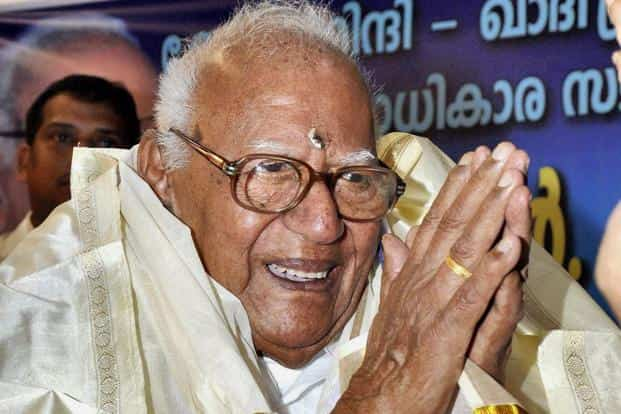
Krishna Iyer Living Legend for 100 years
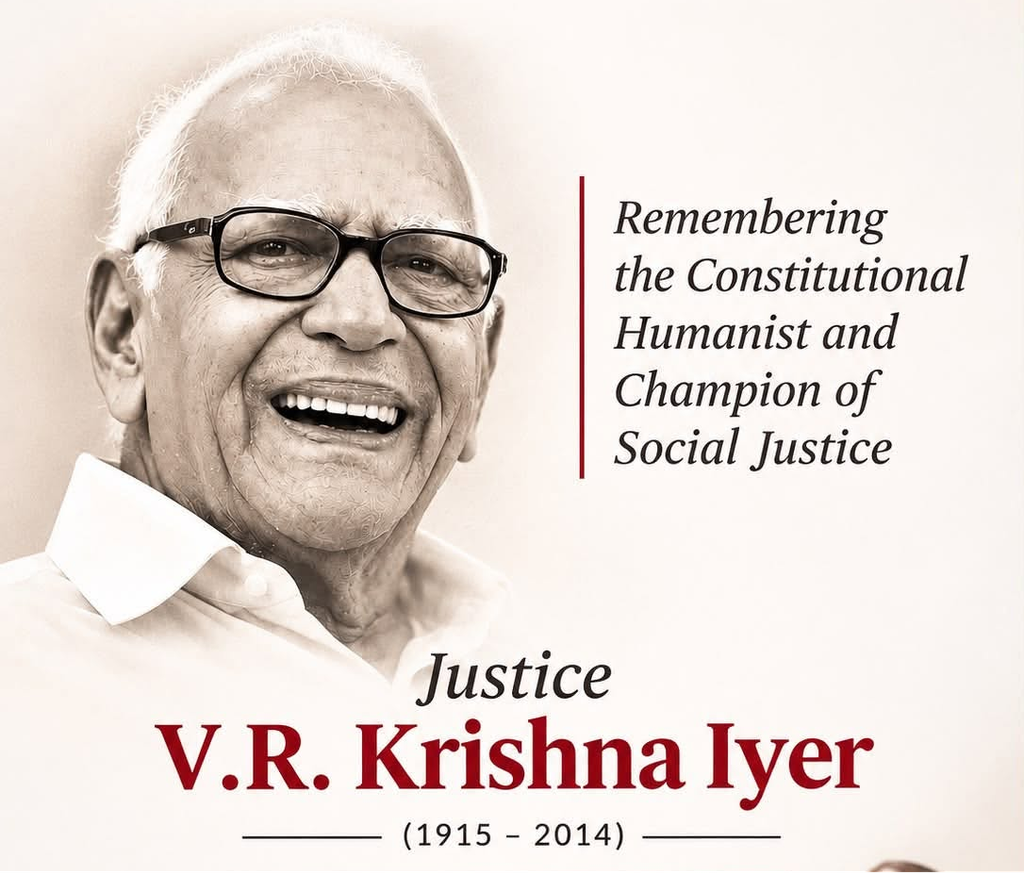
‘Padma Vibhushan’ Justice Vaidyanathapuram Rama Krishna Iyer (15 November 1915 – 4 December 2014) was a living legend for 100 years, one of India’s most distinguished jurists, whose life extended far beyond the courtroom. Iyer’s constitutional philosophy was shaped not merely by his legal education but by his experience as a practising lawyer, legislator, minister, reformer and judge. He was referred to as a Conscience Keeper of Justice in India, on his Death Anniversary today. Justice V R Krishna Iyer was an ardent Carnatic Classical Music enthusiast and was also proficient in playing the VEENA. Justice VR Krishna Iyer was a great admirer of Vidwan Shri K V Narayanaswamy and his music. KVN’s biography written in Tamil by the veteran journalist and music lover Neelam in 2001, was translated into English the same year by Justice VR Krishna Iyer
Krishna Iyer was a visionary and a pathbreaking judge, who reformed the Indian criminal justice system with bold changes to jails & police stations, and forged new tools to dispense social justice & justice in the public interest, which stood not just the test of time, but had a profound impact on justice delivery in India in the decades which followed. He pioneered the legal-aid movement in the country. Before that, he had pioneered land reforms law as a state minister & independent politician, which became a model for the rest of the country. He stood up for the poor and the underprivileged and was jailed for this once, as an activist lawyer. He zealously guarded human-rights regardless of finding himself isolated. He was a crusader for social action & the environment, and a champion of civil liberties, throughout life. A sports enthusiast and a prolific author, he was conferred with the Padma Vibhushan in 1999. Judges in India and around the world continue to cite his judgments in their decisions in court. (Tributes from Venkata Raman G) .
A Humanist Forever, A Jurist Not Forgettable
How his constitutional philosophy enriched the Basic Structure doctrine, strengthened social justice, and protected the democratic foundations of the Indian Republic. The Constitution of India is not merely a document distributing powers among the Legislature, Executive and Judiciary. It is a social and political commitment to transform a deeply unequal society into a democratic republic founded on liberty, equality, fraternity and justice. Its survival depends not only on the words written in 1950 but also on the willingness of constitutional institutions to preserve its founding principles against arbitrary exercises of power.
Among the great judicial minds who gave life, meaning and human purpose to the Indian Constitution, Justice V.R. Krishna Iyer occupies a distinguished position. His contribution was particularly significant in developing a constitutional philosophy that placed human dignity, individual liberty, social justice and the protection of weaker sections at the centre of constitutional interpretation .Tributes offered to Justice Krishna Iyer, By Madabhushi Sridhar, Advocate Prabhakar Kadaru, Chief Guest Justice Nagesh Beegamapaka, in Hyderabad on 15.11.2026.
The Basic Structure doctrine, evolved by the Supreme Court in Kesavananda Bharati v. State of Kerala (1973), established that Parliament’s power to amend the Constitution under Article 368 was not unlimited. Parliament could amend any constitutional provision, but it could not destroy the Constitution’s basic structure. Although Justice Krishna Iyer was not a member of the thirteen-judge Bench in Kesavananda Bharati, his subsequent judgments and constitutional pronouncements gave this doctrine an important humanistic and socially transformative dimension.
This distinction is important. He was not the originator of the Basic Structure doctrine. His enduring contribution was to explain why constitutional limitations matter to ordinary citizens and why democracy cannot be reduced to the numerical strength of a parliamentary majority.

A constitutional limitation on unlimited power
The historical significance of Kesavananda Bharati v. State of Kerala, (1973) 4 SCC 225, lies in its recognition that the Constitution is supreme and Parliament, although possessing constituent power under Article 368, is not sovereign in the British parliamentary sense. The thirteen-judge Bench, by a narrow majority of 7:6, held that Parliament could amend the Constitution, including Fundamental Rights, but could not alter its basic structure or destroy its essential identity. The doctrine was a response to a fundamental constitutional question: Can a parliamentary majority, merely because it has the numbers, change the character of the Republic, eliminate judicial review, abolish democracy or extinguish the rights and freedoms of citizens?
The answer was no
The judgment did not provide an exhaustive list of basic features. Different judges identified different constitutional essentials, including constitutional supremacy, republican and democratic government, secularism, federalism, separation of powers, judicial review, individual dignity and freedom, and the balance between Fundamental Rights and Directive Principles. Justice Krishna Iyer’s constitutional philosophy is important in understanding the deeper purpose of this limitation. For him, the Constitution was not an instrument of governmental convenience. It was a charter of human emancipation.
The Constitution as a social revolution: N.M. Thomas
One of Justice Krishna Iyer’s most important contributions came in State of Kerala v. N.M. Thomas, (1976) 2 SCC 310. The case concerned equality of opportunity in public employment and the constitutional validity of special measures benefiting Scheduled Castes and Scheduled Tribes. Justice Iyer’s concurring opinion rejected the narrow understanding that equality meant treating everybody identically, regardless of historical and social disadvantages. He understood equality as a substantive constitutional promise requiring the State to address entrenched inequalities.
His celebrated description of the Constitution was:
“A great social document, almost revolutionary in its aim of transforming a medieval, hierarchical society into a modern, egalitarian democracy.” This statement captures the social philosophy underlying his constitutional interpretation. He drew attention to the contradiction identified by Dr. B.R. Ambedkar: political equality could not survive indefinitely alongside social and economic inequality. The Constitution therefore had to be interpreted as an instrument for removing historical disadvantages and creating conditions in which every citizen could enjoy meaningful equality.
Justice Iyer explained that:
“Equality of opportunity is not simply a matter of legal equality.”
Its existence depends not merely on removing disabilities but also on creating abilities and opportunities. This approach strengthened the constitutional relationship between Articles 14, 15 and 16 and the Directive Principles, particularly Article 46, which requires the State to promote the educational and economic interests of weaker sections. The significance for Basic Structure jurisprudence is considerable. Equality cannot be understood merely as a formal legal arrangement. Social justice and an egalitarian order are integral to the constitutional identity of India. The Supreme Court itself recalled Justice Krishna Iyer’s description of the Constitution in its 2024 judgment in Property Owners Association v. State of Maharashtra, 2024 INSC 835, while discussing the constitutional commitment to social justice and an egalitarian social order.
Constitutional humanism against legislative majoritarianism: Maneka Gandhi
Another landmark contribution came in Maneka Gandhi v. Union of India, (1978) 1 SCC 248. The case concerned the impounding of Maneka Gandhi’s passport without furnishing adequate reasons or providing a meaningful opportunity to be heard. It raised important questions about personal liberty under Article 21 and the relationship between Articles 14, 19 and 21. Justice Krishna Iyer’s concurring opinion gave an expansive interpretation to constitutional liberty and procedural fairness.
His words remain particularly relevant: “The compulsion of constitutional humanism and the assumption of full faith in life and liberty cannot be so futile or fragmentary that any transient legislative majority in tantrums against any minority, by three quick readings of a bill with the requisite quorum, can prescribe any unreasonable modality and thereby sterilise the grandiloquent mandate.”
This is among his most significant constitutional statements. He was warning against the possibility that a temporary legislative majority could use formal legislative procedures to undermine the substance of constitutional liberty.
The importance of this observation extends beyond passport restrictions. It articulates a fundamental principle of constitutional democracy: numerical majority cannot be a substitute for constitutional morality.
Justice Iyer further insisted that procedure under Article 21 must be fair, reasonable and just. A law cannot become constitutionally acceptable merely because it has passed through the prescribed legislative process. His interpretation contributed to the development of the post-Maneka Gandhi understanding of Article 21, under which personal liberty is protected through an integrated reading of Articles 14, 19 and 21.
The Delhi High Court subsequently referred to this very passage in Naz Foundation v. Government of NCT of Delhi, 160 DLT 277 (2009), while discussing the constitutional obligation to protect minorities against majoritarian encroachment. This is an important bridge between Justice Iyer’s constitutional humanism and the Basic Structure principle that democracy, fundamental rights and judicial review must remain protected.
Fundamental Rights and Directive Principles: Two inseparable commitments
The Basic Structure doctrine received further reinforcement in Minerva Mills Ltd. v. Union of India, (1980) 3 SCC 625. The Supreme Court invalidated Sections 4 and 55 of the Constitution (42nd Amendment) Act, 1976, which attempted to give primacy to all Directive Principles over specified Fundamental Rights and remove limitations on Parliament’s amending power. The judgment, delivered by a five-judge Bench, reaffirmed two fundamental constitutional propositions: A. Limited amending power is itself an essential feature of the Constitution, and B. Judicial review is indispensable to maintaining constitutional limitations. Justice Y.V. Chandrachud, writing the principal judgment, made a particularly important observation: “The Indian Constitution is founded on the bedrock of the balance between Parts III and IV.” He explained that Parts III and IV are like two wheels of a chariot. One cannot be sacrificed in the name of the other. The Court further observed: “Anything that destroys the balance between the two parts will ipso facto destroy an essential element of the basic structure of our Constitution.”
These are statements from the Minerva Mills judgment, not quotations from Justice Krishna Iyer. Nevertheless, they express a constitutional philosophy closely associated with his approach in N.M. Thomas: fundamental rights and social justice must reinforce each other. The State cannot claim to achieve economic justice by extinguishing human freedom. Equally, it cannot claim to protect liberty while ignoring the material conditions that prevent millions from enjoying it. This balance is central to the constitutional vision of a democratic welfare State.
The Constitution is an organic document, not a static instrument
Justice Krishna Iyer consistently opposed mechanical and excessively technical approaches to constitutional interpretation. In N.M. Thomas, he explained that constitutional law must respond to the changing social realities of the country. He observed: “Law, including constitutional law, can no longer go it alone” but must be illumined by sociology and allied fields of knowledge. He also emphasised that constitutional interpretation must take account of ethics, economics, politics and sociology. This approach is important because the Constitution was framed not merely to regulate the government of 1950 but to guide the future development of an evolving nation. The Basic Structure doctrine also reflects this organic understanding. Its content is not confined to a closed list of words or provisions. Courts identify essential constitutional features by examining the Constitution as a whole, including its Preamble, institutional arrangements, Fundamental Rights and Directive Principles. Justice Iyer’s approach encouraged courts to look beyond literal provisions and examine the human and social consequences of constitutional interpretation.
Judicial independence and the responsibility of judges
Justice Krishna Iyer attached exceptional importance to the independence, integrity and social responsibility of the judiciary. In his constitutional writings and judgments, he insisted that judges must understand the social philosophy of the Constitution. Legal scholarship alone is insufficient if judicial institutions become insensitive to the suffering of ordinary citizens.
One of his important observations about the judiciary was: “The Constitution is the property of the people.” This principle captures the democratic foundation of constitutional adjudication. Judges do not own the Constitution, nor do governments have a proprietary claim over it. They are entrusted with interpreting and implementing the constitutional will of the people. The judiciary’s role is particularly significant when the political branches exercise powers beyond constitutional limits.
In Minerva Mills, the Supreme Court articulated the institutional principle in these words: “Every organ of the State, every authority under the Constitution, derives its power from the Constitution and has to act within the limits of such power.” This is the Court’s formulation in the judgment, rather than a direct quotation from Justice Iyer. It nevertheless reflects the constitutional discipline that his jurisprudence consistently advocated. An independent judiciary, judicial review and separation of powers are not privileges of judges. They are safeguards available to citizens against arbitrary governmental power. The later constitutional jurisprudence, including L. Chandra Kumar v. Union of India, (1997) 3 SCC 261, reaffirmed the centrality of judicial review by the Supreme Court and High Courts as part of the Basic Structure.
Democracy is more than the rule of the majority
The greatest danger to constitutional democracy arises when electoral victory is interpreted as an unlimited licence to govern. A government may possess an overwhelming majority in Parliament or a State Legislature. But that majority cannot claim authority to abolish constitutional safeguards, destroy judicial independence, discriminate against minorities or eliminate the basic freedoms of citizens.
Justice Krishna Iyer’s observation in Maneka Gandhi about a transient legislative majority acting against minorities is particularly relevant in this context. It anticipates a continuing constitutional challenge: how to reconcile democratic majority rule with the rights of those who are politically weaker.
The Basic Structure doctrine provides an institutional answer. Parliament may amend the Constitution to respond to changing circumstances, but it cannot destroy the democratic foundations that make parliamentary government legitimate in the first place. The doctrine therefore protects not only the Constitution against Parliament but also Parliament and democracy against the possibility of their own constitutional destruction.
The lasting significance of Justice Krishna Iyer
The contribution of Justice V.R. Krishna Iyer should be assessed in the proper historical and judicial context. The Basic Structure doctrine originated in the collective reasoning of the judges in Kesavananda Bharati. Justice H.R. Khanna’s opinion was particularly important in establishing the distinction between the power to amend and the power to destroy the Constitution. Justice Krishna Iyer was not a member of that Bench, nor was he a member of the Minerva Mills Bench. His contribution was through other landmark judgments, especially N.M. Thomas and Maneka Gandhi, and through a broader constitutional philosophy that enriched the meaning of liberty, equality, social justice, and human dignity. His jurisprudence helped explain why the Constitution must be protected and what that protection must mean to the people.
The following constitutional principles emerge from his work:
- Human dignity: Constitutional rights must protect the individual against arbitrary State action.
- Substantive equality: Equality requires the removal of historical and structural disadvantages, not merely identical treatment.
- Social justice: The Directive Principles are essential to the transformative objectives of the Constitution.
- Constitutional limitations: A legislative majority cannot claim unlimited authority over individual liberty.
- Judicial responsibility: Courts must interpret the Constitution in the light of its social philosophy and protect constitutional rights.
- Democratic pluralism: The rights of minorities cannot be sacrificed to the preferences of the majority.
These principles complement the Basic Structure doctrine and help preserve the constitutional identity of India.
The Constitution belongs to the people
The Basic Structure doctrine is one of India’s most significant contributions to constitutional jurisprudence across the world. It establishes that the power to amend a Constitution is not the power to destroy its identity. The doctrine has protected constitutional supremacy, democracy, secularism, federalism, judicial review, separation of powers, individual dignity, and the balance between liberty and social justice. Justice V.R. Krishna Iyer gave these principles a distinctly human dimension. His constitutional vision reminds us that the Constitution must not become a document serving those who occupy positions of power. It must remain an instrument of justice for those who need protection from power. His words in Maneka Gandhi remain a warning to every generation:
“The compulsion of constitutional humanism” cannot be defeated by a transient legislative majority.
That is the enduring message of his judicial philosophy. The Constitution is not the property of a government, a political party or a parliamentary majority. It belongs to the people of India. Its basic structure represents the enduring commitments of the Republic, and no temporary exercise of political power can legitimately erase them. The real test of constitutional democracy is not how much power a government commands, but how faithfully it respects the constitutional limitations on that power. Justice Krishna Iyer’s jurisprudence continues to remind us that the strength of the Indian Constitution lies not merely in its legal provisions but in its commitment to the dignity, liberty and equality of every human being.
Significant Judgement of Iyer
| Judgment/authority | Citation | Relevance |
| Kesavananda Bharati v. State of Kerala | (1973) 4 SCC 225 | Origin of Basic Structure doctrine |
| State of Kerala v. N.M. Thomas | (1976) 2 SCC 310 | Krishna Iyer’s social justice and substantive equality jurisprudence |
| Maneka Gandhi v. Union of India | (1978) 1 SCC 248 | Constitutional humanism, liberty and fair procedure |
| Minerva Mills Ltd. v. Union of India | (1980) 3 SCC 625 | Limited amending power and balance between Parts III and IV |
| L. Chandra Kumar v. Union of India | (1997) 3 SCC 261 | Judicial review as Basic Structure |
| Naz Foundation v. Government of NCT of Delhi | 160 DLT 277 (2009) | Application of constitutional humanism and minority rights |
| Property Owners Association v. State of Maharashtra | 2024 INSC 835 | Later Supreme Court recognition of Krishna Iyer’s constitutional philosophy |
Krishna Iyer’s opinion: The original judgment in Maneka Gandhi contains Justice Krishna Iyer’s separate concurring opinion, particularly paragraph 81. The Supreme Court judgment in N.M. Thomas contains his separate opinion. The Minerva Mills judgment must be cited separately because its important Basic Structure observations were made by a different Bench.
The Preamble is the philosophical and normative foundation of the Basic Structure doctrine. The Kesavananda Bharati judgment (1973) made explicit that the Preamble is an integral part of the Constitution and that its underlying principles help identify the Constitution’s basic features. The Preamble does not merely introduce the Constitution. It expresses its identity, objectives and foundational values: Sovereignty, Socialism, Secularism, Democracy, Republic, Justice, Liberty, Equality and Fraternity, assuring the dignity of the individual and the unity and integrity of the Nation. The Basic Structure doctrine derives its constitutional meaning from these foundational commitments, read with the Constitution as a whole. It is important, however, not to suggest that the Preamble alone is the legal source of every element of the doctrine.
Constitutional Safeguard
The Basic Structure doctrine, rooted in the philosophy of the Preamble and articulated in Kesavananda Bharati, is a constitutional safeguard against the destruction of the Republic’s identity. Justice V.R. Krishna Iyer’s contribution lies in explaining the human purpose behind these constitutional limitations. He reminds us that democracy is not the unrestricted rule of a majority, liberty is not a gift of the government, and equality is not merely a formal promise. The Constitution is a commitment to social transformation and human dignity. Its ultimate custodian is the people of India, and every institution of the State is accountable to its constitutional vision.
| Gist of the article: Justice V.R. Krishna Iyer and the Basic Structure of the Constitution 1. The Preamble as the foundation: The Preamble embodies the constitutional philosophy and fundamental values from which the Basic Structure doctrine draws its meaning. Kesavananda Bharati v. State of Kerala (1973) recognised the Preamble as an integral part of the Constitution. 2. Constitutional supremacy: Parliament has the power to amend the Constitution under Article 368, but cannot destroy its basic identity. No parliamentary majority is above the Constitution. 3. Justice Krishna Iyer’s contribution: Though he was not a member of the Kesavananda Bharati Bench, his subsequent judgments enriched the Basic Structure philosophy by explaining its human, democratic and social justice dimensions. 4. Constitution as a social revolution: In State of Kerala v. N.M. Thomas (1976), he described the Constitution as a great social document intended to transform a hierarchical society into an egalitarian democracy. 5. Substantive equality: Equality under Articles 14, 15 and 16 does not mean merely identical treatment. It requires affirmative measures to remove historical and social disadvantages. 6. Constitutional humanism: In Maneka Gandhi v. Union of India (1978), he emphasised that personal liberty and human dignity cannot be defeated by arbitrary governmental action or temporary legislative majorities. 7. Liberty and fair procedure: Articles 14, 19 and 21 must be understood together. Any procedure affecting personal liberty must be fair, just and reasonable. 8. Fundamental Rights and Directive Principles: The objectives of individual liberty and social justice are complementary. Neither can be sacrificed to destroy the constitutional balance. Minerva Mills (1980) reinforced this principle. 9. Protection of minorities: Democracy is not simply majority rule. A temporary political majority cannot use its numerical strength to undermine the rights of minorities. 10. Judicial independence and review: An independent judiciary and judicial review protect citizens against unconstitutional exercises of legislative and executive power. 11. An evolving Constitution: Constitutional provisions must be interpreted in the light of changing social realities, human dignity and the transformative objectives of the Republic. 12. Constitution belongs to the people: Neither Parliament nor the Government owns the Constitution. All constitutional authorities derive their powers from it and remain subject to its limitations. The central argument: constitutional philosophy The Preamble provides the constitutional philosophy; the Basic Structure doctrine protects that philosophy against destruction; and Justice V.R. Krishna Iyer’s jurisprudence gives it a human and socially transformative meaning. The Constitution must protect not merely institutions of government but also the dignity, liberty, equality and fraternity of the people. |

Law professor and eminent columnist
Madabhushi Sridhar Acharyulu, author of 63 books (in Telugu and English), Formerly Central Information Commissioner, Professor of NALSAR University, Bennett University (near Delhi), presently Professor and Advisor, Mahindra University, Hyderabad. Studied in Masoom Ali High School, AVV Junior College, CKM College, and Kakatiya University in Warangal. Madabhushi did LL.M., MCJ., and the highest law degree, LL.D. He won 4 Gold Medals at Kakatiya University and Osmania University.
Email: cicsridhar@gmail.com
Mobile: 8447651505