Tragedy of Accountability
Judiciary and Legislature have to face “We the INDIA of India”
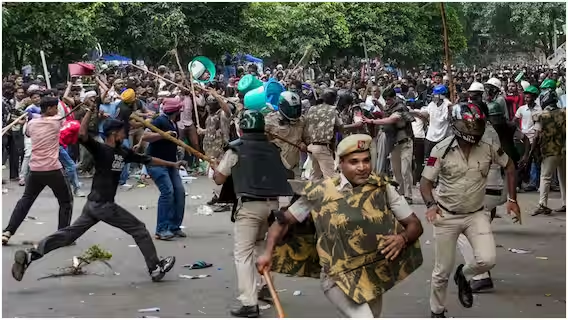
When a crowd pelts stones, the law does not permit the state to respond with boulders. Yet, recent events on the streets of New Delhi reflect a troubling slide into disproportionate state response. In the wake of intense student demonstrations, the image of heavily armed paramilitary forces confronting unarmed citizens raises a fundamental question: Is the state managing public order, or is it waging war against its own citizens? Is it one Lathi versus an AK-47? Was it a war or military action?
Police have the right to defend, not the people!
The people question you, then they claim the right to private defence, and by extension, the state’s authority to deploy force, is governed by strict legal boundaries. Under the Bharatiya Nyaya Sanhita (BNS), 2023, the legal framework for self-defence is codified under Sections 34 to 44:
- The Proportionality Rule (Section 37 BNS / S. 99 IPC): The injury inflicted must not be greater than what is strictly necessary for defence. No right of private defence exists if protection from public authorities is accessible.
- Lethal Force Threshold (Section 38 BNS / S. 100 IPC): Causing death or using lethal force in self-defence is legally permissible only under specific severe conditions—such as a reasonable apprehension of death, grievous hurt, rape, abduction, or acid attacks.
Lethal force is permitted only under specific severe threats under Section 38 of the BNS (S 100 of the IPC). The police are legally permitted to use lethal force in self-defence under Section 38 of the BNS if you face an assault carrying a reasonable apprehension of:
- Death or Grievous Hurt
- Rape or assaults with intention to gratify unnatural lust
- Yashovardhan Jha Azad
- Wrongful Confinement where you cannot access public authorities for rescue
- Acid Attacks (or an attempt to throw acid) that creates a fear of grievous hurt
The right to self-defence is designed purely to ward off imminent danger, not to penalize, exact revenge, or disperse peaceful political assemblies. Aiming high-velocity firearms or lethal kinetic weapons at protesters fleeing a site violates the foundational principle of minimum force.
All this is the “Jantar Mantar Crackdown” rule of law
The issue reached a boiling point following a crackdown by the Rapid Action Force (RAF) on July 20, 2026, during the “Sansad Chalo” march organized at Jantar Mantar over civil service exam leaks.

Former IPS officer and Intelligence Bureau (IB) Special Director Yashovardhan Jha Azad (this writer is a colleague in the Central Information Commission of the Union of India, from 2013-18), alongside injured student protesters, alleged that security forces deployed pump-action guns firing metallic pellets without warning or prior resort to milder measures like water cannons. Crucially, the plea contends that pellets were fired into the crowd as students were actively retreating with hands raised in surrender.
Hearing the matter, a three-judge bench led by Chief Justice of India Surya Kant issued critical interim directives:
- Preservation of Evidence: Ordering the Central Government to immediately secure and preserve all RAF ammunition logs from the site to prevent tampering.
- Medical Relief: Directing the Delhi Government to ensure immediate, comprehensive medical care for all injured victims.
While the Apex Court expressed caution regarding a blanket ban on pellet guns—citing police regulations that permit a “graded response” in extreme scenarios—it brought state action under direct judicial scrutiny.
Unprovoked Force:
The plea filed through Advocate Vrinda Grover alleges that the RAF suddenly fired pump-action guns, releasing metallic pellets as student protesters were actively retreating with their hands raised in surrender.
Indiscriminate Weaponry:
The petitioners argue that metallic kinetic projectiles are inherently “indiscriminate and unconstitutional,” carrying an excessive risk of causing permanent bodily injury. The application asserts that law enforcement skipped basic crowd management protocols, firing pellets without utilizing water cannons or giving clear public dispersal announcements first.
Beyond the decommissioning of pellet guns, the petition seeks exemplary compensation, medical treatment, and formal rehabilitation for the victims.
Thanking the SC
The three-judge bench, led by Chief Justice of India Surya Kant, took immediate steps but questioned the request for a sweeping ban: The Apex Court issued a critical interim directive ordering the Central Government to immediately preserve the ammunition logs of the RAF personnel deployed at Jantar Mantar to ensure evidence of the scale of firing is not altered.
The court directed the Delhi Government to ensure that all injured petitioners and similarly placed victims receive immediate and adequate medical care.
The “Graded Response” Dilemma:
The Supreme Court expressed skepticism about a blanket prohibition, observing that police guidelines permit the deployment of pellet guns under a “graded response” protocol in exceptional situations where tear gas and lathi charges completely fail. The bench noted that because the underlying police rules authorizing these weapons were not explicitly challenged in the current format of the PIL, it could not summarily declare their use illegal.
Echoes in the House of Elders

The fallout echoed strongly inside Parliament. Speaking in the Rajya Sabha on July 30, 2026, MP Mukul Wasnik launched a scathing critique of the government’s posture:
“How the police personnel and paramilitary forces used batons on the youth, on the students… Pellet guns were used there. Batons were rained down in such a manner that nails had been fixed onto them. Tear gas was used relentlessly… Even within the Parliament House complex, forces deployed on armoured vehicles stood with modern automatic weapons, as though this Government had fully prepared itself to confront terrorists.”
- What was happening outside on the streets, we could not see while sitting here. But even within the Parliament House, just a few metres away from here, the forces deployed on armoured vehicles, standing there with the latest modern guns in their hands—it appeared as though this Government had fully prepared itself to confront terrorists. And if they were to be seen anywhere around the Parliament House, they would be gunned down. Such was the atmosphere.
- Even if we could not speak about it inside Parliament, at least think within your hearts whether this incident happened here or not.
MP Wasnik began his harsh-hitting speech, “But I believe that the incidents which took place on the streets of Delhi in the past few days, because of which the political credibility of the present Central Government has suffered wounds, I believe those wounds will not heal for years and years, and the marks that they have left behind are marks that will never fade away”.
How do they measure the ‘”Minimum Force”
Civilian agitation over public grievances—whether over exam integrity or political accountability—cannot be treated as a military engagement. Deploying combat tactics and indiscriminate kinetic weapons against citizens erodes democratic legitimacy.
When the doctrine of “graded response” degrades into brute force, the state fails its primary duty under the Constitution. Public order must be maintained through the rule of law, not through the shadow of the AK-47.

Law professor and eminent columnist
Madabhushi Sridhar Acharyulu, author of 63 books (in Telugu and English), Formerly Central Information Commissioner, Professor of NALSAR University, Bennett University (near Delhi), presently Professor and Advisor, Mahindra University, Hyderabad. Studied in Masoom Ali High School, AVV Junior College, CKM College, and Kakatiya University in Warangal. Madabhushi did LL.M., MCJ., and the highest law degree, LL.D. He won 4 Gold Medals at Kakatiya University and Osmania University.
Email: cicsridhar@gmail.com
Mobile: 8447651505