An Introduction to the Ashta Vinayak
Across the sun-baked hills and river-bent villages of Maharashtra, eight stones rest in the earth. They were not carved by human hands. They rose from the soil over centuries, shaped by time and water and something older than memory, into the likeness of the elephant-headed god. These are the Swayambhu shrines of the Ashta Vinayak. Not a pilgrimage of distance, but a pilgrimage of the mind.
Over the next eight papers, we will walk this ancient circuit. Not as tourists ticking off temples, but as quiet seekers tracing the arc of human wisdom. Each shrine marks a specific stage in the growth of consciousness: from the clarity of intent to the discipline of capability, from the courage to face fear to the silence of ultimate liberation. This is the geography of the soul, mapped in stone.
But to understand why these eight forms matter, we must first understand the form that holds them all together.
The Form That Begins All Things
Ganesha is perhaps the most familiar presence in our daily lives. We see him on our doorsteps, on our desks, and at the start of every new venture. The ancient stories tell us that he was created by Parvati from the pure essence of her own body to guard her inner chambers. When Shiva returned and found his path blocked by this unknown child, a fierce battle broke out, resulting in the boy losing his head. To restore him to life, Shiva granted him the head of an elephant and named him the leader of his celestial forces, the Ganapati. In that sacred moment, Shiva blessed him with a unique position: Ganesha would always be worshipped first, because he represented the ultimate balance of strength and wisdom.
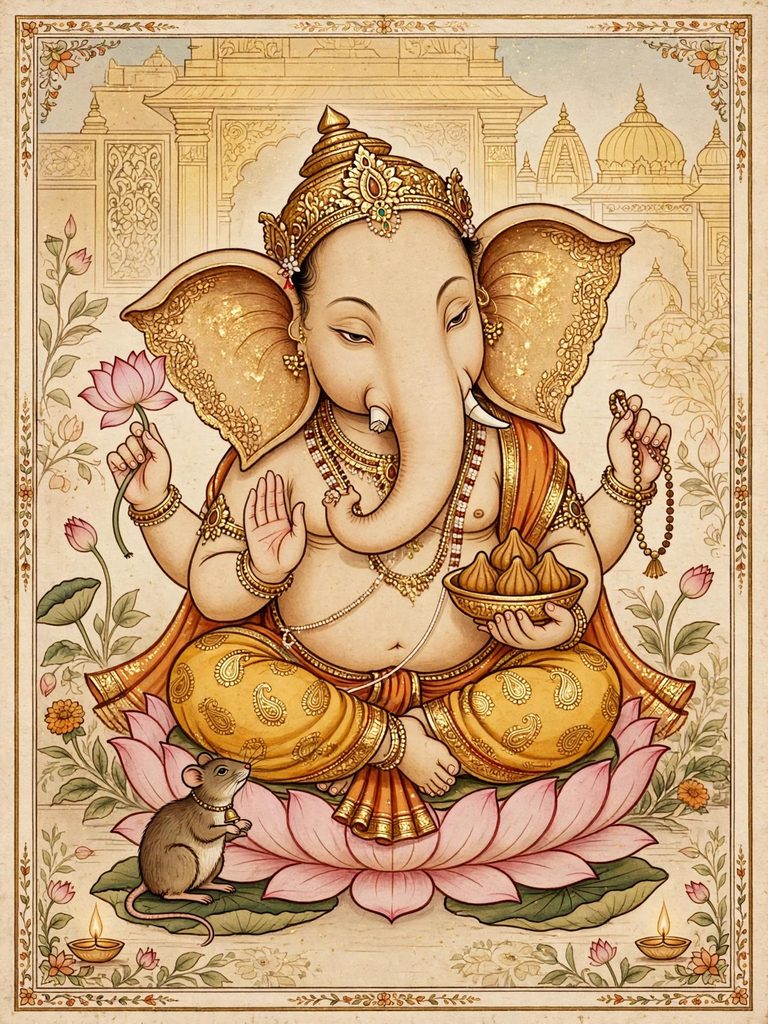
This transformation is why Ganesha is celebrated as the remover of obstacles. He is an expression of supreme intellect made visible, and every aspect of his form speaks a quiet language.
Across the sun-baked hills and river-bent villages of Maharashtra, eight stones rest in the earth. They were not carved by human hands. They rose from the soil over centuries, shaped by time and water and something older than memory, into the likeness of the elephant-headed god. These are the Swayambhu shrines of the Ashta Vinayak. Not a pilgrimage of distance, but a pilgrimage of the mind.
Over the next eight papers, we will walk this ancient circuit. Not as tourists ticking off temples, but as quiet seekers tracing the arc of human wisdom. Each shrine marks a specific stage in the growth of consciousness: from the clarity of intent to the discipline of capability, from the courage to face fear to the silence of ultimate liberation. This is the geography of the soul, mapped in stone.
But to understand why these eight forms matter, we must first understand the form that holds them all together.
The Form That Begins All Things
Ganesha is perhaps the most familiar presence in our daily lives. We see him on our doorsteps, on our desks, and at the start of every new venture. The ancient stories tell us that he was created by Parvati from the pure essence of her own body to guard her inner chambers. When Shiva returned and found his path blocked by this unknown child, a fierce battle broke out, resulting in the boy losing his head. To restore him to life, Shiva granted him the head of an elephant and named him the leader of his celestial forces, the Ganapati. In that sacred moment, Shiva blessed him with a unique position: Ganesha would always be worshipped first, because he represented the ultimate balance of strength and wisdom.
This transformation is why Ganesha is celebrated as the remover of obstacles. He is an expression of supreme intellect made visible, and every aspect of his form speaks a quiet language.
The Large Head: The capacity for deep thought and vast contemplation. A reminder that no problem is too complex when approached with an expansive mind.
The Big Ears: The willingness to listen deeply before speaking. Wisdom begins not with answers, but with attention.
The Small Eyes: Sharp focus, looking past surface distractions to see the core of a matter. In a world of noise, the eyes teach us to see what truly matters.
The Single Tusk: The power of choice, breaking through dualities to arrive at a singular truth. It is said Ganesha broke his own tusk to write the Mahabharata — sacrifice for wisdom.
The Trunk: Incredible adaptability. It is strong enough to uproot a tree, yet delicate enough to pick up a needle from the ground. This is the balance of power and gentleness we all seek.
The Large Belly: The ability to digest all of life’s experiences — the sweet and the bitter — with equanimity. Nothing is rejected. Everything becomes nourishment.
The Mouse at His Feet: The ego, desire, the restless mind. It is small because once wisdom sits enthroned, desire serves it, not the other way around.
The Modak in His Hand: The reward of sadhana. Sweetness earned through effort. The joy that comes only after the discipline.
When we look at Ganesha, we are looking at a mirror of what the human mind can achieve when it is balanced, attentive, and wise.
The Eight Faces of Wisdom
While Ganesha belongs to the entire world, he holds a very unique relationship with the landscape of Maharashtra. Scattered across its green hills, riverside villages, and mountain caves are the eight ancient shrines of the Ashta Vinayak. They belong to the soil, the water, and the rocks of this region. And in each one, he appears differently — not because the god changes, but because the seeker changes at each stage of the journey.
The circuit, when walked with awareness, reveals a quiet progression. Each temple is not merely a destination. It is a milestone on an inner map. The stones do not change, but the one who stands before them does.
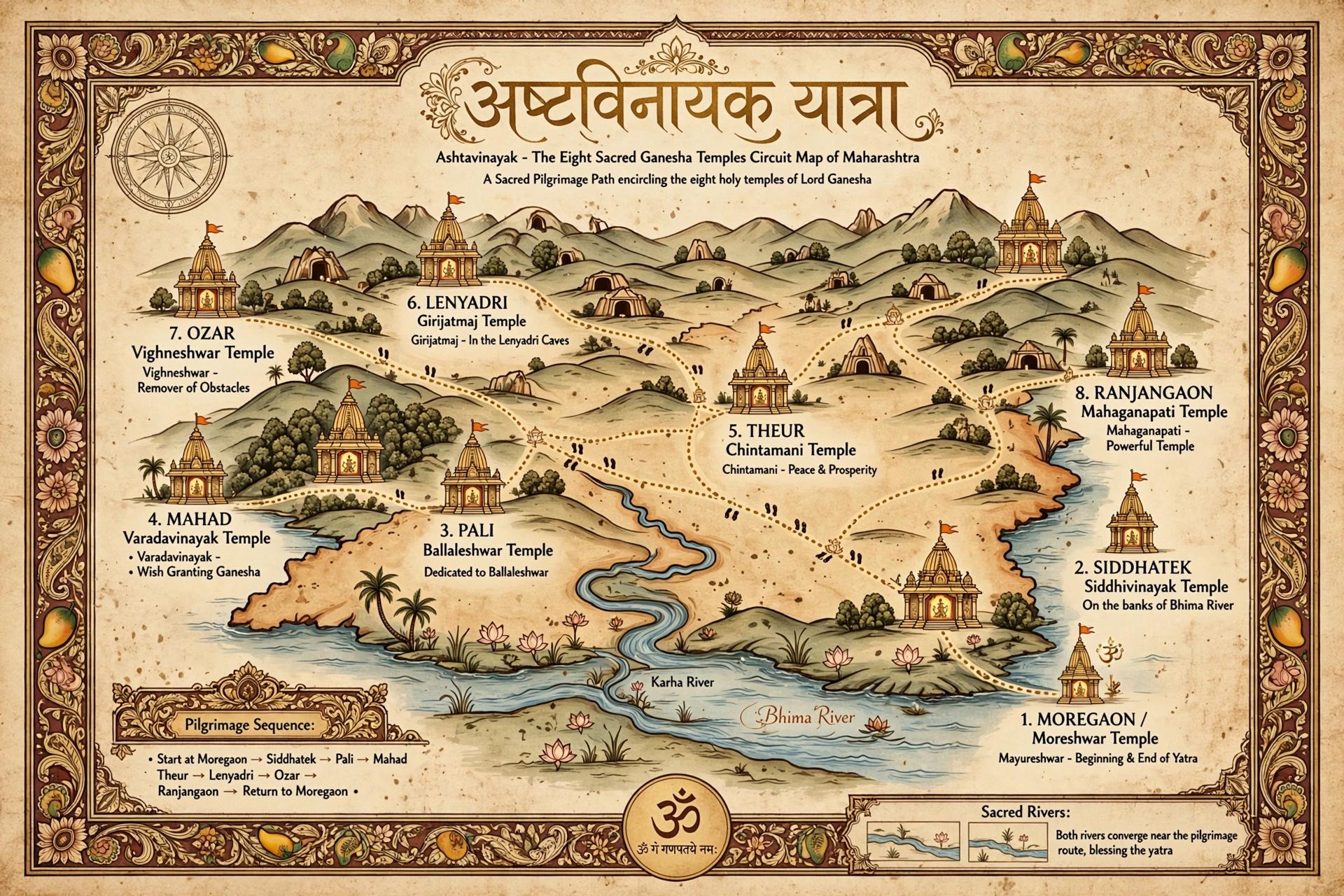
Here is the path we will walk together:
1. Moregaon — Mayureshwar: Clarity of Intent — The Beginning. Before any journey, we must clear the poison of distraction. Like the peacock that transforms venom into beauty, this first step teaches us to establish a pure sankalpa.
2. Siddhatek — Siddhivinayak: Discipline and Capability — The Preparation. Raw effort is not enough. Here we learn that power without structural alignment is just noise. Vishnu himself had to pause here to gain siddhi.
3. Pali — Ballaleshwar: Protection from Fear — The Courage. Named not for the god but for a boy-devotee, this shrine teaches the courage of surrender. When we are tied to the tree of doubt, trust loosens the ropes.
4. Mahad — Varadvinayak: Healing and Acceptance — The Surrender. Life gives us afflictions we cannot fight. Here, beside an ancient pond, we learn that acceptance is not defeat. It is the threshold of transformation.
5. Lenyadri — Girijatmaj: The Cave of Silence — The Stillness. High in a mountain cave, we discover that the deepest wisdom is born in silence. The noise must fall away before the voice of the soul can be heard.
6. Ozar — Vighneshwar: The Power of Devotion — The Surrender. The demon of obstacles, Vighnasura, surrendered here. We learn that obstacles are not external. They are internal friction. When clarity is absolute, hurdles dissolve.
7. Theur — Chintamani: The Final Integration — The Release of Worry. At the confluence of rivers, we learn to lay down our burdens. The Chintamani jewel teaches us that worry comes not from lack, but from fear of loss.
8. Ranjangaon — Mahaganapati: The Warrior Spirit — The Action. The Sovereign Self. The final shrine. Shiva himself paused here before his greatest battle. We learn that true leadership is sovereignty over our inner kingdom.
How to Read This Series
As we visit these eight ancient shrines one by one, we will follow a simple rhythm:
The Arrival: What does the place feel like? What do we see, hear, and smell as we approach?
The Ancient Legend: What story does this stone hold? What myth echoes through these walls?
The Uniqueness of the Form: How does this Ganesha look different from the others? What does his posture, trunk, and expression reveal?
The Inward Lesson: What does this form teach us about our own lives, our struggles, and our growth?
The Taste of the Temple: What offering is made here? What flavour does this place hold in the memory?
The Closing Reflection: What do we carry with us as we leave?
This is not a guidebook. It is an invitation.
Come, Let Us Begin
The Ashta Vinayak is not a journey you complete. It is a journey you become. With each shrine, a layer of noise falls away. With each step, the path inward becomes clearer.
The first stone waits for us in the quiet village of Moregaon, where the Karha River loops gently around the land, and a dark fortress-temple holds the first face of wisdom.
Come, let us begin.!
Author Biography: – R Srinivasa Murthy, the author, is a corporate leader, an independent writer, and a student of Hindhu Philosophy. He Identifies as a Demystic, committed to removing unnecessary mysticism from traditions to offer practical systems for the next generation. His upcoming book, Logic of And: Sanatana Dharma as a Toolkit for the Contemporary Seeker, aims to bridge ancient wisdom with modern life to foster an inclusive, living civilisation.

With a journalistic long journey, we bring you https://primepost.news, a dynamic platform committed to unraveling the intricate tapestry of Indian politics, particularly delving deep into the heart of Telangana and Andhra Pradesh. Our blog is not just a source of news; it’s a reservoir of insights, analysis, and thought-provoking reviews.