Dharma Unbound
There comes a moment in every serious journey when disillusionment compels us to examine what truly moved us in the first place. Was it power? Position? Recognition? Or was there, beneath all these transient instruments, something deeper—a commitment that made us willing to stand, serve, struggle and perform?
For many, power was never the destination. It was only a means through which responsibility could be exercised. The true source of energy was commitment: a conviction that certain duties were worth performing and certain purposes worth pursuing, irrespective of applause, advantage or reward.
It is therefore natural to feel disillusioned when a responsibility once regarded as our rightful prerogative is taken away; when our voice is diminished; when our agency is constrained; when the spirit that sought to contribute discovers that it has little say in the very matters to which it had given itself.
Yet the loss of external authority need not constitute the loss of inner authority.
Power is circumstantial. Commitment is constitutional.
Authority may be bestowed. Responsibility must be lived.
Recognition may be granted. Conviction must be earned within oneself.
This distinction takes us directly into the deeper philosophical terrain of Dharma.
In the Hindu civilisational understanding, Dharma is not merely a prescribed obligation. It is the principle that holds together action, conscience, responsibility and the larger order of existence. It asks not simply what is advantageous, but what is worthy; not merely what can be done, but what ought to be done.
The teaching of the Bhagavad Gita acquires extraordinary relevance here. Action is not to be abandoned merely because its fruits are uncertain. Nor is one’s duty to be measured by the applause it receives. The individual is called to act with clarity, discipline and equanimity—to give oneself wholly to the rightful action while relinquishing possessiveness over its outcome.
That is not resignation.
It is disciplined freedom.
There comes, therefore, a point beyond which the mature spirit must cease asking, “How much power remains with me?” and begin asking, “What remains worthy of my effort?”
That question transforms everything.
If authority is withdrawn, responsibility can remain.
If recognition is withheld, contribution can remain.
If one is pushed to the margins, one’s inner centre can remain unshaken.
If circumstances deny the opportunity to command, they cannot necessarily deny the opportunity to serve.
And sometimes it is precisely when external power recedes that the deeper strength of character becomes visible.
When position disappears, character speaks.
When recognition disappears, conviction reveals itself.
When authority disappears, responsibility becomes a choice.
This is the threshold at which adversity can become philosophy.
Isolation need not become bitterness; it can become reflection.
Silence need not become surrender; it can become inner consolidation.
Disappointment need not become defeat; it can become discernment.
And action, freed from the constant demand for recognition, can become Karma Yoga—work performed as an offering rather than as a transaction.
This is the higher meaning of commitment.
Commitment does not ask whether the world is watching.
It asks whether the work is worthy.
It does not ask whether one will be rewarded.
It asks whether one’s conscience permits indifference.
It does not ask whether one occupies the centre.
It asks whether, wherever one stands, one can still contribute to the larger good.
That is the positive assertion that must arise beyond a certain point.
Not an assertion of wounded ego.
Not a revolt against circumstance.
Not an obsessive pursuit of lost power.
But a quiet, uncompromising declaration of inner sovereignty:
I shall continue because I believe.
I shall perform because I am responsible.
I shall serve because my purpose is larger than my position.
I shall not permit circumstance to become the measure of my spirit.
This is where the Hindu philosophical vision becomes not merely ancient wisdom but a living discipline for modern life.
For the highest freedom is not the freedom in which every obstacle disappears. It is the freedom to remain inwardly whole while confronting obstacles that cannot immediately be removed.
Circumstances may determine our position; they need not determine our character.
Others may influence our opportunities; they need not possess our conscience.
Institutions may confer authority; they cannot confer Dharma.
The world may recognise our work—or remain silent before it.
But the worth of an action does not become greater because it is applauded, nor smaller because it is ignored.
There is, therefore, a profound dignity in continuing to perform without bitterness.
To continue without resentment is strength.
To serve without servility is strength.
To remain principled without becoming rigid is strength.
To accept limitation without surrendering purpose is strength.
And to retain compassion while possessing conviction is perhaps the highest strength of all.
Ultimately, the question is not whether we can control circumstances. We rarely can.
The question is whether circumstances can control who we become.
That answer must remain ours.
This is the sovereignty of the inner self.
Dharma becomes the axis.
Commitment becomes the discipline.
Conviction becomes the light.
Action becomes the expression.
Equanimity becomes the strength.
From this perspective, even the experience of being denied becomes capable of transformation. What appears initially as deprivation can become detachment. What appears as isolation can become introspection. What appears as powerlessness can become the discovery of a power that does not depend upon institutional permission.
The deepest power is therefore not the power to command others.
It is the power to command oneself.
Not the power to make the world obey one’s will, but the power to prevent the world from corrupting one’s purpose.
Not the power to occupy the highest position, but the strength to remain upright wherever destiny places us.
That is Atma-bal—the strength of the inner self.
That is Dharma—fidelity to what ought to be upheld.
That is Karma Yoga—wholehearted action without bondage to its fruits.
And that is the final philosophy of the indomitable spirit:
Power may be lost; purpose need not be.
Authority may be withdrawn; responsibility need not be.
Recognition may disappear; conviction need not.
Circumstances may change; Dharma need not.
Therefore, beyond a certain point, life demands not complaint but consecrated continuation.
Continue because the work remains worthy.
Continue because responsibility remains sacred.
Continue because conviction remains alive.
Continue because one’s Dharma does not become irrelevant merely because the circumstances surrounding it have become difficult.
And finally, let the spirit make its highest assertion—not loudly, not arrogantly, but with the serenity of one who has understood the deeper order of things:
I do not require power to remain purposeful.
I do not require recognition to remain responsible.
I do not require authority to remain true.
I require only the courage to remain faithful to what I know to be worthy.
For ultimately:
Power belongs to circumstance.
Responsibility belongs to character.
Commitment belongs to conscience.
Dharma belongs to the eternal.
And the human being who discovers this does not merely endure adversity.
He transcends it.
He rises without arrogance.
He acts without hatred.
He serves without servility.
He perseveres without bitterness.
He walks without fear.
And he continues—not because the world has granted him power, but because he has discovered something greater:
The truest victory is not to possess power over the world, but to possess oneself.
Beyond power lies purpose.
Beyond purpose lies Dharma.
Beyond Dharma lies inner freedom.
And in that freedom, the indomitable spirit becomes luminous.
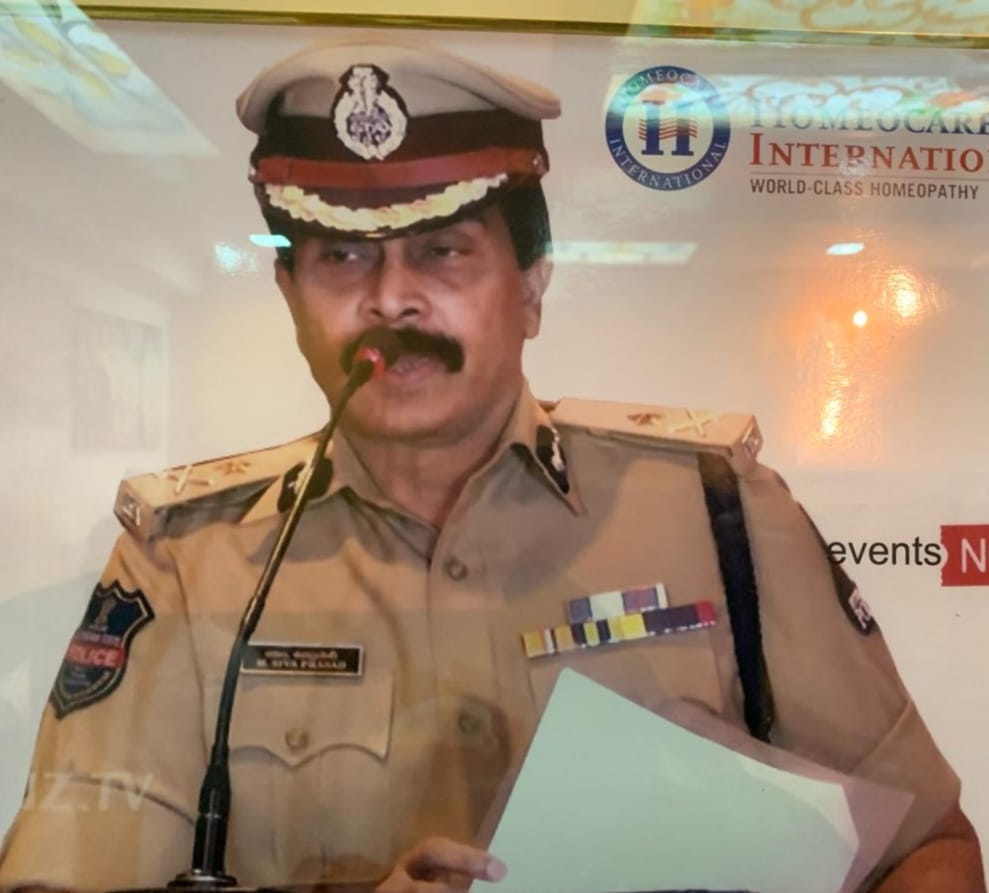
M. Shiva Prasad, IPS (Rtd.) is a dedicated law enforcement professional who served the combined Andhra Pradesh cadre before opting for the Telangana cadre. Though a native of Andhra Pradesh, he considers himself a true Hyderabadi with an abiding love for the Telugu people. Driven by sincerity, fearlessness, and a lifelong fight against inequality and injustice, his ultimate strengths remain his goodwill and deep affection for the public and the police force. Today, he continues his mission by writing snippets and articles true to his conscience.
Email: Shivareach@yahoo.com
Mobile: 98480 38774

Super. I could understand the essence of Bhagavadgita. It’s very true. Worthy.