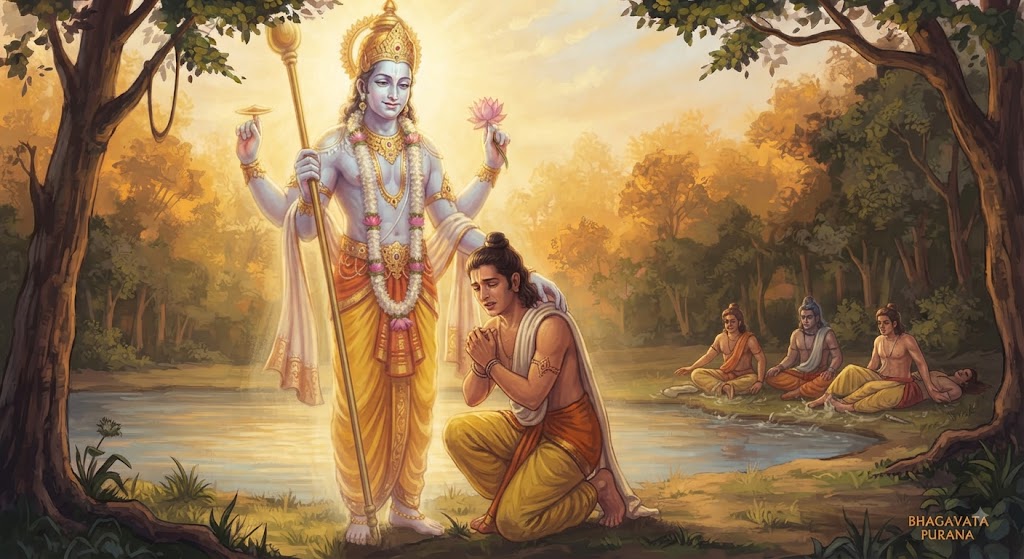
Paper 4: The Great Sleeper
Yudhisthira remained perfectly still. He had just pointed to the ultimate anchor of a mother’s love, but the Yaksha was ready to test his clarity further. The voice from the shadows picked up the pace, offering four fast paradoxes that seem to defy the laws of biology:
- What does not close its eyes while sleeping?
- What does not move after birth?
- What is without a heart?
- And what grows by its own speed?
If you look at them with a purely literal lens, you get stuck trying to solve a nature puzzle. But the Yaksha was pointing toward the hidden, invisible patterns of life. He was asking about how things grow silently without our permission, how certain forces never rest, and how a life can look fully alive on the outside while being completely empty within.
Yudhisthira took a calm breath and answered with effortless precision:
- A fish does not close its eyes while sleeping.
- An egg does not move after birth.
- A stone is without a heart.
- And a river grows by its own speed.
Let us unpack these four answers. They give us a profound mirror to look at our daily habits, our emotional openness, and the silent current of our lives.
The Open Eye: The Corporate Autopilot
Yudhisthira says a fish does not close its eyes while sleeping.
Because fish lack eyelids, they sleep with their eyes wide open. To anyone swimming past, they look fully awake and alert. We often live our daily lives exactly like that fish. A student sits through a long lecture staring at the teacher, but their mind is completely asleep. A homemaker moves through repetitive kitchen work while lost in mental noise. A working professional sits in meetings, replying to emails on pure muscle memory. On the outside, we look active. But on the inside, our true awareness is fast asleep.
In his groundbreaking book Emotional Intelligence, global thinker Daniel Goleman describes how the greatest trap for any professional is a lack of self-awareness. He shows how easy it is to operate purely out of old habits and automatic reactions without noticing how our mood affects our environment. If you are just moving mechanically through your day without presence, you are not truly awake; you are simply a fish sleeping with its eyes open.
The Still Potential: Breaking the Shell
The riddle states that an egg does not move after birth.
An egg holds incredible potential, but until it cracks open, it remains completely stationary, quiet, and passive. Many of us treat our lives like that uncracked egg. A young person sits with a brilliant business idea, a homemaker dreams of starting a local initiative, or a seeker wants to write a book, but they never take that first awkward step. We stay completely still because we are terrified of the friction it takes to break the shell.
Modern psychology writes a lot about the comfort zone trap. It shows how humans naturally prefer a predictable, motionless environment over the vulnerability of growth. Our ancient wisdom reminds us that keeping yourself completely safe and still is not living. A life that refuses to move and break past its boundaries is just an egg waiting to expire.
The Hardened Centre: The Blocked Heart
When asked what is without a heart, Yudhisthira points directly to a stone.
A stone is cold, rigid, and completely indifferent to the world around it. It does not feel the warmth of the sun or the gentleness of the rain. In our high-pressure world, it is very easy for a human heart to turn into a stone. When you get hurt by a broken trust or burnt out by a demanding corporate culture, your natural defence mechanism is to build a heavy wall.
You tell yourself that if you stop feeling, you will stop hurting. You become emotionally cold to your family, cynical toward your colleagues, and indifferent to the world. But when you harden your centre to protect yourself from pain, you also lock out joy and connection. True strength is keeping your heart soft and receptive even when the world gets rough.
The Silent Flow: The Current of Habit
The final riddle asks what grows by its own speed, and the answer is a river.
A river starts as a tiny, humble stream high in the mountains. It does not make a massive announcement when it begins, but it never stops moving. It keeps flowing, day and night, quietly carving its way through solid rock, gathering strength until it becomes an unstoppable force.
Our daily habits are exactly like that river. A single small action, like scrolling on your phone for ten minutes before sleep or taking a moment to write down a quiet thought, seems insignificant today. But when repeated day after day, that tiny stream turns into a massive river that carves out the very landscape of your destiny. Your life is shaped by a silent river of habits, growing every single day by its own momentum.
How do we take these four paradoxes and use them tomorrow?
The Sleeping Fish (Waking from Autopilot): Imagine walking into your home tomorrow evening. Your eyes are open and you are looking at your family, but your mind is still stuck on an unresolved email, a stressful exam, or domestic worries. That is the sleeping fish. Catch yourself in that exact moment. Take a deep breath, consciously wake your mind up, and bring your full presence into the room.
The Motionless Egg (Breaking the Shell): Look at the personal goals, courses, or creative ideas you have been putting off. If you are waiting for the perfect day, the perfect mood, or complete certainty before starting, you are acting like the motionless egg. Realize that an egg only breaks from the inside through friction and effort. Take one small, imperfect step today to crack the shell.
The Heart of Stone (Staying Emotionally Soft): Think about a recent misunderstanding with a colleague, friend, or family member that left you feeling bitter or defensive. It is tempting to build a wall and turn cynical. But an unfeeling heart is just a stone. Choose to keep your centre soft, practice forgiveness, and protect your capacity for warmth and empathy.
The River’s Current (Tending to Your Daily Habits): Look at your quiet daily routines—whether it is ten minutes of quiet reading, a daily walk, or an hour wasted on mindless digital scrolling. Remember that these small daily streams continuously carve out your future like a river. Choose to nurture small, constructive habits today, knowing that their momentum will silently carry you toward a resilient tomorrow.
When you step off autopilot, break your self-imposed shells, protect your warmth, and steer your habits, you cease to be a passive bystander in your own story.
True life begins the moment you choose to stay awake.
Author Biography: – R Srinivasa Murthy, the author, is a corporate leader, an independent writer, and a student of Hindhu Philosophy. He Identifies as a Demystic, committed to removing unnecessary mysticism from traditions to offer practical systems for the next generation. His upcoming book, Logic of And: Sanatana Dharma as a Toolkit for the Contemporary Seeker, aims to bridge ancient wisdom with modern life to foster an inclusive, living civilisation.

With a journalistic long journey, we bring you https://primepost.news, a dynamic platform committed to unraveling the intricate tapestry of Indian politics, particularly delving deep into the heart of Telangana and Andhra Pradesh. Our blog is not just a source of news; it’s a reservoir of insights, analysis, and thought-provoking reviews.
The Explanation of the Fish,Egg,Stone and River is Important for us in our Daily life until to Death.
Really it is a marvelous Explanation and it creates a Vibe inside me.
Thanks you sir.
I want more Explanation of many things like peace.It means How to make our Body and soul in peace at any of the situation in our life.Plz explain.👍🙏😍😍🌻🌻
The author mapped the answers of Yudhishthir to real life example drawing beautiful solutions. “Be awake” despite sleeping, Working towards outgrowing while appearing to be still, emotional maturity (like that of a seasoned professional), garnering one’s own capacity to make a big force – all these revea the maturity of thought of the author. Beautiful!
Most difficult questions have the easiest of answers. Like I am unable to do some task, just get up try and do it