The Unresolved Sagas of a Decade-Old Telangana
Part-II
After the formation of Telangana, over a decade after the historic “appointed day” of June 2, 2014, the romanticism of statehood has transformed into the complex, hard-nosed reality of governance, fiscal management, and institutional friction. This article deep-dives into the contemporary problems of Telangana, its ongoing geopolitical and natural resource wars with Andhra Pradesh, and its shifting political landscape.
The Liquid War of the Twin Rivers & Its Politics
In 2014, the euphoria of Telangana’s birth was anchored in the hope that the region’s waters would finally stay within its borders, quenching the thirst of the parched districts of Mahabubnagar, Nalgonda, and Warangal. The old argument was simple: Andhra rulers had systematically diverted the Krishna and Godavari rivers. Yet, more than a decade later, water remains the most volatile flashpoint between the sibling states of Telangana and Andhra Pradesh, transforming from an internal colonial grievance into a bitter interstate legal battle.
The Battle over the Krishna Basin
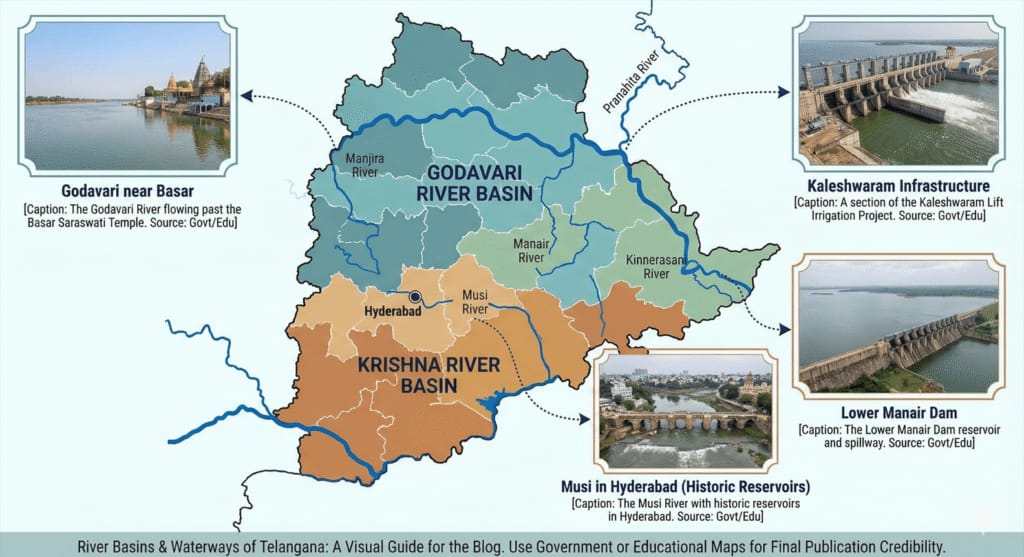
The partition of water assets under the Andhra Pradesh Reorganisation Act, 2014, was intended to be temporary. The Krishna River Management Board (KRMB) was established to oversee the distribution, but it has turned into an arena of constant dispute.
- The 66:34 Conundrum: Initially, water sharing was arranged in a 66:34 ratio, favoring Andhra Pradesh out of the total dependable yield. Telangana has aggressively protested this setup, demanding an equal 50:50 interim sharing formula until the Krishna Water Disputes Tribunal-II (KWDT-II) delivers a final verdict on allocations.
- The Hydel Power Standoff: In peak summer and sowing seasons, projects like Srisailam and Nagarjuna Sagar witness literal standoffs. Telangana relies heavily on these reservoirs for low-cost hydel power generation to drive its massive agricultural lift irrigation projects. Andhra Pradesh routinely objects, arguing that drawing water for power generation depletes the drinking and irrigation storage meant for its downstream delta regions. The deployment of central paramilitary forces at the dam gates has become a recurring image of federal anxiety.
The Paradox of the Godavari and the Shadow of Mega-Projects
Further north, the Godavari basin tells a story of staggering engineering ambition mixed with economic controversy. Telangana bypassed old constraints by constructing the Kaleshwaram Lift Irrigation Project (KLIP), widely touted as one of the world’s largest multi-stage lift irrigation systems.
While KLIP dramatically shifted agricultural practices, spurring a massive increase in winter rice cultivation across rainfed zones, it introduced severe systemic vulnerabilities. The massive financial burden of operating these heavy-pumping lifts, combined with structural failures (such as the sinking of piers at the Medigadda Barrage), has turned water management into an existential fiscal crisis. Meanwhile, downstream Andhra Pradesh continues to construct its own massive venture, the Polavaram Project, sparking upstream submergence concerns within Telangana’s tribal borderlands.
The Ghost of the 2014 Act
(Assets, Liabilities, and Apportionment)
The physical borders were drawn cleanly on the map in 2014, but the institutional divorce between Telangana and Andhra Pradesh remains incomplete. The bureaucratic machinery is still haunted by the incomplete implementation of the Andhra Pradesh Reorganisation Act, specifically regarding Schedules IX and X.
| UNRESOLVED STATE DIVORCE (SCHEDULES IX & X)[Schedule IX: State Corporations]—> Dispute over 80+ entities[Schedule X: Training Institutes]—> Dispute over 140+ apex bodies GEOGRAPHIC VS. POPULATION BASIS [Telangana’s Claim] <—“Assets belong where they physically stand.”[Andhra Pradesh’s Claim]—>”Divide everything 58:42 by population ratio.” |
The Wealth of Hyderabad
At the heart of the deadlock is a fundamental philosophical disagreement on how to divide state assets:
- Andhra Pradesh’s Argument: Assets should be split based on the population ratio (58:42), ensuring that citizens of the residual state get their fair share of the institutional wealth built during the unified era.
- Telangana’s Stance: It maintains a strict geographical principle—if an institution or its land physically sits within Telangana’s borders (overwhelmingly in Hyderabad), it belongs entirely to Telangana.
Because of this impasse, over 80 state corporations (Schedule IX) and more than 140 higher education and training institutes (Schedule X) sit in a state of administrative paralysis. Billions of rupees in bank deposits, land parcels, and headquarters infrastructure remain frozen, tied up in Supreme Court litigations and unproductive bilateral committee meetings.
The Power Tariff Deficit
The division of the power sector has caused deep financial issues. Andhra Pradesh claims that Telangana owes it over ₹7,000 crore for power supplied post-bifurcation to keep Hyderabad’s grids alive. Telangana has countered with its own multi-crore claim, citing unpaid dues from Andhra Pradesh for power generation infrastructure and coal supply from the Singareni Collieries.

Law professor and eminent columnist
Madabhushi Sridhar Acharyulu, author of 63 books (in Telugu and English), Formerly Central Information Commissioner, Professor of NALSAR University, Bennett University (near Delhi), presently Professor and Advisor, Mahindra University, Hyderabad. Studied in Masoom Ali High School, AVV Junior College, CKM College, and Kakatiya University in Warangal. Madabhushi did LL.M., MCJ., and the highest law degree, LL.D. He won 4 Gold Medals at Kakatiya University and Osmania University.
Email: cicsridhar@gmail.com
Mobile: 8447651505