A Historical and Evolutionary Look at the Moral and Philosophical Dimensions
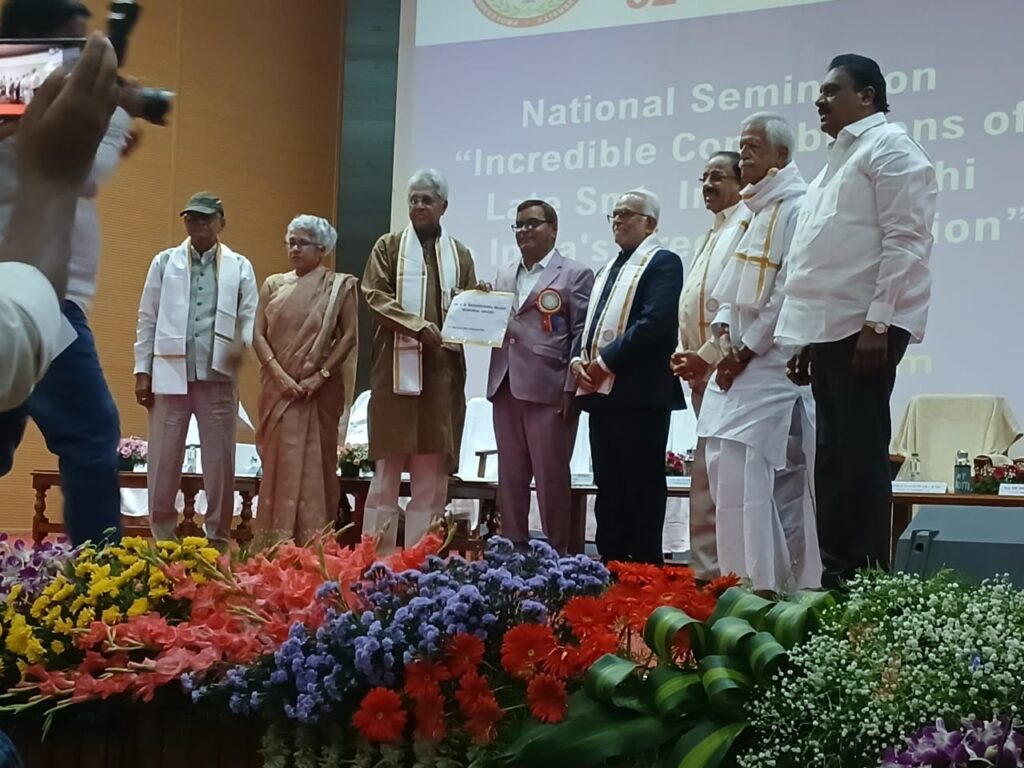
62nd Foundation Day Lecture
Professor Jayashankar Telangana Agricultural University
Former Judge, Supreme Court of India
At the very outset, let me express my deepest gratitude in being asked to speak at the 62nd Foundation Day of Professor Jaishankar Telangana Agricultural University. I must hasten to add that it is only with utmosthumility that I accepted this responsibility. In a country in which nearly 56% of people are engaged in agriculture and allied sector activities, a nation as a people that evolved for thousands of years on the foundations of bronze age agrarian revolution, and in a country in which the very life breath we take is a gift of our toiling farmers, it cannot be anything but humility as a platform on which I could have taken on this responsibility.
It also gladdens my soul, at some deep sub-conscious level to be doing this. I was born in a village not too far from here in a hardscrabble peasant background. Coming of age in late 1950s and 1960s, I have vivid memories of the toil of farmers still reeling from extreme feudal exploitation, how traditional mores of cooperation between denizens of the villages were strained by forces of division even as entrenched forces of retrogression sought to undermine efforts to belong to a new and inclusive nation based on ideas of equality and justice. I was also acutely conscious of people of great vision, and deep emotional and philosophical commitment to the people of India envisioning comprehensive, 360 degree efforts of national reconstruction, an integral and essential component of which was the idea that the farmer needs to be empowered to make the choices, have the knowledge and funds available to take the risk, and consequently become fully participating social forces in forging a renewed national identity and build a strong nation that, true to its agrarian civilizational ethos, could again boast of security of food for all, including the poorest. The founding of this Agricultural University was very much a part of this great national rebuild – as both a spiritual and also a material reconstruction.
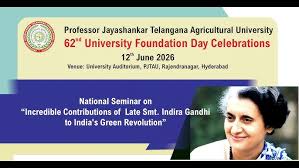
I would be remiss if I were to merely intone that establishment of institutions such as PJTAU was for national reconstruction and not at least briefly state our peoples own historical struggles that led us to the founding moment. Such a historical perspective is also needed because this lecture is to be, broadly, about the contributions of Smt. Indira Gandhi[1]. That can of course also be done by a dry recitation of various accomplishments, while she was the Prime Minister. However, such a recitation would be fundamentally incomplete, because Mrs Gandhi was herself a part of and also the product of the intense intellectual and emotional churning that was the freedom movement.
Consequently, the great emotional and political investments she made – at the risk of even her own political career – for promotion of the Green Revolution, and all the attendant institutional changes in the wider economic institutions and markets, have to be understood as being animated by the emotional response of a freedom movement that was about rebuilding the people as a nation – all the people, including the poor and also the exploited multitudes in its villages.
Make no mistake about it, the idea of “freedom” for the great men and women who fought for our independence from the colonial oppressors and elite exploiters enabled by colonial systems was not merely about political freedom. It was to be a far larger endeavor – a complete rebuild of our socio–economic, spiritual and evenindividual mindsets. It was most definitely about ensuring that its hundreds of millions of poor, including its farmers, were emancipated from the shackles of poverty, ignorance, and social institutions. Great nationalist thinkers like Dadabhai Naoroji had pointed out in 1901 itself that colonial practices devastated Indian farmers by enforcing a “relentless drain of wealth” – a consequence of which were the recurring famines.[1] R.C. Dutt, an ICS officer and economic historian traced the impoverishment of the farmer to excessive and arbitrary taxation policies (even during droughts) that stripped peasants of reserves and drove the farmers into the clutches of moneylenders and the burden of perpetual debt.[2] In his communications with Lord Curzon, R.C. Dutt also forcefully demanded that state tax burdens on agricultural sector be curtailed, protect peasant land ownership and undertake macro-economic steps to reduce rural poverty.[3]
[1] Naroji, Dadabhai: “Poverty and Un-British Rule in India”, 1901.
[2] R.C. Dutt, “Famines and Land Assessments in India.”
[3] R.C. Dutt, “Open Letters to Lord Curzon”.
[1] I need to place on record here that as a young man, I actively participated in Shri. Jayaprakash Narayan’s call for “Total Revolution” and was a bitter critic of the political developments leading up to and during the Emergency phase. But, I wish to place on record that this was on account of a genuine belief that Mrs. Gandhi’s restrictions on democratic participation and on constitutional rights were fundamentally misguided and flawed. My opposition was in that sense deeply intellectual as well as emotional. Nevertheless, it was clear to me even then, and more so later on, that Mrs Gandhi’s contributions in centering the problems of the masses, especially about the need for poverty alleviation, and her resolute stand against super power bullying, to name but two of the many contributions, were not merely about governance, but also a pursuit of the larger goals of genuine freedom, to be seen as not merely freedom from colonial shackles but also freedom from the shackles of ignorance, hunger and other forms of poverty, social discrimination and inherent dehumanisation in a hierarchical society.
Notwithstanding the fact that the nascent struggles for greater say in administration of India, and its socioeconomic policies, in early years of functioning of Congress Party was essentially led by native professionals, great nationalists like Gopalkrishna Gokhale were acutely aware that the battle for self rule, and freedom from colonial masters, could only be waged if the vast impoverished masses, living mostly in its villages, became a voluntary and active part of the struggle. It is of course a part of our popular lore of how Gopalkrishna Gokhale advised Mahatma Gandhi to tour all parts of India, and especially its villages, to understand its people and to have a tactile foundation for a moral framework to draw the poor, the masses and the rural folk also into the struggle for freedom from colonial exploitation and also to make them resilient enough to not allow the reinstantiation of exploitation by irresponsible native elite communities. But even before his eventual return in 1914, and acting out on the advice of Gokhale, Mahatma Gandhi had begun to think deeply about what freedomshould mean for India and Indians. This is reflected in Hind Swaraj, a 30,000 word set of dialogues he wrote on the journey when he was returning from London to South Africa in 1908. It substantially set the arguments that “Swaraj” cannot merely mean political freedom from the English rulers and replacement of that with the same systems of exploitation, coupled with epistemic abandonment of the humanity and non recognition of the problems and needs of its vast masses, especially the nearly 85% living in its villages. Any summation of Mahatma Gandhi would necessarily be an oversimplification for at least two reasons. Because he reflected on, and even acted on, many hundreds of aspects of the social, political and economic spheres – always
[1] Naroji, Dadabhai: “Poverty and Un-British Rule in India”, 1901.[1] R.C. Dutt, “Famines and Land Assessments in India.”
[1] R.C. Dutt, “Open Letters to Lord Curzon”.
requiring a deep and total commitment to Satyagraha as a life force of Indian sensibilities and Indian civilizational motive force. Secondly, his thoughts and paradigms also evolved, and his commitment to truthful revelation of all that he thought of, including his mistakes, means that any reference to the Mahatma at any point of time might have to be further connected to his evolved thoughts down the years.[1] But starting with Champaran in 1917, when his first mass satyagraha movement was launched, to relieve peasants from the debilitating “Tinkathia” system, through his enunciation of Gram Swarajya’s as a political formation that can limit the overweening and inherently violent modern nation state, to his treks through Naokhali farm lands to prevent the communal killing, one can view the consistent concern for the poor masses and the kissans. In Poorna Swaraj he talks about this at stretch, and it pays to cite him extensively here:
Economic Equality –“…. Is the master key to non-violent Independence. Working for economic equality means …. The levelling down of the few rich in whose hands is concentrated the bulk of nation’s wealth on the one hand, and the levelling up of the semi-starved naked millions on the other. A non-violent system of government is clearly an impossibility so long as the wide gulf between the rich and the hungry millions persists….. Those who think that the major reforms will come after the advent of” political “Swaraj are deceiving themselves as to the elementary working of non-violent Swaraj. It will not drop from heaven all of sudden one fine morning. But it has to be built up brick by brick…We have travelled a fair way in that direction. But a much longer and weary distance has to be covered before we can behold Swaraj in its glorious majesty.”[1]
[1] This has also meant that much lesser people, of far greater compulsive intellectual dishonesties, attacked him for his alleged inconsistencies or unacceptable proclamations regarding equal status of all.[1] M.K. Gandhi, “Poorna Swaraj”, pages 27-29. Penguin Random House, 2023. Reprint with an introduction by Dhananjay Rai.
With regard to Kisans, the Mahatma was of the opinion that the life source for satyagraha and of a non-violent co-existence is to be found amongst them. InPoorna Swaraj, as an extension of his thoughts on economic equality he writes:“Swaraj is a mighty structure. Eighty crores of hands have to work at building it. Of these kisans.. are the largest part…. When they become conscious of their non-violent strength, no power on earth can resist them…. They must not be used for power politics. I consider it to be contrary to the non-violent method. Those who would know my methods of organizing kisans may profitably study the movement in Champaran when satyagraha was tried for the first time in India… It became a mass movement which remained wholly non-violent from start to finish… There had been several violent revolts to get rid of the grievance. The kisans were suppressed. The non-violent remedy succeeded in full in six months…. The reader may also profitably study the kisan movements in Kheda, Bardoli and Borsad. The secret of success lies in a refusal to exploit the kisans for political purpose …Organization round a specific wrong they understand. They need no sermons on non-violence…”
Mahatma Gandhi readily recognized that the foundation of a new nation had to be on the principles of non-violence, and he felt that the rebuilding of the nation necessarily had to be on the cooperative principles to be found in our agrarian civilization. So, the well being of the farmer, and food security of the nation, was not just an economic programme, but a spiritual and social necessity, as a goal of the nation, and also infuse the people as a nation with pride.
Others have also reflected on the centrality of the Indian peasant to the potentially greatest contribution that India can make as a “vishwaguru”. Will Durant, the historian and philosopher, often remarked about the incredible resilience of the Indian peasant, of how she/he viewed political upheavals and collapse of kingdoms with a sense of detachment, and how the peasant continued to till the lands even as armies clashed next to their fields. In “Our Oriental Heritage”[1], he wrote:
“Perhaps, in return for conquest, arrogance and spoliation, India will teach us the tolerance and gentleness of the mature mind, the quiet content of the unacquisitive soul, the calm of the understanding spirit and a unifying, pacifying love for all living things.”
Jawaharlal Nehru, our first Prime Minister, wrote about the same “tolerance and gentleness” as a continuity that formed the civilizational platform for the formation of the new nation-hood from the utter devastation of colonial exploitation, in collaboration with many from the elite and dominant communities. For those who were struggling for freedom – and more so than those forces that were tied to regressive forces of the exploiting classes along with the British – it was clear that the Benthamiteutilitarian liberalism that prescribed a laissez faire hands off approach by the State/polity to economic activities, even as millions died in famines (again and again) was both inhuman in and of itself, and also fundamentally destructive of the establishment of a non-violent, stable and progressive society. These were the lessons of the Bengal Famine of 1770, Dogi Bara (White Skull)
[1] Durant, Will: “The Story of Our Civilization – Our Oriental Heritage”, Vol. 1.
Famine of 1791, the Great Famine of 1876-1878 etc. It is said that in the Dogi Bara (White Skull) Famine, so many people died of starvation, that the dried mud roads of Deccan were bleached white!
Almost as final imprint of this lesson, the Bengal Famine of 1942-1943, in which 3 million people died, hammered the historical lessons home once more. Bengal, which was predominantly a rice producing region, had begun to import nearly 20% of rice it consumed from Burma. Unfortunately, as always due to impact of two weather patterns, El Nino and La Nina, rains failed in Bengal. Equally problematically, peasants had been dispossessed of their customary rights to production of food for self consumption, with the British granting European style property rights to landlords (zamindars) in order to promote cash crops production for exports. As the Japanese advanced into Burma, imports of rice fell sharply. War time inflation also meant that purchasing capacity of the peasants and the poor in Bengal fell dramatically. The burning of boats to prevent access to potential advance of Japanese army meant that very little aid, if any was available, would reach the hinterlands. Relief efforts that “civil society” launched were essentially limited to a small proportion of elite “middle class communities” of Calcutta and other bigger towns, even as humans who were mere skin on skeletons began to throng urban centers for food. Churchill, who harboured great evil against India and Indians, refused to divert a few ships to transport grains from other parts of the World. Want to know something else? Almost all the Congressman had been put in jails, because of Quit India Movement, and had previously resigned from the provincial legislative assemblies when British government involved India in World War 2 without consulting Indians. However, those who were currying favour with the British Colonial masters and were seeking to make Quit India movement a failure had formed governments in the provinces, and filled the legislative assemblies under the Government of India Act, 1935. Do you want to know what such people did in those legislatures? They enacted laws to prevent the transport of grain to Bengal. Each province had become its own “Food Republic”, and the idea of India as a nation, owing care to suffering and dying masses elsewhere was squished underfoot. All of you should ask yourselves this question, as a research topic – who were these Indians, which political formations were these that filled the provincial legislative halls under the 1935 GoI Act and behaved in such an evil and socially irresponsible manner. Remember again that all the Congress stalwarts were in jails, and they had resigned from thoselegislative assemblies a few years prior.
Consequently, with the return of the greatest generation of Indians to ever trod the Earth from jails, and worked to give to the nation a Constitution, the people as a nation gave to themselves a progressive blue print as the foundational document to organize their polity as a nation state. The Preamble to our Constitution speaks of the great liberties and rights – of faith, expression and justice – as tools to ensure that the inherent dignity of every human being in India is assured as indefeasible – both as individuals and as groups. The polity was organized as a federal one, being a Union of States – albeit with a centralizing tendency, the people were recognized as inherently vested with inalienable fundamental rights, as a part of their inherent human dignity. And it was mandated, through non justiciable Directive Principles of State Policy (yet were deemed as foundational to governance) inter alia, that the State always seek to instantiate social justice (Article 38), prevent the concentration of economic power and material resources in a manner that may work to the detriment of the many (Article 39(b)) and organize agriculture and animal husbandry on modern and scientific lines (Article 48).
The above was an emphatic and a clear denunciation of Benthamite liberalism and its laissez faire principles that had been followed by the British in India, and used by some in the India’s exploiting elite classes to usurp social product for themselves even as hundreds of millions lived in extreme squalor, plagued by disease and hunger, and suffered the consequences of illiteracy and ignorance. This is clearly contrary to India’s own ancient philosophical insights. For instance Samkhya philosophy mandates that both individuals and individuals in social groups (societies, communities) need to banish the pain of ignorance, of hunger and material needs and of spiritual needs of all human beings. This is seen as foundational to purushartha.
The work started off in earnest, post ratification of the Constitution even as inherited problems – of extreme resource scarcity, very small skilled work force, humongously unequal society (in economic and social terms – Babasaheb called it graded layers of inequality) that severely limited access – made progress slow. Nevertheless, the visionary that Pandit Nehru was, he started the Country off on the path towards food sufficiency, by investing in the agrarian sector. Remember, the First Five Year Plan was focused on the agrarian sector. Our life expectancy in 1947 was roughly 30 years (and if we removed the life expectancy of the top 5%, it was probably around 28). By the time Pandit Nehru passed away, a country that had faced negative (minus -) 3.5% growth per annum for 10 years prior to Independence, had started growing at 4 and even 5% per annum. Life expectancies crossed 50 years, Public Distribution Systems were established.
Amartya Sen reflecting on famines in India states that the epistemic blindness to the miseries of the less well to do and those in extremely dire straits was less likely in democracies.[1] I think this statement is largely true, given that an India that had confronted repeated famines in the previous 250 odd years (and less frequently prior to that) has not confronted a single famine in the modern democratic India.
However, the proposition by Sen is incomplete. We also need visionary leaders who are willing to work for the moral vision that justice has to necessarily mean the protection, in some significant way, of the weakest first.In Pandit Nehru we had that visionary leader. Make no mistake about that. It also required a moral determination that societies and markets should be first organized to at least eliminate extreme forms of deprivation. Nehru did not succeed in completely abolishing poverty – nor could he have done that, given the accumulated detritus of hundreds of years and the inordinately difficult task of establishing homogenous administrative/governance systems. Nevertheless, he set the nation state on a progressive path, on a path that was true to the nation’s own philosophical insights of compassion and of a Ram Rajya in which the weakest would also be protected. As I said before, democracy by itself is not an automatic cure. This became apparent as rains failed in mid 1960s, and we fought a war with Pakistan in 1965. This resulted in a severe agricultural crisis, and nearly 70,000 people died in Bihar. The food grain production fell from 89 million metric tons in 1965 to 72 million metric tons in 1966. Even as food production failed, population was rising. From 36 crores in 1951 to 44 crores in 1961 and 55 crores in 1971. India’s dependence on US for import of wheat under PL 480 created huge strategic problems. Lyndon Johnson famously throttled the shipments to try to arm twist India into falling in line with US foreign policy objectives in South East Asia, particularly Vietnam. This was the
[1] Sen, Amartya: Poverty and Famines: An Essay on Entitlement and Deprivation.
infamous “ship to mouth” era of US aid to India. What was further degrading was that US was supplying Milo grains – a low grade sorghum used as animal feed in the United States.
Mrs. Indira Gandhi became the Prime Minister after a short stint by Gulzarilal Nanda post sudden death of the stalwart Lal Bahadur Shastri. It was Shastri who first initiated the first steps towards Green Revolution. Rankled by the “short tether policies” of the crude Texan, Lyndon B. Johnson, Mrs. Gandhi wholeheartedly supported the proposal made by C. Subramaniam, the Union Minister for Food and Agriculture from 1964 to 1967.
In the same period, India was also blessed that it had another great mind and scientist, Dr. M.S. Swaminathan[1] who had become the Director of Indian Agricultural Research Institute in 1961. It is said that simple twists of fate, of great men, lead to greatest consequences for nations. Though he was selected for the Indian Police Service in 1949, Dr. Swaminathan chose to be a Plant Geneticist and studied at the Institute of Genetics in Netherlands. In 1963, he famously persuaded Dr. Normal Borlaug to visit India and study India’s wheat varieties. The rest was history as they say – but we need to delineate it a bit to understand the roles each of these stalwarts played in moving India to food sufficiency, and saving the lives of hundreds of millions.
In October 1963 100 kgs of improved dwarf varieties of Mexican wheat, namely Sonora, Lerma Rojo, and Mayo were imported by IARI. In 1964, 15 medium holding farmers of Jaunti village of Punjab-Haryana sowed these 100 kgs of seeds. In four months they harvested 4 tons per hectare of these dwarf, rust resistant wheat while other farmers were only getting 1.5 tons per hectare in 7 months. The farmers of Jaunti further multipled the Mexican seed at 1:30 ratio, as certified by IARI. In 1965, the Jawahar Jaunti Seed Cooperative Society was formed with 54 farmers producing the seed in 840 acres. This is the beginning of the Green Revolution. Of course much more needed to be done.
And that is when Mrs. Gandhi, to use a sporting parlance, really stepped up to the plate. She gave her full political support to the proposal to expand the Intensive Agricultural Area Programme (“IAAP”), notwithstanding the opposition by many MPs, as it covered just a 3rd of all the then districts of India. It is to Mrs Gandhi’s credit that she had imbibed all the moral lessons of the freedom struggle, having been herself a freedom fighter. And she understood the moral urgency of extreme hunger of hundreds of millions of Indians. Often derided as a mere “kat puthli” who was to dance at the instance of a strong Syndicate in the shadows, she placed her political career on the line and fought back.
As with all instances of attempts at bringing about changes, especially technological changes to replace centuries old practices, what one needs is a comprehensive set of policies that addresses and defuses the resistance to change. The strategy of Green Revolution was about a package of practices designed initially for irrigated areas. This meant that success of the project was of greater importance than benefits of performative politics implied by extending to all the districts. This resulted in resounding success. Wheat production which was just 11 million tons in 1960 reached 75 million tons in1984 and 85 million tons in 2017, and stands at 117 million tons at present.
Subsequently, Green Revolution was also extended to rice cultivation. In 1967 high yielding Rice 8, developed in the International Rice Research Institute, Manila, was brought to India. IR-8, like with wheat in Jaunti Village, was given to one farmer, Nekkanti Subba Rao in Andhra Pradesh who successfully multiplied it in his native village. In 1970 India’s rice production was 42 million tons, which grew to over 50 million tons in 1980 and currently stands at 150 million metric tons.
As repeatedly stressed by knowledgeable agri scientists, India moved from a “ship to mouth” status to exporter of 22 million tons of rice and 2.5 million tons of wheat. This was made possible because the State acted in a manner to support the transformation. The Food Corporation of India was established in 1965 when Lal Bahadur Shastri was the Prime Minister, and C. Subramaniam was the Union Minister for Food and Agriculture. The FCI began to purchase 15% of wheat, and 20% of rice – of total production at a Minimum Support Price. This forms the buffer stock, and is a precaution against natural calamities.
Under Mrs Gandhi it was realized that a move also needs to be made to encourage increases in productivity in dry farming areas. As the initial phase of Green Revolution was confined to irrigated areas, Mrs Gandhi – on the initiative and advice of Dr. Swaminathan – made the effort to establish the International Crop Research Institute for Semi Arid Crops (ICRISAT). This was established in 1972. The mandate was to develop high yielding seeds crops in areas with less than 700mm of annual rainfall. Its impressive achievements include development of watershed management practices for India, releasing 1200 crop varieties across 81 countries, restoring 15 million hectares of degraded land, introduction of high nutrition ground nuts and iron and zinc fortified pearl millet and sorghum. It also maintains the germplasm of 128,000 varieties of crops from 144 countries.
The real test was of course about finances. Mrs. Gandhi had to face the acid test of her leadership in that regard. Most of India’s private sector banks at that time were family owned, and availability of credit to rural sectors was hugely problematic, or nearly non-existent. Green Revolution required the farmers to have significant financial resources for various inputs. While there may have been an element of political gamesmanship in sidelining the Syndicate, the ideological differences about whether communities resources were to be made available for ensuring livelihood and food security for hundreds of millions of Indians brought this to a head. Again, this was political brinkmanship. She staked her reputation and political career. But nationalize the 14 banks she did, in 1969, primarily to extend credit to farmers and other economic players in the rural sectors.
But change is not easy. Though the objective was “Class Banking to Mass Banking” and nationalized banks were instructed to lend 40% of their total lending to Agriculture and small scale industries, the laws could not be changed significantly. The issue was of credit worthiness of farmers and their ability to provide security. After she came back to power in 1980, she – based on the report B. Sivaraman – got the Parliament to establish National Bank for Agriculture and Rural Development or popularly known as NABARD. Its function is to refinance all Banks and Cooperative Sector Banks. The total loans including long term loans, refinanced by NABARD stands at Rs 33 Lakh crores.NABARD refinances bank loans upto 40% of crop loans at 4.5%.
Of course, there are always unintended consequences. All of the foregoing also meant that the benefits were flowing only to big land holders, and problems of landlessness and hidden unemployment was rampant. One of the primordial concepts of freedom movement was that peasants are the real land owners. Mrs. Gandhi viewed her pushing of land reforms in 1970s as a realization of that aspect of our freedom movement.
India as a nation-state continued to evolve, and continued to fight for many of the values that animated the freedom struggle that was in the first instance a political struggle. But it was never meant to replace the cabal of the Englishmen-Indian Elites, with Indian Elites, exploiting its masses and its kisans.
Professor Jayashankar Telangana Agricultural University was founded as an essential and significant part of the sacred task that Indian freedom movement had set for itself – that India’s masses shall not starve, and India’s kisans will earn a decent livelihood and also think of themselves as a valuable part of India’s efforts at rebuilding itself as a nation. Its founding, on the Land Grant Model of Kansas State University, was first inaugurated by Shri Lal Bahadur Shastri. And an year later its University Building was inaugurated by Mrs Indira Gandhi. It would not be out of place to note that Dr M Channa Reddy, who handled both Agriculture and Panchayat Raj Ministries, played a critical role in enabling the university to take shape.
Its accomplishments are of course too numerous for me to list out here. But some may be stated: (1) development and release of 525 improved crop varities; (2) TAU developed rice varieties such as Swarna, Telangana Sona, BPT 5204 etc., are cultivated in nearly 25% of the rice growing areas across 12 states in India; (3) nearly 50% of India’s rice exports are derived from this University developed rice varieties; and (4) it contributes about 35% of the country’s breeder seed requirement for rice and supplies breeder seed to 14 Indian states.
The list goes on and on. Instead of reciting all of them, let me say this. This Country and this State owes a massive debt of gratitude to this University for being such an important part of India’s efforts to ensure livelihoods for its farmers and nutrition for its teeming millions. The Country and the State also owe to all the stakeholders of this University, both past and present, a massive debt of gratitude, because the institution and its stakeholders have responded to the call of our freedom fights, and stalwarts like Mrs. Indira Gandhi, Dr. M.S. Swaminathan and Dr. C. Subramaniam.
There is obviously much to do. Nutrition is a complex subject, and we are failing a significant proportion of our populace in terms of their micro-nutrients consumption, and even macro nutrients consumption, such as protein. Farmer suicides are still a problem. And the ugly head of Benthamite liberalism, and its evil twin – the idea of laissez faire economy in which the State – as a collective repository of the power of the people as a nation – is to not be bothered about those being left behind has raised its ugly head again for the last 35 odd years. Many of the very same forces that had benefitted from the politicasl economy built on the bodies of India’s toiling masses again talk about global paradigm and the sacrifices to be made by India’s poor – even as the entire economy is turned into a honey pot to be licked clean by a few. Even as problems of climate change are likely to impose massive costs on India’s farming sector, and imperil its food security, the political economy continues to veer dangerously towards the same old principles of epistemic abandonment of the problems of the poor and those being left behind.
So, to all the stakeholders of this University, I say this in conclusion: your institution was born to perform certain noble, and even sacred tasks. In the midst of the new tumult, always remember the principles that led to the foundation of this University. May you continue to serve this nation in accordance with the highest and noblest values that led to the founding of this institution.
Jai Hind.
[1] If there is one person who deserves the Bharat Ratna, posthumously at least, it is Dr. Swaminathan.
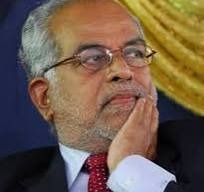
Justice B Sudershan Reddy is a former judge of rhe Supreme Court. He was a judge of erstwhile Andhra Pradesh High Court and Chief Justice of Assam High Court. He is known for his radical judgment in Salwa Judum case. He has been carrying a copy of the Constitution in his pocket for about five decades. He was the candidate of the combined Opposition in the election of Vice President of India recently.