
Jyotirlinga Paper 7
The Legend
The story of Baidyanath temple begins with the peak of ambition. Ravana, the king of Lanka, performed a fierce penance to please Lord Shiva. He wanted to bring the divine power of the Linga to his kingdom to make it invincible. Shiva, moved by this dedication, granted the request but set one condition, if the Linga were placed on the ground anywhere during the journey, it would stay there forever.
As Ravana carried the Linga toward Lanka, the gods grew concerned about the balance of power. They devised a plan to ensure the Linga remained in a neutral place. Through divine play, Ravana felt an overwhelming need to relieve himself. He handed the Linga to a local cowherd, who, finding it too heavy, placed it on the ground. When Ravana returned, he could not move the Linga. In his frustration, he pressed down on it with his thumb, leaving a visible mark. This site in Deoghar became known as Baidyanath, where the deity is worshipped as the Divine Physician.
History
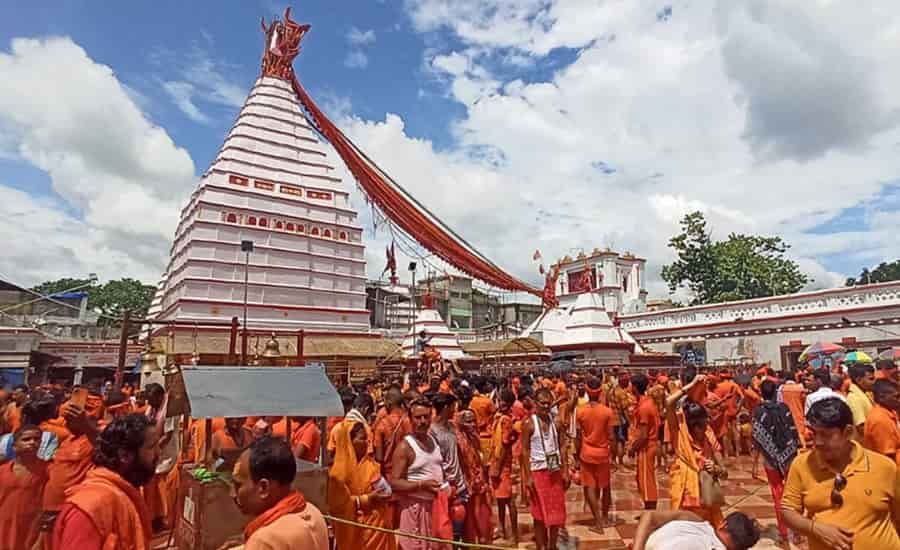
Baidyanath Dham has stood as a centre of faith for centuries. Unlike many temples built by a single king, this complex grew through the contributions of many dynasties. The Gadhwal kings and later the local rulers of Gidhaur played a major role in its upkeep. Today, it is located in the Deoghar district of Jharkhand, a region known for its rolling highlands and ancient forests.
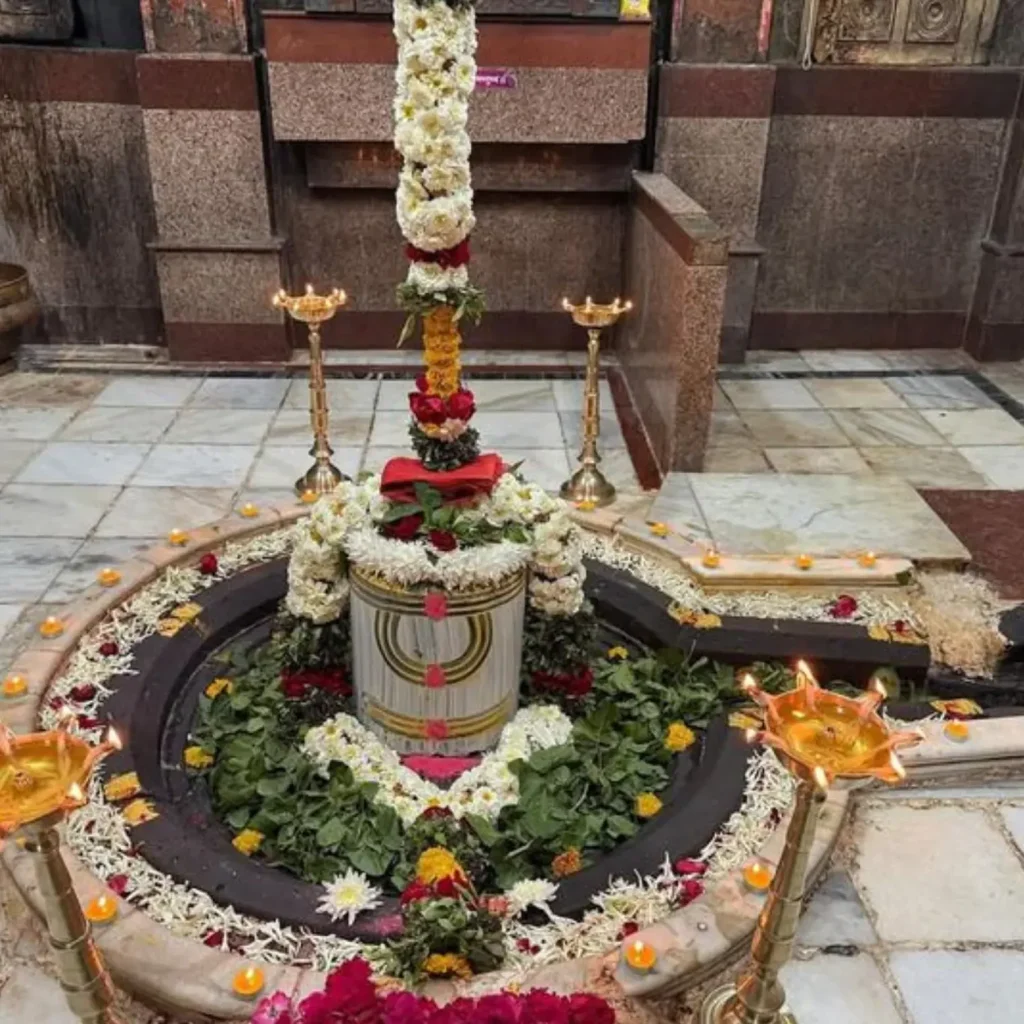
The architecture is simple and sturdy. It features a pyramid shaped tower that stands 72 feet tall. A unique feature of the temple is the Chandra-Kanta Mani. While many temples have a water vessel above the Linga, this one is traditionally made of moonstone. It was placed there specifically to cool the deity after the fiery intensity of Ravana’s penance. Unlike the standard copper vessels used for rituals elsewhere, this moonstone acts as a permanent symbol of soothing and recovery.
The layout offers a rare lesson in balance. The shrines of Shiva and Shakti stand facing each other, linked by a massive red silk thread. This is known as the Gathbandhan. In this tradition, Shiva is the Vaidya or the doctor, while Shakti is the Aushadhi or the medicine. The thread symbolizes the union of the Healer and the Healing Energy. It teaches us that the intent to fix something is incomplete without the active grace to carry it out.
Deoghar means the Abode of Gods. During the month of Shravan, millions of seekers walk 105 kilometres from Sultanganj in Bihar to Deoghar. They carry holy water to offer at the temple. This tradition connects the physical body with a sense of high purpose. It shows that the road to restoration often requires a long and mindful walk.
Deeper Meaning
Baidyanath represents the essential balance between Ambition and Limitation. Ravana was a high-performer who had the drive to own the divine. But he forgot that even the greatest force has human limits. This site is a reminder that no matter how much power you gain, you still have to respect the laws of nature and the needs of your body.
The name Baidyanath shifts our view of Shiva. He is often seen as the destroyer, but here he is the Healer-Shiva. It tells us that real growth isn’t just about adding new skills or chasing a higher status. It is about fixing the cracks in our own character. It is about the work we do on the inside to stay whole. The core lesson is about being both a Striver and a Restorer. In our world, we are taught to keep running. But Baidyanath teaches us that you must also know when to check yourself into the recovery room. True wholeness is not just about being strong. It is about accepting your strength and your scars at the same time.
Relevance to Contemporary Life
In our current culture, we celebrate the relentless grind. We honor the constant pressure to produce and the pride of being busy. We treat our minds like tools that should never stop. Baidyanath is an ancient warning against modern burnout. It reminds us that ignoring your limits doesn’t make you a hero. It eventually leads to a collapse.
This site teaches us the Importance of the Pause. In a long race, the runner who wins is the one who knows how to manage their energy. To be a high achiever in the long run, you must become an expert in your own recovery. Rest is not a sign of weakness. It is a strategic choice for staying in the game.
It also speaks to Leadership through Empathy. A leader is often expected to be the healer for their team. You cannot just demand results. You must also have the capacity to mend the friction and the fatigue within your group. True leadership is about building a culture where restoration is as valued as the final goal.
Real Life Examples
- The Professional Athlete: An elite player does not just spend all their time on the field. They spend an equal amount of time on nutrition, sleep, and physical therapy. They know that a body that cannot heal is a body that cannot compete. Their success is a result of the work and the rest.
- The Corporate World: The shift toward Work-Life Integration is a modern form of Baidyanath’s wisdom. Leaders are starting to realize that a stressed mind is a less creative mind. By respecting the off-hours and giving people the space to disconnect, organizations see higher productivity and better long-term results.
- Nature’s Rhythm: Consider the Forest. Trees do not bloom all year round. They have seasons of intense growth and seasons of dormancy where they pull their energy back into the roots. This pause is what allows them to survive the winter and return stronger in the spring. Nature knows that constant blooming leads to death.
- Architecture: We see the need for expansion joints. Large buildings and bridges are not built as one solid, rigid piece. They have small gaps to allow for movement and stress. Without these gaps to handle the pressure, the structure would crack and fail. Humans need those same gaps in their schedules to stay standing.
Seeker’s Summary
Baidyanath is the temple of the Divine Physician. It teaches us that the road to power must include the road to recovery. We learn that:
- Ambition without acknowledging limits leads to a fall.
- True strength is found in the ability to heal yourself and others.
- The pause is not an interruption to the journey; it is a vital part of it.
- Healing is a union of intent (Shiva) and active energy (Shakti).
About the Author
(R Srinivasa Murthy, the author is a corporate leader, independent writer and is a student of Hindu philosophy. He is a Demystic, dedicated to stripping away unnecessary mysticism around traditions and practices to present a practical system for the next generation. His upcoming book, “Logic of And: Sanatana Dharma as a Toolkit for the Contemporary Seeker“, bridges the gap between ancient wisdom and modern life to build an inclusive and living civilization.)

With a journalistic long journey, we bring you https://primepost.news, a dynamic platform committed to unraveling the intricate tapestry of Indian politics, particularly delving deep into the heart of Telangana and Andhra Pradesh. Our blog is not just a source of news; it’s a reservoir of insights, analysis, and thought-provoking reviews.





It’s a very good write up on Baidyanath Temple. Balance of power. Detailed description. This says nothing has been created without a reason. There is a valid reason for every happening. This can be understood and realised with this story. And very inspiring.
Well narrated! Application of the principle of balance between ambition and restraint is amply demonstrated by the limitations we encounter in practical life. Sometimes they reveal the irrationallity / danger behind our ambition – like the case of indiscriminate destruction of environment seeking economic development..
Great job – both innovative thought and reflection by the author.
Well narrated! Application of the principle of balance between ambition and restraint is amply demonstrated by the limitations we encounter in practical life. Sometimes they reveal the irrationallity / danger behind our ambition – like the case of indiscriminate destruction of environment seeking economic development..
Great job – both innovative thought and reflection by the author. Congratulations!
The Hindu mythology not only narrate the history of Gods but also Way Of Life. The way this interpretation has been made out of 12 Jyothir Linga’s is quite amazing.
And I feel Lord Shiva, who has been termed as God of Destroyer is actually God of Path, as eventually those who born have to die, he shows how to live & reach him.
This should be treated as Case Study for HR & for Corporate Top Echelon’s, to nurture & safeguard the performance index.
A highly insightful article by Mr. R. Srinivasamurthy. The paper presents the significance of Baidyanath Jyotirlinga with remarkable depth, clarity, and spiritual insight. The theme of restoration and healing is beautifully woven into the narrative, making it both informative and thought-provoking.
I am particularly inspired by this work, as Mr. R. Srinivasamurthy was my former boss and a mentor
Thanks Mr Murthy
Excellent write-up. The article beautifully balances ancient philosophy with modern life lessons, reminding us that true success lies not only in striving but also in healing and renewal. A powerful and relevant message for today’s generation.
Thanks
Sonu Saini
As someone involved in industrial operations, I appreciate the emphasis on preventive health and restoration. Good health is the foundation for productivity, safety, and quality of life. The connection between personal effort and guided recovery is well explained. A meaningful perspective on healing, wellness, and personal transformation. “A valuable article to read.”
As someone involved in industrial operations, I appreciate the emphasis on preventive health and restoration. Good health is the foundation for productivity, safety, and quality of life. The connection between personal effort and guided recovery is well explained. “A valuable article to read.”
As someone involved in industrial operations, Good health is the foundation for productivity, safety, and quality of life. The connection between personal effort and guided recovery is well explained. “A valuable article to read.”
Very inspiring to read. The concept of combining self-discipline with professional healing support is powerful and relevant in today’s fast-paced world. As someone involved in industrial operations, Good health is the foundation for productivity, safety, and quality of life. “A valuable article to read.”
An insightful article highlighting the importance of holistic healing and restoration. The connection between personal effort and guided recovery is well explained. Good health is the foundation for productivity, safety, and quality of life. “A valuable article to read.”
An insightful article highlighting the importance of holistic healing and re-establishment. The connection between personal effort and guided recovery is well explained. Good health is the foundation for productivity, safety, and quality of life. “Very good article to read.”
A wonderful and touching read. It reminds us that healing is a journey of courage, trust, and perseverance. The connection between personal effort and guided recovery is well explained. Thank you for sharing this inspiring story and message of hope.”
The connection between personal effort and guided recovery is well explained. Thank you for sharing this inspiring story and message of hope.”