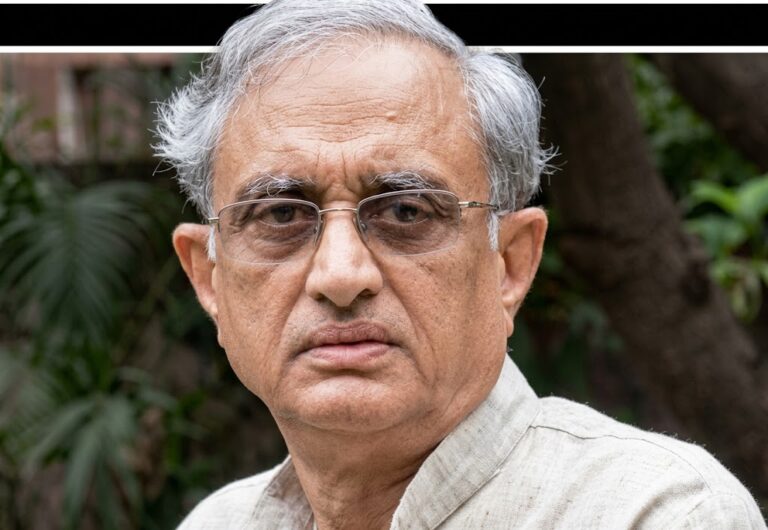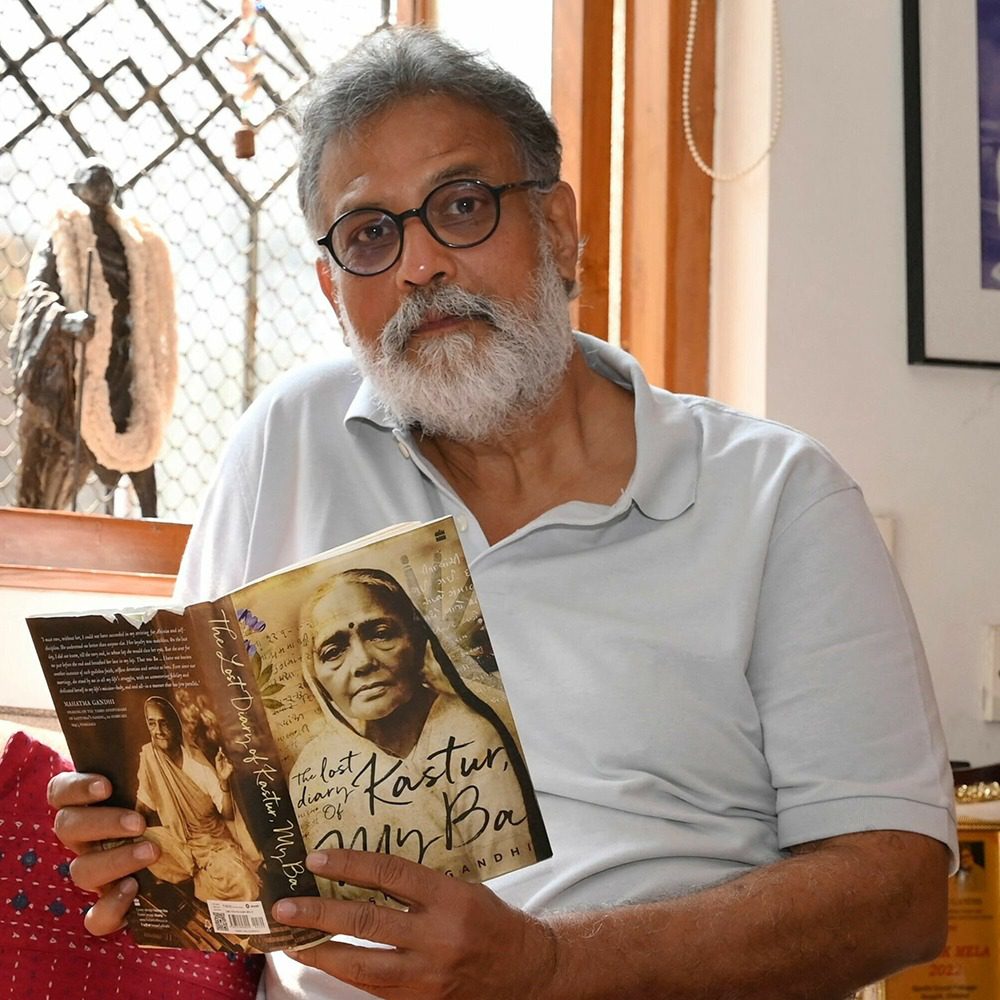
This video speech of Tushar Gandhi was used in the People’s Integration Council which was floated after the National Integration Council was dissolved. Tushar Arun Gandhi (born 17 January 1960) is an Indian author and son of Arun Manilal Gandhi, thus great-grandson of Mahatma Gandhi. In March 2005, he led the 75th anniversary re-enactment of the Dandi March. The following is the Text of the Speech.
Awakening the Masses
Namaskar, I am Tushar Gandhi. I would like to start this video with a sincere appeal to Shri Sonam to now end his fast. He has achieved something spectacular. After a long, long time, a person’s suffering has managed to awaken the Indian masses like we haven’t seen for a long time. His fast is today bringing out people onto the streets in support of him. That is one of the greatest signs in the apathy that we saw in the Indian masses during the last 12 years of the NDA rule in India.
Many mass movements happened, but the masses were not awakened to the extent that Sonam Wangchuk’s penance has brought about today. I think Sonam Wangchuk should also realize this and be satisfied, because the demand for the resignation of the Minister of Education in the Indian government in the Modi government was never going to be achieved. We must understand that the present government has its roots in a fascist ideology. They do not believe in democratic principles; they do not respect democratic institutions. They have trampled everything.
From Jallianwala Bagh to Bhagat Singh
We have seen that in the NRC-CAA movement, the way they sent goons to attack Shaheen Bagh, the way the farmers were forced to sit on the road for one year on the outskirts of Delhi, and the kind of barricades that were put in their way. This shows that this government doesn’t bother. It’s as bad as the British colonial government. There is an argument and an opinion gaining ground that the nonviolent movement succeeded because the British were benevolent. If you look at the history of the British Empire, I’m not just talking about India, I’m giving examples of India—but if you were to add all the human massacres conducted in the name of the British crown in totality, we must think about that.
Neither has the government of the UK apologized sincerely and condemned Dyer for committing a massacre of humanity. That is how cruel the British Empire was. The way they dealt with the revolutionaries despite Bapu appealing to the Viceroy to spare Bhagat Singh and his friends, not once, not twice, but on five recorded occasions, the colonial administration refused to convert his execution into a long-term sentence.
How the British Actually Prepared for Gandhi’s Death
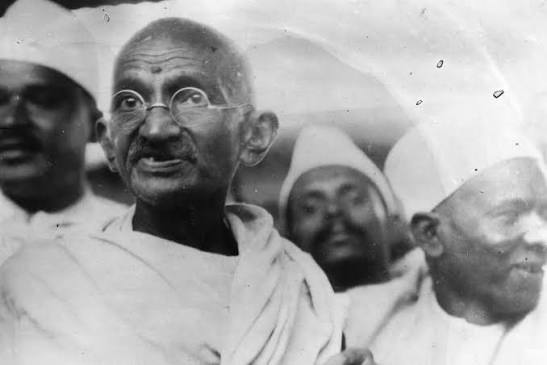
Even during the 21-day fast at the Aga Khan Palace detention center, instead of releasing him or giving him medical aid, they sent out drafts of obituaries worldwide to all the diplomatic missions of the British Empire and gave instructions to the diplomats on the obituary to be released in case of Gandhi’s death. The colonial administration stocked up on wood for his cremation on the premises in case of his death. Sarvepalli Radhakrishnan was visiting Shanghai, and he went to the British High Commission there and he found one of those missives which said that in case of Gandhi’s death, this is the obituary you have to release. He came back and said that the British government is prepared for Gandhi’s death.
This is how benevolent the British government was towards Gandhi. So, I think that theory needs to be debunked that it was easier for Gandhi because the British were kind and gentle. Yes, they were benevolent to a saucer whose apology they accepted and gave him a pension to become their stooge. This government is born out of that slave mentality to the colonials and the fascist mentality that they inherited from the Nazis of Europe. If you look at Golwalkar and his ‘Bunch of Thoughts’ you see that it is largely inspired by ‘Mein Kampf’ from Adolf Hitler.
Two Peas from the Same Pod
So how can we expect them to obey and honor democratic principles? How do we expect them to even think that in a democracy, the people are the biggest power there is? Because to them, they are the supreme rulers, as bad as a crown, as bad as a colonialist. You must remember the history of the freedom movement: at every opportunity, the parent organization of the BJP—the RSS—collaborated with the British and tried to sabotage the freedom movement. The greatest example was Syama Prasad Mookerjee’s letters to the Governor of Bengal on how to thwart the Quit India movement and marginalize it. All these are historic facts.
I reiterate them today because of this whole idea that if we had the British today, maybe they would have been better with Sonam Wangchuk than the present government. No, they are both peas from the same pot—the fascist government that we face today and the colonial government whose sole objective was to sustain the crown in India.
Beyond the ‘Two-Minute Reel’ Critique
There’s also a campaign saying that Bapu’s protests or fasts were for an audience and conducted for social media and in the two-minute reel format, accusing that Gandhi’s methods did not benefit the forest dwellers or that they wouldn’t have succeeded. Yes, when he did the Dandi March, at the end of his 241-mile walk when he arrived in Dandi, he did give a message saying, “I want world sympathy in this battle of right against might.” The very fact that the battle of right against might does not succeed without evoking a public sentiment, a public empathy, a public sympathy is the crux of that battle. It is not a battle fought with bullets and bombs where the might of the weapon will subdue the opponent. This is a reformation on a moral and ethical basis.
So, a public opinion has to be created. That is why initially, when Bapu planned to walk for 6 days and pick up salt at the nearest saline water source, he realized that it was too short a time to explain to the people whose support he wanted about what he was doing. He extended it to 24 days, and that is where the Salt Satyagraha was such a spectacular success. After Bapu picked up salt at Dandi, it spread across the nation. Even when all the leaders of that movement were in prison, people were making salt in their villages, in their hamlets, in their communities, in their localities, and defying the British on terraces and halls in the city. In Mumbai itself, there were three venues where the Salt Satyagraha was performed, and the British colonial government brutalized the satyagrahis. But that is the essence.
Fasting as Penance vs. Protest
Bapu’s fasts were very rarely against an administration, very rarely against some grievance that he wished to resolve. Most of his fasts were penances for when he felt that he or those whom he considered to be his closest aides and colleagues were straying from the path and erring in their ethical and moral behavior. The only three fasts which he carried out because of certain circumstances that he felt were not acceptable were the epic fast against the Poona Pact, where he felt that if the British awarded a separate electorate to the Dalits, then the freedom movement would be divided—not because he was worried that his leadership would be compromised, but because he realized that the Dalits were a very big and important part of the freedom movement, and if the British succeeded in removing them from the mainstream, the freedom movement would be jeopardized and may even collapse.
Dr. Babasaheb Ambedkar, although he felt that he was coerced into accepting some of the terms and coming to a compromise with Bapu, was a patriot. With that consideration, he shook the hand that was extended to him. He felt betrayed—I would have felt betrayed also. Those, and the last two fasts in Kolkata and Delhi when Bapu felt that his people, whom he trusted, had abandoned his path, so he fasted to bring them back to their senses and to establish communal harmony and peace in the nation.
Bapu’s Final Penances and the Awakening of Sonam Wangchuk
Not many people know that during the entire peace yatra in Noakhali and Tripura—the riot-torn districts—and then in Bihar, Bapu had conducted a fast where he consumed half the nutrition that he used to have in a day as a penance for what he believed was wrong. It took a toll on his health, but throughout that yatra, he continued to do that. When he came back to Kolkata in free independent India, his only two fasts in independent India were conducted in public because at that time, the government focused on him because they knew that the message he was sending out, the people would believe more than if the government was to make appeals for communal peace, harmony, and the cessation of hostilities between the two communities.
These were the facts for which Nathuram Godse was sent to silence that voice—a voice which was leading India away from where it is being led for the past 12 years by the present government. So please, please let us not say that the British were very benevolent and that’s why our nonviolent movement succeeded. It was difficult. It took four decades to bring the British to their knees—four decades of continuous sacrifices by millions of people.
That is where I want to go back to where I started and congratulate Sonam Wangchuk, because he, after a long time, seems to have awakened the soul and the spirit of the Indian people. So please understand before generalizing and making statements which sound very good in a 45-second reel but are far from the reality of history, demeaning the sacrifices of stalwarts like Bhagat Singh and martyrs like Bapu and so many others who laid down their lives and sacrificed their entire lifetimes for the freedom of this country.
Editor, Prime Post
Ravindra Seshu Amaravadi, is a senior journalist with 38 years of experience in Telugu, English news papers and electronic media. He worked in Udayam as a sub-editor and reporter. Later, he was associated with Andhra Pradesh Times, Gemini news, Deccan Chronicle, HMTV and The Hans India. Earlier, he was involved in the research work of All India Kisan Sabha on suicides of cotton farmers. In Deccan Chronicle, he exposed the problems of subabul and chilli farmers and malpractices that took place in various government departments.
Email: ravindraseshu7@gmail.com
Mobile: 9063718675