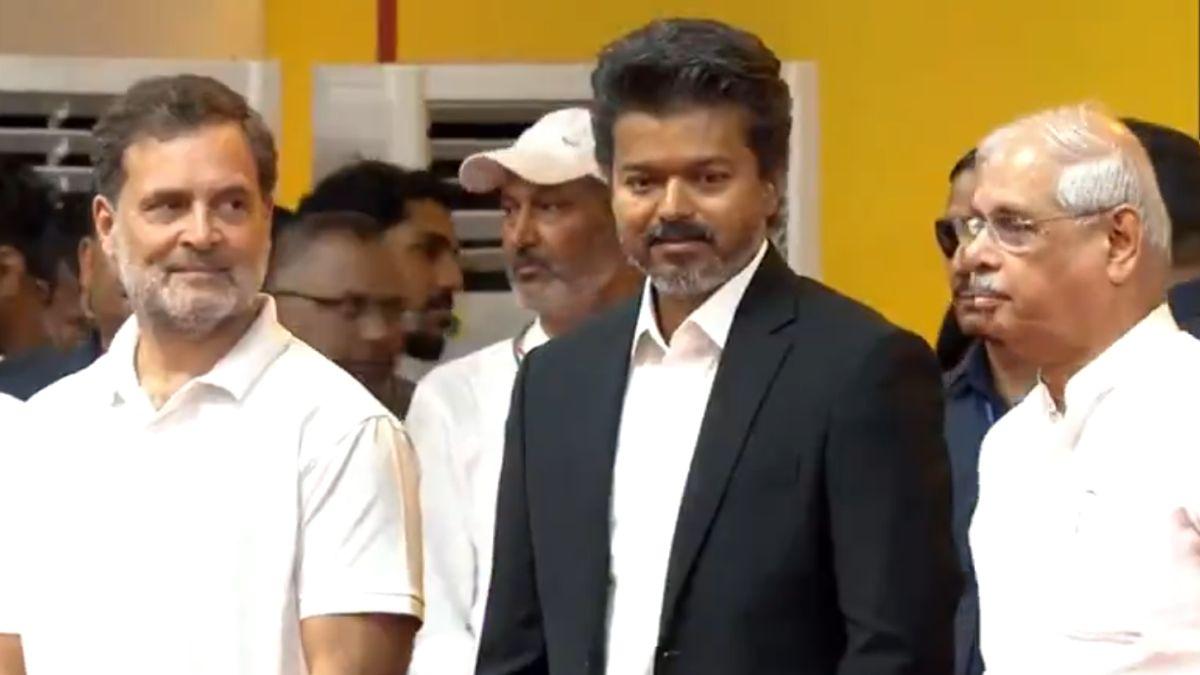
The constitutional debate emerging from the fractured 2026 Tamil Nadu Assembly verdict is not about personalities, emotions, political popularity, or media narratives. The real question is simple: What does the law permit? Can actor-politician Vijay become Chief Minister without proving majority support in the Assembly? Equally important, can the Governor refuse to invite the leader of the single largest party merely because he lacks an absolute majority at the outset? Fortunately, Mr Vijay could muster the necessary strength to form the Government, and the Governor followed the norms properly and allowed him to be sworn in to the office of Chief Minister. With this slender ‘majority’, one more than half number of MLAs has at any time, may any happen. The policy, in such situations, is established by the Supreme Court and conventions, evolved over a period of time.
The answer lies not in political speculation but in the Constitution of India and the authoritative interpretation given by the Supreme Court in S. R. Bommai v. Union of India.
Mr. Vijay’s Tamizhaga Vettri Kazhagam (TVK) reportedly emerged as the single largest party with 108 seats, falling short of the 118 required for a simple majority in the 234-member Assembly. This has naturally triggered intense negotiations, coalition talks, and political manoeuvring. Yet constitutional principles remain clear irrespective of political uncertainty.
The Governor is not expected to act on rumours, television debates, press leaks, or speculative claims. Constitutional functionaries can act only on officially established material, letters of support, coalition agreements, and verifiable claims made by elected legislators. If Mr. Vijay or any alliance seeks to form the government, they must present credible evidence of majority support. The Governor has neither the constitutional duty nor the authority to “organize” support for any claimant. That responsibility belongs entirely to political parties and elected representatives.
The Precedent
The Supreme Court’s judgment in S. R. Bommai v. Union of India remains the foundational precedent governing such situations. The Court laid down several enduring constitutional principles. First, the majority enjoyed by a government must always be tested on the floor of the Legislative Assembly and not determined subjectively by the Governor. Second, gubernatorial discretion is not absolute and cannot be exercised arbitrarily. Third, constitutional processes cannot be manipulated for partisan or political purposes.
Therefore, the central constitutional principle is straightforward: nobody – including Mr. Vijay – can become Chief Minister merely because of public popularity, electoral momentum, or media perception. Equally, nobody can be denied the opportunity solely because they are short of a majority at the initial stage, provided they can demonstrate a realistic possibility of commanding confidence on the Assembly floor.
Bridging the Gap: From Single Largest Party to House Majority
The Governor’s role is limited but constitutionally sensitive. If a claimant appears capable of securing majority support, the Governor may invite that leader to form the government, subject to an immediate floor test. The Governor cannot indefinitely delay the process while personally evaluating political probabilities. Nor can Raj Bhavan become the venue for determining legislative strength. The Assembly alone is constitutionally competent to decide the majority.
Several later Supreme Court interventions reinforce this principle. In Rameshwar Prasad v. Union of India, concerning the dissolution of the Bihar Assembly, the Supreme Court warned against denying political parties a fair opportunity to explore Government formation. Premature constitutional action without allowing democratic processes to unfold was strongly criticized. The 2017 Manipur Government formation controversy produced another constitutional lesson. Although the Congress emerged as the single largest party, the Governor invited a BJP-led post-poll coalition that claimed majority support. The episode demonstrated that constitutional legitimacy ultimately depends not on being the largest single party but on commanding majority confidence in the House.
Karnataka constitutional crisis
Similarly, the 2018 Karnataka constitutional crisis highlighted the dangers of prolonged delays. The Governor invited the BJP as the single largest party and granted fifteen days to prove a majority. The Supreme Court intervened swiftly and reduced the period to twenty-four hours, fearing horse-trading, inducements, defections, and political manipulation. The government collapsed during the confidence vote itself. The Karnataka episode established an important constitutional norm: Governors should avoid granting unnecessarily long periods for proving majority because delay itself can destabilize democracy.
Raj Bhavan vs The Supreme Court
The 2019 Maharashtra government formation controversy further strengthened this jurisprudence. President’s Rule was revoked dramatically in the early morning hours, and a government was sworn in based on disputed claims of support. The Supreme Court intervened quickly and ordered an immediate floor test. The constitutional message was unmistakable: the majority must be demonstrated transparently on the Assembly floor, not through confidential claims inside Raj Bhavan.
These precedents directly shape the present Tamil Nadu situation. If Mr. Vijay claims the ability to form a government, the constitutional course is not indefinite delay, private negotiations within Raj Bhavan, or speculative assessment by the Governor. The proper constitutional mechanism is a prompt floor test before the elected Assembly.
Follow the Constitution as explained by SC
Article 164(2) of the Constitution reinforces this principle through the doctrine of collective responsibility. A Council of Ministers survives only so long as it enjoys the confidence of the Legislative Assembly. The office of the Chief Minister is therefore inseparable from the legislative majority.
Consequently, the present constitutional issue is neither pro-Vijay nor anti-Vijay. It concerns the preservation of parliamentary democracy itself. The Governor cannot arbitrarily appoint a Chief Minister who lacks legislative support. At the same time, the Governor cannot reject a claimant merely because the majority is yet to be formally tested. Constitutional morality requires neutrality, transparency, and immediate recourse to the Assembly floor.
If TVK secures credible support from other legislators and presents authentic letters backing Vijay’s leadership, the constitutional convention would require the Governor to provide an opportunity to prove a majority within a short and reasonable period. If that majority fails during the floor test, the government must fall. That alone is the constitutional method recognized by the Supreme Court.
Democracy as a Numbers Game, Not a Popularity Contest
In a hung Assembly, democracy is not decided in television studios, resorts, or Raj Bhavans (Or Lok Bhavans). It is decided only inside the Legislative Assembly through an open floor test. That is the enduring constitutional legacy of S. R. Bommai v. Union of India and the later constitutional crises that followed it. No governor can ignore this dictation of the Supreme Court based on the Constitutional conventions, especially in Tamil Nadu in a fast-changing political scenario.
[Vikas Bansode, Attorney at Law, Supreme Court, the author of the article, is a former Legal Advisor to the Governor of Karnataka, Andhra Pradesh, Kerala, and a former advisor to the Chief Minister of Karnataka.]

With a journalistic long journey, we bring you https://primepost.news, a dynamic platform committed to unraveling the intricate tapestry of Indian politics, particularly delving deep into the heart of Telangana and Andhra Pradesh. Our blog is not just a source of news; it’s a reservoir of insights, analysis, and thought-provoking reviews.