His Courage and the Power of the Press
The life of Sri M. S. Acharya is a story of courage, commitment, and transformation. He belonged to a generation for whom freedom was not an abstract constitutional principle but a cause that demanded personal sacrifice. As a young man in Hyderabad State, he witnessed repression and participated in the struggle for liberation. In later years, he carried the same spirit into journalism, making the newspaper a vehicle for public awareness, social responsibility and fearless expression. His journey from the Hyderabad Liberation Movement to Janadharma and Warangal Vani represents a remarkable continuity: the young freedom fighter who once carried information secretly eventually became the journalist who carried the voice of the people openly.
When even a newspaper could become dangerous
The Hyderabad State of the 1940s was a difficult environment for those seeking political freedom. Circulation of newspapers and movement literature could attract official attention. In such circumstances, collecting information and transmitting it to activists was itself an act of courage. Acharya became associated with efforts to gather information concerning the liberation movement and communicate it to leaders operating from border camps. Secret documents and pamphlets had to be moved discreetly and at speed. According to family and movement recollections, information was sometimes carried even to prisoners.
The printed word therefore acquired a special significance. A newspaper was not merely something to be read; it could connect isolated activists, inform the public and sustain a movement. Printing material was difficult to obtain. It is recalled that cyclostyling machines were brought from Madras concealed within bundles of newspapers. Such equipment enabled the preparation and circulation of material required by activists.
Among those associated with this network was Talluri Ramaiah Swamy, connected with Saradhi, who is remembered as reporting information to the Hyderabad newspaper under the editorship of Dr. M. Chenna Reddy and helping carry confidential material and pamphlets from border camps to movement leaders. These were not the activities of a conventional journalist working from a newsroom. They were the actions of people who understood that information itself could become a form of resistance.
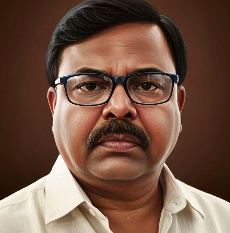
Through various social media platforms like Facebook, Warangal-born and Hyderabad-settled biographer Mohammad Ghouse has extensively documented and praised M. S. Acharya’s high standards of journalism.
Courage under threat
The dangers were personal as well as political. Family recollections record repeated attacks on Acharya’s house by Razakars. On one occasion, he was reportedly beaten with lathis and spears but did not disclose the information sought from him. Local traders intervened and helped protect him. In another incident near Intezaar Ganj in Warangal, a Nizam military officer is recalled as having struck him with a motorcycle, causing him to fall and attempting to attack him further. Irukulla Srisailam is remembered as having rescued him. The threat of Shehar Badar—being ordered to stay away from the town—added to the insecurity. When the danger became acute, families had to leave Warangal for their safety. For a young man, these experiences could have led to withdrawal from public life. In Acharya’s case, they appear to have strengthened his determination.
Building courage among the young
Acharya’s contribution was not confined to transmitting information. He also participated in activities that brought young people together. At Kothakonda Jatara, youth camps were organised under the leadership of Pendyal Ramanuja Rao. Acharya worked as a volunteer, helped circulate information and maintained contact with young activists. Through the Pratapa Rudra Dal, he was associated with wrestling competitions held during 1946, 1947 and 1948. In ordinary circumstances such competitions might have been regarded simply as sporting events. In the political atmosphere of the time, however, bringing young people together required organisation and courage. Training activities were also associated with Sundar Bhavan in Hyderabad, involving Kousam Vaikuntham, A. Rama Rao and Veerabhadra Rao. The recollections further mention Dr. Amaram Rama Rao and a training camp at Nagpur under the leadership of Dr. Munje. Whatever the precise institutional character of these activities, they formed part of a period in which young people were seeking ways to organise themselves and prepare for a profoundly uncertain future.
Standing with ordinary people
One of the most human aspects of Acharya’s story is his involvement in protecting ordinary residents. During periods of insecurity, he reportedly joined Mallesh Mallesham and Aduvala Venkatanarsaiah in night patrols in Papayyapet and other colonies of Warangal. They carried lathis and other protective implements, guarded vacant houses and moved among residents to reassure them. Such work rarely appears prominently in formal histories. Yet it reveals what public service meant at the grassroots. When people were frightened, someone had to stand with them. When houses were deserted, someone had to protect them. When uncertainty prevailed, someone had to provide courage. Acharya was prepared to do that.
Freedom as a way of life
His commitment was also reflected in participation in programmes associated with national leaders, including Mahatma Gandhi, in volunteering at public meetings and in wearing khadi as an expression of the freedom movement. For him, therefore, freedom was not simply the removal of one political authority. It involved personal discipline, public participation and responsibility towards society. The recollections concerning equipment moved through Mamunur airport, including binoculars associated with the movement, further illustrate the atmosphere of secrecy and vigilance in which activists operated.
Returning to a free Warangal
The decisive change came in September 1948. Following the Indian Government’s military action known as Operation Polo, Hyderabad State was integrated into the Indian Union. According to family recollections, Acharya returned to Warangal on September 22, after the city had been liberated. That return carried a significance beyond the personal. A family that had been forced to leave because of threats could now return to its home. A young man who had worked under conditions of secrecy could now look towards a future in which public expression could be pursued more openly. But freedom did not end Acharya’s public journey. It changed its form.
From freedom fighter to journalist
The most inspiring feature of Acharya’s life is what he did with the experience of the struggle. He did not leave public life behind after liberation. Instead, he entered the world of journalism with a deeper understanding of the value of information, public awareness and the freedom to speak.
Through Janadharma, which he founded and edited, he created a platform for public issues. Later, through Warangal Vani, he expanded that journalistic mission. The values of his youth remained visible in his journalism: courage in the face of authority, concern for ordinary people, commitment to information and an insistence that the press should serve society. There is therefore a direct line between his early struggle and his later journalism.
As a young man, he risked his life to carry information to those fighting for freedom. As a journalist, he devoted his life to making information available to the people.
That is perhaps the simplest way to understand his legacy.
The power of an inspiring life
The story of M. S. Acharya is not inspiring merely because he faced danger. Many people of his generation faced danger. What distinguishes his life is the continuity of his commitment. He did not treat freedom as the end of his responsibility. He treated it as the beginning of another responsibility: to use freedom constructively. The secret pamphlet became the newspaper. The underground network became public journalism. The night patrol became public service. The courage required to resist repression became the courage required to question authority. And the concern for the freedom of Hyderabad became a lifelong concern for the freedom of expression and the dignity of ordinary citizens. This is why remembering M. S. Acharya is relevant not only to historians of the Hyderabad Liberation Movement but also to journalists, students and citizens today. His life offers a simple lesson: circumstances may change, but commitment to truth and public service need not change.
A legacy beyond a statue
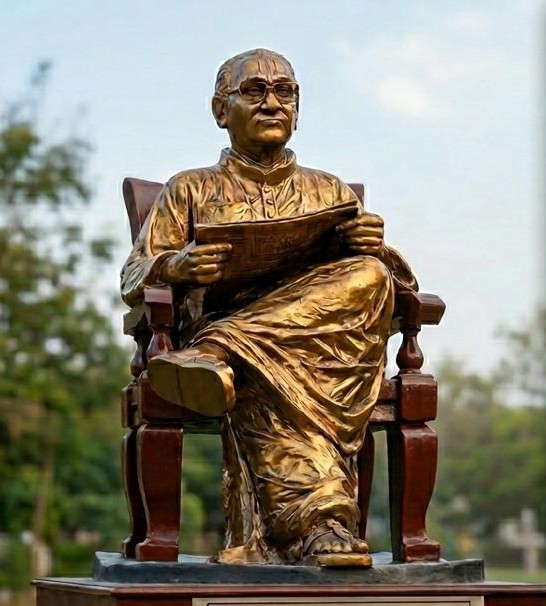
The unveiling of a statue of Sri M. S. Acharya is therefore more than an act of remembrance. It is an opportunity to recall a generation that experienced freedom as sacrifice and understood journalism as responsibility. A statue can preserve his likeness. His newspapers preserve his words. But his greatest memorial is the example of a life lived with courage. He began his public journey when possessing a newspaper could be dangerous. He ended it as a veteran journalist whose newspapers became part of the public life of Telangana. Between those two points lies a remarkable journey—from freedom fighter to journalist, from secrecy to public expression, from personal risk to public service. Sri M. S. Acharya’s life reminds us that freedom acquires meaning only when it is used responsibly. The press acquires credibility only when it remains committed to the public. And a person’s legacy becomes enduring when personal courage is transformed into a service that benefits generations beyond his own. His life was his message: freedom must be defended, truth must be communicated, and public service must continue even after the struggle for freedom is over.
M. S. Acharya Award to Kovela Suprasannacharya
Honouring a Literary Association and a Journalistic Tradition
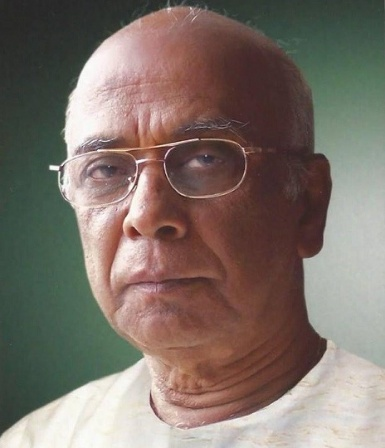
The M. S. Acharya Award has been conferred on Kovela Suprasannacharya, the distinguished Telugu scholar, writer, poet and literary critic, on the occasion of the 103rd birth anniversary of M. S. Acharya, freedom fighter and founder-editor of Janadharma and Warangal Vani. The award assumes special significance because of the close literary association between Suprasannacharya and M. S. Acharya. Suprasannacharya served as the Honorary Editor of the Janadharma literary bimonthly, published by M. S. Acharya. Their association brought together journalism and literature and created a space for serious literary and intellectual discussion. Former Income Tax Officer and IRS officer G. N. Gyanaprakash, former senior banker J. B. Muniratnam, Prof. Madabhushi Sridhar, Rajagopalachary, Kovela Gopal, Seshavataram and Kovela Santosh spoke on the occasion. The award is not merely a recognition bestowed on an individual literary figure. It represents a tribute to a long-standing literary association, a journalistic tradition and an intellectual culture of a generation. M. S. Acharya created Janadharma as a platform for public journalism, while Suprasannacharya contributed to its literary and intellectual character. Their association through the literary edition of Janadharma represents an important meeting point between the worlds of journalism and literature.
Remembering M. S. Acharya through service
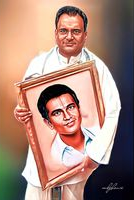
The commemoration of M. S. Acharya has also been connected with initiatives intended to turn remembrance into public service. On the occasion of his centenary, the M. S. Acharya Foundation, associated with Prof. Madabhushi Sridhar and his family, established the Acharya Clinic at Gorrekunta. With the support and permission of the late Prof. Parameshwari, founder of the Ashraya voluntary organisation, his friends, students and trustees, the medical centre was completed at a cost of approximately Rs. 12 lakh. The clinic provides medical services to residents of the old-age home. Doctors attend the centre on designated days, and medical camps are also conducted periodically. Thus, the memory of M. S. Acharya has been associated not merely with commemorative events but also with a continuing commitment to public welfare.
Preserving his life and legacy
The life of M. S. Acharya has also been documented through books and institutional publications. The renowned publishing house EMESCO published From Paper Boy to Editor: The Life Story of M. S. Acharya, written by Prof. Madabhushi Sridhar, in 2024. The Telangana Media Academy published a monograph on M. S. Acharya in 2025, further documenting his contribution to journalism and public life. A statue of M. S. Acharya was also established near the park in the Journalists’ Colony at Gopanpally, Hyderabad, at a cost of approximately Rs. 8 lakh. It was unveiled on 7 March 2026 in the presence of ministers, friends, relatives, journalists and well-wishers. On 3 October 2026, his 103rd birth anniversary, floral tributes were paid to him in remembrance of his contribution as a freedom fighter, journalist and public servant.
A tribute that connects generations
The honour bestowed on Kovela Suprasannacharya therefore acquires a significance beyond an individual award. It brings together two distinguished strands of Telugu public life: the fearless journalism of M. S. Acharya and the literary scholarship of Kovela Suprasannacharya. It also recalls a period when journalism and literature were not isolated spheres but interacted closely in shaping public thought and intellectual life. The Janadharma literary bimonthly provided such a meeting ground, with Suprasannacharya serving as its Honorary Editor. Honouring him today is therefore also a way of honouring that shared literary and journalistic heritage. At 91, Suprasannacharya continues to represent a generation that regarded literature not merely as an artistic pursuit but as an important part of the intellectual life of society. The M. S. Acharya Award consequently stands as a tribute not only to Kovela Suprasannacharya but also to the enduring relationship between literature, journalism, public service and social responsibility.
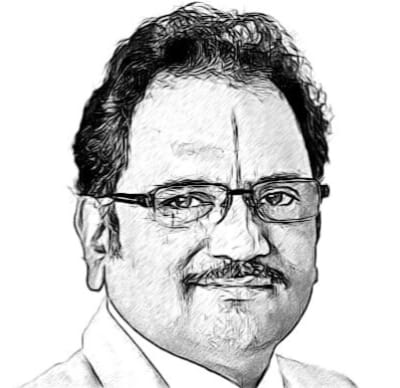
Law professor and eminent columnist
Madabhushi Sridhar Acharyulu, author of 63 books (in Telugu and English), Formerly Central Information Commissioner, Professor of NALSAR University, Bennett University (near Delhi), presently Professor and Advisor, Mahindra University, Hyderabad. Studied in Masoom Ali High School, AVV Junior College, CKM College, and Kakatiya University in Warangal. Madabhushi did LL.M., MCJ., and the highest law degree, LL.D. He won 4 Gold Medals at Kakatiya University and Osmania University.
Email: cicsridhar@gmail.com
Mobile: 8447651505