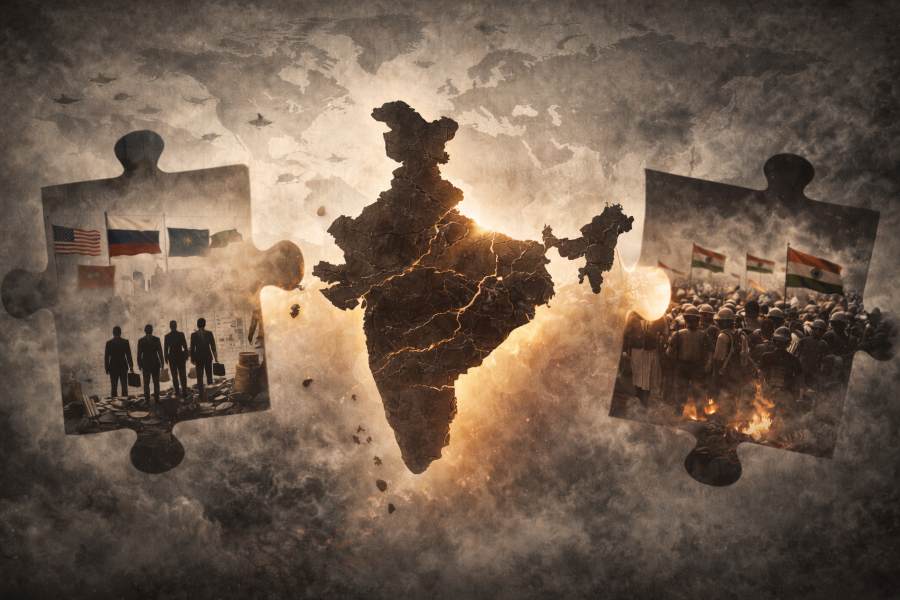
The Republic Amid a Converging Arc of Geopolitical Conflict
There are moments in the history of nations when geography ceases to be merely a physical reality and becomes a strategic destiny. India today stands at precisely such a moment. The Republic is confronted not by a single adversary or a solitary crisis, but by a convergence of military, economic, geopolitical, technological and ideological challenges unfolding simultaneously across nearly every frontier. From the icy heights of the Himalayas to the turbulent waters of the Strait of Hormuz, from the Bay of Bengal to the Indian Ocean, India is compelled to safeguard its sovereignty in an era where conventional warfare, cyber conflict, economic coercion, proxy terrorism, information warfare and maritime competition increasingly overlap.
Unlike the Cold War, when strategic equations were relatively predictable, the contemporary international order is characterised by fluid alliances, transactional diplomacy and contested global leadership. Institutions created after the Second World War struggle to respond effectively to twenty-first century conflicts. The rules-based international order itself is under unprecedented strain as great-power rivalry intensifies.
China: The Principal Strategic Challenge
No external challenge confronting India is more comprehensive than the rise of China. Beijing’s ambitions transcend territorial disputes. They encompass military supremacy, technological dominance, economic influence, maritime expansion and geopolitical leadership across Asia. China’s military modernisation has transformed the balance of power along the Himalayan frontier. Massive investments in border infrastructure, high-altitude airfields, all-weather roads, rail connectivity, surveillance systems and dual-use villages have fundamentally altered the operational environment. The People’s Liberation Army has demonstrated its willingness to employ calibrated coercion, incremental territorial assertion and psychological pressure without necessarily crossing the threshold into full-scale war.
Recent reports from tribal communities in Arunachal Pradesh alleging Chinese occupation of traditional grazing lands reinforce long-standing concerns regarding China’s strategy of creating facts on the ground. India has consistently rejected Beijing’s territorial claims and repeated attempts to rename places within Arunachal Pradesh. The issue is not merely cartographic; it concerns sovereignty, indigenous rights and long-term strategic stability. China’s strategy extends far beyond land borders. Through the Belt and Road Initiative, the China–Pakistan Economic Corridor, port acquisitions across the Indian Ocean, expanding naval deployments and growing influence in neighbouring countries, Beijing seeks to establish strategic depth around India. This “string of strategic access points” has implications extending from Gwadar and Hambantota to the western Indian Ocean.
Equally significant is China’s dominance in critical minerals, rare earth processing, batteries, solar manufacturing, telecommunications equipment and advanced industrial supply chains. Strategic competition today is increasingly determined not only by armies but by control over technology and industrial ecosystems.
Pakistan: Proxy Conflict in a Nuclear Environment
Pakistan remains India’s most persistent source of conventional and unconventional security challenges. Despite military asymmetry, Islamabad has repeatedly relied upon proxy warfare, cross-border terrorism, radicalisation networks, information operations and sustained diplomatic propaganda to impose costs upon India while avoiding direct conventional escalation. The infrastructure supporting extremist organisations has survived repeated international scrutiny. Ceasefire arrangements have reduced infiltration at certain periods, yet the ideological ecosystem that sustains terrorism remains resilient.
Recent intelligence assessments and media reports suggest renewed attempts by Pakistan-based actors to revive instability in Jammu and Kashmir through infiltration, recruitment of local over-ground networks, radical online propaganda, coordinated misinformation campaigns and efforts to internationalise the Kashmir issue in global forums. Such strategies are intended not merely to provoke sporadic violence but to create a perception of persistent instability capable of attracting external diplomatic intervention.
Pakistan’s security establishment has historically viewed Kashmir as an unfinished geopolitical objective. Whenever conventional military options become strategically untenable, hybrid warfare, proxy terrorism, cyber operations, psychological warfare and information manipulation have often emerged as preferred instruments of statecraft. The convergence of these methods represents a continuing challenge to India’s internal security architecture. The nuclear dimension further complicates strategic calculations. Deterrence prevents large-scale conventional conflict while simultaneously encouraging limited proxy operations below the threshold of war. This “stability-instability paradox” remains one of South Asia’s most enduring strategic dilemmas.
Bangladesh: Instability in an Otherwise Successful Partnership
India’s relationship with Bangladesh has produced significant gains in connectivity, trade and security cooperation over the past decade. Nevertheless, political uncertainty, internal polarisation and the growing influence of religious extremism have introduced fresh vulnerabilities. Should domestic instability deepen, India could confront renewed pressures in illegal migration, cross-border crime, radicalisation and refugee flows. Border management therefore requires both humanitarian sensitivity and robust security mechanisms.
Myanmar: Civil War and India’s Eastern Security
Myanmar’s prolonged civil conflict has transformed India’s eastern frontier into a complex security landscape. The breakdown of state authority has facilitated narcotics trafficking, illegal arms movements, organised crime and refugee migration. Several insurgent groups operating in India’s Northeast have historically exploited the difficult terrain and weak governance across the frontier. The challenge therefore extends beyond migration to encompass regional stability, infrastructure connectivity and national security.
Nepal: Strategic Balancing in the Himalayas
Nepal illustrates the complexities of twenty-first century diplomacy. Deep civilisational ties continue to bind India and Nepal through open borders, economic interdependence and cultural affinity. Simultaneously, expanding Chinese investments, infrastructure projects and political engagement have introduced strategic competition into the Himalayan region. India’s long-term interests require patient diplomacy that respects Nepal’s sovereignty while strengthening mutually beneficial partnerships.
The Indian Ocean: The New Theatre of Global Competition
If the Himalayas constitute India’s defensive shield, the Indian Ocean represents its strategic lifeline. Nearly 95 per cent of India’s merchandise trade by volume and the overwhelming majority of its energy imports travel by sea. The security of maritime trade routes therefore directly influences economic growth, industrial production and energy availability. China’s expanding naval deployments, overseas logistics facilities and submarine patrols signify an evolving maritime competition. India’s naval modernisation and partnerships across the Indo-Pacific have consequently assumed unprecedented importance.
West Asia and the Strait of Hormuz
India imports roughly 85 per cent of its crude oil requirements and nearly half of its natural gas consumption. A substantial proportion originates in West Asia. The Strait of Hormuz, barely 33 kilometres wide at its narrowest navigable point, carries nearly one-fifth of global petroleum supplies and a significant share of liquefied natural gas. Any military confrontation involving Iran, the United States or regional powers immediately affects global energy markets. Recent fluctuations in oil prices following renewed tensions illustrate the fragility of global energy security. Diplomatic initiatives aimed at reducing tensions remain essential not merely for regional peace but for global economic stability.
For India, prolonged disruption would increase inflation, widen the current account deficit, raise fertiliser costs, increase transport expenses and reduce fiscal flexibility. Energy security has therefore become inseparablefrom national security.
The Expanding Definition of National Security
The concept of national security has undergone profound transformation. Military capability remains indispensable, yet contemporary strategic resilience increasingly depends upon technological innovation, semiconductor manufacturing, cyber security, artificial intelligence, quantum computing, space capabilities, biotechnology, critical mineral access and resilient digital infrastructure. Economic resilience has become strategic resilience. Supply chain disruptions during the pandemic demonstrated how vulnerabilities in pharmaceuticals, electronics, shipping and critical components can rapidly translate into national security risks.
India’s Strategic Opportunities
Despite these challenges, India’s position is not one of strategic helplessness.
The nation possesses several enduring strengths:
* One of the world’s fastest-growing major economies.
* A young demographic profile.
* Expanding digital infrastructure.
* Credible democratic institutions.
* A rapidly modernising military.
* Growing defence manufacturing capabilities.
* Increasing global diplomatic influence.
* Leadership within the Global South.
* Strategic partnerships with the United States, France, Japan, Australia, the Gulf states and Europe.
* Membership in forums such as the Quad, BRICS, SCO and G20, enabling India to engage diverse power centres simultaneously. Few countries enjoy such diplomatic flexibility.
Policy Imperatives
India’s response must be comprehensive rather than reactive.
Priority areas include:
* Accelerating defence modernisation.
* Strengthening indigenous research and defence manufacturing.
* Diversifying crude oil, LNG and fertiliser imports.
* Expanding strategic petroleum reserves.
* Investing in renewable energy, green hydrogen and nuclear power.
* Enhancing cyber resilience.
* Modernising intelligence coordination.
* Strengthening border infrastructure.
* Building maritime dominance across the Indian Ocean.
* Deepening partnerships with ASEAN, Africa and the Gulf.
* Intensifying counter-terrorism cooperation, intelligence-sharing and anti-radicalisation initiatives to neutralise hybrid threats emanating from across India’s western frontier.
* Expanding economic competitiveness through manufacturing, logistics and technological innovation.
Conclusion: A Republic Tested by History
India’s greatest strategic challenge is not merely hostile neighbours. It is the simultaneous convergence of external aggression, internal vulnerabilities, economic interdependence and technological disruption. To the north stands an assertive China pursuing territorial revisionism. To the west persists cross-border terrorism sustained by ideological extremism, renewed attempts to destabilise Jammu and Kashmir through hybrid warfare and continued efforts to internationalise issues that India regards as integral to its sovereignty. To the east lie instability, migration and transnational criminal networks. Beyond the Arabian Sea, conflict in West Asia threatens India’s energy lifelines and economic stability.
History teaches that geography cannot be altered, but strategy can. Nations that recognise emerging realities early, invest in comprehensive national power and build resilient institutions transform crises into opportunities. Those that fail to anticipate converging threats become prisoners of circumstance.
India’s future will therefore depend not only upon military preparedness but upon the collective strength of its economy, diplomacy, technology, institutions and national resolve. The coming decades will determine whether the Republic merely responds to global turbulence or emerges as one of the principal architects of a stable, multipolar international order. The choices made today will shape not only India’s destiny but also the strategic balance of Asia in the twenty-first century.


With a journalistic long journey, we bring you https://primepost.news, a dynamic platform committed to unraveling the intricate tapestry of Indian politics, particularly delving deep into the heart of Telangana and Andhra Pradesh. Our blog is not just a source of news; it’s a reservoir of insights, analysis, and thought-provoking reviews.