Federal Concerns in the 2026 Delimitation Debate
These ‘emergency’ amendments should not convert the democracy into despotism. The Centre should answer the doubts about changing the basic structure of the Indian Constitution. The problem is the doubtful transparency in the functioning of the entire nation. The proposed delimitation exercise has consequential constitutional and political battles before Parliament. The issue is no longer confined to the reservation of seats for women or the drawing of electoral boundaries.
It concerns the distribution of political power among States, the future size of Parliament, the federal balance, the constitutional process, and the strategies employed by the ruling party to secure the special majority required to amend the Constitution.
The April 2026 defeat of the Constitution (131st Amendment) Bill was a significant setback for the BJP-led government. But it is turning into their advantage with defections and amendments. The Bill had sought to expedite women’s reservation by linking it with delimitation, but it failed to secure the required two-thirds majority in the Lok Sabha. The government subsequently reconsidered its approach. The new Constitution (132nd Amendment) Bill, 2026, proposes a uniform increase of 50% in Lok Sabha and State Assembly seats, while retaining each State’s relative share of Lok Sabha representation until 2051. The revised strategy seeks to address the objections of regional parties, particularly those concerned about losing representation because of population differences between States. The political message is unmistakable: the government has learnt from its defeat and is trying to reconstruct the parliamentary numbers before bringing the constitutional amendment back.
The November ‘redesign’ & revised ‘package’
The earlier proposal was politically vulnerable because:
- It sought to redistribute parliamentary representation based on population changes,
- Raising fears that States which had successfully stabilised population growth could lose their relative influence in the Lok Sabha.
- Southern States, in particular, had expressed concern that population-based redistribution would penalise them for their achievements in family planning, education and social development.
The revised proposal changes the political equation. It promises a 50% increase in seats for every State and Union Territory while maintaining their existing relative share. The Lok Sabha’s maximum strength is proposed to rise to 850, and State Assemblies would also expand. Constituency boundaries within States would be redrawn using the 2011 Census figures, while the inter-State distribution of seats would remain protected until 2051. The revised package is designed to remove the principal objection raised by regional parties without abandoning the government’s larger objective of implementing women’s reservation before the 2029 general election.
The April defeat was therefore not simply a defeat of a Bill. It was a demonstration that constitutional amendments cannot be passed merely because the ruling party has an ordinary parliamentary majority. The Constitution demands a special majority, compelling the government to negotiate, persuade, accommodate and, sometimes, alter the legislative proposal itself.
A constitutional amendment & extraordinary political resolution
- Article 368 of the Constitution establishes a special procedure for constitutional amendments. A Bill must be passed in each House by a majority of the total membership of that House and by not less than two-thirds of members present and voting.
- The two Houses must pass it separately.
- A joint sitting cannot be convened to overcome a constitutional amendment’s defeat in either House.
- Where an amendment affects provisions covered by the federal ratification requirement under Article 368, approval by at least half of the State legislatures is also necessary.
- The precise ratification requirement must be assessed against the final text of the amendment and the provisions it changes.
This makes constitutional amendment a process of negotiation, not merely a test of the government’s numerical strength. A ruling party with a comfortable ordinary majority may still be unable to amend the Constitution without the support of opposition parties, regional parties or other MPs.
The April experience exposed this vulnerability. The earlier Bill was defeated, and the government has now returned with a substantially revised legislative package. The changes are politically significant because the government has altered the terms of the proposal in response to objections about the distribution of power among States. The constitutional question is whether the revised proposal adequately addresses those objections, or whether the government is principally attempting to assemble the numbers needed to pass the Bill.
Political persuasion and political engineering
The political developments preceding the new Bill suggest that the government is working systematically to expand its support beyond its existing parliamentary strength. The political report supplied for this article describes the Centre’s efforts to exploit divisions within the INDIA bloc, engage regional parties and attract support from MPs who may no longer remain aligned with their original political formations. Such efforts are part of parliamentary politics. Governments negotiate with parties, seek alliances, persuade members and build coalitions. A constitutional amendment can legitimately attract support from parties that disagree with the government on other issues.
But the distinction between political persuasion and political engineering must not disappear. If legislators are induced to abandon their political commitments through offers of power, office or other benefits, the democratic legitimacy of the resulting majority becomes a serious concern. These allegations must be independently established and cannot be treated as proven merely because a party changes its position. The government’s challenge is to demonstrate that the proposed amendment is supported because its constitutional merits have convinced Parliament, not simply because the arithmetic has been rearranged.
The political significance of this exercise lies in the fact that the ruling party appears to have learned from the April defeat. Instead of insisting on the original proposal, it has modified the Bill to accommodate concerns of regional parties. The revised package has reportedly attracted support from parties and factions that were earlier hesitant, including the Sharad Pawar-led NCP faction, whose support was linked to a uniform increase in seats across States. This is the working of parliamentary democracy, but it also raises the question whether the government is building a durable constitutional consensus or a temporary majority for a measure that will shape political representation for generations.
Delimitation is a federal question, not just an electoral exercise
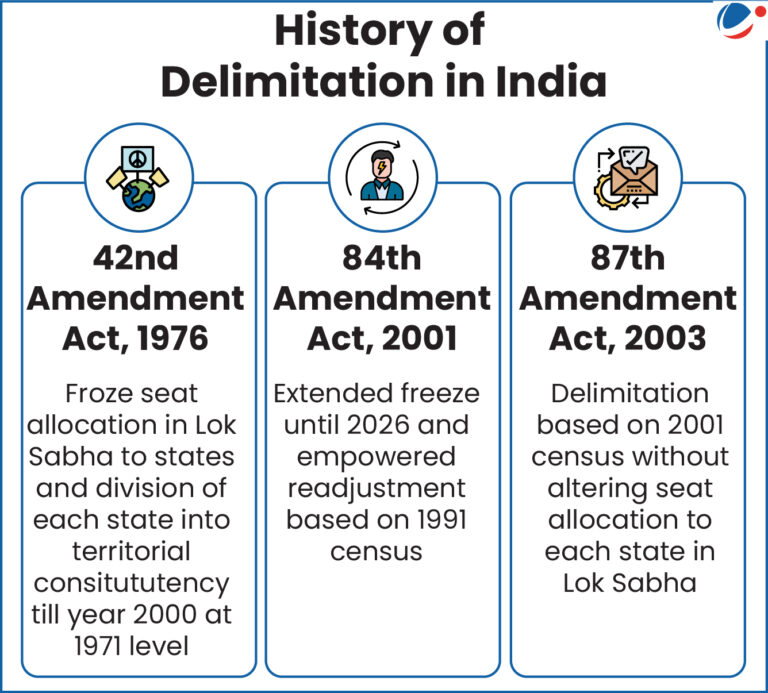
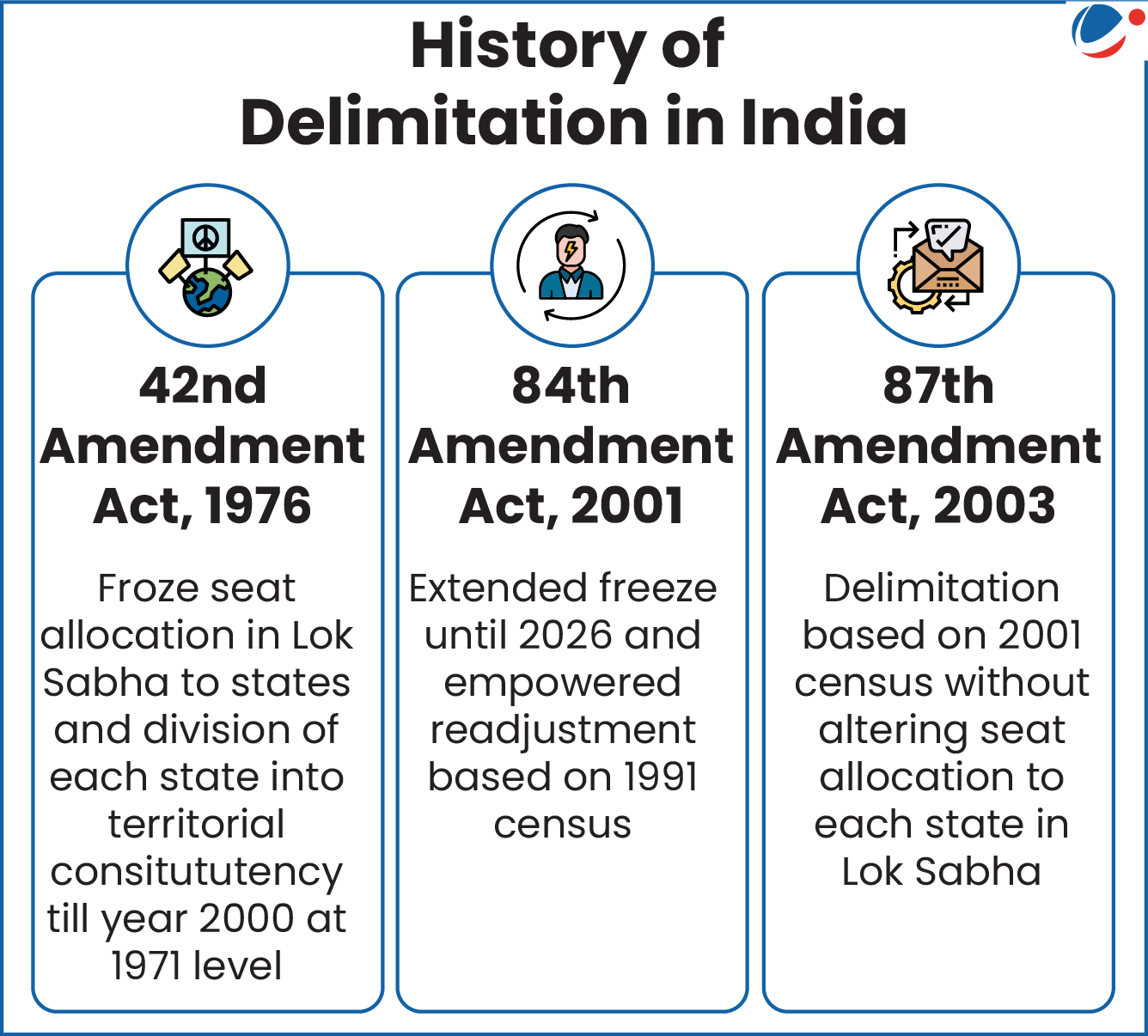
The Constitution recognises population as a basis for representation, but India has also consciously adopted constitutional freezes to prevent States that have controlled population growth from being politically disadvantaged. The 42nd Amendment in 1976 froze the distribution of seats. The 84th Amendment in 2001 extended the freeze, originally as a measure to encourage population stabilisation.
The Freeze
The new proposal takes a different route. Rather than continuing the old freeze explicitly on the basis of the 1971 Census, it seeks to preserve the relative allocation through Article 334A, linking the protection to the implementation of women’s reservation. The proposed increase in seats is uniform, 50% for every State and Union Territory, while the constituencies within each State would be redrawn using the 2011 Census figures.
This creates an unusual constitutional arrangement. The population figures used to redraw boundaries within States will be different from the population principle used to distribute seats among States. The government argues that the arrangement protects federal fairness while enabling women’s reservation.
However, the constitutional relationship between these two objectives deserves a much more detailed examination. Women’s reservation does not, by itself, require a 50% expansion of every legislature. Nor is the expansion of the Lok Sabha necessarily the only possible mechanism to provide 33% reservation. The government should explain why this particular arrangement is necessary, why the percentage of expansion is fixed at 50%, and why the constitutional protection of State-wise representation is being extended until 2051. A constitutional amendment should not merely announce its objectives. It should demonstrate the rational connection between the objectives and the means adopted.
The 50% increase: accommodation or political bargain?
The revised proposal is politically clever. By providing that every State will receive a 50% increase in its existing seats, the government addresses the fear of southern States that population-based delimitation would reduce their share of national representation. It also offers a major expansion of elected representatives across the country.
But a uniform increase in seats is not the same thing as a resolution of all federal concerns:
- The question of representation involves at least three competing principles:
- Population equality, federal balance, and the political equality of citizens.
- The principle of “one person, one vote” demands that representation should not be excessively unequal.
- Federalism, however, recognises that States are constitutional units whose interests cannot be reduced to population alone.
- Population stabilisation, developmental achievements and regional disparities must also be considered.
A parliamentary committee could have examined these competing principles, studied the likely impact of the proposed changes, heard the States and recommended a durable framework. A constitutional restructuring affecting the political map until 2051 should not be treated as an emergency measure merely because the next general election is approaching.
The government has the power to propose constitutional amendments. But constitutional power is not a substitute for constitutional prudence.
Women’s reservation & unrelated changes
The 106th Constitutional Amendment, enacted in 2023, introduced reservation of one-third of seats for women in the Lok Sabha and State Legislative Assemblies. Its implementation was linked to the publication of Census figures and a subsequent delimitation exercise. The new proposal seeks to change that mechanism and bring women’s reservation into effect after a fresh delimitation under the proposed constitutional framework.
Women’s representation is an urgent democratic necessity. Political parties have long promised greater participation by women, yet their representation remains far below the proportion they constitute in the population. Parliament should not allow technical, administrative or political obstacles to perpetuate this exclusion. But a measure intended to advance gender equality should not be used to avoid scrutiny of other major constitutional changes. The expansion of Parliament, the redistribution or preservation of State representation, the delimitation of constituencies and the rotation of reserved seats are distinct matters with different implications.
These subjects can be legislatively connected, but their connection must be constitutionally justified. Parliament should examine whether women’s reservation can be implemented promptly through a less complicated mechanism, whether delimitation is essential at this stage, and whether the proposed seat expansion is proportionate to the stated objective.
The new Bill reportedly provides for rotation of women’s reserved seats through the Delimitation Commission. Rotation itself raises questions of electoral continuity, accountability, constituency development and the ability of sitting representatives to seek re-election. These are important matters requiring public debate.
Credibility and Judicial Credentials?
Can it be independent, with controversial Gyan Singh-like Commissioners? The proposed Delimitation Commission will exercise enormous influence over the future political representation of citizens. Its task will not be merely administrative. It will determine the boundaries within which political parties compete, the constituencies reserved for women, and the territorial distribution of electoral power. The independence, composition, appointment process, and transparency of the Commission are therefore fundamental. The process must be insulated from political influence, and the Commission must provide reasoned decisions that can withstand public scrutiny.
Even if the Commission is headed by a serving or former judge, judicial credentials alone cannot guarantee institutional independence. The process of appointment, the role of the government, the criteria for drawing boundaries, the opportunity for public objections, and the transparency of its decisions are equally important.
The Delimitation Commission must not become an instrument of the political executive. Its credibility is essential to the credibility of the elections that follow.
The opposition’s responsibility
The Opposition must also act responsibly. It cannot oppose every constitutional initiative simply because it is introduced by the ruling party. Women’s reservation has broad democratic legitimacy, and the protection of State representation is a legitimate concern. Opposition parties should identify the precise constitutional defects, demand safeguards and propose alternatives.
If the revised Bill genuinely protects every State’s proportionate representation, that provision deserves serious consideration. But support for one positive feature cannot require silence on other issues. Parliamentarians must scrutinise the full legislative package, including the proposed increase in the size of legislatures, the use of Census figures, the extension of the freeze until 2051 and the powers of the Delimitation Commission. The Opposition should insist on detailed legislative scrutiny and a parliamentary committee examination. It should also seek a public explanation of the constitutional, demographic and administrative basis for the proposed 50% expansion.
The INDIA bloc’s internal differences may provide the ruling party with opportunities to secure additional support. But the Opposition’s unity should not be measured merely by whether all its members vote against the government. Its real responsibility is to defend constitutional principles while offering constructive alternatives.
The numbers versus legitimacy
The BJP’s political strategy appears to have evolved after its April defeat. It has changed the legislative proposal, accommodated regional concerns, attempted to widen its support base and prepared to return to Parliament with a fresh constitutional amendment. This demonstrates political adaptability and the importance of parliamentary arithmetic.
A two-thirds majority, however, is only the procedural requirement. It does not automatically establish that the proposed amendment is the best constitutional solution. A majority can amend the Constitution only within the limits of the constitutional framework, including the Basic Structure doctrine.
Parliament is not merely a place where numbers are counted. It is the forum in which the country’s constitutional future is debated, contested and decided. A constitutional amendment affecting representation until 2051 should be subjected to the highest degree of scrutiny. If the government has changed its proposal because it listened to the concerns of States and Opposition parties, that is a welcome democratic development. If it is relying principally on defections, political inducements, divisions within the Opposition or hurried negotiations to secure the required votes, it risks converting a constitutional exercise into a political transaction. The distinction matters.
Constitutional consensus!?!
The special sitting of Parliament beginning November 30, 2026, should not be treated as a deadline for political victory. It should be treated as an opportunity to establish a constitutional consensus. The government should refer the constitutional amendment and accompanying delimitation legislation to an appropriate parliamentary committee. The committee should invite views from State governments, constitutional experts, political parties, women’s organisations, election specialists and civil society. It should publish an impact assessment of the proposed expansion, examine the consequences for federal representation, and recommend safeguards for an independent Delimitation Commission.
The constitutional amendment also requires careful examination of whether it affects the representation of States in Parliament within the meaning of Article 368’s State-ratification requirement. Article 368 requires a special majority in each House and, for amendments falling within its specified federal categories, ratification by at least half of the State legislatures. India’s political map cannot be redrawn merely to meet the convenience of the next general election. Women’s reservation is a constitutional promise; delimitation is a constitutional exercise; federal representation is a constitutional guarantee of political balance. These principles must be harmonised, not manipulated against one another. The BJP may succeed in securing the numbers this time. BJP may have rebuilt the parliamentary arithmetic after the April setback. Regional parties may have found sufficient safeguards in the revised proposal to reconsider their position. The Opposition may remain divided. But winning the two-thirds majority is not the same as winning constitutional legitimacy.
A constitutional amendment should survive not only the vote in Parliament but also the scrutiny of history, the confidence of the States and the trust of citizens. The political map of India is too important to be decided through a numbers game alone.
Law professor and eminent columnist
Madabhushi Sridhar Acharyulu, author of 63 books (in Telugu and English), Formerly Central Information Commissioner, Professor of NALSAR University, Bennett University (near Delhi), presently Professor and Advisor, Mahindra University, Hyderabad. Studied in Masoom Ali High School, AVV Junior College, CKM College, and Kakatiya University in Warangal. Madabhushi did LL.M., MCJ., and the highest law degree, LL.D. He won 4 Gold Medals at Kakatiya University and Osmania University.
Email: cicsridhar@gmail.com
Mobile: 8447651505