A Critical Examination of Representative Governance, Electoral Integrity, and Voter Roll Deletions
Representative vs. Participatory Democracy
First, we need to understand that we chose a representative democracy, not a participatory democracy. Unfortunately, at that time, technology had not advanced to the point where people’s opinions or views could be found out about different issues, whether they were issues of policy or of law, because democracy really means rule by the people—rule by the wishes of the people, strictly speaking.
All laws and policies should be in accordance with the wishes of the people, but we chose a form of democracy called representative democracy where we would select or elect our representatives once in five years, and those representatives thereafter would make our laws, make our policies, and govern us. The thinking behind this was that it would not be practically possible to ascertain people’s views on all important issues of law and policy to ensure that they are made according to the wishes of the people. So it was thought. This has been the case in most countries, where they chose representative democracy thinking that the only practical way of having a government that governs according to the wishes of the people would be to select or elect representatives once in five years or a certain number of years, and thereafter allow those representatives to decide policies and laws. We could have done better. For example, in Sixth Schedule areas—in the tribal areas—there is a provision for having Gram Sabhas, and Gram Sabhas are supposed to be meetings of all the adults in a particular village. Those adults decide important issues affecting that village; they sit together, discuss, and decide. But that is not possible in larger constituencies. It is possible in a village where you have a maximum of 1,000 people or so, but it is not possible in an assembly constituency or a parliamentary constituency, or rather in blocks, districts, tehsils, states, etc. Therefore, we thought that the only possible method is representative democracy.
However, in many countries, we have a system of initiative and referenda where, on important issues, if a sufficient number of people—let’s say 10% of the population—sign an initiative saying that they want, say, the Lokpal law, then there is a referendum on that issue. In that referendum, if the majority of the people vote for that law, it automatically becomes law without having to go to Parliament.
We didn’t choose even that. Now, however, with our current technology, it would be easily possible to ascertain the views of people—almost everybody has mobile phones, smartphones. You can have fairly robust technological methods of determining the views of people on all or any major issue at one time.
Unfortunately, our representative democracy did not yield what we wanted. If you ask an ordinary person, ‘Do you think your government is running according to your wishes? Are you happy with the functioning of your government?’ Most people’s honest answer will be no, they are not happy. Though they have elected that government technically, they are not happy, and the reason is that very often these elected MLAs and MPs do not act in the public interest. They are often motivated by corrupt considerations. They are often motivated by various lobbies of corporate houses who influence them. We are now also seeing large-scale defections and the buying and selling of MPs and MLAs in the country. Therefore, this is the first—and in fact a very important—challenge to our constitutional democracy: how to make our democracy more participatory.
Decline of Parliamentary Functioning and Committees
See, the only participation of citizens in the making of law and policy was supposed to be through the institution of parliamentary committees. The idea was that important laws would be referred to a Standing Committee or a Select Committee of Parliament, and that committee would invite independent experts who were outside Parliament, hear their views on that subject, and thereafter give a report to Parliament; that report would be discussed in Parliament.
But even that has been more or less dispensed with in the current dispensation. In the last 12 years, virtually hardly 5% of the laws passed in Parliament are referred to parliamentary committees, by and large. In fact, if you see how Parliament is functioning these days, sometimes 50 laws are passed in one day. Every law takes one or two minutes; it is introduced, the Speaker asks for voting, half of the opposition MPs may have been suspended, there is a lot of *hungama* inside Parliament, people say ‘oh, oh, oh,’ and the Speaker says ‘passed.’ Again, the next law is tabled, people say ‘oh, oh, oh,’ and the Speaker says ‘passed.’
If you see the functioning of Parliament, there is hardly any discussion on any important issue. If the opposition wants to discuss an issue—let us say the influence of Adani or the favors being given to Adani—the Speaker does not allow any discussion on that. He constantly interrupts opposition speakers. Speakers have become—this present Speaker is a disgrace—Om Birla is an absolute disgrace. We’ve never had such a disgraceful Speaker in Parliament like this fellow Om Birla. He runs Parliament as if he’s the servant of Mr. Modi and Mr. Amit Shah, and he looks at them as to whether to allow anything or not to allow anything. This is not supposed to be the functioning of the Speaker, yet this is what Parliament has become.
First-Past-the-Post and the Dominance of Money Power
Even in this representative democracy, we have seen that the role of money power in elections has overtaken everything else. The reason why money plays such an important role in elections is because you have First-Past-the-Post at two levels. First, when you vote for your MP or MLA, the one who receives the highest number of votes—even if he receives only 30% of the vote—becomes the sole representative of that constituency. That means if the other candidates together have received 70% of the votes, they count for nothing; only that one person becomes the sole representative of that constituency. Thereafter, when the government is formed, the party or the coalition which gets a majority of the seats becomes the sole government; the opposition counts for nothing.
The result is that when we go out to vote, we do not necessarily vote for our favorite candidate or our favorite party if we feel that our favorite candidate or party has no chance of winning or forming the government, because we don’t want to waste our vote. We know that if the person or the party that we vote for will not be elected or will not form the government, our vote is wasted. Therefore, we see who the two people are who are in the race to either get elected or to form the government, and we choose the less bad among the two, according to us.
How do we see who has any chance of getting elected or forming the government? What is the basis of our perception that so-and-so has no chance of winning and is not in the race? That perception is formed on the basis of the visibility of the candidates or the parties. And that visibility is largely a function of money, because if you have more money, you can advertise extensively in electronic media and print media, you can put up large hoardings, and you can have your posters and banners carried by paid political workers. Today, large election meetings and rallies are also organized by paying money—giving contracts to people that if you bring one bus of people, we will give you ₹5 lakh; if you bring 100 buses, we will give you ₹5 crore or whatever.
People are brought by paying money for their rallies, and then the electronic media or print media will show that Mr. Modi addressed such a large rally, and therefore people will feel that Mr. Modi or his party must be in the running—it is certainly one of the strong contenders. This is how this perception is formed.
Now, we put a limit on the spending of candidates. Today, that limit is ₹1 crore for Parliament and about ₹25 lakh for Assembly. But we did not put any limit on spending by political parties. The BJP, in one year, officially collects more than ₹10,000 crores by way of donations, which are almost compulsory donations from corporates, etc. Of course, in between, they had electoral bonds, which were supposed to be an anonymous method of donation because these corporates felt that they were getting exposed—because they were getting contracts from the BJP government and having to pay large sums of donations, which appeared like kickbacks. Therefore, they asked for an anonymous system of donations, and electoral bonds were brought. If you see, once in five years, if there is a parliamentary election and the BJP puts up 500 candidates, they can spend a maximum of ₹500 crores on those 500 candidates according to the official limit. But the BJP gets ₹50,000 crores in five years—this is official; unofficially, they get another ₹50,000 crores. It makes a mockery of the limit which has been put on individual election candidates. It is meaningless. You can spend only ₹500 crores on candidates, but you can spend ₹50,000 crores through your political party. What is the meaning of this limit? Ridiculous!
Even the limit on individual candidates is not enforced. We know that there are candidates who are spending ₹50 crores instead of ₹1 crore, which is the limit, and they are not being caught. It is a corrupt practice to spend more than the limit, yet people sometimes spend 50 times the limit and still are not caught or charged for corrupt practices. Why? Because they are spending all this money in cash.
When Mr. Modi brought demonetization, he said that the main object of demonetization was to have a cashless economy: ‘I want all people to spend and take money through banking channels only, no cash.’ Now, I can understand that you cannot have this rule for ordinary people who cannot do everything through banks. But they could have easily made this rule for candidates and political parties. They could have brought a simple one-line amendment to the Representation of the People Act stating that candidates and political parties will only spend money or take money through banking channels, no cash—and if anybody is found with cash or found spending or taking money in cash, it will be a corrupt practice and he will be disqualified, and the party’s registration will be cancelled. But that law was not brought, with the result that these people are spending any amount of money in cash.
Look at the difference in the financial capacity of the BJP versus the other opposition parties. The BJP alone today has at least four times the funds of all other parties put together, and they are able to win elections because they have such enormous amounts of money. Their booth-level agents—who are called *Panna Pramukhs*, who manage a maximum of 1,000 voters—are paid ₹ 50,000 a month, and they can afford to pay them ₹50,000 a month. This whole election has become a money game. As Anna Hazare had once famously said, it’s a vicious circle: from money to power, and then misusing that power to make more money.
Concerns Over EVMs, VVPATs, and Voter Suppression
Then there is the issue of EVMs and VVPATs. Electronic Voting Machines initially, when first introduced, did not have any software inside them. But the Supreme Court said that you need to have a paper trail; you cannot have electronic voting counted through EVMs without any paper trail, and therefore every EVM must be fixed with a paper trail. That is why VVPAT machines were introduced. Now every EVM has a VVPAT machine, but despite the Supreme Court saying that you must have a paper trail, they count only 2% of the VVPAT slips. Only 2%—and there too they say that if there is a mismatch between the EVM count and VVPAT paper count, then yes, the VVPAT paper count will prevail, but that will not make them count the other 98% of the VVPAT votes.
Because VVPAT machines were introduced, software had to be introduced in EVMs, and this software can be malicious. Because the EVM also has a timer, you can easily create malicious software for EVMs which says that up till 10:00 AM, when the demonstration is held to test the EVM before the booth agents, the EVM will function perfectly fine. But after 10:00 AM, every second vote will go to the BJP. You can easily program the machine like that—very easy, very simple software.
Every EVM is fitted with software, and for every constituency it’s a different software because the position of each party in every constituency may be different—BJP may be number two in one constituency, maybe number three in another constituency. Therefore, the EVM and the VVPAT machine need to know which symbol is at which button, so that when the voter presses the second button, the VVPAT prints the symbol corresponding to button number two. That is why you have to have software, and this software is loaded separately, machine by machine, by an official of the Election Commission before the election. You can easily make malicious software which says that after 10:00 AM every second vote will go to the BJP.
You can even fool the VVPAT, because VVPAT earlier had a transparent screen. A few years ago, after the Modi government came, the screen was made black. Now you cannot see the slip inside the VVPAT machine except when the bulb comes on for exactly five seconds. During those five seconds when the bulb lights up, you can see what symbol has been printed on the slip; then the light goes off and thereafter you cannot see anything inside the machine. You can easily program the VVPAT so that if two consecutive votes are cast for an opposition candidate, the same slip shown to the first voter will be shown to the second voter—the slip will not be cut and will not fall inside. Usually families vote together and vote for the same candidate. When the second voter comes and votes for the same candidate, the light comes on and he is shown the same slip shown to the previous voter. Then when he leaves and the third person comes, that one slip is cut and falls, and another slip of the BJP may be printed, cut, and dropped in while the light is off and the screen is dark. So you can fool both the voter and the agents.
Whether it is being done on a large scale or not, one can’t say. Probably today it is not being done on a large scale, but it is probably being done on a small scale, because in West Bengal recently, in one polling booth with an 88% Muslim population, 98% of the vote went to the BJP. This cannot happen; it is impossible that 98% of Muslim votes will go to the BJP. Either the Returning Officer made a wrong note—though the BJP may have got only two votes, he noted 798 votes in the BJP column—or the EVM had been manipulated. We don’t know what happened, but this is a very serious problem, and therefore the demand of the opposition that we should go back to proper paper ballots is a very legitimate demand. Most countries in America, Europe, etc., have gone back to paper ballots after seeing the problems that EVMs can have.
Then there is this problem of preventing voters from voting. In Rampur and one other constituency during by-elections, we found that the police had just cleared out all the Muslim areas. They were Muslim-majority constituencies, and yet the Muslim vote cast was only 5% to 10% because the police just did not allow them to come out and vote. This is another very serious problem with our whole system of election—a new problem which has arisen only recent
From NRC and CAA to the Special Intensive Revision (SIR)
Now coming to this SIR: when the BJP came to power, it came thinking that they would declare India a Hindu Rashtra. They thought they would somehow cobble together a two-thirds majority and say that non-Hindus will have other rights, but will not have voting rights. Then they realized that secularism is part of the Basic Structure of the Constitution; you cannot even bring a constitutional amendment to override that, and you cannot declare a Hindu Rasht
So, they thought of another method. They said, ‘All right, we will have a National Register of Citizens—we will have an NRC,’ thinking that in that NRC, they would remove largely the names of Muslims and therefore have a *de facto* Hindu Rashtra. Unfortunately, the first state where they did the NRC was Assam, and unfortunately for them, it was monitored by the Supreme Court. They appointed commissioners who monitored this NRC process, and though the process was highly flawed—about 20 lakh people were removed from the NRC for no fault of theirs—the percentage of Hindus and Muslims removed from the NRC was equal to the percentage of their population in Assam. Therefore, it was not discriminatory against Muslims.
So, the BJP thought, ‘All right, we will now get the Hindus restored back in the NRC by bringing the Citizenship Amendment Act.’ The idea of the CAA was to ask these Hindus who had been left out to say that they had fled Bangladesh, Pakistan, or Afghanistan as refugees and therefore citizenship should be granted to them. Unfortunately, that plan also did not work because people were not willing to say that—they were Indian citizens who had been left out because they couldn’t produce the required documents, just like in this SIR. They refused to say they were refugees from Pakistan or Bangladesh, so that plan also failed.
Now they thought of this SIR. They said, ‘All right, now we will do an SIR and we will achieve the same result *de facto*.’ Because the Election Commission is theirs and the judiciary is also theirs, they calculated that with both under their control, they can put anybody they want in the voters’ list and remove anybody they want from the voters’ list. Although the law says that the process of adding or subtracting names from the voters’ list is a power vested with the ERO (Electoral Registration Officer)—every constituency has its own SDM who is the ERO—here, Gyanesh Kumar, without even consulting the other two Election Commissioners, passed an order saying that this power to add or remove names from the electoral roll will now be vested with the IT cell, called ECINET, which is the IT cell of the Election Commission. He appointed one lady in charge of that, and that lady also appears to have given charge of ECINET to some third parties—probably some BJP functionaries appointed by Amit Shah or Modi—to decide who is to be removed from or added to the voters’ list.
Structural Flaws and Legal Violations in the SIR Process
There are three kinds of problems with this SIR. First is structural problems, which make the process totally irrational and arbitrary. Second is violations of the law, rules, and manual that the Election Commission already had. Third is completely *mala fide* actions of the Election Commission—and of course, the second and third are related. Regarding the structural problems: earlier also SIRs have been done—in 2002 it was done, and prior to that also—but never was a new voters’ list prepared from scratch. Earlier, the SIR was door-to-door enumeration. People went door-to-door with the old voters’ list and asked who lived there, whether a person was still there or not, who else had moved in, and on that basis the new electoral roll was prepared using the old voters’ list as the base.
Now they say that everybody has to fill out an enumeration form, and that form comes with your previous name and address printed on it. Many people received the enumeration form, while some people didn’t receive it. Those who didn’t receive the form could not fill it up, and if they couldn’t fill it up, their names were deleted from the draft roll. Some people who had shifted out either didn’t receive the enumeration form, or even if they received it, it came with their earlier address; since they were living at a new address, they couldn’t fill it up with their new address, and they were also removed from the draft roll.
As was pointed out in Telangana, more than 10%, 15%, or maybe 20% of people have been removed from the draft roll in this manner. Perhaps even more than 20%—in Delhi, 33% were removed from the draft roll, and out of the remaining, another 33% have been given notices for logical discrepancy or for being unmapped.
When we pointed this out to the Supreme Court recently in the context of the Delhi SIR, we said: look, it is totally irrational that you are saying those who do not fill up enumeration forms—because they did not receive them or have shifted to a new address within Delhi—will have their names knocked out of the draft roll. And then you say that if your name has been knocked out of the draft roll, you have to fill up Form 6 to get back on the roll. Form 6 is for new voters, where you have to make a declaration that you have never voted before—and if your declaration is false, you are liable to be jailed for a year.”
Wiping Out Voter History and Reversing the Burden of Proof
“So they are asking everybody who shifted out or who did not receive the enumeration form, despite being previous voters, to fill up Form 6 as a new voter, give a false declaration, and get a new EPIC number. Their whole previous history of voting, which is retained in their earlier EPIC number, is wiped out. When the Supreme Court said, ‘Look, this is totally irrational, what are you doing?’ they recently backtracked and said, ‘Okay, now you can just give a declaration that you have changed your address and we will add you.’ They are saying that you don’t have to fill up Form 6; you can fill up Form 8 or just give a declaration that you have moved to this address and we will add you. They also said that those who didn’t fill up the enumeration forms because they didn’t receive them can now fill up enumeration forms. I mean, they said all that, but they did not print or send any fresh enumeration forms to those who had been deleted. In the recent hearing in the Supreme Court, we pointed this out, and at that stage, they said, ‘All right, now you can download a blank enumeration form and then fill it up.’ This option was not available earlier.
As it was pointed out, there are not many people who have the capacity or are IT-savvy enough to download forms. Moreover, they required people to map themselves—even those who filled up enumeration forms. They said that you will have to map yourself with the 2002 SIR roll, show that your parents or grandparents were there in that roll, and prove your relationship with them, or you have to submit any number of the 11 documents which they mentioned. Then, of course, Aadhaar was also added, though they said they do not treat Aadhaar as proof of citizenship.
In Bihar, we had studied the other 11 documents which the Election Commission had mentioned. A majority of the people in Bihar did not have even a single one of those documents. Only Aadhaar was possessed by about 98% of the people; even school certificates in Bihar were held by only about 40% of the people.
The whole business of this SIR is that they have reversed the burden of proof. Earlier, the system was that if your name is in the electoral roll, you are presumed to be rightfully there. If they want to knock your name off the electoral roll, they have to give you notice, give you reasons for knocking you off, and give you an opportunity for a hearing. That’s what the Supreme Court said in that 1995 judgment of Lal Babu Hussein, which was about the removal of voters from the list on the ground that they are non-citizens. The Supreme Court said that if their name is there in the earlier voters’ list, they are presumed to be citizens. If you want to remove them, you have to give them notice with reasons as to why you are suspecting that they are not citizens, and give them an opportunity to present any evidence, oral or documentary.
Many people don’t have any documentary evidence. All they can do is give an affidavit saying, ‘Look, I was born here, my parents were born here, I am a citizen of this country.’ Even Form 6, which is for new voters, has only three requirements: you have to show some proof of your age that you are above 18 (Aadhaar is good enough for that), you have to show some proof of your residence or address (Aadhaar is good enough for that), and you have to just give a self-declaration that you are a citizen. No proof is required for citizenship—only a declaration. If somebody wants to question that, they have to produce evidence to show why you are not a citizen, and thereafter every opportunity has to be given to you to produce any evidence of any kind—oral or documentary—to show that you are a citizen. Even oral evidence is good enough; you produce two neighbors who say, ‘Yes sir, we know that he has been living here, we have been seeing him since his birth,’ and that’s good enough.
But this whole SIR exercise has turned it around and said: ‘You prove, and we will decide what to accept as proof.’ And now we will centralize it before the Election Commission with Gyanesh Kumar, and Gyanesh Kumar outsources it to the BJP and says that some BJP officer will decide whose name is to be included and whose name is to be excluded. This whole SIR exercise has become a farce.
The Arbitrary ‘Logical Discrepancy’ Rule in West Bengal
Then they have this ‘logical discrepancy.’ There was no logical discrepancy in Bihar; they started it in Bengal, and in Bengal the whole process is so badly tainted. Even there, they ran roughshod—60 to 70 lakh people were issued notices for logical discrepancy. The population of Muslims in Bengal is about 27%, yet about 65% of the people who were issued notices for logical discrepancy were Muslim. The Supreme Court appointed some judicial officers and gave them two minutes each to decide every case, and they decided cases in which 27 lakh people were excluded and 33 lakh people were included in the electoral roll. Out of 27 lakh, 22 lakh filed appeals before a tribunal which was set up. That tribunal has decided so far about 1.4 lakh cases in the last six months. Out of those 1.4 lakh cases, 93% have been found to be wrongly excluded.
To decide the remaining 21 lakh cases will take another 14 years, and the Supreme Court is now telling people, ‘It doesn’t matter if you don’t vote this time, you can vote next time. It doesn’t matter if you can’t vote next time, you can vote after that. Doesn’t matter if you can’t vote after 14 years, you can vote after that.’ Ridiculous! And now local body elections are coming. In local body elections, these excluded people will not be permitted to vote despite the fact that it has been found and proved that 93% have been wrongly excluded.
Earlier, we used to hear this principle—Justice Sudershan Reddy is here—that it is better to allow 99 guilty people to walk free rather than convict one innocent person. If you apply that principle to voting rights, the heavens will not fall if some wrong people are also included in the voters’ list, but the heavens do fall if some right people are excluded from the voters’ list. And here you have a case where 93% of the right people have been excluded from the voters’ list, and that number is huge—27 lakhs! Why should they not be brought back till their appeals are decided?
There is no definition of logical discrepancy! They are saying that if your name is spelled as Muhammad in one place and Mahmood in another place, that’s a logical discrepancy. Even if there is one letter difference or one space difference, it’s a logical discrepancy. If you have more than five siblings, that’s a logical discrepancy. If the age difference between your parents and you is less than 15 years, that’s a logical discrepancy. If the age difference between your grandparents and you is less than 40 years, that’s a logical discrepancy. There is no comprehensive definition of logical discrepancy, and they have never revealed the algorithm they used for earmarking people under logical discrepancy. It is widely suspected and believed that the algorithm the Election Commission used is a malicious algorithm designed to target Muslims. That is why in West Bengal, 65% to 66%—two-thirds of those targeted for logical discrepancy—were Muslims.
Lack of Transparency, Statutory Violations, and ‘WhatsApp’ Governance
Then there is no transparency. The rules provide that whenever a Form 6, 7, or 8 is given to the Election Commission, it has to be put out on their website on the same day so that people can look at it. There is no transparency—they’re not putting out Forms 6, 7, and 8. Contrary to the rules, which require that not more than 10 or 50 forms can be given by one person, we are finding that Booth Level Agents have been submitting more than 1,000 Form 7s for exclusion, totally violating the rule, and nothing is put out on the website of the Election Commission. Nobody is being prosecuted for this.
They are targeting Muslims and those people whom they know do not vote for the BJP. Once you have a corrupt Election Commission—with this Gyanesh Kumar sitting there, a third-rate corrupt fellow, a total lackey of the BJP, giving control of the voters’ list to some BJP functionary—naturally, if some BJP BLO has given 1,000 names for exclusion, they will remove those 1,000 names. Aap bhaagte rahiye—you keep being afraid, keep running around in circles, while they hold all the power to add whichever name they want and delete whichever name they want. And the misfortune is that the Supreme Court just keeps going along with it, saying a little something here and there in between.
The Indian Express published a very detailed report saying that there were 14 occasions on which the other two Election Commissioners objected to the decisions being taken by Gyanesh Kumar, and yet those decisions were implemented—decisions about centralizing this process of addition and removal, which is totally contrary to law, and decisions about adding the requirement to show mapping with the previous SIR to Form 6, which is a statutory form that cannot be altered. Even this decision to do the SIR across the whole country violates the law. Under Section 21(3) of the Representation of the People Act, the Election Commission can do a Special Intensive Revision in a constituency or a part of a constituency for reasons to be recorded in writing. It doesn’t empower them to say, ‘Well, we will do an SIR for the whole country because there may be some people who have died, some who have shifted, or some who may not be citizens in the list.’ Unfortunately, the Supreme Court allowed that.
Who took the decision to do an SIR? When Anjali Bhardwaj asked under RTI, the Election Commission formally said, ‘We have no record of any decision being taken by the Election Commission to do an SIR.’ When this was raised in the Supreme Court, the Election Commission’s response was, ‘Sometimes in an emergency we take decisions without a formal meeting; we do it electronically by consulting each other on WhatsApp.’ What is the emergency in doing an SIR for the whole country? How can you do this by WhatsApp? And they have not given any evidence of even that WhatsApp exchange, while the other two Election Commissioners are saying no meetings were held of the Election Commission for the past year—no meetings, no minutes, no agenda, nothing.
The consequence of this is that state governments are saying, ‘If your name is excluded from the electoral roll, for our purpose you are not a citizen, and therefore we will deny you each and every facility given by the government, including rations.’ This is the level to which we are going, and the Supreme Court is just watching this whole absurdity go on.
Machine-Readable Rolls, De-duplication, and the Case for Social Audits
First, the Election Commission was not even giving the draft roll; they said, ‘We will not disclose anything, not even the draft roll, not even the exclusions.’ When the Supreme Court told them to disclose the draft roll, they disclosed it, but said they would not give it in a machine-readable form so that people cannot check it. Even today, after this SIR, people have shown that there are millions of errors in this electoral roll. Quite apart from illegal deletions, there are millions of duplicate entries—there are people whose names appear 20 times in this electoral roll after an SIR. The way to check that would have been to run a single machine-readable check of the electoral roll, which is why they are not giving it in a machine-readable form. The rules say that they have to use de-duplication software to check duplicate entries, but they said, ‘No, we don’t use it because we found last time that there were some problems with this software.’ It is absurd! On the one hand, the Election Commission claims to use electronic technology to transform everything; on the other hand, they refuse to use de-duplication software.
The only correct way of doing an SIR would have been to conduct a videographed social audit, booth by booth, which is already provided for in the Election Commission’s manual. In such a booth-level sabha, you go to a booth and announce that on a specific day, time, and place, the BLO will read out the names from the previous electoral roll one by one. People will state whether a person is still there or not, who has moved in recently, or whose name was wrongly excluded last time. Others can raise objections, everything is videographed, and it becomes very easy to verify who is a legitimate voter and who is not.
Instead of that, the Election Commission has deliberately chosen this mala fide method. The consequence is that over 13 crore people who have been excluded now risk being deprived of their ration cards, benefits, and government schemes. They will de facto become non-citizens of the country, even though the Supreme Court stated that exclusion from the electoral roll does not mean loss of citizenship. Still, many state governments under the BJP are treating it as a loss of citizenship to deprive people of benefits. On top of all the broader problems of our electoral democracy, we have now created a much more serious crisis through this SIR. It’s good that people across the country are becoming aware and there is a growing movement against this SIR.
Compromise of Institutions: Appointment of Election Commissioners and Judges
The last issue I wanted to touch upon is the appointment of Election Commissioners. Under the earlier law, the government appointed the Election Commissioners. This law was struck down by a Constitution Bench of the Supreme Court three years ago, which ruled that the government cannot appoint Election Commissioners—it must be done by a non-partisan, neutral body comprising the Prime Minister, the Leader of the Opposition, and the Chief Justice of India until a law is made.
The government immediately brought a law replacing the Chief Justice with a Union Minister nominated by the Prime Minister, ensuring the government regained control. This law was challenged by us. Recently, in a two-judge bench decision, the senior judge, Justice Dipankar Datta, held that this law is unconstitutional. However, the junior judge, Justice Satish Chandra Sharma—without disclosing his conflict of interest that his son was recently appointed Senior Standing Counsel of the Election Commission by Gyanesh Kumar—heard the case and ruled that the matter should be decided by a Constitution Bench. Because the matter has now been referred to a Constitution Bench, it will drag on for several years, during which time the government will continue appointing whoever they want.
In their system, their best pick is to appoint a person who is vulnerable to blackmail—someone who may have done something wrong. Gyanesh Kumar, we know, is being investigated in Kerala for allegedly demanding a ₹20 crore bribe, due to which a foreign engineer committed suicide and left a suicide note naming the demand. Such people are vulnerable. The government can always tell them, ‘Tomorrow, if you do not obey what we are telling you to do, the ED and CBI will come and arrest you, and you will spend the rest of your life in jail.’
We are seeing that vulnerability to blackmail is now the main criterion for the government when choosing judges as well, even more than ideological sympathy for the BJP. A judge who is vulnerable to blackmail will totally follow the diktat of the government, whereas a judge who is merely ideologically committed may not always follow every order. For example, regarding a former Chief Justice who was ideologically aligned with the BJP, Justice Adarsh Kumar Goel had raised a very strong objection to his elevation even as Chief Justice of a High Court, pointing out that he had purchased numerous properties at undervalued prices that needed investigation. Ideological commitment doesn’t guarantee total obedience, whereas blackmail virtually succeeds in making them comply.
I am glad that there is a growing sentiment against this SIR and that people have raised this issue. I wish for this movement to become stronger in the days to come so that this is reversed. At the same time, we must set right the larger challenges facing our constitutional democracy before we can be assured of a truly functioning democracy in this country. Thank you very much.”
Modi-Shah Selects Vulnerable Officials for Top Constitutional Posts
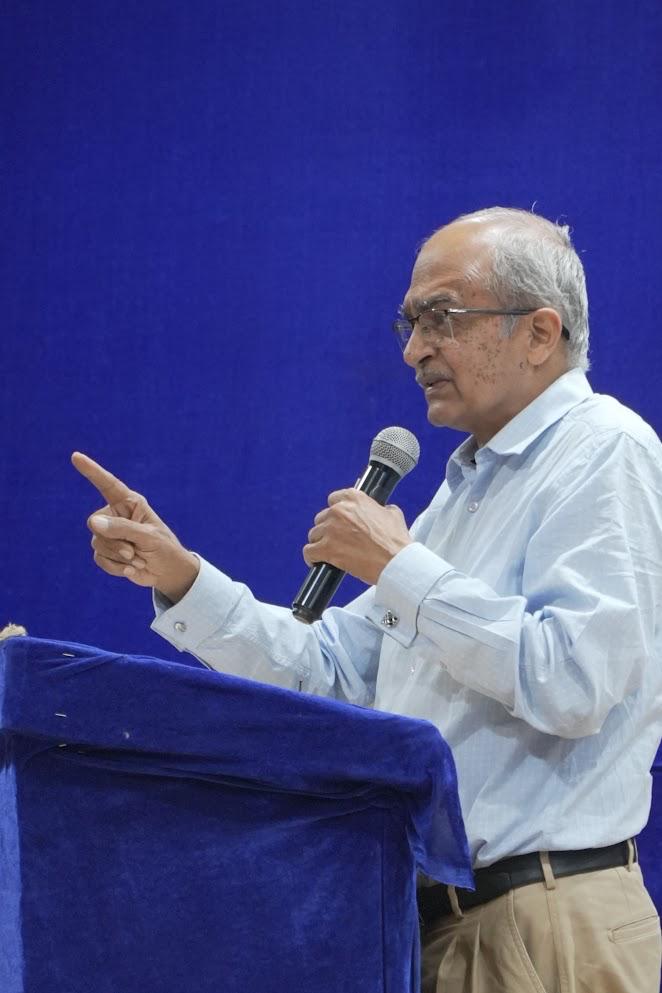
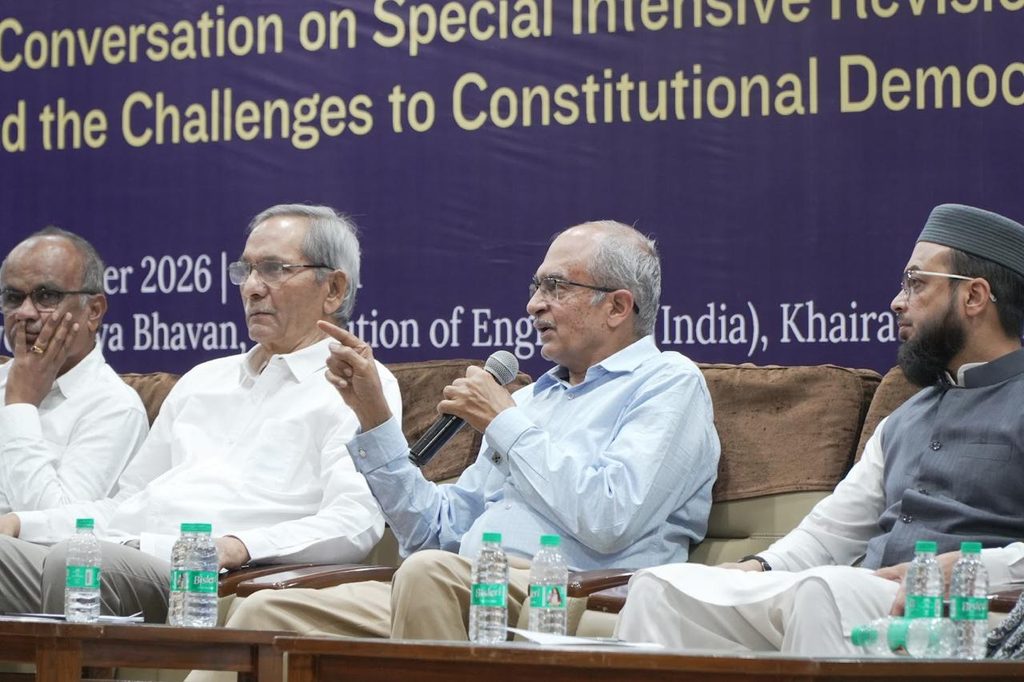
During an interactive session at a seminar organised by the Forum for Constitutional Democracy in Hyderabad, Supreme Court advocate Prashant Bhushan alleged that Prime Minister Narendra Modi and Union Home Minister Amit Shah select “vulnerable” individuals for key positions in constitutional bodies, including the judiciary and the Election Commission. According to Bhushan, individuals with compromising past records are appointed to these posts so that they feel compelled to comply with the government’s demands. He claimed that such officials face the implicit threat of having past cases reopened against them if they fail to follow directives.
During the session, Bhushan raised specific allegations regarding Chief Election Commissioner (CEC) Gyanesh Kumar, claiming that the officer faced corruption allegations during his tenure in Kerala. Bhushan stated that a contractor who died by suicide had previously alleged that Kumar demanded a lump-sum payment to overlook construction irregularities. Describing Kumar as a deeply corrupt officer, Bhushan further claimed that similar criteria of vulnerability are being used to make several appointments to the higher judiciary, alleging that many judges in the top court have questionable past records. Responding to a question from the audience on why the ruling dispensation did not secure a full majority in the 2024 Lok Sabha elections if Electronic Voting Machines (EVMs) were manipulated, Bhushan suggested that tampering with the machines on a massive scale carries a high risk of exposure.
He stated that altering EVM outcomes requires software professionals to physically access and install malicious software in individual machines across different constituencies. “It is difficult to covertly install malicious software in a large number of EVMs across various constituencies, as the operation could be exposed through any channel,” Bhushan said, adding that this logistical risk likely limited the scale of any alleged manipulation attempts.
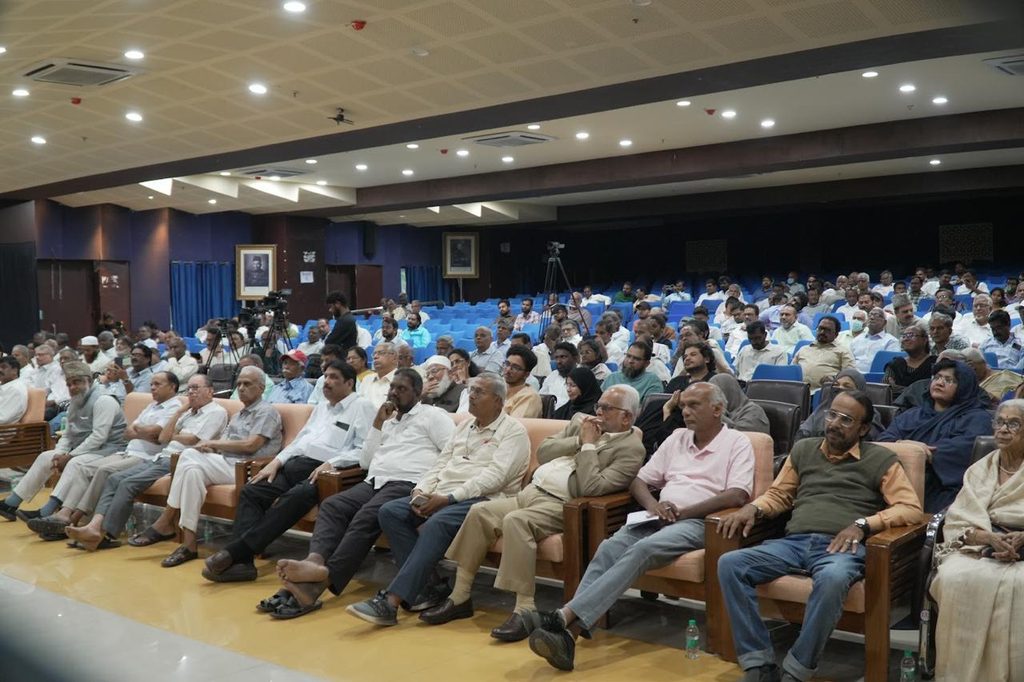
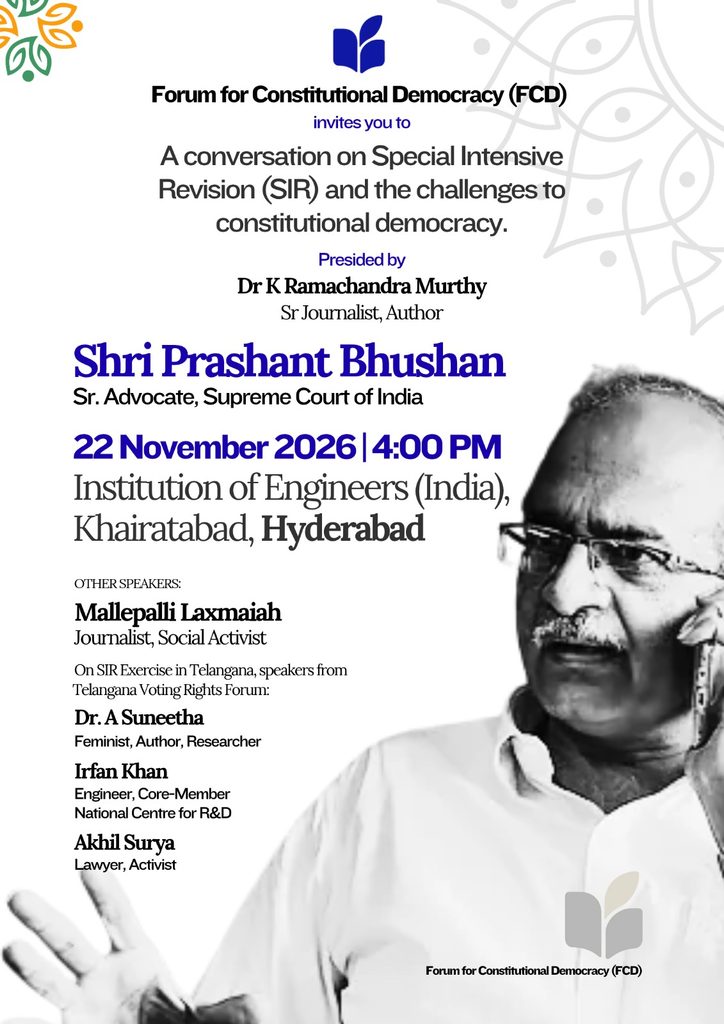
(Prashant Bhushan, Senior Advocate of the Supreme Court of India, delivered a lecture on ‘Special Intensive Revision (SIR) and the Challenges to Constitutional Democracy’ at a meeting organized by the Forum for Constitutional Democracy (FCD) at the Institution of Engineers (India), Khairatabad, Hyderabad, on November 22, 2026.)

With a journalistic long journey, we bring you https://primepost.news, a dynamic platform committed to unraveling the intricate tapestry of Indian politics, particularly delving deep into the heart of Telangana and Andhra Pradesh. Our blog is not just a source of news; it’s a reservoir of insights, analysis, and thought-provoking reviews.