The Art of the Two-Thirds Defection: The Shiv Sena (UBT) Crisis
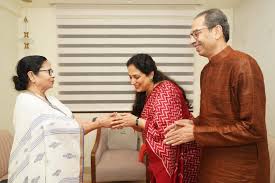
There has never been a question about the BJP failing in its attempts to encourage defections and make up two-third majority in Parliament. The defection of the Trinamool Congress MPs, besides the MLAs, soon after the elections the TMC lost did not surprise the political observers. The six out of nine MPs belonging to Shiv Sena (UBT) faction leaving the party, on whose symbol they won the elections just two years ago in 2024, for the BJP is seen as a part of political game played by Narendra Modi and Amit Shah. The defections to the BJP have come to be accepted without question. Uddhav Thackeray is helpless as Mamata Banerjee was.
Despite losing the name and election symbol of Shiv Sena, Uddhav could win nine Lok Sabha seats in 2024 because there was a sympathy wave in favour of him post the 2022 split. Mamata Banerjee was considered as an invincible leader in 2024 and in 2021 when elections to Lok Sabha and West Bengal Assembly were won by her handsomely. The same leaders have become spectators when their MPs (MLAs) left them in droves. In the whole drama of defections, Modi would not open his mouth excepting his usual tirade against the Congress. Shah says something on the occasion and does not extend the conversation.
From Ideological Splits to Silent Shifts: A Changing Playbook
Maharashtra Chief Minister Devendra Fadnavis, flanked by his deputies Eknath Shinde and Sunetra Pawar, on Sunday declared that ‘Operation Tiger’ was a success. Shinde boasted that he has never left any operation incomplete. Two of the total six rebel MPs, Nagesh Patil Ashtikar and Omraje Nimbalkar, announced on Sunday that they have decided to defect to the Shiv Sena headed by Shinde. They have not said a word against Uddhav Thackeray whom they have ditched. The rumour about the Shiv Sena (UTB) merging with the Congress has no takers. Six out of nine MPs comprise two-third majority which would not attract the anti-defection law. This law is being used by the BJP all through the twelve years in power to encourage defections from regional parties. Be it Shiv Sena, Nationalist Congress party in Maharashtra and TMC in West Bengal, the defections would be announced only after mobilizing two-thirds of the numbers.
There is a difference in Shinde’s defection along with majority of Shiv Sena MLAs in 2022 and the defection of the six MPs now. Shinde publicly criticized Udhav Thackeray’s leadership and his (Uddhav’s) association with the Congress as the main reasons for their crossing the floor. He commented the other day that blood (of Thackeray shared by Uddhav) is not important but the philosophy (of senior Thackeray championed by Eknath Shinde) is. Now there is no such criticism by the rebels. They keep quiet.
Shiv Sena (UBT) leader Uddhav Thackeray addressing a rally in Mumbai North East on Sunday said, “Though the Shiv Sena fought against the Congress for so many decades, the Congress never tried to break our party. It is the BJP sin.” The Congress which ruled the roost till 1977, had encouraged defections from the opposition and frequently used Article 365 imposing President Rule in opposition-ruled states (Till the SC judgment in SR Bommai case made it difficult). But the Congress did not have the skills of the BJP is undermining the opposition. It was against the Congress that the regional parties had sprouted across the country.
From Anti-Congress Fronts to BJP’s New Strategy
Be it Sharad Pawar’s NCP or Mamata’s TMC or YS Jagan Mohan Reddy’s YSRPC, they were all rebels from the Congress. We have DMK, AIADMK, TDP, SP, Biju Janata Dal, RJD, JD(S) and other regional parties that were launched with an ideology which was against the Congress and with the main motto of defeating the Congress. Subsequently, the Congress had a tie-up with most of the regional parties or kept fighting against them. It is a different story with the BJP. Till 2024, the BJP also tried to have a tie-up with the regional parties. But the results in 2024 Lok Sabha elections have thwarted the saffron ambition of ‘Is baar char sow paar’ (This time it will be more than 400 seats). That setback in the election where it had failed to win the majority on it’s own, had made the BJP to think of a plan where there would not be any possibility of BJP losing an election. This strategy was implemented by Hasina in Bangla Desh.
The BJP leadership has decided to make use of the changed election law and appoint their own ‘yes’ men as election commissioners and most obedient person as Chief Election Commissioner (CEC). The SC chief justice was removed from the selection committee and he was replaced by a cabinet minister (Amit Shah). The opposition leader is there for namesake. All the decision are made by the PM and HM. It is now impossible to defeat the BJP in any election. The Election Commission (EC) had started SIR (Special Intensive Revision) of voters’ lists throughout the country. The burden of proving the citizenship and as a genuine voter has been shifted to the voter. So far in ten states and three union territories, 6.5 crore voters have been removed from the lists. If the SIR is completed in all the states, the number of removed voters would be about 16 crore, more than 15 -20 percent of the voters. Most of the removed voters belong to the weaker sections, Muslim and Dalit communities. In other words, the voters that usually vote for opposition parties are being targeted.
The Post-2024 Strategy: Institutional Shifts and Electoral Revisions
According to the EC design, the BJP would be losing elections in states (on its own volition) where it is in hopeless minority, such as Kerala and Tamil Nadu. If the BJP is in a position to fight, the saffron party will win thanks to the EC. That was how it won Bihar, Assam and West Bengal in recent elections with huge majority and lost in Kerala and Tamil Nadu. In Bihar, Nitish Kumar, whose JD(U) was bigger than the BJP when the alliance started had gradually become second to the BJP, had to handover the post of chief minister to the saffron party and settle for RS membership. TDP chief Chandrababu Naidu knows about it but pretends as if it does not affect him.
The assemblies are not very important to the BJP in the present context. It recently got defeated on the floor of Lok Sabha when it tried to get a Bill, which was named women reservations bill but, in fact, it was actually a delimitation bill, in Lok Sabha. Unable to digest it, it was then decided that the BJP has to improve its numbers in both Lok Sabha and Rajya Sabha by hook or by crook. That was why they are very keen to encourage as many MPs to defect from the other parties. Even in recent RS elections, the way the nomination of Meenakshi Natarajan was rejected by the Returning Officer in Madhya Pradesh and an independent candidate supported by the BJP won over the Congress candidate through cross-voting by opposition members in Jarkhand were instances where the BJP got the seats to its kitty by any means. In Punjab, six RS AAP members defected to the BJP.
What Options Remain for the Opposition?
A time in the history of democracy in India has come, after 80 years of independence, when the political parties in opposition are forced to think of ways other than elections to defeat the ruling party since elections are thoroughly manipulated. Om Birla, the Speaker of Lok Sabha, who is ever ready, even on a Sunday, to meet the rebels from opposition parties, had met the six rebels of Shiv Sena (UBT) and accepted their letter which informed him that they have decided to join the Shiv Sena (Shinde). Almost all the democratic institutions – including the EC, Judiciary, media, CBI, ED, Income Tax department – have become willing tools in the hands of the ruling NDA dispensation, what is the way left to the opposition?
Rewriting the Rules: The Blueprint for Permanent Electoral Dominance
The two-third majority the BJP has been trying to mobilize in Parliament will be used to amend the constitution in order to shift to ‘one country-one election’ and delimitation according to the convenience of the BJP. One can look at the carving of the constituencies in Assam (They were carved in such a way that the Muslims spread over fifty constituencies will be brought into 25 constituencies which will be left to the opposition and the rest would have Hindu majority where the BJP can sweep), where the opposition can win only Muslim dominated seats, to know what kind of justice the people of the country can expect from the present dispensation.

Prominent Journalist
Dr. K. Ramachandra Murthy is a versatile journalist with a distinguished career. Dr. Murthy began his extensive career with Andhra Prabha of The Indian Express group in Bengaluru. He was editor of Udayam, Vaartha and Andhra Jyothy. Dr. Murthy founded and edited HMTV news channel and The Hans India, an English newspaper. He was also editorial director of the Telugu newspaper, Saakshi. He was awarded Ph. D for his research work in rural reporting. Dr. Murthy’s five decades in journalism showcases his influential roles across both print and electronic media. He wrote the political biography of NTR published by Harper Collins.
Email: murthykondubhatla@gmail.com
Mobile: 9908002211