Part-II
Deputy CM of AP & his FIRs against Journalist Nageshwar
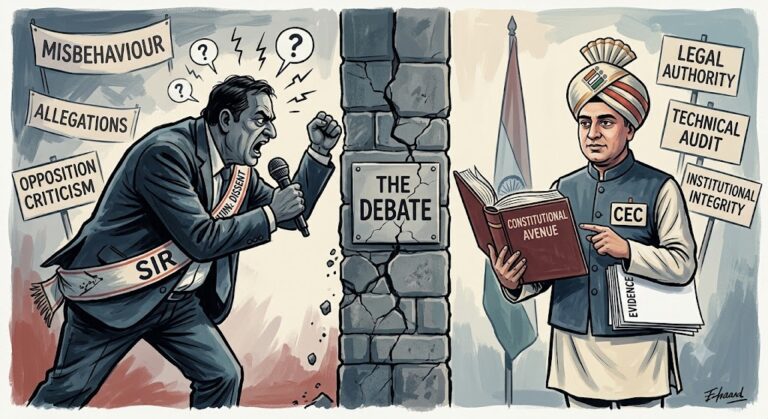
Justice Sudershan Reddy argues that political analysis is not a crime. Analysts may be correct or mistaken. Their conclusions may be accepted or rejected. Their interpretations may later prove inaccurate. But disagreement with an analysis cannot justify criminal proceedings.
The proper response to a political opinion is another opinion. The answer to speech is more speech. Democratic debate depends upon the free exchange of ideas, not on intimidation through legal processes.
Justice Sudershan Reddy reminds us that freedom of expression is not merely one among many rights. It is the foundation of democratic life itself. Without the freedom to discuss, analyse, criticize, and question public affairs, democracy becomes an empty ritual.
It is not really about Jounalist K. Nageshwar
The controversy, therefore, is not really about K. Nageshwar. It concerns a broader constitutional principle. If political commentators can be targeted for expressing opinions, the resulting fear will affect every journalist, academic, writer, and citizen.
Democracy requires robust public discussion. It requires independent journalism. It requires analysts who are willing to interpret events and challenge official narratives. Protecting these freedoms is not an act of favour toward individuals; it is a defence of the constitutional order itself.
Why Democracy Needs Dissent
It is about Freedom of Expression, Dissent, and the Search for Truth. It is the defence of freedom of expression rests upon a simple idea: democracy survives through discussion, not conformity. It describes journalism, scholarship, and political commentary as forms of a continuous search for truth. Those engaged in public debate may occasionally make mistakes. They may rely on incomplete information. Their conclusions may later be challenged. Yet the possibility of error cannot become a justification for censorship.
The freedom of expression performs several essential democratic functions. First, it promotes the search for truth. Public debate allows competing ideas to be tested, challenged, and refined. Truth emerges not from official declarations but from open discussion.
Second, free expression cultivates social tolerance. Citizens learn to coexist with opinions different from their own. A democratic society is not one in which everyone agrees. It is one in which disagreement can be expressed without fear.
Third, freedom of expression encourages self-restraint. People who participate in public debate learn the discipline of argument, evidence, and persuasion rather than coercion.
A dialogue was raised and answered
Why should people discuss?
Why should they analyse?
Why should they explain the hidden meaning behind political events?
Because when an ordinary citizen listens to such discussions, that citizen begins to feel:
“I too am part of this society.”
“I too have a stake in public affairs.”
“I too have a voice.”
- That feeling strengthens democracy.
- It creates participation.
- It builds citizenship.
- This is not a new idea.
- It is as old as modern democracy itself.
The philosophical foundation of this principle is often associated with Voltaire’s famous statement:
“I may not agree with you, but I will defend to the death your right to say it.”
Whether or not the quotation is exact, the idea remains central to democratic thought. Justice Sudershan Reddy also rejects the notion that freedom is a gift bestowed by the Constitution. Rather, he argues that freedom of expression was earned through India’s long struggle against colonial rule. The Constitution merely recognized and guaranteed a liberty that generations of freedom fighters had already demanded.
The Justice explained further:
You all remember the French Revolution.
You all know the philosopher Voltaire.
A statement attributed to him captures the essence of democratic freedom: “I am not agree with what you say, but I will defend to the death your right to say it.”
What does this mean?
It means:
“I may disagree with every word you utter.”
“I may reject your views completely.”
“But I will fight throughout my life to defend your right to express those views.”
That is the philosophical foundation of freedom of speech and expression.
That is the moral basis of democracy.
And now we must ask ourselves:
For such a simple political analysis, should there be such a huge uproar?
Should an individual be subjected to such attacks merely because he expressed an opinion?
Should Nageshwar become the centre of a political storm simply because he analysed a political development? That is the real question before us.
A particularly important theme in his speech is dissent. Democracy cannot exist without dissent. Citizens must be free to question governments, challenge prevailing opinions, and express alternative viewpoints. The suppression of dissent may create temporary political comfort, but it weakens democratic institutions in the long run.
A case study of Bennett Coleman & Co. v. Union of India
In Bennett Coleman & Co. v. Union of India, the Supreme Court held that freedom of the press is an essential part of Article 19(1)(a). The Court rejected governmental attempts to indirectly restrict the circulation and functioning of newspapers.
The judgment recognised an important principle:
- A democracy does not require a submissive press.
- It requires an independent and questioning press.
- Governments may prefer praise, but constitutional democracy demands scrutiny.
- The role of journalists is not to validate power but to examine it.
Political Analysis Is Not Defamation
- Political commentary has always been central to democratic life.
- Editorials, opinion columns, television discussions, public lectures, YouTube analyses, and social media commentary are modern forms of political participation.
- A political analyst interprets events, assesses motives, evaluates decisions, and presents conclusions.
- Those conclusions may be accepted or rejected.
- They may be accurate or inaccurate.
- They may persuade or fail to persuade.
- But they cannot automatically become criminal acts merely because they inconvenience powerful individuals.
- If every political prediction, interpretation, or criticism becomes the basis for police complaints, democratic discourse will disappear.
- The answer to speech is more speech.
- The answer to analysis is counter-analysis.
- The answer to criticism is rebuttal.
- The answer cannot be criminal intimidation.
The defence of free speech, therefore, cannot be selective. It must apply even when the speaker’s views are unpopular or controversial. A society that protects only agreeable opinions is not protecting freedom at all. In the end, the message is clear: democracy requires tolerance, debate, criticism, and dissent. These are not threatening to the constitutional order; they are its lifeblood. (This article is based on the inspiring speech of Justice Sudershan Reddy on 4th June 2026)
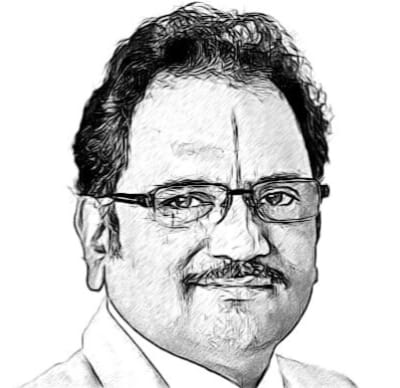
Law professor and eminent columnist
Madabhushi Sridhar Acharyulu, author of 63 books (in Telugu and English), Formerly Central Information Commissioner, Professor of NALSAR University, Bennett University (near Delhi), presently Professor and Advisor, Mahindra University, Hyderabad. Studied in Masoom Ali High School, AVV Junior College, CKM College, and Kakatiya University in Warangal. Madabhushi did LL.M., MCJ., and the highest law degree, LL.D. He won 4 Gold Medals at Kakatiya University and Osmania University.
Email: cicsridhar@gmail.com
Mobile: 8447651505