Telangana’s Liquor Economy
Political Expediency and the Slow Bankruptcy of Society
“मदिरालय जाने को घर से चलता है पीनेवाला,
‘किस पथ से जाऊँ?’ असमंजस में है वह भोलाभाला,
अलग-अलग पथ बतलाते सब, पर मैं यह बतलाता हूँ—
‘राह पकड़ तू एक चला चल, पा जाएगा मधुशाला।’”
— हरिवंश राय बच्चन, मधुशाला
Harivansh Rai Bachchan’s Madhushala was poetry, metaphor and philosophy. Telangana’s liquor story is something altogether different. It is a question of public finance, public health, human productivity and political responsibility.
The latest National Family Health Survey-6 (NFHS-6) presents a deeply disquieting picture. 43.9 per cent of men aged 15 years and above in Telangana reported consuming alcohol, against 18.9 per cent nationally. Among women, the corresponding figure is 7.1 per cent, against 1.1 per cent nationally. Telangana thus ranks at the top among the larger Indian States in reported male alcohol consumption.
The rural–urban divide is even more revealing. 46.6 per cent of rural men reported consuming alcohol, compared with 36.3 per cent in urban areas. This is therefore not merely a metropolitan phenomenon; it has penetrated the social and economic fabric of rural Telangana.
One distinction, however, is essential. NFHS-6 measures the proportion reporting alcohol consumption; it does not measure the quantity consumed. The survey figures should therefore not be mechanically equated with liquor sales. Yet when high reported prevalence is considered alongside Telangana’s enormous liquor market and excise receipts, the State can hardly avoid a serious policy examination.
The fundamental question is uncomfortable but unavoidable:
Has alcohol ceased to be merely a regulated commodity and become an instrument of fiscal governance?
When Revenue Becomes a Political Argument
Liquor sales in Telangana reportedly reached approximately ₹40,209 crore in 2025–26, while total excise revenue, including licence fees and other receipts, crossed ₹44,000 crore.
There is nothing inherently illegitimate about taxing alcohol. Governments across the world regulate and tax intoxicants precisely because of their social costs.
The problem begins when the regulator and the beneficiary become institutionally intertwined.
The State regulates alcohol.
The State licenses its sale.
The State collects the tax.
The State benefits from the revenue.
And the same State is expected to reduce the harm caused by consumption.
Therein lies the contradiction.
The Treasury counts the excise rupee; society pays the externality.
The Political Economy of the Bottle
Liquor possesses an attraction for governments that few other revenue sources possess. It generates substantial revenue quickly; the consumer base already exists; and taxation can be embedded in the price.
But the social cost is dispersed.
It appears in a hospital rather than a Treasury statement.
It appears in a police station rather than an excise report.
It appears in a family rather than a budget document.
It appears in the lost education of a child.
It appears in the diminished productivity of a worker.
It appears in premature mortality.
Thus the State’s accounting system captures the private revenue but inadequately captures the public cost.
Every rupee collected through alcohol carries a corresponding question: what is the social cost of generating it?
The Rural Worker and the Vanishing Wage
The particularly high consumption reported among rural men deserves serious attention.
For a financially secure consumer, alcohol expenditure may be discretionary. For a daily-wage worker, agricultural labourer or economically vulnerable household, the same expenditure can consume a substantial portion of disposable income.
The consequences travel far beyond the drinker.
A day’s wage spent on alcohol can mean less food. Less food can mean poorer health. Poorer health can mean reduced productivity. Reduced productivity can mean lower household income. Lower income can generate further indebtedness.
The cycle becomes self-reinforcing.
This is why alcoholism cannot be dismissed as merely an individual’s private failing. At scale, it becomes a labour-market, household-economy and human-capital problem.
The Youth Question
India celebrates its demographic dividend. Telangana too possesses a substantial working-age population and a reservoir of young human capital.
But demographic advantage is not created by numbers alone.
A demographic dividend requires health, education, skills, discipline, employability and productivity.
A young population weakened by addiction, indebtedness, ill health or declining productivity cannot deliver the demographic dividend that policymakers so readily invoke.
The deeper danger is the normalisation of drinking as an ordinary component of social life, particularly when alcohol is easily available and its fiscal importance is publicly visible.
Young people observe institutions.
When the State speaks of healthy citizens while simultaneously deriving substantial revenue from alcohol, the message becomes contradictory.
The Myth of Pure Individual Choice
The standard defence is simple: drinking is an individual’s choice.
That is true only in the narrowest sense.
Choice operates within a social environment.
Availability matters. Price matters. Peer pressure matters. Family circumstances matter. Stress and unemployment matter. Cultural normalisation matters. Access to treatment matters.
An adolescent growing up in an environment where alcohol is ubiquitous does not encounter the bottle under the same circumstances as an affluent adult making an occasional personal choice.
Public policy therefore cannot invoke “individual freedom” and then withdraw from the consequences.
Freedom of choice cannot become an excuse for governmental indifference to addiction.
Pseudo-Morality and the Convenient Silence
There is a deeper hypocrisy in the manner in which society discusses alcohol.
The poor drinker is condemned as irresponsible.
The politician speaks of family values.
The social reformer speaks of culture.
The intellectual speaks of morality.
The government speaks of welfare.
Yet the same system quietly calculates how much revenue alcohol can generate.
This is pseudo-morality.
It condemns the individual while remaining silent about the institutional structure that profits from widespread consumption.
It lectures the alcoholic about self-control but rarely asks whether treatment and rehabilitation are adequate. It lectures families about responsibility but does not adequately calculate the social cost imposed upon them.
Moral outrage directed exclusively at the consumer is convenient; examining the system that monetises consumption is uncomfortable.
A mature society must therefore move beyond moral sermonising and examine the economics, incentives and institutions behind the bottle.
Health: The Bill That Does Not Appear in the Budget
The medical consequences of harmful alcohol consumption are well established.
Alcohol is associated with liver disease, several cancers, cardiovascular disorders, injuries and dependence. It can also contribute to road accidents, violence and family distress.
Yet the State’s accounting system remains remarkably selective.
The excise receipt is recorded immediately.
The cirrhosis case appears years later.
The road accident is recorded elsewhere.
The domestic violence case appears in another institutional register.
The child’s educational deprivation is rarely quantified.
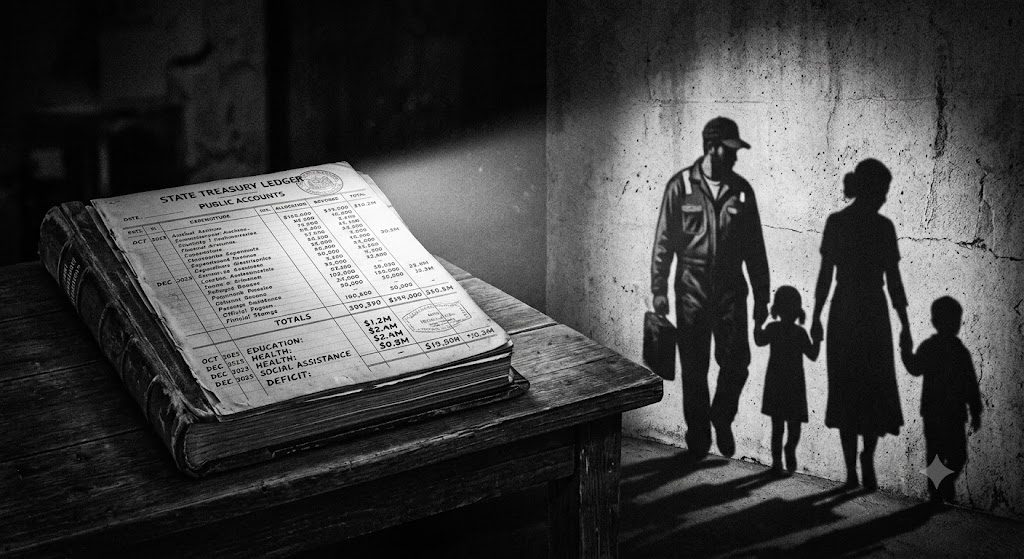
The loss of productivity does not appear in the excise ledger.
Thus the fiscal benefit is visible while the social cost remains fragmented.
What is revenue in one department becomes expenditure, suffering or lost productivity in another.
A responsible State should therefore publish an annual Social Cost of Alcohol Report, bringing together the costs borne by health services, policing, road safety, social welfare and the economy.
The Systemic Failure
The problem cannot be attributed to one government or one political party.
It is systemic.
The excise system is designed to collect revenue.
The political system sees fiscal resources.
The commercial system sees a market.
The consumer sees pleasure, escape or social acceptance.
The health system encounters the consequences.
The police system encounters accidents, violence and disorder.
The family absorbs the hidden cost.
And the next generation inherits the consequences.
Each institution deals with one fragment of the problem.
Nobody is sufficiently responsible for the whole.
That is the essence of systemic failure.
A system cannot be judged solely by the efficiency with which it collects revenue. It must also be judged by the consequences of the activity from which that revenue arises.
The Excise Trap
Every government inherits the temptation to preserve a dependable source of revenue.
An opposition may condemn alcohol dependence while in office, but once entrusted with the State’s finances, it confronts the same arithmetic.
The rhetoric changes.
The revenue remains.
The liquor economy survives.
The social cost accumulates.
The real failure is the absence of a durable political consensus to reduce fiscal dependence on alcohol.
If the State genuinely wishes to reduce harmful consumption, it must answer a difficult question:
How will the revenue be replaced?
Until that question is answered, prohibitionist rhetoric will remain easier than structural reform.
“Tomorrow We Will Close the Bars”
Political declarations that bars will be closed “from tomorrow” may generate headlines.
But governance cannot be conducted through theatrical announcements.
Abrupt prohibition without administrative preparedness can encourage illicit liquor, smuggling, bootlegging and corruption.
The alternative is intelligent harm reduction combined with long-term fiscal reform.
The State can progressively reduce harmful availability, strictly enforce licensing conditions, prevent sales to minors, regulate outlet density, strengthen de-addiction services, expand counselling, improve public awareness and diversify its revenue base.
The objective should not be to maximise excise receipts.
It should be to reduce harmful consumption and its consequences.
The Workforce Cannot Be Intoxicated
Telangana seeks investment, industrial expansion, technological growth and a globally competitive workforce.
But productivity is ultimately human.
A worker who is frequently absent, medically compromised or financially distressed because of addiction is a loss not merely to his family but to the economy.
The State therefore needs to examine alcohol policy alongside labour productivity.
How many workdays are lost?
How many accidents are alcohol-related?
How much household income is diverted?
How much public-health expenditure is incurred?
How much potential human capital is lost?
These are not moralistic questions.
They are economic questions.
A State cannot claim to be building a knowledge economy while ignoring a preventable drain on its human capital.
Bankruptcy Beyond the Balance Sheet
Bankruptcy need not mean merely an empty Treasury.
There can be social bankruptcy, institutional bankruptcy and moral bankruptcy.
A household may remain financially solvent while its relationships collapse.
A government may collect record excise revenue while its health system bears rising alcohol-related costs.
A society may congratulate itself on economic growth while losing productive human beings to addiction.
A political system may proclaim welfare while becoming dependent upon a commodity that can impoverish vulnerable households.
That is bankruptcy of a different kind.
The ultimate wealth of a State is not its excise collection. It is the health, productivity and dignity of its people.
The Press and Its Short Sight
There is another uncomfortable issue: the role of the media.
Record liquor sales are reported.
Excise collections are reported.
Price revisions are reported.
New licences are reported.
But the cumulative social cost rarely receives the same sustained scrutiny.
The press must go beyond the announcement.
It must ask the second question:
What did society pay for the revenue the government collected?
That is the difference between journalism and publicity.
A democracy requires not merely information but scrutiny.
The Silence of the Pseudo-Intellectual
India’s educated discourse is often remarkably selective.
We debate caste, cinema, celebrity culture, electoral arithmetic and ideological symbolism.
Yet an issue affecting household finances, public health, productivity, women, children and the future of the workforce can remain strangely peripheral.
This is not intellectual sophistication.
It is selective blindness.
Pseudo-intellectualism is particularly dangerous when it replaces evidence with fashionable commentary.
The real intellectual task is not to moralise about the drunkard.
It is to interrogate the system that makes intoxication economically profitable, socially normalised and politically convenient.
Beyond the Excise State
Telangana does not need an overnight fiscal revolution. It needs a long-term strategy.
Revenue must increasingly come from productive economic activity—manufacturing, services, technology, tourism, logistics, better property taxation, improved compliance and formalisation.
Alcohol taxation may remain a regulatory instrument.
It should not become a substitute for economic reform.
The State should progressively measure success not by the amount of excise revenue collected, but by measurable reductions in:
* harmful alcohol consumption;
* alcohol-related disease;
* road accidents;
* domestic violence;
* absenteeism and lost productivity;
* household indebtedness attributable to alcohol; and
* alcohol dependence among young people.
That would represent a transition from revenue maximisation to social governance.
A State Cannot Drink Its Way to Development
Telangana has Hyderabad, one of India’s major technology and services centres. It possesses substantial human capital, a large working-age population and considerable economic potential.
Its future cannot therefore be built upon a paradox in which the State finances welfare partly through a commodity that can undermine the very households welfare seeks to strengthen.
A State cannot drink its way to development.
Nor can society consume its future while celebrating the revenue generated by that consumption.
The NFHS-6 figures should not be reduced to the sensational headline that “Telangana tops alcohol consumption”. They should be understood as a warning about public health, family economics, labour productivity, youth and governance.
The real question is not whether alcohol can generate revenue.
Of course it can.
The real question is whether the price paid by society is greater than the revenue received by the State.
That calculation must be placed before the public.
Until it is, Telangana’s liquor economy will remain a classic case of fiscal convenience defeating social responsibility.
And that is the systemic failure that must finally be exposed—not merely the individual who stands before the bottle.
“राह पकड़ तू एक चला चल, पा जाएगा मधुशाला।”
— हरिवंश राय बच्चन
But the path before a modern State cannot be merely the path to the Madhushala.
It must be the path towards a healthier, more productive, economically secure and morally responsible society.

M. Shiva Prasad, IPS (Rtd.) is a dedicated law enforcement professional who served the combined Andhra Pradesh cadre before opting for the Telangana cadre. Though a native of Andhra Pradesh, he considers himself a true Hyderabadi with an abiding love for the Telugu people. Driven by sincerity, fearlessness, and a lifelong fight against inequality and injustice, his ultimate strengths remain his goodwill and deep affection for the public and the police force. Today, he continues his mission by writing snippets and articles true to his conscience.
Email: Shivareach@yahoo.com
Mobile: 98480 38774

Sir,
Sorry to say :
Govt exchequer runs majorly on Registrations & on Excise Duty on Liquor.
Registrations or on downside for TG Govt, at least, let Govt earn on Excise Duty .
In these scenarios is it TG or AP or any other state in South, their breadwinner is Liquor.
తాగుదాం, ఊగుదాం has become motive of Common Man, irrespective of his financial ability.