Cultural and Structural Roots
Modern Constitution, Enduring Hierarchies
India presents one of the great paradoxes of civilisation. It possesses a Constitution that proclaims equality, a democratic polity that confers universal adult franchise, a judiciary entrusted with fundamental rights, and a social order that publicly celebrates the dignity of every human being. Yet beneath this constitutional superstructure survive two extraordinarily resilient hierarchies—caste and gender.
Neither is merely an economic question. Neither can be explained exclusively by poverty, education or employment. They are embedded in the historical memory, social psychology, family structure, customary practices and cultural imagination of India. The deeper dilemma is that the law has moved considerably faster than society.
The result is a curious Indian duality: equality in the text, hierarchy in the mind; modernity in institutions, antiquity in social behaviour.
The Caste That Survived Its Original Rationale
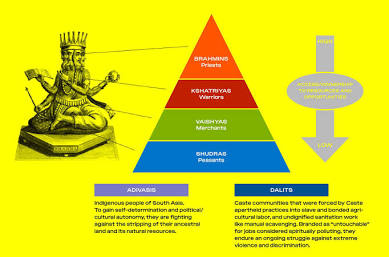
Historically, Indian social stratification cannot be reduced to a single, unchanging institution. The classical distinction between varna, the innumerable jatis, occupational communities, tribal identities and later administrative classifications evolved through centuries. Occupation, ritual status, locality, kinship and political power interacted in producing a remarkably intricate social order.
But whatever its historical origins, the contemporary reality is unmistakable: caste has become predominantly a matter of birth.
The son is born into the caste of the father; the daughter inherits the same social identity; marriage is frequently arranged within the caste; kinship remains caste-conscious; and social networks often reproduce the same boundaries. An occupational theory of caste therefore explains only part of contemporary India. The decisive mechanism today is hereditary social identity.
Pew Research Center’s large India survey found that 98% of Indians identified with a caste category, regardless of religion. Around 70% said that most or all of their close friends belonged to the same caste. More remarkably, 64% considered it very important to prevent women in their community from marrying outside the caste, while 62% said the same regarding men.
These figures expose the central contradiction. The educated Indian may hesitate to speak openly about caste; he may even consider himself emancipated from caste prejudice. Yet marriage, friendship, kinship and political mobilisation can continue to reproduce caste boundaries beneath the surface.
The stigma has therefore not disappeared; it has become socially sophisticated.
The Silence of the Urban Middle Class
There is another dimension that statistics alone cannot capture.
The urban middle class has learnt the language of constitutional equality. It is often embarrassed to discuss caste openly. Caste may disappear from polite conversation, yet reappear with remarkable precision when a marriage proposal, political alliance, electoral calculation, residential preference or family relationship is under consideration.
This produces a perception–reality gap.
Pew found that 82% of Indians said they had not personally experienced caste discrimination during the preceding year, while only 20% perceived a great deal of discrimination against Scheduled Castes. Among SCs and STs themselves, however, 17% reported personal caste discrimination during that period, with considerable regional variation.
These figures should neither be dismissed nor misread. They do not prove that caste discrimination has vanished. Nor do they establish that every member of a historically disadvantaged community experiences discrimination continuously. They demonstrate something subtler: caste operates through both overt discrimination and invisible social reproduction.
A society can therefore become less openly discriminatory while remaining deeply caste-conscious.
When Occupation Becomes Hereditary Stigma
The most disturbing manifestation is the persistence of occupational stigma. Sanitation, waste collection, sewer cleaning and other hazardous occupations have historically been disproportionately associated with communities placed at the bottom of the caste hierarchy. The very existence of legislation prohibiting manual scavenging demonstrates that occupational degradation cannot be treated merely as an economic accident.
The Government’s own social-justice machinery continues to operate rehabilitation and mechanisation programmes for sanitation workers, waste pickers and persons formerly engaged in manual scavenging. The 2013 law prohibits employment as manual scavengers and hazardous manual cleaning of sewers and septic tanks.
The contradiction is stark: a Republic that has abolished untouchability by constitutional command still has to administer programmes to eradicate the occupational consequences of an ancient social stigma.
That is not merely poverty. It is inherited social memory.
The Futility of Caste Arithmetic Without Social Understanding
India’s difficulty in discussing caste is compounded by the inadequacy and inconsistency of its demographic data. The Government itself acknowledges that reliable contemporary all-India OBC population data are unavailable because the decennial caste census was discontinued after 1931; the Mandal Commission estimated the OBC population at 52%, but that remains an estimate rather than a contemporary census enumeration.
Pew similarly cautions that caste estimates differ according to methodology, question wording, sampling and whether respondents self-identify or are classified through census procedures.
Thus, the obsession with percentages can itself become misleading.
A caste census may tell us how many people belong to a category; it cannot by itself tell us how caste consciousness is changing.
Indeed, an interesting paradox follows. If the social stigma attached to caste identity makes sections of the urban and educated population reluctant to disclose it, while political mobilisation makes caste identity increasingly useful in certain contexts, statistical proportions may change without any corresponding demographic transformation.
Caste arithmetic, therefore, must not be mistaken for caste sociology.
The Political Afterlife of Caste
Caste has survived partly because it has acquired a new political utility. Electoral democracy has converted communities into constituencies. A social identity that once determined ritual position can now determine political representation, reservation claims, coalition arithmetic and welfare targeting.
This is not to say that affirmative action itself created caste consciousness. The historical disadvantages it seeks to address predate the Republic. The Constitution expressly permits special provisions for socially and educationally backward classes and for Scheduled Castes and Scheduled Tribes. The Scheduled Castes and Scheduled Tribes (Prevention of Atrocities) Act, 1989, further created a specialised legal framework for atrocities, Special Courts and victim rehabilitation.
The difficulty lies elsewhere: a remedy designed to overcome inherited hierarchy can, under certain political circumstances, also preserve the salience of the identity through which the hierarchy is measured.
That is a sociological paradox, not an argument for abandoning constitutional safeguards.
Pasmanda Muslims and the Complexity of Caste Beyond Hinduism
The caste question cannot be confined neatly within Hindu society.
Indian Muslims themselves contain considerable internal social stratification. The Sachar Committee documented substantial socio-economic variation among Muslim communities and found that large sections were located within OBC categories, while also noting the limitations of available data on Muslim caste classification.
The contemporary political discourse surrounding Pasmanda Muslims reflects precisely this internal diversity.
It would therefore be analytically unsound to claim that an exact percentage—such as “90%”—of Pasmanda Muslims belong to SC, ST and Most Backward communities without a reliable contemporary dataset. Nor should the social identity of Indian Muslims be reduced to a single caste formula.
The important sociological point is different:
Caste-like social stratification has travelled beyond the boundaries of the religious tradition in which the classical caste order historically developed.
Politics inevitably notices this social reality. Whether political parties seek these communities primarily for representation, welfare or electoral purposes is a question that must be examined case by case rather than presumed universally.
Caste and the Crisis of Hindu Social Cohesion
The historical burden of caste has fallen particularly heavily upon Hindu society because caste hierarchy became deeply intertwined with its social institutions.
But an important distinction must be maintained.
The decline of caste hierarchy is not synonymous with the decline of Hinduism.
Hindu civilisation is considerably older and more internally diverse than its caste structure. Its philosophical traditions contain conceptions of spiritual universality, ātman, dharma, compassion and human interconnectedness that cannot simply be equated with hereditary hierarchy. The contemporary paradox is nevertheless striking. Sections of the socially dominant castes have increasingly abandoned many traditional ritual practices while retaining, at times, the social or political advantages attached to caste identity. Conversely, sections of historically depressed communities may display intense attachment to festivals, ritual observances and religious traditions.
This should not automatically be interpreted as hypocrisy or irrationality. Religion can provide dignity, belonging, memory and collective identity to communities that have experienced social exclusion.
But it does reveal a profound question:
When faith becomes primarily a vehicle of social anxiety, ritual fear or competitive identity, rather than ethical conviction, both religion and society impoverish themselves.
India’s caste and religious structures therefore stand at a crossroads—not because Hinduism is mechanically “disappearing”, but because the social legitimacy of hereditary hierarchy is becoming increasingly difficult to reconcile with constitutional democracy and modern individual dignity.
THE OTHER HALF OF THE DILEMMA: THE GIRL CHILD
If caste represents India’s inherited hierarchy, gender represents its most intimate hierarchy. A girl does not merely enter a family at birth; she enters a social system already burdened with expectations about sexuality, marriage, dowry, honour, domesticity and obedience. The constitutional promise is uncompromising. Article 15 prohibits discrimination on grounds including sex and expressly permits special provisions for women and children.
Yet social reality remains stubborn.
India’s 2026 Global Gender Gap Report score places the country at 131st globally, with only 64.5% of the overall gender gap closed. Educational parity is comparatively high, but economic and political parity remains substantially weaker. The World Economic Forum records women’s labour-force participation parity at only 44.1%, while representation among legislators, senior officials and managers remains particularly low. The direction of change is not uniformly negative. India’s official PLFS data show female labour-force participation rising substantially—from 23.3% in 2017-18 to 41.7% in 2023-24.
But participation alone does not constitute emancipation.
A woman may enter the labour market and still remain subordinate within the household. She may be educated and still be denied autonomy in marriage. She may earn and still carry the overwhelming burden of domestic labour. She may occupy public space and yet be judged primarily through notions of modesty, sexuality and family honour.
The Girl Child and the Burden of Honour
The deepest cruelty is perhaps that the girl is frequently treated not as an autonomous citizen but as the repository of family honour.
The historical child-sex-ratio data remain a grim indicator. Census 2011 recorded 918 girls for every 1,000 boys in the 0–6 age group, down from 927 in 2001. Government analysis identified son preference, the perceived economic and social security provided by sons, dowry and violence against women among the factors underlying the adverse ratio.
The contradiction between public worship of the feminine divine and social anxiety about the birth of a daughter is one of India’s most painful cultural ironies.
A society may invoke Durga, Kali, Lakshmi and Saraswati with devotional fervour and yet calculate the economic liability of a daughter before she has learnt to speak.
The deity is worshipped.
The daughter is negotiated.
That contradiction demands moral scrutiny.
Sexual Violence and the Failure of Social Protection
The enormity of the problem is visible in official crime statistics.
NCRB data for 2023 recorded 448,211 registered cases of crimes against women. Crimes against children totalled 177,335 cases, of which 67,694 were registered under the POCSO Act. Crimes recorded against Scheduled Castes stood at 57,789.
These are registered cases, not the total universe of victimisation. Registration is affected by reporting, access to police, family pressure, stigma, fear and the willingness of institutions to record complaints.
The law has consequently had to build an increasingly elaborate protective architecture.
The Protection of Children from Sexual Offences Act, 2012, criminalises penetrative and non-penetrative sexual assault, sexual harassment and the use of children for pornography, while providing Special Courts and child-sensitive procedures.
The very sophistication of this statutory framework is evidence of a disturbing reality: the State has been compelled to construct an extensive legal shield around citizens whom society ought to have protected by culture and conscience.
Social Media: The New Theatre of Humiliation
The digital revolution has created another frontier.
A woman’s photograph can be appropriated, altered, sexualised, circulated and weaponised within minutes. Children are exposed to forms of sexual exploitation that earlier generations could scarcely have imagined. Reputation, once destroyed within a village or neighbourhood, can now be destroyed across a digital universe.
The law is struggling to keep pace with technology.
But legislation alone cannot cure a culture that treats women as objects of consumption, humiliation or control.
The problem is not merely the criminal mind. It is also the social gaze.
The Constitutional Republic Versus the Social Republic
India therefore contains two republics.
The first is the Constitutional Republic.
It speaks of equality before law, non-discrimination, dignity, liberty and social justice. Article 17 abolishes untouchability; Article 15 prohibits discrimination and permits affirmative measures; Article 16 guarantees equality of opportunity in public employment; and Parliament has enacted special laws against caste atrocities, untouchability, manual scavenging and sexual offences against children.
The second is the Social Republic.
It still asks:
What is your caste?
Whom will you marry?
What will people say?
Is the child a boy or a girl?
How much dowry?
What is the family’s status?
Which community?
Which lineage?
Which religion?
The first republic is citizenship-based.
The second remains substantially identity-based.
And the tragedy is that millions of Indians inhabit both simultaneously.
THE INDIAN DILEMMA
Caste and gender are not isolated maladies. They are mutually reinforcing systems of hierarchy.
A woman from a historically marginalised caste may encounter the burdens of caste, class and gender simultaneously. A poor sanitation worker may experience occupational stigma, economic vulnerability and social exclusion. A girl born into a socially conservative household may encounter restrictions on education, mobility, marriage and employment long before the State can intervene.
The vocabulary of equality has therefore expanded faster than the social imagination of equality.
India has abolished untouchability constitutionally, but not necessarily its psychology.
India has legislated equality between men and women, but not yet achieved equality in the household.
India has expanded women’s education, but education has not automatically dissolved patriarchy.
India has constitutionalised dignity, but social status continues to be inherited.
India has modernised its economy, yet millions remain trapped in inherited social expectations.
That is the Indian dilemma.
The Way Forward Is Not Another Census of Prejudice
The answer cannot lie solely in counting castes or passing another statute.
Nor can it lie in pretending that caste has disappeared because the educated no longer discuss it openly.
Nor can gender equality be reduced to the number of women in Parliament or the number of girls entering school.
The real transformation must occur in the Indian mind.
A child’s worth must cease to depend upon caste.
A woman’s worth must cease to depend upon marriage.
A daughter’s birth must cease to be treated as an economic liability.
A profession must cease to carry hereditary stigma.
A person’s social dignity must cease to be determined by ancestry.
And religion must be judged not merely by the splendour of its festivals, but by the humanity with which its adherents treat the weakest among them.
The Constitution cannot perform this transformation alone. Courts cannot perform it alone. Governments cannot perform it alone. Political parties cannot perform it alone.
The family is the first school of caste; it must also become the first school of equality.
The family is the first school of patriarchy; it must become the first school of dignity.
India does not suffer from a shortage of laws.
It suffers from the distance between law and life, proclamation and practice, worship and conduct, modernity and memory.
The ultimate battle against caste and gender inequality will therefore not be fought merely in Parliament, the courts or the polling booth. It will be fought in the dining room, the classroom, the marriage negotiation, the workplace, the street, the temple, the mosque, the church and—above all—inside the Indian conscience.
Until birth ceases to determine social worth, and sex ceases to determine human freedom, India’s claim to having overcome its ancient hierarchies will remain premature.
The Republic has changed the law. The unfinished task is to change the society.

M. Shiva Prasad, IPS (Rtd.) is a dedicated law enforcement professional who served the combined Andhra Pradesh cadre before opting for the Telangana cadre. Though a native of Andhra Pradesh, he considers himself a true Hyderabadi with an abiding love for the Telugu people. Driven by sincerity, fearlessness, and a lifelong fight against inequality and injustice, his ultimate strengths remain his goodwill and deep affection for the public and the police force. Today, he continues his mission by writing snippets and articles true to his conscience.
Email: Shivareach@yahoo.com
Mobile: 98480 38774