A THINKING “DIMAG” IS NOT A TABOO
INDIA REQUIRES MORE “DIMAGI NAXALS”
An analytical, philosophical and satirical inquiry into dissent, intellectual freedom, social justice and the civilisational imperative to question power
India’s Independence was not merely a transfer of political authority from one ruler to another. It was a promise of emancipation—political, social and intellectual. It was a promise that the citizen would be free to think, question, reason, dissent and participate in the remaking of an unjust social order.
The expression “dimagi Naxal” has now entered India’s political vocabulary. But beyond the immediate political controversy lies a much larger philosophical question:
Can thinking itself become a taboo?
If dimag means the mind, should the citizen be afraid of using it?
If questioning exploitation, inequality, caste hierarchy, concentrated wealth, institutional decay, bureaucratic inertia or governmental excess is treated as ideological subversion, India must pause and examine what it has inherited from its own extraordinary civilisation of questioning.
For India has never been a civilisation of intellectual servility.
It has been a civilisation of argument, inquiry, dissent and discovery.
A THINKING “DIMAG” IS NOT A TABOO
The Republic does not need obedient minds.
It needs inquiring minds.
A scientist who questions an established theory is not an enemy of science.
A doctor who challenges accepted medical practice is not an enemy of medicine.
A philosopher who questions God, society or authority is not an enemy of civilisation.
A historian who revisits an accepted narrative is not an enemy of the nation.
A journalist who investigates power is not an enemy of government.
A citizen who asks why justice is delayed is not an enemy of the judiciary.
A young person who asks why opportunity remains unequal is not an enemy of the State.
Democracy is not the art of agreeing with power.
It is the institutionalisation of disagreement without violence.
That distinction is fundamental.
THE END OF THE GUN DOES NOT MEAN THE END OF THE QUESTION
The decline of armed Left-Wing Extremism is an important development in India’s internal-security history. The State has a legitimate duty to defeat armed insurgency and protect citizens from violence.
No philosophy can provide moral immunity to killing.
No grievance legitimises the murder of civilians.
No revolution acquires legitimacy merely because it calls itself revolutionary.
But another distinction must be preserved.
The defeat of armed extremism must not become an invitation to defeat intellectual dissent.
The gun can be defeated by superior force.
A thought cannot.
Ideas must be answered by better ideas.
Arguments must be defeated by stronger arguments.
Injustice must be confronted by justice.
That is the constitutional way.
CHARVAKA — THE ANCIENT QUESTIONER
If questioning established authority is itself to be regarded with suspicion, India’s own philosophical history would become an uncomfortable witness.
Consider Charvaka, or Lokayata.
It represented one of the most radical sceptical and materialist currents of Indian thought. It challenged the authority of the Vedas, questioned ritualism and emphasised perception and empirical knowledge.
Charvaka did not merely disagree politely.
He questioned foundations.
He questioned inherited authority.
He questioned metaphysical assumptions.
He questioned the very means by which society claimed to know what was true.
Would such a thinker be regarded today as an intellectual rebel?
Perhaps.
But India did not destroy the memory of the argument.
It preserved it through centuries of philosophical contestation.
That is one of the great strengths of Indian civilisation.
It allowed thought to fight thought.
THE UPANISHADS — QUESTIONING AS A CIVILISATIONAL METHOD
The Upanishadic tradition offers an even deeper lesson.
The seeker does not merely receive truth from authority.
He asks.
He doubts.
He enquires.
He pursues the question beyond the obvious answer.
The philosophical spirit of neti, neti—“not this, not this”—is itself an intellectual refusal to accept premature certainty.
The great dialogues of Indian thought are not monuments to intellectual submission.
They are monuments to inquiry.
The Buddha questioned suffering and the foundations of human attachment.
The Jain tradition cultivated anekantavada, the recognition that reality may possess multiple aspects and that intellectual absolutism can itself be a form of error.
The philosophical schools of India argued fiercely with one another.
Vedanta, Sankhya, Nyaya, Vaisheshika, Mimamsa, Buddhism, Jainism and Charvaka did not speak with one voice.
India’s intellectual greatness lay precisely in its refusal to have only one voice.
CHARAKA AND SUSHRUTA — THE MIND AGAINST SUFFERING
Then come Charaka and Sushruta.
Their legacy is not revolutionary politics. It is something more enduring—the application of reason to human suffering.
Medicine begins with a question:
Why does a human being fall ill?
Surgery begins with another:
Can suffering be reduced by intervention?
The traditions associated with Charaka and Sushruta demonstrate the ancient Indian impulse to observe, classify, reason and experiment.
Sushruta’s surgical tradition is particularly significant for its sophisticated understanding of anatomy and operative techniques.
The larger lesson is universal:
Human progress begins when somebody refuses to accept suffering as inevitable.
That sentence can produce a physician.
It can produce a scientist.
It can produce a reformer.
It can produce a revolution.
The difference lies in the method.
FROM ARYABHATA TO NEWTON
Aryabhata questioned the heavens.
He did not simply inherit the cosmological assumptions of his age. He applied mathematics and observation to understand celestial phenomena and contributed profoundly to Indian astronomy and mathematics.
Bhaskara extended mathematical thought further.
Centuries later, Newton transformed humanity’s understanding of motion and gravitation.
The great intellectuals of science shared one characteristic:
They were dissatisfied with unexplained reality.
They did not ask:
“Who am I to question?”
They asked:
“Why?”
Why does an object fall?
Why do planets move?
Why does disease occur?
Why does matter behave as it does?
Why does society distribute wealth unequally?
Why does one human being possess power over another?
Every civilisation advances through such questions.
EDISON AND THE IMPULSE TO INVENT
Thomas Edison represents another form of the same intellectual temperament.
The inventor looks at an existing limitation and refuses to regard it as permanent.
Darkness becomes a technological problem.
Communication becomes an engineering problem.
Sound becomes a recording problem.
Movement becomes a cinematic possibility.
The inventor says:
“There must be another way.”
That is the spirit of innovation.
The wheel itself was an act of intellectual rebellion.
The printing press was an act of intellectual rebellion.
The steam engine was an act of intellectual rebellion.
Electricity transformed civilisation.
The computer transformed knowledge.
Artificial intelligence is now transforming the relationship between human beings and information.
Civilisation advances because somebody refuses to accept “impossible” as the final answer.
MARX AND ENGELS — THE QUESTION OF WEALTH
Karl Marx and Friedrich Engels introduced another powerful dimension into the history of questioning.
They asked uncomfortable questions about capital, labour, class and the distribution of economic power.
Their revolutionary conclusions remain controversial.
Their political prescriptions remain deeply contested.
Their historical predictions were not uniformly fulfilled.
But their questions remain relevant.
Who owns the means of production?
Who controls capital?
How is wealth distributed?
Does economic power become political power?
Can extreme concentration of wealth coexist indefinitely with social equality?
These are not exclusively Marxist questions.
They have become questions of contemporary capitalism itself.
To read Marx is not to become a Marxist.
To study Mao is not to become a Maoist.
To study Naxalism is not to become a Naxalite.
Understanding an ideology is not subscribing to it.
Indeed, a confident democracy should encourage its citizens to study even ideas with which they profoundly disagree.
Dangerous ideas are better defeated through understanding than through ignorance.
THE PHILOSOPHICAL PARADOX
Here lies the central paradox.
India wants to become a global scientific and technological power.
It wants young people to innovate.
It wants entrepreneurs to take risks.
It wants scientists to challenge existing knowledge.
It wants universities to produce original research.
It wants artificial intelligence, biotechnology, space science and advanced engineering to flourish.
Yet the same society cannot logically cultivate fear of independent thought.
A nation cannot demand scientific temper in the laboratory and intellectual obedience in society.
It cannot ask its engineers to challenge equations while asking its citizens not to challenge assumptions.
It cannot celebrate Newton while fearing the question.
It cannot celebrate Charaka and Sushruta while discouraging inquiry.
It cannot invoke its ancient philosophical heritage while demanding intellectual conformity.
The mind cannot be switched on selectively.
Once liberated, it asks questions everywhere.
QUESTIONING IS NOT VIOLENCE
This distinction cannot be blurred.
A person may oppose capitalism without planting a bomb.
A person may demand land reform without carrying a rifle.
A person may oppose corporate concentration without supporting Maoist insurgency.
A person may defend tribal rights without becoming an extremist.
A person may criticise the government without seeking to overthrow the Constitution.
A person may favour socialism and remain a constitutional democrat.
A person may favour capitalism and remain equally committed to democracy.
Ideas are not crimes merely because they are inconvenient.
Conduct is another matter.
Incitement to violence, terrorism, armed rebellion and deliberate attacks upon civilians are matters for the law.
The constitutional State must draw the line there—with evidence, precision, proportionality and due process.
THE REAL BATTLE IS AGAINST EXPLOITATION
The more meaningful question, therefore, is not:
“How many dimagi Naxals are there?”
It is:
“How many citizens are still thinking about exploitation?”
Why does wealth remain concentrated?
Why does caste continue to influence social opportunity?
Why does quality education remain unequal?
Why does healthcare remain unaffordable for so many?
Why does bureaucratic inertia often become a barrier to justice?
Why does justice take years?
Why does political power require enormous financial resources?
Why does black money persist?
Why do organised economic interests exercise disproportionate influence?
Why do vulnerable communities continue to experience displacement and insecurity?
These questions should not be suppressed.
They should be answered.
If the system is just, it should survive scrutiny.
If a policy is sound, it should survive criticism.
If an institution is strong, it should survive investigation.
If a government is confident, it should welcome questions.
Only a fragile system fears the mirror.
THE CONSTITUTION — INDIA’S ALTERNATIVE TO REVOLUTION
India’s greatest achievement was not merely independence from colonial rule.
It was the creation of a constitutional mechanism through which profound social transformation could occur without permanent civil conflict.
The Constitution offers a route:
From oppression to reform.
From exclusion to representation.
From inequality to equality.
From arbitrary authority to fundamental rights.
From hereditary privilege to democratic citizenship.
From social hierarchy to constitutional fraternity.
The Constitution is not an obstacle to social transformation.
It is India’s peaceful instrument of social transformation.
The unfinished task is to make its promises real.
A DEMOCRACY NEEDS “DIMAG”
India’s future will not be secured by citizens who merely repeat slogans.
It will be secured by citizens who can distinguish:
Fact from propaganda.
Argument from abuse.
Dissent from violence.
Evidence from rumour.
Patriotism from political conformity.
India needs more scientists.
More researchers.
More philosophers.
More teachers.
More independent journalists.
More constitutional scholars.
More social scientists.
More inventors.
More public intellectuals.
More citizens willing to ask uncomfortable questions.
In that sense, India does require more “dimagi” citizens.
Not “dimagi Naxals” in the sense of people who advocate armed Maoist violence.
But dimagi citizens in the noblest sense—citizens who use their minds.
THINK. QUESTION. ARGUE. RESIST INJUSTICE.
The Indian mind has never been a prisoner of silence.
The Upanishadic seeker questioned existence.
The Buddha questioned suffering.
Charvaka questioned metaphysical authority.
Charaka questioned disease.
Sushruta questioned the limits of surgery.
Aryabhata questioned the heavens.
Bhaskara questioned mathematical possibility.
Newton questioned gravity.
Darwin questioned biological permanence.
Marx questioned economic power.
Einstein questioned the nature of space and time.
Edison questioned technological limitation.
Ambedkar questioned caste.
Gandhi questioned the morality of empire.
Their conclusions differed radically.
Some contradicted one another.
Some were later disproved.
Some transformed humanity.
But none of civilisation’s great advances came from not thinking.
THE FINAL IRONY
If dimagi means “of the mind”, India should not be frightened by the word.
It should reclaim it.
Let the mind think.
Let the scholar argue.
Let the scientist experiment.
Let the historian question.
Let the journalist investigate.
Let the student protest peacefully.
Let the citizen demand justice.
Let the Constitution determine where legitimate dissent ends and unlawful violence begins.
The answer to an inconvenient mind is not a label.
It is an argument.
The answer to exploitation is not silence.
It is reform.
The answer to injustice is not submission.
It is justice.
The answer to extremism is not intellectual conformity.
It is constitutional confidence.
And the answer to a thinking citizen should never be fear.
A THINKING CITIZEN IS NOT THE ENEMY.
A THINKING “DIMAG” IS NOT A TABOO.
INDIA REQUIRES MORE “DIMAGI NAXALS” — CITIZENS WHO THINK, QUESTION, REASON, RESEARCH AND COURAGEOUSLY CONFRONT INJUSTICE WITHOUT RECOURSE TO VIOLENCE.
That is not rebellion against India.
That is the mind of India.
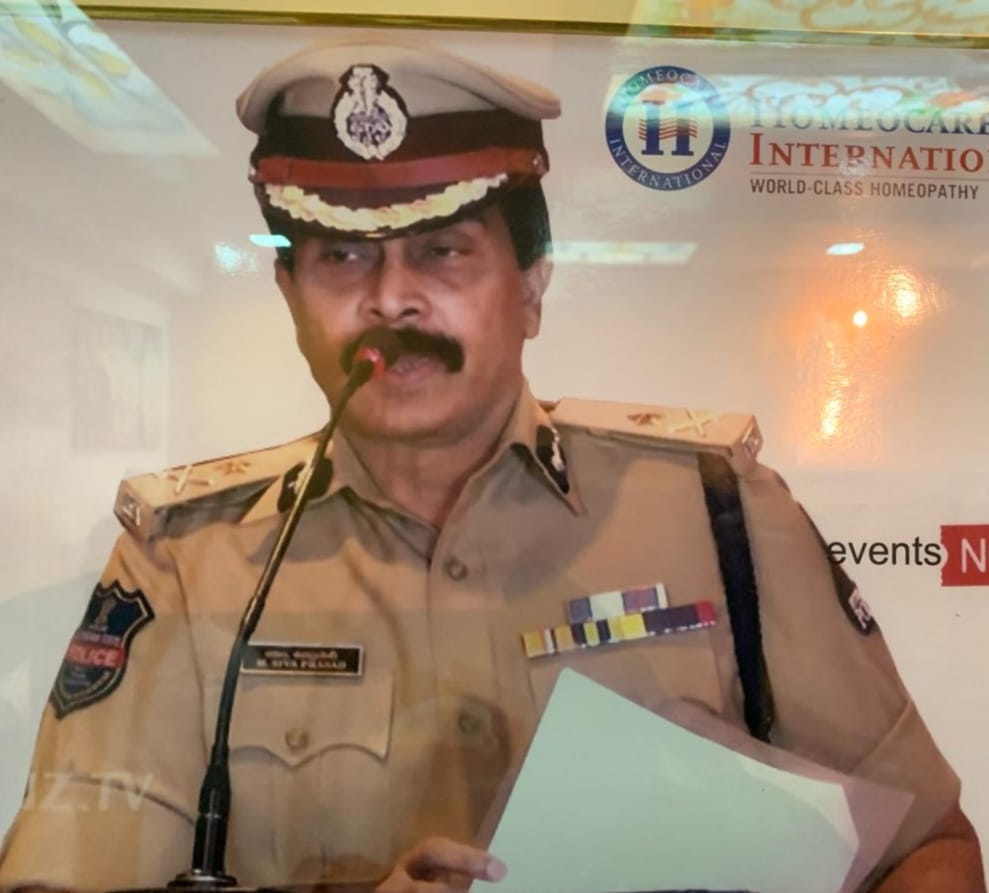
M. Shiva Prasad, IPS (Rtd.) is a dedicated law enforcement professional who served the combined Andhra Pradesh cadre before opting for the Telangana cadre. Though a native of Andhra Pradesh, he considers himself a true Hyderabadi with an abiding love for the Telugu people. Driven by sincerity, fearlessness, and a lifelong fight against inequality and injustice, his ultimate strengths remain his goodwill and deep affection for the public and the police force. Today, he continues his mission by writing snippets and articles true to his conscience.
Email: Shivareach@yahoo.com
Mobile: 98480 38774

Excellent perspective by M. Shiva Prasad. It is crucial for a thriving republic to distinguish between armed extremism—which threatens public safety—and constructive intellectual dissent, which drives progress. As Indian civilisational history demonstrates, questioning authority and seeking truth through debate are foundational values, not taboos. An informed, critical citizen is an asset to constitutional democracy, not an adversary.