
The Journey So Far
We have travelled through three distinct landscapes. At Somnath (Sea front), we learned to rebuild from the ashes. At Mallikarjuna (Mountains), we balSanced the Masculine and Feminine energies within us. At Mahakaleshwar (Geographic centre), we mastered stillness amidst the flow of time. Now, we arrive at the banks of the river Narmada. At Omkareshwar, we learn the art of being in tune.
The Legend: The King who resonated with Nature
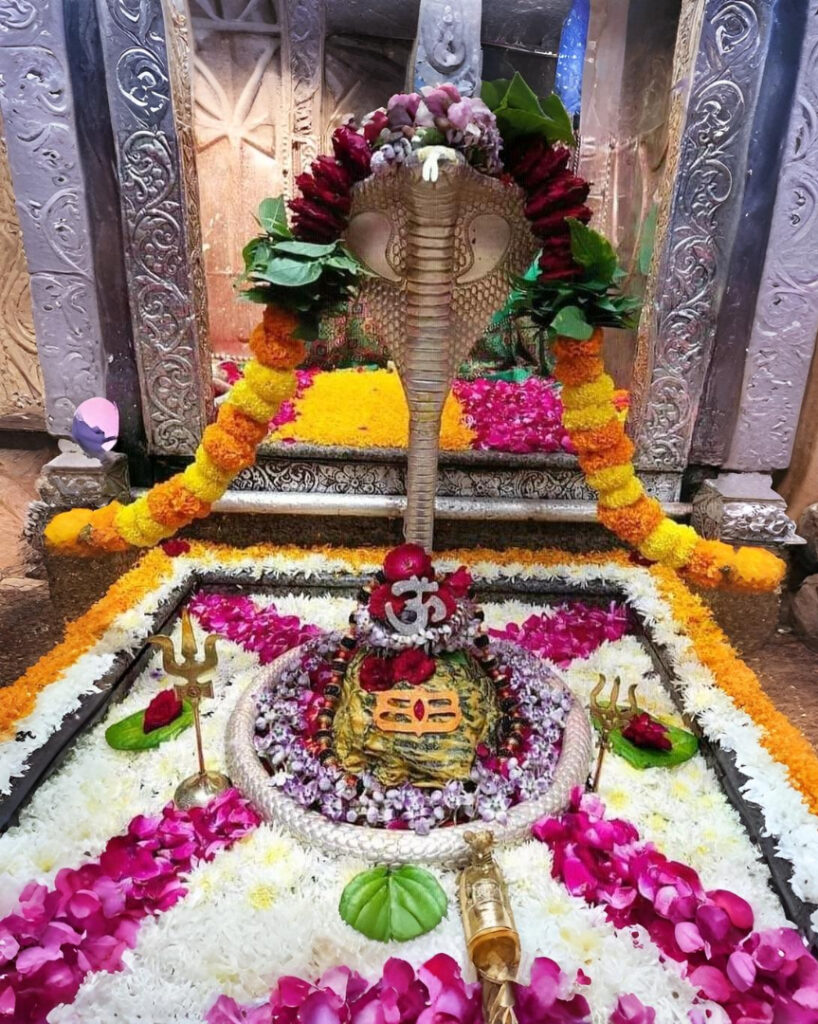
King Mandhata was a ruler of the Ikshvaku dynasty and an ancestor of Lord Rama. He had reached the peak of earthly success, yet he felt a deep emptiness. He realized that his crown was a heavy burden that did not offer him the ultimate truth.
He decided to leave his palace to seek a wisdom as an ordinary seeker, not bound by titles. He chose a spot on the banks of the Narmada for an intense penance. His devotion created a massive vibration which was the sound of the universe, Om. The legend says the physical world had to respond; the mountains bowed, and the Narmada river parted to encircle the King, carving the island into the shape of the syllable Om.
Lord Shiva manifested in two forms: the Omkareshwar Jyotirlinga on the island and the Mamleshwar Jyotirlinga on the mainland. Although they sit on opposite banks, they are two halves of the same light, teaching us that our inner spiritual heart and our outer worldly duty are two temples of the same truth.
The History: The Meeting in the Cave

Beneath the main temple lies a small cave where a young Adi Shankara met his Guru, Govinda Bhagavatpada. When the Guru asked who he was, Shankara did not mention his name or village. Instead, he spoke the Dashashloki (Ten Verses), a concise declaration that he was not his body or his mind. While he later composed the famous Nirvana Shatakam (Six Verses of Liberation) with its iconic refrain—Chidananda Roopa Shivoham Shivoham—the logic remains the same. Both works serve as a masterclass in the Logic of Subtraction.
The Deeper Lesson: The Dashashloki Protocol Within the stillness of that cave, Shankara offered a manual for the soul, showing us how to shed the heavy masks of titles and roles to find the light that stays when everything else is stripped away. He used the method known as Neti-Neti (“not this and not that”). The first verse sets the tone: Na bhumir na toyam na tejo na vayuh, na kham nendriyam va na tesham samuhah. This translates to: “I am not the earth, nor water, nor fire, nor air, nor ether. I am not the senses, nor even the mind.” By identifying with this inner resonance, you realize you are not just the professional title you hold. You are the pure consciousness observing the role. You are the music that continues even when the speaker is turned off.
Relevance to the Modern Seeker In a world of constant noise, we are told to shout to be heard and accumulate titles to be seen, creating a deep division between our public persona and our true self. Omkareshwar teaches us that resonance is more powerful than volume. A bell does not need to scream to be heard. It simply vibrates at its true frequency, and the sound carries. When your inner values match your outer actions, the world naturally aligns with you. You stop fighting for attention and start attracting what belongs to you.
Real-Life Applications
The Career Transition Crisis: When a long-held corporate title suddenly disappears due to retirement or organizational restructuring, the resulting silence can feel like a loss of who you are. The Logic of Subtraction reminds you that your professional wisdom and leadership are the resonance, while the designation was merely the speaker system you used to project it. Your value as a mentor and strategist remains the same even if your job title changes.
The Professional Rebirth: You might reach a stage where you choose to leave a high-pressure, high-status role to start something of your own or pivot to a simpler path that feels more meaningful. While peers might judge the move as stepping down from power, the Mandhata Effect is about aligning your daily life with your inner values rather than external expectations. When your intent is clear, the pressure to maintain a certain status eventually fades, and you find a more sustainable peace in your new pursuit.
The Changing Family Dynamic: As children grow independent and leave home, the role of the active parent begins to fade, often leaving a void. The Dashashloki Filter helps you realize that you are the silent awareness that supported that role for decades. You are the steady presence that exists before, during, and after any specific stage of life.
The Daily Burnout Recovery
Modern exhaustion often comes from the bleed between our work and our lives. The Two-Bank Integration suggests treating your professional responsibilities as the temple on the mainland and your personal peace as the temple on the island. You must consciously cross the bridge every day, leaving the noise of the mainland behind so it does not disturb the silence of the island. By naming the bridge, you create a sacred boundary that protects your true self from the demands of your designation.
The Seeker’s Summary
Resonance is the natural result of alignment. Just as the river carves the island and the Guru shapes the seeker, you must bridge the two banks of your own life. When your inner truth matches your outer actions, you become an immovable presence. You no longer fight the current; you become the island. You become the light, an inseparable part of that eternal Jyoti.
About the Author
[R Srinivasa Murthy, the author of the article, is a corporate leader and independent writer dedicated to demystifying Hindu philosophy for the next generation. His work strips away unnecessary mysticism to reveal a practical system for modern living. In his upcoming book, Logic of And: Sanatana Dharma as a Toolkit for the Contemporary Seeker, he bridges ancient wisdom and current life to help build an inclusive, living civilization.]

With a journalistic long journey, we bring you https://primepost.news, a dynamic platform committed to unraveling the intricate tapestry of Indian politics, particularly delving deep into the heart of Telangana and Andhra Pradesh. Our blog is not just a source of news; it’s a reservoir of insights, analysis, and thought-provoking reviews.



The path for Entrepreneurs is here.
Na bhumir na toyam na tejo na vayuh, na kham nendriyam va na tesham samuhah-
Well articulated 🙏🙏
Excellent job! Great mapping to life lessons.
The Om symbol of the Shrine (natural one) with its brief geological explanation and photo would have added great value.
As such great!
An insightful article connecting the resonance of life from ancient history to today’s corporate world.
Great efforts in analysing ancient wisdom reflection in modern organizational and today realities.
A beautiful bridge between ancient wisdom and modern living. By grounding the Dashashloki and Nirvana Shatakam in relatable, bite-sized lessons, this article offers a much-needed demystification for today’s world!
A beautiful bridge between ancient wisdom and modern living. By grounding the Dashashloki and Nirvana Shatakam in relatable, bite-sized lessons, this article offers a much-needed demystification for today’s world!
A beautiful bridge between ancient wisdom and modern living. By grounding the Dashashloki and Nirvana Shatakam verses in relatable, bite-sized lessons, this article offers a much-needed demystification for today’s world!
A beautiful bridge between ancient wisdom and modern living. By grounding the verses in relatable, bite-sized lessons, this article provides much-needed demystification for modern times!
A beautifully written and deeply thought-provoking article. The way ancient wisdom has been connected with modern professional and personal life is truly impressive.
The message that our true identity is beyond designations and titles is very relevant in today’s fast-moving world. I particularly liked the concept of “resonance over volume” A very powerful, practical and thought provoking article.
Excellent articulation and a wonderful effort to simplify spiritual philosophy for modern readers. Wishing you many more such insightful writings ahead