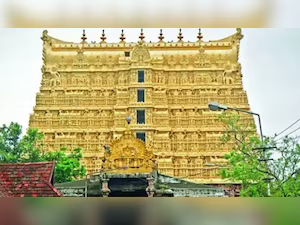
Anatomy of a Breach: The Psychology and Systemic Failures Behind Modern Temple Irregularities
From Devotion to Exploitation
Analyzing the Corrupt Mindset and Bureaucratic Loopholes in Ayodhya and Tirumala
The paradox of temple administration in India presents a stark contrast: while some institutions safeguard ancient treasures with impeccable integrity, others suffer from systemic corruption and white-collar embezzlement. The staggering discovery of wealth in the subterranean vaults of the Sree Padmanabhaswamy Temple in 2011 serves as a global benchmark for asset preservation. Conversely, recurring financial irregularities in other prominent religious centers highlight a deeply troubling shift in the psychological and administrative framework of modern temple management.

The Padmanabhaswamy Legacy: A Masterclass in Custodianship and Ethical Sincerity
The Sree Padmanabhaswamy Temple in Thiruvananthapuram, Kerala, stands as a supreme symbol of absolute fidelity in preserving sacred wealth. When its hidden vaults (Kallaras) were opened in 2011 under judicial oversight, global gold and diamond experts were left astounded. The unearthed treasure—comprising solid gold idols, antique jewelry, pure gold coins dating back centuries, and priceless diamonds—was estimated to be worth over lakhs of crores of rupees. In fact, experts declared the hoard literally invaluable due to its immense historical, cultural, and numismatic worth.
The true marvel, however, was not just the magnitude of the wealth, but the fact that it remained entirely intact over centuries. This impeccable preservation is directly attributed to the Travancore Royal Family, who operated under the unique spiritual and legal philosophy of Padmanabha Dasa (servants of the deity).
Pillars of the Padmanabhaswamy Model
Spiritual Stewardship: The trustees did not view themselves as owners, administrators, or beneficiaries of the wealth; they viewed themselves strictly as custodians holding property in trust for the deity.
Transcendental Accountability: For generations, the royal family maintained a profound psychological barrier against misappropriation, rooted in the belief that stealing from the divine brings spiritual ruin.
Absence of Personal Avarice: Unlike modern bureaucratic setups, the traditional custodians operated with a sense of honor that completely eliminated the desire to commodify the sacred for personal gain.
This historic transparency and devotion established a standard of ethical sincerity that remains virtually unparalleled in global history.
The Anatomy of Institutional Corruption: Psychology and Systemic Failures
In sharp contrast to the Padmanabhaswamy model, the administrative landscape of many modern mega-temples—such as those in Tirumala, Ayodhya, Vijayawada, and Srisailam—is frequently marred by allegations of fund misuse, donation siphoning, and the theft of ornaments. As temple revenues grew exponentially, traditional systems were replaced by sprawling Temple Trusts and bureaucratic boards. This shift inadvertently created an environment ripe for institutionalized malpractice.
The individuals responsible for these modern irregularities—whether officials, staff, or trustees—exhibit a complex psychological profile distinct from that of a common thief. They are rarely driven by survival; instead, their actions are dictated by white-collar greed, entitlement, and systemic moral decay.
The Bureaucratic Mindset and Rationalization Matrix
Desensitization to the Sacred– For many modern authorities and employees, the temple ceases to be a spiritual sanctuary and becomes merely a lucrative corporate entity. Daily proximity to massive cash flows and gold diminishes their reverence, replacing it with a transactional worldview.
The Justification Matrix- Corrupt officials rarely perceive themselves as criminals. They weaponize cognitive dissonance, convincing themselves that they are underpaid for managing complex operations, or that the temple’s vast wealth is “surplus” that will not be missed.
Exploitation of Institutional Trust- Religious institutions inherently operate on high levels of trust and, historically, lower levels of aggressive auditing. Corrupt trustees hide behind a facade of piety, using rituals and public displays of devotion as a shield to deflect suspicion while quietly exploiting weak oversight.
Ultimately, this trend reveals a profound crisis of faith among those tasked with protecting it. While the public drops hard-earned money into hundis out of pure devotion, certain ethical administrators view these donations merely as unmonitored revenue. To reverse this trend, modern temple trusts must bridge the gap between bureaucratic management and spiritual accountability, adopting the rigorous, honor-bound transparency demonstrated by the custodians of the Sree Padmanabhaswamy Temple.

Editor, Prime Post
Ravindra Seshu Amaravadi, is a senior journalist with 38 years of experience in Telugu, English news papers and electronic media. He worked in Udayam as a sub-editor and reporter. Later, he was associated with Andhra Pradesh Times, Gemini news, Deccan Chronicle, HMTV and The Hans India. Earlier, he was involved in the research work of All India Kisan Sabha on suicides of cotton farmers. In Deccan Chronicle, he exposed the problems of subabul and chilli farmers and malpractices that took place in various government departments.
Email: ravindraseshu7@gmail.com
Mobile: 9063718675



Very nice article. Congratulations