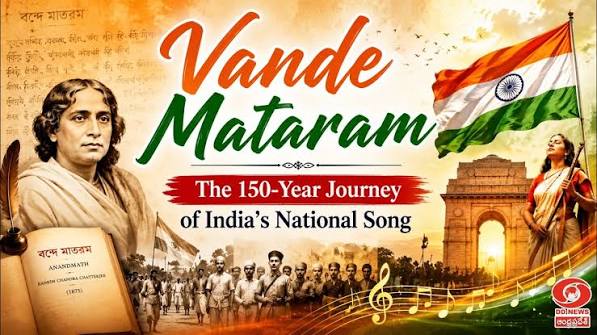
From Literary Verse to National Voice: The Anthem That Fuelled Freedom
Echoes of Awakening: The Storied Legacy of Vande Mataram
The historic journey of Vande Matarm, the Indian national song, has been going on for more than one and half century with different decisions taken at different times. The Congress party has been central to all the decisions, the BJP being responsible for the latest turn of events. As a matter of fact, the BJP was not in the picture when the song was written or sung at the AICC. It was not a part of the Bengal division or freedom movement. But the BJP has been in power for more than twelve years and is very keen on implementing the Hindu agenda.
Prime Minister Narendra Modi launched a year long commemoration of the song’s 150th anniversary on 07 November 2025. In December last year both the Houses of Parliament held special discussion on it during which the 1937 Congress decision was examined. Modi and Union Home Minister Amit Shah had found fault with the decision. They described the partition of song as the foundation of partition of India into two nations, India and Pakistan. On 15 August 2026, all the six stanzas were sung from the Red Forte for the first time. Some days later, the Congress Working Committee met and decided to stick to the 1937 decision and sing only the first two stanzas.
Implementation of the Congress Decision
The Congress Working Committee’s decision in August 2026 to sing only the first two stanzas of Vande Mataram has been roundly condemned by the BJP calling it anti-national. It was only expected. However, the Congress was just reaffirming a decision of the party taken 89 years ago, in the last week of October 1937. But there was no India as we know it today and there was no Parliament or a Bill passed by it. In the light of the decision of the Parliament to punish anyone who violates its decision to sing the national song completely with three years imprisonment, what will happen to the Congress’ latest decision? Will the Congress party implement its decision to sing only two stanzas? If so, will the government arrest the Congress leaders and send them to jail?
The controversy that was discussed for a number of decades back was over which parts of the song were secular or inclusive and which stanzas were not, hence could not be sung? Now the BJP-led Union Government’s move to give ‘due respect’ to the national song was in keeping with its Hindutva policy of radical religious discourse. The Parliament in July amended the Prevention of Insults to National Honour Act, extending to Vande Mataram, the national song, the same status that the National Anthem, Jana Gana Mana, had enjoyed so far. Preventing or disrupting the singing of Vande Mataram is now a criminal offence punishable with up to three years in jail. A separate notification was issued saying that singing the national song means singing all the six stanzas. It would take 3-minute-10 seconds. The song was taken forward by great sons of Bengal, Aurobindo Ghose and Rabindranath Tagore.
The Structural Breakdown of Vande Mataram’s Six Stanzas
Written by Bankim Chandra Chatterjee in 1875 in Sanskritised Bangali, the song was first published as part of a serialized novel in ‘Bangadarshan.’ After the song was incorporated into the novel, ‘Anandmath,’ in a book form in 1882, the controversy had begun. The novel was set against the backdrop of Sanyasi Rebellion against the British and the local Muslim ruler. The book, ‘Anandamath’ was banned by the British. The song was praised and criticised. The praise was for focusing on the revolutionary movement in history. The criticism was on account of alleged fictionalization showing minorities in a disparaging manner. It was Aurobindo Ghose who translated the song into English and published in 1909 with a caption “Mother, I Bow to Thee.” He translated all the six stanzas. ‘Maa Tujhe Salaam’ was the latest by AR Rehman on the same lines.
While the first two stanzas were without any controversy describing a fertile land with cool winds and ‘its nights rejoicing in moonlight.’ The third stanza speaks of millions of throats and sharpness of words. In this stanza the mother drives away the armies of her enemies. The fourth speaks of the Hindu goddesses we see in temples. The fifth talks about goddesses Durga with ten weapons, Lakshmi or Kamala playing in lotuses and Vani or Saraswati with veena. The last and the sixth stanza also runs in the same worshipping mode.
Symbol of Unity: The Historical Legacy of Vande Mataram
It was the Nobel laureate Rabindranath Tagore who set Vande Mataram to music and sang at the Congress session in Kolkata in 1896. The agitators during the partition of Bengal cried ‘Bande Mataram’ while they were lathi-charged until they swooned. The song moved beyond Bengal and came to be known as the national song promoted mostly by the Congress. But the song was not allowed to be sung at Kakinada session of AICC. In October 1937, the Congress had decided to sing only the first two stanzas.
It was a very popular protest song during the freedom struggle. Lala Lajpati Rai launched a journal called Vande Mataram from Lahore. On 20 May 1906 in Barisal (now in Bangladesh), more than ten thousand people-both Hindus and Muslim – marched together with Vande Mataram flags in a landmark nationalist procession. In 1907, Bhikaiji Cama created the first version of India’s national flag (the Tiranga) in Stuttgart, Germany. It had Vande Mataram on flag written in the middle band.
Nehru, Bose, and Jinnah: The Political Tug-of-War Over Vande Mataram
When the AICC session was held at Kakinada, now in the state of Andhra Pradesh, in 1923, Maulana Mohammad Ali Jauhar who was presiding over the session had objected to singer Pandit Vishnu Digambar Paluskar who was about to sing Vande Mataram. When Mohammad Ali Jinnah left the Congress and floated the Muslim league his complaints against the Congress included Hindi and Vande Mataram which the Congress would impose on the country. Presiding over the annual session in Lucknow on 15 October 1937, Jinnah said Hindi is to be national language of all India and the Bande Mataram is to be the national song, and is to be forced upon all. He said “the majority community have clearly shown their hand: that Hindustan is for the Hindus.” The same week, Subhas Chandra Bose wrote to the then AICC president Jawaharlal Nehru suggesting that the latter should talk to Tagore about the national song. Nehru agreed to speak to Tagore. He replied to Bose on 20 October 1937 in which he said that he had obtained the English version of ‘Anandamath’ to understand the background. During the parliamentary debate in December 2025 on the 150th anniversary of Vande Mataram, the BJP criticized Jawaharlal Nehru for removing stanzas from the song; in response, the Congress party recirculated archival records from 1937 to clarify that restricting the song to its first two stanzas was a collective decision involving leaders like Rabindranath Tagore and Mahatma Gandhi. Nehru wrote to Bose, “There is no doubt that the present outcry against Bande Mataram is to a large extent a manufactured one by the communalists. At the same time there does seem some substance in it …. Whatever we do cannot be to pander to communalists’ feelings but to meet real grievances where they exist.”
The 1937 Kolkata Committee and the 1950 Accord
The CWC of the Congress met in Kolkata from October 26 to November 1, 1937 while the wider AICC meeting was held simultaneously from October 29 to October 31. A committee comprising Maulana Azad, Jawaharlal Nehru, Subhash Chandra Bose, Rabindranath Tagore recommended the adoption of the first two stanzas as national song. Gandhi had already voted for it in Guwahati meeting in 1936. He said the people should not replace Vande Mataram with Jai Hind since the song was being sung right from the inception of the Congress party in 1885. Tagore said only the first two stanzas should be in the national song and the rest of the stanzas cannot unite all communities. Moreover, the rest of four stanzas are seldom sung by people. The first two stanzas were adopted as the national song. Beside the members of the committee and Gandhi, those who were present on the occasion in the CWC meeting include Rajendra Prasad, Vallabhbhai Patel, Govind Ballabh Pant, JB Kripalani, among others.
On 14 August 1947, at the ceremony making the transfer of power from the British Raj to the Indian Dominion, Sucheta Kripalani sang the first stanza of Vande Mataram as the opening item. The Constituent Assembly debated whether Vande Matarm or Jana Gana Mana should be the National Anthem. On 24 January 1950, Rajendra Prasad, as the president of the constituent assembly, announced that Jana Gana Mana written by Ravindra Tagore shall be the National Anthem. This is also a curtailed version- the first of the five verses of ‘Bharoto Bhagyo Bidhata’’, a religious hymn originally composed for the monotheistic Brahma Samaj.

Prominent Journalist
Dr. K. Ramachandra Murthy is a versatile journalist with a distinguished career. Dr. Murthy began his extensive career with Andhra Prabha of The Indian Express group in Bengaluru. He was editor of Udayam, Vaartha and Andhra Jyothy. Dr. Murthy founded and edited HMTV news channel and The Hans India, an English newspaper. He was also editorial director of the Telugu newspaper, Saakshi. He was awarded Ph. D for his research work in rural reporting. Dr. Murthy’s five decades in journalism showcases his influential roles across both print and electronic media. He wrote the political biography of NTR published by Harper Collins.
Email: murthykondubhatla@gmail.com
Mobile: 9908002211

An exceptionally well-researched piece by Dr. K. Ramachandra Murthy. Tracing the trajectory of Vande Mataram—from Bankim Chandra’s literary vision and Tagore’s musical arrangement to its ongoing role in India’s political discourse—offers vital historical context. Laying out the chronological evolution so clearly brings much-needed depth and clarity to the conversation. A compelling read!