A Classical Research Editorial Analysis
Abstract
India’s healthcare system represents one of the greatest paradoxes of modern development. A nation that has emerged as a global pharmaceutical powerhouse, a leading exporter of vaccines, and an internationally recognised destination for complex medical procedures continues to struggle in providing equitable, affordable, and quality healthcare to its own citizens. Despite notable improvements in life expectancy, maternal mortality, infant mortality, and disease control, India’s healthcare architecture remains structurally fragile.
This contradiction is neither accidental nor inevitable. It is the cumulative consequence of decades of inadequate public investment, weak governance, institutional decay, regulatory capture, commercialization of medicine, deficiencies in medical education, and persistent political neglect. The result is a dual healthcare economy: an overstretched and deteriorating public health system alongside an aggressively expanding corporate medical industry. Between these two extremes stands the ordinary Indian citizen—particularly the poor—who often confronts illness not merely as a medical condition but as an economic catastrophe.
The Indian healthcare crisis is therefore not simply a failure of medicine. It is a failure of governance, public policy, institutional accountability, and political priorities.
I. The Structural Paradox: Progress Amid Persistent Failure
Independent India has undoubtedly achieved measurable public health gains. Life expectancy has increased from around 48 years in 1970 to nearly 70 years today. Infant mortality has declined dramatically, maternal deaths have fallen substantially, and immunisation coverage has expanded through sustained national campaigns.
Yet these encouraging indicators conceal a disturbing structural reality.
India continues to spend around 2–2.5% of GDP on public health, considerably below many middle-income economies and below levels often associated with achieving broad universal health coverage. Total health expenditure remains heavily dependent on private spending, and out-of-pocket payments continue to account for a large share of healthcare financing, exposing millions of households to financial hardship.
Thus, statistical improvement has not translated into systemic resilience.
Healthcare has increasingly evolved from a constitutional welfare obligation into a market commodity.
II. The Collapse of Public Healthcare Infrastructure
The deterioration of government healthcare facilities is neither hidden nor disputed. It is a reality visible across large parts of the country.
Thousands of Primary Health Centres function without specialists, diagnostic laboratories, adequate medicines, functioning operation theatres, or even uninterrupted electricity and drinking water. Community Health Centres frequently fail to meet prescribed staffing norms. District hospitals remain overcrowded while tertiary government hospitals carry an enormous burden that far exceeds their designed capacity.
Infrastructure alone does not constitute healthcare.
Buildings without equipment, hospitals without medicines, and institutions without specialists cannot deliver meaningful healthcare.
The consequence is predictable.
Citizens lose confidence.
III. The Human Resource Crisis: Doctors Without Systems
India continues to face shortages and uneven distribution of qualified healthcare professionals. Rural and remote regions are particularly affected, while specialists remain concentrated in metropolitan centres.
The problem, however, extends beyond numerical shortages.
Many government hospitals struggle with chronic absenteeism, weak administrative supervision, declining professional morale, inadequate continuing medical education, limited opportunities for advanced training, and insufficient accountability.
Young doctors frequently work under enormous pressure with inadequate infrastructure, while patients encounter long waiting periods, overburdened emergency departments, and fragmented continuity of care.
Where institutional support collapses, professional commitment inevitably weakens.
The healthcare system suffers not merely from a shortage of doctors, but from a shortage of functioning systems that enable doctors to perform effectively.
IV. When the Poor Prefer Corporate Hospitals
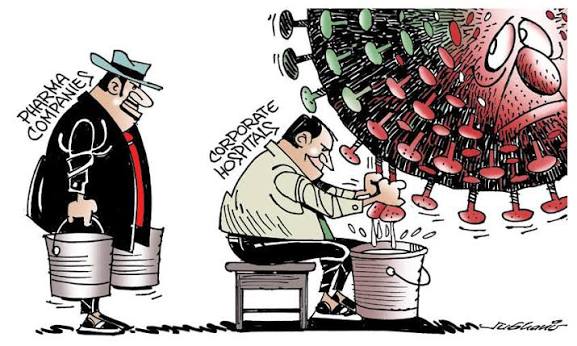
Perhaps the most powerful indictment of India’s public healthcare system lies in a painful social reality.
Even poor households often choose expensive private hospitals despite knowing that treatment may plunge them into debt.
Families routinely mortgage agricultural land, sell jewellery accumulated over generations, borrow from informal moneylenders at exorbitant interest rates, or liquidate lifetime savings simply to finance emergency medical treatment.
This is not necessarily because corporate hospitals are always superior.
It is because citizens perceive government hospitals as uncertain, overcrowded, inadequately staffed, and lacking timely specialised care.
Trust has migrated from public institutions to commercial medicine.
That migration carries devastating economic consequences.
Medical expenditure remains among the leading causes of household financial distress in India.
V. The Rise of Commercial Medicine
The rapid expansion of corporate healthcare has transformed medicine into one of India’s fastest-growing commercial sectors.
Large hospital chains increasingly operate within sophisticated business models involving occupancy targets, revenue optimisation, high-value procedures, premium diagnostics, specialised packages, and insurance-linked treatment pathways.
Modern technology has undoubtedly improved clinical outcomes in many institutions.
However, commercialization also introduces powerful financial incentives.
Patients generally lack the technical knowledge necessary to assess whether expensive investigations, surgical procedures, prolonged intensive care admission, or repeated imaging studies are medically indispensable.
This asymmetry of information creates an inherently unequal relationship between physician and patient.
Medicine, traditionally regarded as a profession founded upon public trust, increasingly risks being evaluated through financial performance indicators.
VI. Medical Negligence and Weak Accountability
Medical negligence remains among the most emotionally and legally complex areas of public policy.
The overwhelming majority of healthcare professionals discharge their duties with integrity under difficult circumstances.
Nevertheless, when negligence occurs, patients often encounter formidable barriers to obtaining accountability.
Regulatory proceedings are prolonged.
Professional disciplinary mechanisms frequently move slowly.
Civil litigation requires enormous financial resources.
Expert evidence remains difficult to obtain.
Many affected families ultimately abandon legal remedies altogether.
Justice delayed becomes justice denied.
The absence of swift, transparent, and independent accountability mechanisms weakens public confidence in the healthcare system.
VII. Medical Education: Quantity Without Competence?
India has witnessed unprecedented expansion in medical education.
Hundreds of new medical colleges have been established over the past two decades, many within the private sector.
Expansion, however, has not always been accompanied by proportional improvements in educational quality.
Concerns are frequently expressed regarding shortages of experienced faculty, inadequate patient exposure in some institutions, insufficient laboratory infrastructure, limited surgical training opportunities, and variability in clinical competence across colleges.
Clinical medicine cannot be mastered through classroom instruction alone.
Competence emerges from supervised patient care, rigorous clinical exposure, ethical mentorship, and repeated practical experience.
Degrees alone cannot substitute for professional proficiency.
VIII. Coaching Culture and the Examination Crisis
Medical education begins with one of the world’s most competitive entrance examinations.
The emergence of an enormous private coaching industry has fundamentally altered this landscape.
Success increasingly depends upon access to expensive coaching institutions rather than solely on conceptual understanding acquired through school education.
Repeated controversies surrounding examination integrity—including reported paper leak allegations affecting major competitive examinations in recent years—have intensified public anxiety regarding fairness, meritocracy, and institutional credibility.
When examination systems lose public confidence, professional legitimacy inevitably suffers.
Medical education demands integrity from admission through graduation.
Any compromise at the entry point weakens confidence in the profession itself.
IX. Overseas Medical Education: Opportunities and Challenges
Thousands of Indian students pursue medical education abroad each year because domestic seats remain limited relative to demand.
Many foreign medical institutions provide high-quality education.
However, concerns have also been raised regarding some programmes where differences in language, clinical exposure, healthcare systems, and educational standards may affect preparedness for practice in India.
Graduates returning from abroad often require careful integration into India’s clinical environment through transparent assessment and competency-based evaluation.
The objective should neither be indiscriminate criticism nor unquestioning acceptance. The objective should be uniform clinical competence irrespective of where medical education was obtained.
X. Political Neglect and the Governance Deficit
India’s healthcare crisis ultimately reflects a deeper crisis of governance.
Successive governments have announced ambitious programmes, insurance schemes, digital initiatives, and new institutional frameworks.
Yet sustained investment in public hospitals, primary healthcare, preventive medicine, public health laboratories, epidemiological surveillance, biomedical research, and human resources has frequently lagged behind need.
Healthcare rarely dominates electoral discourse with the same intensity as subsidies, infrastructure announcements, or short-term welfare measures.
Public health requires long-term investment whose political returns may not be immediately visible.
This structural mismatch between electoral incentives and healthcare needs has perpetuated chronic underinvestment.
The consequences are visible in overcrowded hospitals, workforce shortages, delayed procurement, infrastructure deficits, and regional inequalities.
XI. Governance Failure Beyond Infrastructure
The healthcare crisis is not merely financial.
It is administrative.
It is regulatory.
It is institutional.
It is intellectual.
Policy formulation often remains fragmented across multiple ministries and levels of government. Regulatory enforcement varies widely across states. Procurement systems suffer delays. Public health data systems require strengthening. Coordination between preventive and curative services is frequently inadequate.
Corruption, bureaucratic inertia, weak monitoring, inconsistent implementation, and poor accountability further diminish public confidence.
Perhaps most damaging is wilful neglect—the tendency to acknowledge systemic deficiencies without undertaking structural reform.
The problems are widely documented.
The evidence is abundant.
The deficiencies are neither hidden nor newly discovered.
They persist because meaningful reform has too often lacked sustained political commitment.
XII. Public Health as an Instrument of National Development
Healthcare cannot be viewed merely as social expenditure.
It is productive national investment.
Healthy populations generate higher labour productivity, greater educational attainment, improved demographic dividends, stronger economic growth, and greater national resilience.
Every rupee invested in preventive healthcare, disease surveillance, sanitation, and primary medicine yields long-term economic dividends that exceed immediate fiscal costs.
Conversely, neglected public health imposes enormous hidden economic burdens through lost productivity, impoverishment, disability, and reduced human capital.
Conclusion: A Crisis of Political Choice
India’s healthcare crisis is neither inevitable nor insurmountable.
The country possesses outstanding physicians, internationally respected medical scientists, world-class hospitals, a globally competitive pharmaceutical industry, and remarkable public health achievements in areas such as vaccination and disease control.
The central failure lies elsewhere.
It lies in the persistent neglect of public healthcare institutions.
It lies in inadequate investment.
It lies in fragmented governance.
It lies in inconsistent regulation.
It lies in allowing commercial incentives to expand faster than public safeguards.
Above all, it lies in treating healthcare as an expenditure to be contained rather than a constitutional obligation and a strategic national investment.
A civilised society is ultimately judged not by the sophistication of its elite hospitals but by the quality, accessibility, and dignity of healthcare available to its poorest citizen.
Until India restores its public healthcare system as the foundation of national well-being—while ensuring transparent regulation, high standards in medical education, and accountability across both public and private sectors—the promise of equitable healthcare will remain an aspiration rather than a lived reality.

M. Shiva Prasad, IPS (Rtd.) is a dedicated law enforcement professional who served the combined Andhra Pradesh cadre before opting for the Telangana cadre. Though a native of Andhra Pradesh, he considers himself a true Hyderabadi with an abiding love for the Telugu people. Driven by sincerity, fearlessness, and a lifelong fight against inequality and injustice, his ultimate strengths remain his goodwill and deep affection for the public and the police force. Today, he continues his mission by writing snippets and articles true to his conscience.
Email: Shivareach@yahoo.com
Mobile: 98480 38774