Classic writing ‘Shodasi’
On the birth centenary of Gunturu Seshendra Sharma, to be celebrated on 22 October 2026
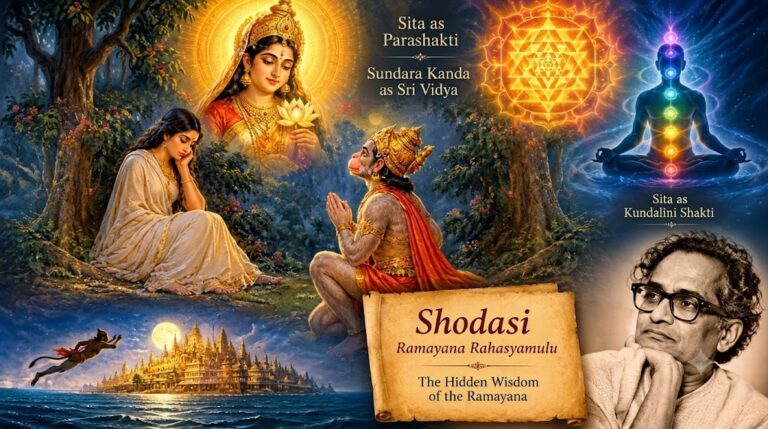
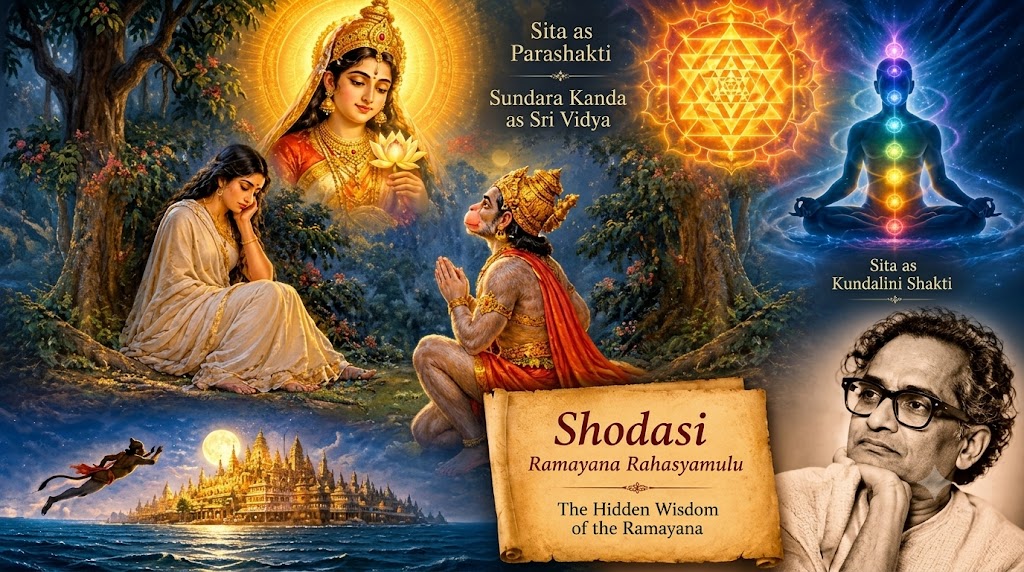
Many scholars have written commentaries on Valmiki’s Ramayana, exploring its literary excellence, ethical teachings, philosophical depth and spiritual significance. Yet Gunturu Seshendra Sharma, the distinguished Telugu poet, approached this great epic from an unusually original perspective. He sought to penetrate its hidden layers of meaning and reveal the spiritual knowledge concealed beneath the narrative. In his remarkable work, Shodasi: Ramayana Rahasyamulu (Shodasi: The Mysteries of the Ramayana), he argued that Valmiki was not merely narrating the story of Rama and Sita but was also communicating the principles of Sri Vidya through the poetic structure and language of the epic.
Sita as Parashakti and the Sundara Kanda as Sri Vidya
The central thesis of Seshendra’s investigation is that the Sundara Kanda, the beautiful and spiritually significant section of the Ramayana, contains an esoteric exposition of Sri Vidya and Kundalini Yoga, while Sita represents Parashakti, the Supreme Divine Feminine Power. He develops this interpretation through comparisons between the Sanskrit verses of the Sundara Kanda and expressions found in the Lalita Sahasranama, the Soundarya Lahari of Adi Shankaracharya, the Sri Sukta, the Devi Mahatmyam and other scriptural traditions.
The significance of Shodasi lies not simply in its devotional conclusions but in the method through which Seshendra arrives at them. His command of Sanskrit, sensitivity to poetic suggestion and comparative reading of sacred texts enable him to identify correspondences that, in his view, disclose a deeper spiritual architecture within Valmiki’s poetry. His interpretation may be understood as an invitation to read the Ramayana simultaneously as epic narrative, poetic masterpiece and spiritual text.
| Why is the Sundara Kanda called Sundara? Seshendra begins with a fundamental question: What is the deeper significance of the word Sundara, meaning beautiful, in the title Sundara Kanda?Beauty, in his interpretation, is not confined to physical appearance or literary elegance. It carries the significance of divine beauty associated with Sri Maha Tripurasundari, the supreme Goddess worshipped in the Sri Vidya tradition. He connects the Sundara Kanda with the spiritual vision expressed in the Soundarya Lahari, the Lalita Sahasranama and the Lalita Trishati, all of which celebrate the Divine Feminine.Seshendra also draws upon the Brahmanda Purana, which, according to his account, associates the different sections of the Ramayana with distinct forms of Rama’s meditation and compares the Sundara Kanda to the full orb of the moon. He relates this lunar imagery to the sixteen phases of the moon and the sixteen Nityas, or eternal manifestations of the Goddess, in Sri Vidya worship.The number sixteen is central to the title Shodasi, which is associated with the sixteenfold manifestation of the Goddess in the Sri Vidya tradition. Seshendra sees the imagery of fullness, beauty and completeness in the Sundara Kanda as corresponding to this divine symbolism. He further invokes the commentary of Lakshmidhara on verse 32 of the Soundarya Lahari to support the relationship between the moon’s sixteen phases and the sixteen Nityas.These connections constitute the foundation of his argument that the Sundara Kanda is more than an episode in the search for Sita. For Seshendra, it is a spiritual text whose significance unfolds through a sustained engagement with the language of the Goddess tradition. |
Hanuman’s longing to see Sita: A prayer for divine vision
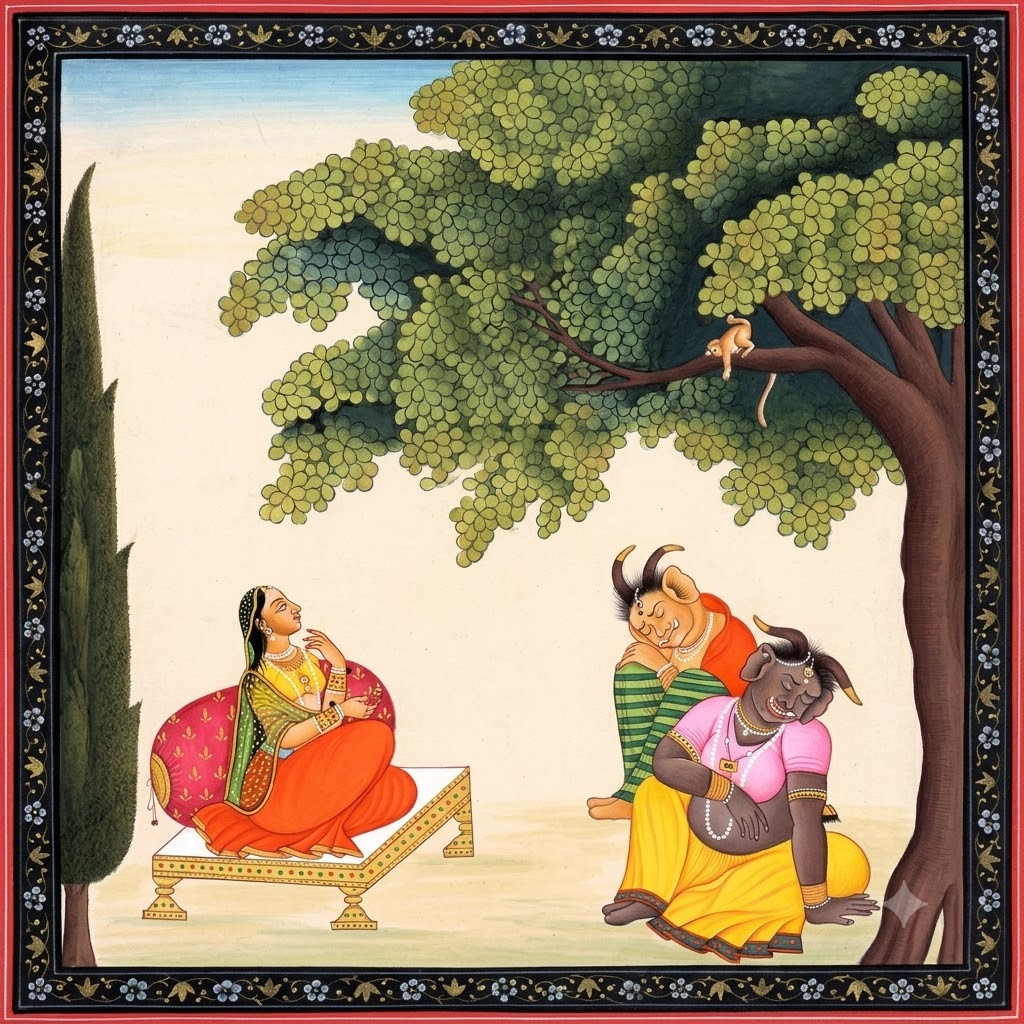
One of the most revealing examples in Shodasi is a verse in which Hanuman expresses his longing to see Sita while searching for her in Lanka. The verse begins:
तदुन्नसं पाण्डुरदन्तमव्रणम् ।
शुचिस्मितं पद्मपलाशलोचनम् ॥
द्रक्ष्ये तदार्यावदनं कदान्वहं ।
प्रसन्नताराधिपतुल्यदर्शनम् ॥
Transliteration:
Tad unnasam pandura-dantam avranaṁ,
Shuchi-smitam padma-palaasha-lochanam;
Drakshye tad aarya-vadanam kada nvaham,
Prasanna-taaraadhipa-tulya-darshanam.
English rendering:
“When shall I behold that noble face, with its elevated form, pale and flawless teeth, pure smile and eyes like lotus petals, radiant like the serene lord of the stars?” The immediate narrative meaning is clear. Hanuman longs to see Sita, whose face and eyes remain vividly present in his imagination. Yet Seshendra finds another dimension in this longing. He reads the desire to behold the noble face as the spiritual yearning of a devotee seeking the vision of the Divine Mother. The expression Arya-vadanam, the noble or revered face, acquires a deeper resonance in his interpretation because Sita is understood as Parashakti. Similarly, padma-palaasha-lochanam, meaning one whose eyes resemble lotus petals, recalls the imagery of the Sri Sukta, which describes the Goddess in terms of lotus-like beauty.
The Lalita Sahasranama contains names such as Shuddhayai Namah (salutations to the Pure One), Dara-smera-mukhambujayai Namah (salutations to Her whose lotus face bears a gentle smile), Vimalayai Namah (salutations to the Immaculate One), Padma-nayanayai Namah (salutations to the Lotus-Eyed One), and Rakendu-vadanayai Namah (salutations to Her whose face resembles the full moon). Seshendra compares these expressions with Valmiki’s descriptions of Sita. For him, such parallels are not merely ornamental similarities. They suggest that the language used to portray Sita also belongs to the vocabulary through which the Divine Mother is celebrated in Shakta literature. This is an important feature of Seshendra’s method: he moves from the literal description of a character to the possible spiritual resonance of the words used to describe her. He asks readers to consider whether Valmiki’s choice of expressions carries implications beyond the immediate narrative.
Sita in Ashoka Vana: The sorrow of the Goddess
Seshendra’s interpretation becomes more elaborate when he examines Valmiki’s description of Sita in Ashoka Vana. Separated from Rama and held captive by Ravana, Sita is portrayed through a series of striking comparisons:
तां स्मृतिमिव सन्दिग्धाम् बुद्धिं निपतितामिव ।
विहतामिव च श्रद्धामाशां प्रतिहतामिव ॥
सोपसर्गां यथा सिद्धिं बुद्धिं सकलुषामिव ।
अभूतेनापवादेन कीर्तिं निपतितामिव ॥
Transliteration:
Taam smritim iva sandigdhaam, buddhim nipatitaam iva;
Vihataam iva cha shraddhaam, aashaam pratihataam iva;
Sopasargaam yathaa siddhim, buddhim sakalushaam iva;
Abhootenaapavaadena keertim nipatitaam iva.
English rendering:
“She appeared like a memory clouded by uncertainty, like an intellect fallen from its proper state, like faith that had been shaken, like hope frustrated, like accomplishment obstructed by impediments, like understanding clouded by impurity, and like fame brought low by an unfounded accusation.”
The passage is powerful even when read entirely within the story. It captures the devastating effects of separation, captivity and unjust accusation upon Sita. Valmiki’s comparisons move beyond physical suffering to describe the disruption of memory, intelligence, faith, hope, accomplishment and reputation.
Seshendra, however, asks why the poet chose precisely these abstract concepts to describe a woman enduring such suffering. He argues that the words associated with memory, intellect, faith, hope and fulfilment also resonate with the names and functions attributed to the Divine Mother in Shakta scriptures. He points to parallels in the Devi Mahatmyam and the Devi Bhagavatam to support his interpretation. In his reading, the descriptions of Sita thus operate on two levels. At the narrative level, they communicate the depth of her sorrow. At the symbolic level, they suggest the temporary concealment of divine power under the conditions of worldly suffering. Seshendra’s approach does not diminish Sita’s human anguish. Rather, it seeks to explain how the epic can present a woman in profound distress while simultaneously allowing her to signify the Supreme Power. The tension between apparent helplessness and underlying divinity becomes central to his understanding of the Sundara Kanda.
Sita as Kundalini Shakti
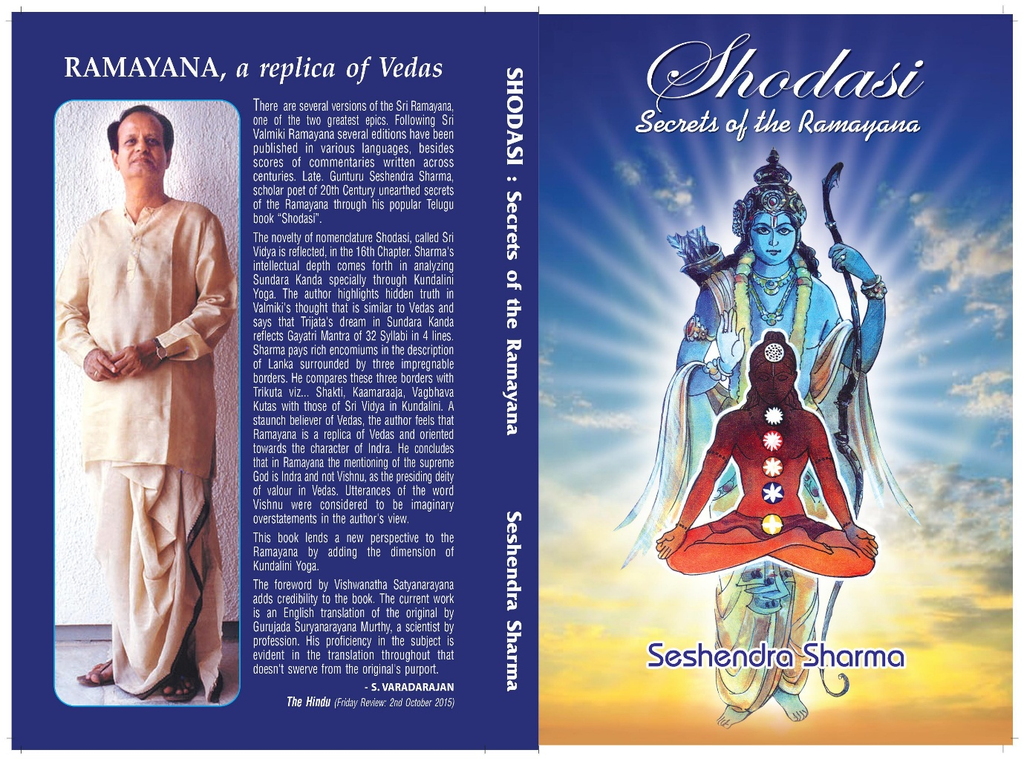
Perhaps the most distinctive aspect of Shodasi is Seshendra’s interpretation of Sita through the symbolism of Kundalini Yoga. Valmiki repeatedly describes Sita as a Tapasi or Tapasvini, terms associated with austerity and spiritual discipline. Seshendra argues that repeated expressions of this kind deserve close attention. In his view, Valmiki sometimes uses recurring words to direct the perceptive reader towards a meaning that is not explicitly explained in the narrative. He also attaches significance to the description of Sita as Bhumau aasinaam, meaning seated on the ground. What might ordinarily appear to be a straightforward description of her physical position becomes, in his reading, a clue to her spiritual symbolism.
His most striking example concerns the comparison of Sita to a female serpent. Valmiki describes her as resembling a serpent coiled around itself, using the expression pannagendra-vadhoom iva—like the consort of the lord of serpents. Seshendra considers the choice of this particular image significant. He compares it with the imagery of Adi Shankaracharya’s Soundarya Lahari, where the power of the Goddess is described through language associated with the serpent and its coils.
In Kundalini Yoga, Kundalini Shakti is traditionally represented as a coiled serpent resting at the base of the subtle body, in the Muladhara Chakra. Through spiritual discipline, this latent power is awakened and rises through the subtle centres. Seshendra reads Valmiki’s description of Sita’s posture and her coiled, sorrowful appearance in the light of this symbolism. The comparison, in his interpretation, is not merely a poetic image of physical suffering. It also suggests the dormant or concealed state of Kundalini Shakti.
He further connects Valmiki’s description of Sita as Bala, or the young maiden, with the conception of Bala Tripurasundari in Sri Vidya. In this way, Seshendra brings together the imagery of the serpent, the language of austerity, the posture of Sita and the symbolism of the Goddess. These are interpretative correspondences proposed by Seshendra, rather than meanings that every reader must necessarily accept as the only possible explanation of Valmiki’s verses. Their significance lies in the sustained attention they invite to the relationships between Sanskrit poetry, yogic symbolism and Shakta theology.
Sita as the Mother of the Three Worlds
Another important passage occurs when Sita addresses Ravana. She declares, in substance, that no one other than him would desire the wife of a righteous man in the three worlds. Seshendra asks why Valmiki invokes the three worlds when the immediate circumstances might have been adequately described without such an expansive reference. He sees in the expression a suggestion of Sita’s cosmic identity. In his interpretation, Sita is not merely asserting her status as Rama’s wife. She is also speaking as the Mother of the three worlds, whose dignity Ravana fails to comprehend. His desire to possess her becomes an act of defiance against the cosmic order and, ultimately, a cause of his own destruction.
The passage illustrates Seshendra’s insistence that the scale of a poet’s language matters. A reference to the three worlds, he argues, may do more than intensify an ordinary statement: it may enlarge the identity of the speaker beyond the limits of the immediate situation. Such a reading depends on recognising the distinction between the direct meaning of a sentence and the additional meaning suggested by its wording, context and associations. Seshendra treats these suggestive meanings as essential to understanding the spiritual depth of the Ramayana.
“I am the wife of the Supreme Being”
Sita’s declaration to Hanuman provides another important foundation for Seshendra’s argument. She says:
मया रामस्य राजर्षेर्भार्यया परमात्मनः ।
Transliteration: Maya Ramasya rajarsh er bharyaayaa paramaatmanah.
English rendering:
“I am the wife of Rama, the royal sage, the Supreme Being.”
The precise significance of the expression lies in the description of Rama as Paramatman, the Supreme Self or Supreme Being. Sita identifies herself in relation to Rama through language that has an explicitly theological resonance. For Seshendra, this is consistent with the understanding of Sita as the divine consort of the Supreme Being and, in the Shakta interpretation, as the manifestation of the Supreme Feminine Power. Hanuman’s response to Sita also attracts Seshendra’s attention. Hanuman recognises that the woman before him is the same Sita whose identity he has been seeking, despite the suffering she has endured. Seshendra reads Valmiki’s description of her continuing radiance as a further suggestion of her divine nature.
He draws particular attention to the expression:
तथापि नूनं तद्वर्णं तथा श्रीमद्यथेतरत् ।
Transliteration: Tathaapi noonam tad-varnam tathaa shreemad yathetarat.
English rendering:
“Even so, her complexion retains its former character and radiance, as before.”
The literal sense concerns the continuity of Sita’s appearance despite her captivity and distress. Seshendra, however, sees significance in the word Shrimat, associated with splendour, auspiciousness and prosperity, and connects it with Sri, the sacred syllable and name associated with Lakshmi.
In his interpretation, Hanuman perceives more than the persistence of physical beauty. He recognises a radiance that captivity cannot extinguish. The language of Sri becomes a possible link between Sita’s identity and the divine feminine principle.
“My heart must be made of stone—or immortal”
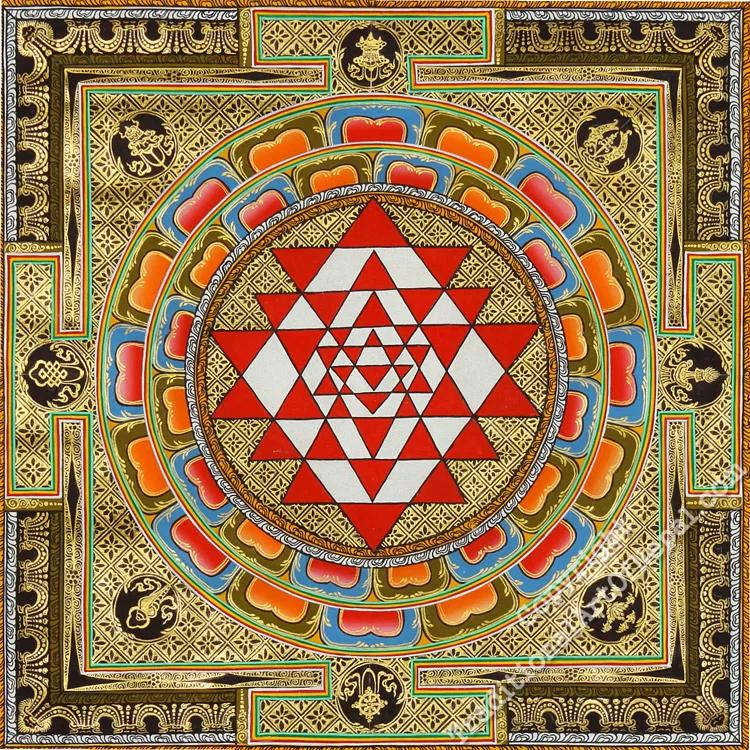
Seshendra also examines Sita’s expression of grief over separation from Rama:
अश्मसारमिदं नूनमथवाप्यजरामरम् ।
हृदयं मम येनेदं न दुःखेनावशीर्यते ॥
Transliteration:
Ashma-saaram idam noonam athavaa py ajaramaram;
Hridayam mama yen edam na duḥkhena avasheeryate.
English rendering:
“My heart must surely be made of stone, or perhaps it is ageless and immortal, since it does not break apart under this suffering.”
The verse expresses an anguish so intense that Sita wonders why her heart has not shattered under the burden of grief. The contrast between a heart of stone and one that is ageless and immortal intensifies the emotional force of her words.
Seshendra pays special attention to ajarāmaram, meaning ageless and immortal. Why, he asks, does Valmiki go beyond the image of a heart made of stone and introduce the idea of immortality? His interpretation relates this expression to the indestructible nature of spiritual reality. He argues that the choice of words may suggest a deeper dimension of Sita’s being, one not exhausted by the suffering visible on the surface. The argument exemplifies Seshendra’s broader method. He treats the vocabulary of the epic not as a collection of interchangeable poetic expressions but as a carefully chosen medium through which the poet can suggest philosophical and spiritual ideas. A word that appears excessive or unnecessary at the literal level may, in his view, acquire significance when read alongside related scriptural traditions.
The method behind Shodasi
The intellectual value of Seshendra’s work lies in the attention he gives to individual words, compounds, metaphors and recurring expressions. He compares Valmiki’s verses with the language of other Sanskrit works and classifies the connections he identifies according to their relationship with words, ideas and narrative context.
His method considers correspondences at three levels: those grounded in verbal expression, those based on shared concepts, and those arising from the larger context of a passage. This allows him to move from the surface meaning of a verse towards what he regards as its suggested or concealed significance.
Such a method is particularly relevant to Sanskrit literary traditions, in which Dhvani, or poetic suggestion, occupies an important place in literary theory. A poem can communicate more than it states directly. Metaphor, allusion, repetition, contextual association and the resonance of individual words can create additional layers of meaning.
Seshendra applies this sensibility to the Ramayana with exceptional intensity. He believes that Valmiki’s mastery consists not only in narrating events but also in choosing words capable of sustaining several levels of interpretation.
At the same time, a distinction must be maintained between the textual evidence and the interpretative conclusions drawn from it. Similar expressions in different scriptures can establish meaningful literary or theological correspondences, but they do not automatically prove that one text was deliberately composed as a coded exposition of another. Seshendra’s achievement is best appreciated by examining the strength of each comparison, the scriptural parallels he identifies and the coherence of the larger interpretation he constructs. This distinction does not diminish the importance of Shodasi. It makes the work more rewarding to study, because readers can engage with both its textual observations and its larger spiritual vision.
Beyond the literal story
Seshendra’s central concern is that the Ramayana should not be reduced to a narrative of events alone. Its literary beauty, ethical teachings and devotional appeal remain indispensable, but he urges readers to explore the possibility of deeper philosophical and spiritual meanings.
He is especially critical of readings that, in his view, fail to recognise the full implications of Valmiki’s language. He compares the situation to a great sage flying like Garuda while the reader attempts to reach him like a crow: the difference in perspective makes the task difficult.
The metaphor conveys Seshendra’s confidence in the interpretative power of a sensitive and disciplined reader. It also reveals his conviction that a great poet’s language may contain possibilities that ordinary reading does not immediately disclose. His enthusiasm occasionally takes the form of severe criticism of readers whom he believes are blinded by intellectual pride, prejudice or an unwillingness to examine unfamiliar interpretations. Yet the lasting value of his work does not depend on accepting every conclusion without question. It lies in the challenge he presents to readers: to return to the original verses, examine their language carefully, compare relevant scriptural passages and consider whether meanings beyond the obvious narrative are possible. For Seshendra, such inquiry requires more than linguistic proficiency. It calls for patience, sensitivity to context and an openness to philosophical and spiritual dimensions of literature.
The Enduring Significance of Shodasi
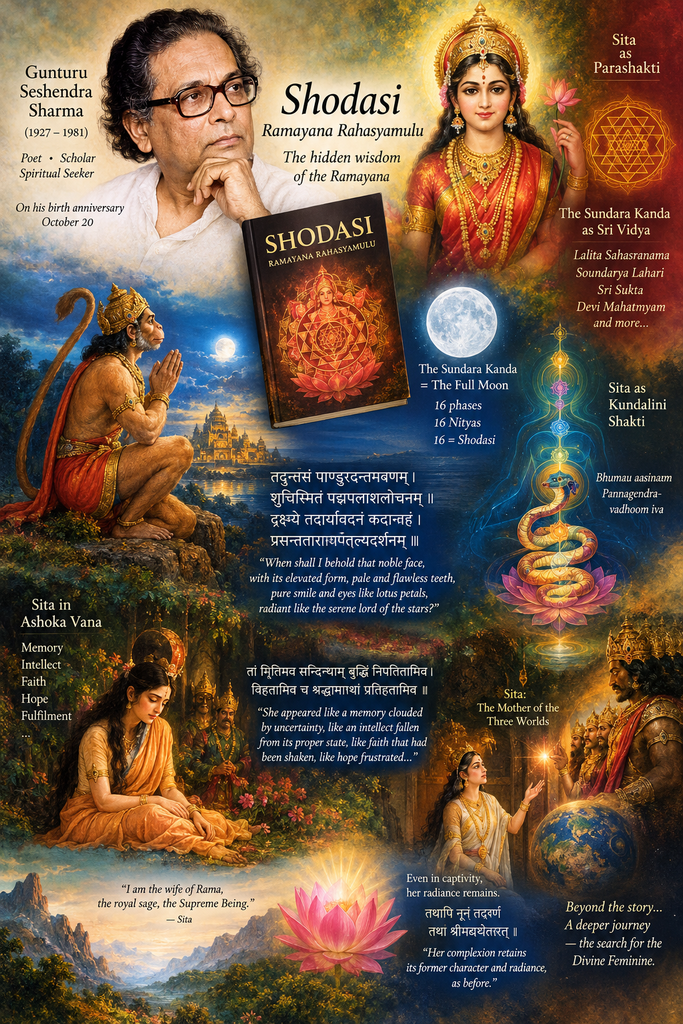
Birth anniversary of Gunturu Seshendra Sharma, Shodasi: Ramayana Rahasyamulu deserves recognition as a distinctive contribution to Telugu literary criticism and the comparative study of Sanskrit texts. Seshendra brings together the poet’s imagination, the scholar’s attention to language and the spiritual seeker’s interest in hidden meanings. His reading of the Sundara Kanda as a text resonant with Sri Vidya, his interpretation of Sita as Parashakti and Kundalini Shakti, and his comparisons with the Lalita Sahasranama, Soundarya Lahari and other scriptures constitute an ambitious interpretative project.
The Sundara Kanda tells us of Hanuman’s extraordinary journey across the ocean, his discovery of Sita in Ashoka Vana, his meeting with her and the hope he carries back to Rama. Seshendra asks us to see another journey within that narrative: the search for the Divine Feminine, the recognition of spiritual power beneath apparent suffering and the discovery of meanings concealed in the poet’s words. Whether every proposed correspondence is accepted or not, his work demonstrates the possibilities of reading a classical epic through the interconnections of poetry, philosophy, theology and yoga.
The true tribute to Seshendra is therefore not merely to praise his scholarship, but to read Shodasi with the same seriousness with which he approached Valmiki. His work reminds us that great literature does not surrender all its meanings at the first reading. It invites us to return, reflect and discover. For Seshendra Sharma, the Sundara Kanda was not beautiful merely because of the events it narrated or the poetry through which it narrated them. Its beauty lay also in the spiritual possibilities he believed were hidden within its language. In seeking to uncover those possibilities, he offered readers a distinctive way of approaching one of India’s greatest epics—and left behind a work that continues to invite inquiry, contemplation and debate.
(Maadabhooshi Shreedhar– Original theme is by Maha Kavi Sheshendra, in Telugu, in the form of literary article by Maadabhooshi Shreedhar, supported by pictures created by AI, after several prompt instructions.)

Law professor and eminent columnist
Madabhushi Sridhar Acharyulu, author of 63 books (in Telugu and English), Formerly Central Information Commissioner, Professor of NALSAR University, Bennett University (near Delhi), presently Professor and Advisor, Mahindra University, Hyderabad. Studied in Masoom Ali High School, AVV Junior College, CKM College, and Kakatiya University in Warangal. Madabhushi did LL.M., MCJ., and the highest law degree, LL.D. He won 4 Gold Medals at Kakatiya University and Osmania University.
Email: cicsridhar@gmail.com
Mobile: 8447651505