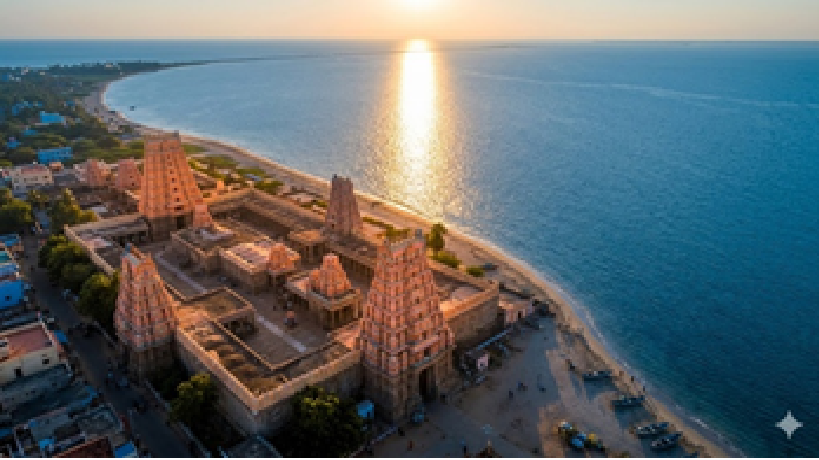
Rameswaram: Where Victory Meets Values
Jyotirlinga Map: Paper 8
Prelude Rameswaram acts as the civilisational anchor where the adrenaline of the warrior finally meets the silence of the shoreline. Most systems of growth focus entirely on the drive to achieve but Rameswaram represents the equally vital capacity to stay and process the cost of that achievement. When Rama won the war and defeated his enemy he did not rush back to the throne to claim his prize. He recognized that even a just war leaves a heavy residue on the soul and he used this junction as a point of accountability. In the map of the seeker this is the moment where the leader must temporarily step aside to let the seeker clean the lens. Rama recalibrated his journey at this very spot turning from the pursuit of victory to the preservation of dharma and in doing so he bridged the gap between what he had done and who he needed to become next.
The Legend and the Sacred Landscape
The narrative of Rameswaram is a masterclass in integration as chronicled in the Skanda Puranah as the Setu Kshetra. Upon his victorious return Rama sought to cleanse the karmic residue of his battles and summoned Hanuman to bring a Himalayan Lingam for the rites. When Hanuman was delayed Sita fashioned the Ramalingam from local sea sand to ensure the purpose was not stalled by a lack of resources. When the stone Vishwalingam finally arrived, Rama established both and decreed that the universal must be honoured before the personal.
The sanctity of this landscape is further defined by Jatayu Teertham which serves as a monument to sacrifice marking where the great bird fell attempting to stop Ravana. It reminds the modern professional that failure in a noble cause is still a form of worship.
Before entering the sanctum, the seeker is guided through 22 wells which legend says Rama created with his arrows to sustain his army during the heat of battle. In a logical view this is a systematic process of letting go where the water that once fuelled the physical survival of the warrior is repurposed to dissolve the ego of the victor. Each well acts as a ritual rinse cycle designed to wash away specific layers of identity and the intoxicating residue of past victories so that the seeker can step forward without the weight of their own history.
History: Two Heroes One Message
The significance of Rameswaram is anchored by two monumental returns being Swami Vivekananda in 1897 after his triumph in the West and Rama after the conquest of Lanka. Vivekananda stood at this anchor and delivered a piercing message stating that worship of the divine is incomplete without the service of man. He used the sanctity of Rameswaram to pivot the national consciousness from inward looking ritual to outward looking responsibility.
This echoes Rama who knelt in the sand to perform atonement at the peak of his external success. Both used this shoreline for a deliberate shift in purpose where Rama transitioned from the warrior to the king and Vivekananda transitioned from the individual monk to the national teacher. The world longest pillared hall built by the Sethupathi Rajas in the 17th century provides the physical scale for this history. Its 1212 pillars create a stone forest of infinite symmetry which serves as a physical reminder of the patience and alignment required to lead a civilisation.
The Ram Setu and the Courage to Let Go
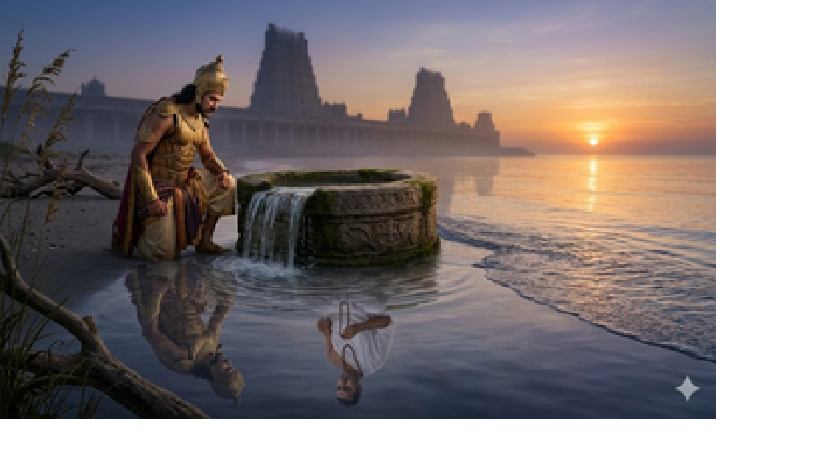
The Ram Setu is the ultimate symbol of engineered intent as a bridge that connects duty to challenge. It proves that when the goal is aligned with dharma even the ocean yields to a structured path. However, the final lesson of Rameswaram lies at Dhanushkodi where Rama was requested by Vibhishana to destroy the bridge because its presence invited future invasions. Rama recognized that the tool of his victory had become a liability for long term peace and he struck the bridge with his bow breaking the very path he had created. This teaches the seeker that the infrastructure of a past success must sometimes be dismantled to protect the sanctity of the future.
Deeper Meaning: Finding Internal Balance
Philosophically Rameswaram is where Vishnu the preserver worships Shiva the dissolver. In the journey of the self this is the moment where the part of you that builds and protects acknowledges the part of you that transforms and moves on. The 22 Teerthams are the mechanics of a self-audit that strips you of titles and achievements to enable you to stand in the shrine as a simple human. You cannot meet the infinite while still wearing the heavy armour of your last battle and this mechanical purification ensures you are fit for the next phase of existence.
Relevance to Daily Life
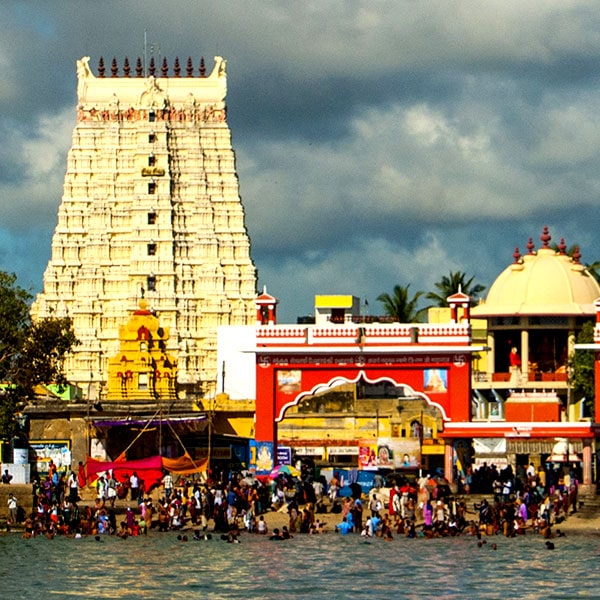
The post success pause is a vital discipline because winning always carries a hidden cost and Rameswaram teaches the necessity of a moral stop to check if your win changed you for the worse. We often become so intoxicated by our achievements that we forget to audit the methods we used to get there.
The sand Lingam teaches us that when the perfect plan fails, we must use the sand at our feet because character is shown by what you create when resources are scarce.
Finally, the act of closing the bridge at Dhanushkodi is a reminder to match the courage of Rama by dismantling what you once built. Many professionals cling to old habits or systems that helped them succeed in the past but those very things often become the barriers to their future innovation and peace.
Real Life Examples
The Transition of the Corporate Commander Consider the shift of a high stakes CEO who after a career defined by aggressive market competition and ruthless expansion pivots toward global mentorship or environmental sustainability. This leader is dropping the anchor to focus on long term legacy rather than the short-term gratification of the next quarterly win. By doing so they are essentially washing away the armour of the commander to become a builder of the future. This recalibration requires the humility to acknowledge that the aggressive tactics which secured their past success are the very things they must shed to be effective in a role focused on nurturing and preservation.
The Startup Founder and the Sand Lingam We see a powerful example in the startup founder who faces a significant delay in major venture funding which represents the missing Himalayan stone. Instead of halting the mission or waiting for the perfect resource they choose to build with the sand of immediate revenue and local grit. This proves that the will to start and the sanctity of the intent are more important than the presence of a perfect budget. They demonstrate that when the ideal tools are delayed the true seeker uses the resources at their feet to sanctify the work and maintain the momentum of the vision.
The Veteran’s Identity Shift A third example is found in the career change of a military veteran or a high intensity project leader moving from a command-and-control environment into a community focused or collaborative role. This transition is a modern walk through the 22 wells as it requires the deliberate washing away of the ego attached to a former title and rank. To become effective in a new and softer world they must let go of the rigid authority that once sustained them. Success in this new territory is not a matter of commanding others but of recalibrating their own identity to lead through empathy and shared purpose.
Seeker’s Summary
The path to significance starts with a deliberate pause because while success is a goal, the true value of that achievement is only found when you stop to recalibrate. You must learn to place universal principles above personal ambition and accept that real clarity is a gradual process rather than a sudden realization. Through the discipline of the 22 washes, you practice letting go of the ego and the residue of past battles to remain both humble and relevant. Ultimately, true leadership is about having the spiritual agility to work with whatever tools you have while possessing the courage to dismantle the very systems that brought you past success to make space for your future values.
About the Author
[R Srinivasa Murthy, the author is a corporate leader and independent writer who is a student of Hindu philosophy. He is a Demystic dedicated to stripping away unnecessary mysticism around traditions to present a practical system for the next generation. His upcoming book Logic of And Sanatana Dharma as a Toolkit for the Contemporary Seeker bridges ancient wisdom and modern life.]

With a journalistic long journey, we bring you https://primepost.news, a dynamic platform committed to unraveling the intricate tapestry of Indian politics, particularly delving deep into the heart of Telangana and Andhra Pradesh. Our blog is not just a source of news; it’s a reservoir of insights, analysis, and thought-provoking reviews.



🙏 Blessed to have visited Rameswaram this month.
Rameswaram is not just a destination; it is an experience of faith, surrender, and inner peace. Standing before Lord Ramanathaswamy, taking the sacred bath at Agni Theertham, and walking through the majestic temple corridors leaves one feeling humbled and spiritually refreshed.
The journey reminds us that pilgrimage is as much about inner transformation as it is about reaching a holy place. Every prayer, every darshan, and every step brings a sense of gratitude, peace, and divine connection.
A truly divine experience that stays with you long after the journey ends.
Har Har Mahadev! 🙏🕉️
Sonu Saini
Congratulations, Mr. R. Srinivasa Murthy Sir, on another insightful article in the Jyotirlinga series. Your ability to present the timeless wisdom of Sanatana Dharma in a practical and relatable manner is truly commendable. The message from Rameswaram—that victory must be accompanied by humility, reflection, and adherence to values—is both powerful and relevant in today’s world. As always, your clear and logical approach helps readers connect ancient teachings with modern life. Wishing you continued success with this remarkable series and your upcoming book.
Superb sir.It is very wonderful to read about shiva,Rama and vivekanandha spiritual context.
What a divine Statement in our spiritual life???.
Fantastic sir.
Plz be continue this spiritual writing for us to read and live in our Life.
Thanks sir❤️😍👍
This is a beautiful account of making a closure, here victory – respectable and responsible to tradition as well as morality by duly mapping Rameshwaram to one’s life. Great job! Thoroughly enjoyed!
Murthy , you have approached the Rameswaram visit from a totally different angle with professional touch by explaining the details in a lucid manner and not relying on stories which differs from person to person and are sometimes illogical also . Thanks for your efforts and it is really enlightening and inspiring.
Sir, Superbly integrated. From the bagage of past successes one should take out the ideas relevant to present challenges, rather than glorifying oneself with ego and being stubborn.
It’s like snake which repeals its skin one should reveal truthfulness.
A compelling article that reminds us that sustainable success comes not only from winning, but from staying true to our values, integrity, and purpose. An inspiring one. Thanks for sharing