The Threshold
Do you remember the morning after a fight?
A bad one. The kind where you said something you did not mean, in the voice you use when you are trying to hurt someone on purpose. You slammed a door. You lay awake afterwards, sick with it. Certain that something between you and your mother had cracked in a way that would not mend.
You came out the next morning braced for silence. For a face gone cold. For the long, slow punishment of a mother who is not speaking to you.
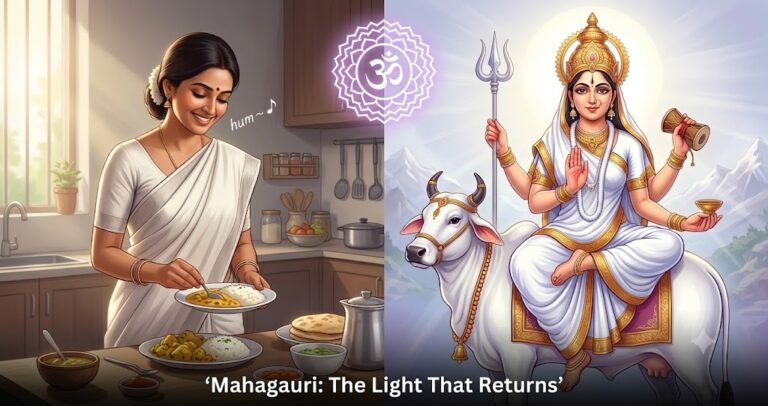
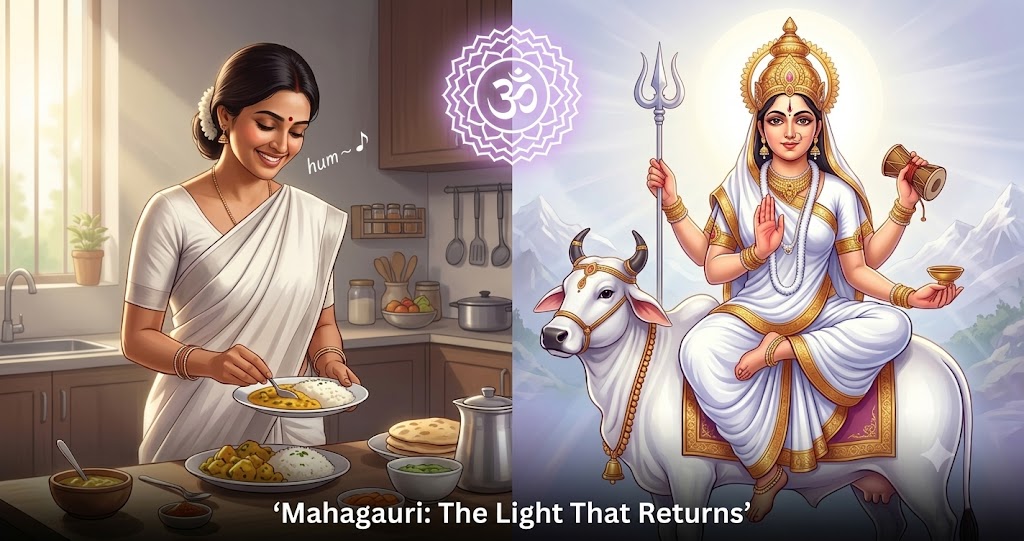
Instead, she was in the kitchen. Humming.
She looked up at you the way she always did. No edge in it. No score being kept. She just said, “Sit, dear. Eat something.”
And on the plate was your favourite. The one you loved.
You had shouted at her the night before. And here she was, at the stove, before you were awake, making the thing you love.
The Turn
On the eighth night of Navaratri, the Mother comes as Mahagauri.
Maha means great. Gauri means white, luminous, radiant. She is the great radiance.
Think of what she was before this.
On the first night, she stood alone on the mountain.
On the second night, she walked the long path.
On the third night, she found her voice.
On the fourth night, she created a world.
On the fifth night, she held it.
On the sixth night, she drew a line.
On the seventh night, she carried the darkness. Alone. In a house full of people. And no one knew.
She did not tell anyone what was wrong. She did not hand it to anyone else. She sat up after everyone had gone to bed, and she held it, and in the morning, she made breakfast.
And then, one morning, the darkness lifted.
Not suddenly. Not dramatically. It simply became lighter. And then lighter still. Until one day she was humming in the kitchen again, and no one noticed, because no one had known she had stopped.
That is what this white is. Not cleanliness. Not innocence. Survival, worn quietly.
And now, on the eighth night, the morning comes.
She is dressed in white. Her skin is luminous again. Her face carries no trace of the night before. She looks as if nothing ever touched her.
But she earned this. She did not arrive here by avoiding the dark. She arrived here by walking through it, all the way, and coming out the other side.
This is the eighth night. Shailaputri taught us to stand. Brahmacharini taught us to walk. Chandraghanta taught us to stay steady. Kushmanda taught us to create from joy. Skandamata taught us to hold. Katyayani taught us to draw the line. Kalaratri taught us to carry the dark. Tonight, the Mother teaches us that light is not the absence of darkness. It is what remains after the darkness has been walked through.
Meeting the Mother
Her name is Mahagauri.
She has four arms. She carries a trident and a small drum. Her other two hands rest in the gestures of fearlessness and blessing. She rides a white bull. She wears white. Her skin is luminous, moon bright. Her face carries no trace of anything difficult.
The old stories tell us her skin darkened during her years of penance. Worn dark by the sun, by the hardship, by the sheer weight of years spent proving her devotion. When she finally married Shiva, he bathed her in the waters of the Ganga. Her original brightness returned, whole and untouched by everything she had endured to reach it.
It matters that her brightness had to be reclaimed. It was not something she was born with and never tested. It was hers because she went looking for it. In the same waters. After everything the years had asked of her.
And she says one thing, to you, today.

“Whatever darkened you was never who you are. Come. Let it wash away.”
That is what your mother did that morning.
She had every right to be cold. She had every right to make you apologise first. She had every right to let you sit with what you had said.
She did not. She stood at the stove instead. And by the time you came out of your room, breakfast was ready. You were not punished. You were not made to earn your way back. You were simply received.
That is grace. Not the absence of a wrong. The refusal to hold it against you.
What She Carries
Look at what she holds. Everything is a teaching.
The trident. The same one Shailaputri carried on the first night. Past, present and future, held without anxiety. It has travelled with her through all eight nights. Only now do we see what it looks like fully at peace.
Your mother carried something like this. She held yesterday and today in the same hand. Old griefs, and the day’s small demands. She did not put one down to pick up the other. She simply carried both, all the time, and no one thought to ask how.
She is the Sahasrara. The crown. The place at the top of the head where everything false has been washed away. The centre that is reached only after the dark has been walked through.
The drum. It is Shiva’s own instrument. The sound said to have started creation itself. She does not play it. She simply carries it. Because it is his, and she is beside him now. Not seeking him. Not proving anything to him. Simply standing where she belongs.
Your mother had something like this too. A habit she picked up from her own mother. A prayer she said because it had been said before her. A way of doing things that did not belong to her alone. She carried it quietly, and passed it on, and you carry it now without knowing where it came from.
The open palm. Raised in fearlessness. The same gesture Chandraghanta carried on the third night, and Katyayani on the sixth. But here, it is at rest. She is not preparing for anything. She is simply open.
Your mother’s hand was open like this in the years after her dark time. Not clenched. Not guarded. Open. She had been through something difficult, and she had come out the other side, and she had not become hard.
That was the miracle. Everyone survives something. Not everyone comes out of it with their warmth intact.
The white bull. The same Nandi who has appeared beside her since the first night. He was with her on the mountain. He waited beside her while she walked. He was there the whole time. And now, at the end of the journey, he walks with her, quietly, into the light.
What She Teaches
Three lessons. Each one quiet. Each one earned.
You are not what broke you. You are what survived it.
Whatever darkened you, whatever you did in your worst year, whatever was done to you, was never the whole truth of who you are. It was a hard time. It passed. And underneath it, something stayed whole.
Your mother knew this. She had a year that could have defined her. A fight that could have ended the relationship. And she refused to let either of them write the ending. She chose the next morning instead. She chose the small, ordinary act of love instead.
Forgiveness does not keep score.
Your mother’s face in the kitchen that morning held no ledger. She was not storing it away. She was not planning to bring it up next week, or next year, when it would hurt more. She had simply put it down.
That is what forgiveness actually is. Not a feeling. Not a decision to like someone again. Just the refusal to keep the receipt.
Grace is not a life without difficulty. It is what you become after one.
You can carry your past like a wound, and let it speak for you in every room. Or you can carry it like a scar. Still there. Still visible if you look. But finished. Closed. No longer deciding what you are able to do.
Your mother came out of her dark year with a scar, not a wound. And she chose, every single morning, to be warm anyway.
The Offering
For those who follow the daily traditions, Mahagauri is honoured with the colour pink. Tenderness after fierceness. The softness that comes once the fight is over.
Her offering is coconut. Whole and untouched at its core, however rough its outside once was. Offer it with the thought, Mother, I offer you what is still whole in me, even after everything.
Place a small bowl of clean water near your altar today. Or a white flower. A quiet echo of the river that restored her.
If you wish, whisper her name. Om Mahagauryai Namah. Or simply, Mahagauri, wash away what darkened me, and leave only what is true.
A Quiet Moment
If you light a lamp today, do not ask her to change what happened. Ask her to help you leave it where it belongs.
Sit quietly. Let her look at you. Feel her hand on your head, and on your heart.
You do not need to explain anything. You do not need to ask for anything. Being seen is enough.
She smiles. Radiant. Unclouded. Entirely at peace with everything she has been through to get here.
And in that quiet, you understand.
There is something you have been carrying. Not a wound any more. A scar. You have been treating it as though it were still open.
It is not. It closed. Some time ago. You simply kept the bandage on.
She is not asking you to forget what happened. She is asking you to notice that it is finished. That you survived it. That you are still here, still whole, still able to love.
Take the bandage off. Not tonight. Not all at once. But soon.
The scar is not a mark of what you lost. It is proof that you healed.
Walking with Her Today
Where is your mother’s grace needed in you today?
Think of one thing you have been treating as a permanent stain instead of a chapter that ended. Ask yourself gently, Is this still true about me, or is it just old?
Forgive someone today, even in a small way, without needing them to earn it first. Not because what they did was fine. Because you are ready to stop carrying it. It may be a person. It may be yourself.
Notice one place where you are still punishing yourself for something long since over. Say to yourself, quietly, I am allowed to be done with this.
If you can, do one small thing today that your mother would have done. Make the tea the way she made it. Fold the clothes the way she folded them. Say the thing she always said before a meal. Not as a ritual. As a way of letting her live in you.
When old shame rises, whisper to yourself, That darkened me. It did not define me.
Let the guilt settle. Let the old story settle.
Beneath all of it, you are still here. Whole. Held in her blessings.
That is the grace she carried. That is the grace you carry too.
Author Biography: – R Srinivasa Murthy, the author, is a corporate leader, an independent writer, and a student of Hindhu Philosophy. He Identifies as a Demystic, committed to removing unnecessary mysticism from traditions to offer practical systems for the next generation. His upcoming book, Logic of And: Sanatana Dharma as a Toolkit for the Contemporary Seeker, aims to bridge ancient wisdom with modern life to foster an inclusive, living civilisation.

With a journalistic long journey, we bring you https://primepost.news, a dynamic platform committed to unraveling the intricate tapestry of Indian politics, particularly delving deep into the heart of Telangana and Andhra Pradesh. Our blog is not just a source of news; it’s a reservoir of insights, analysis, and thought-provoking reviews.