From Khammam’s Flag Collector to India’s Vexillologist
Stitching the Giant Tricolour: Breakthroughs, Hardships, and Unsung Legacy
An Interview with Kambhampati Sanjeeva Rao by Prime Post
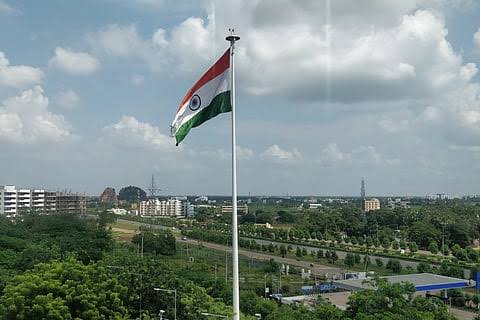
On the banks of Hussain Sagar Lake in Hyderabad’s Sanjeevaiah Park, an 88-metre flagpole flies one of the largest Indian tricolours in the country—a massive 22-metre by 33-metre symbol of national pride. But behind the grandeur of that soaring flag lies the quiet, lifelong devotion of one man Kambhampati Sanjeeva Rao.
In a conversation with Prime Post, Rao shared his remarkable journey, tracing his path from a childhood fascination with the national flag in Khammam to his standing today as one of India’s prominent vexillologists and a master craftsman of giant tri-colours.
Prime Post: Mr. Sanjeeva Rao, you are renowned across the country today for crafting some of the largest Indian tricolours in existence, including the massive flag at Sanjeeviah Park on the banks of Hussain Sagar Lake. How did your fascination with flags begin?
Kambhampati Sanjeeva Rao: Even as a child, I was completely in awe of the Indian Tricolour. That initial fascination naturally expanded as I grew older—I began noticing the flags of other nations, and as I learned more, I came to deeply admire the ideals, history, and struggles each flag represented. It became a lifelong passion. My deep fascination with the Tricolour began in 1995, prompting me to start gathering information about it. Over time, I researched the world’s largest flags and built a collection of national flags from 23 countries.
The Early Journey and Vexillology
Prime Post: Back in the 2007s, when you decided to start an international flag collection from your home in Khammam, how did you go about building it?
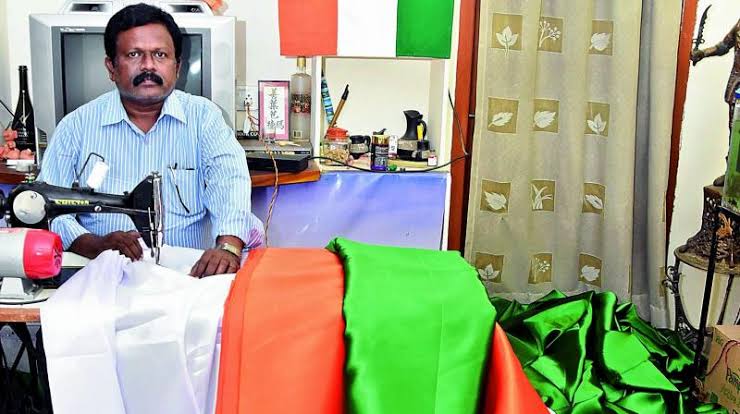
Sanjeeva Rao: In the 1990s, living in Khammam—about 200 kilometres east of Hyderabad—purchasing other international flags was nearly impossible. So, I decided to stitch them myself. Stitching was my hobby. I took immense pleasure in it, and I learnt the tricks along the way. I wrote letters to various foreign embassies requesting the exact specifications of their national flags, often waiting months to hear back. Once I received the dimensions and details, I gathered strips of cloth and stitched a one-metre-long copy of each flag. Today, I have handmade flags of over 200 countries stored in wooden boxes at my home. I got recognition on my work in 2007.
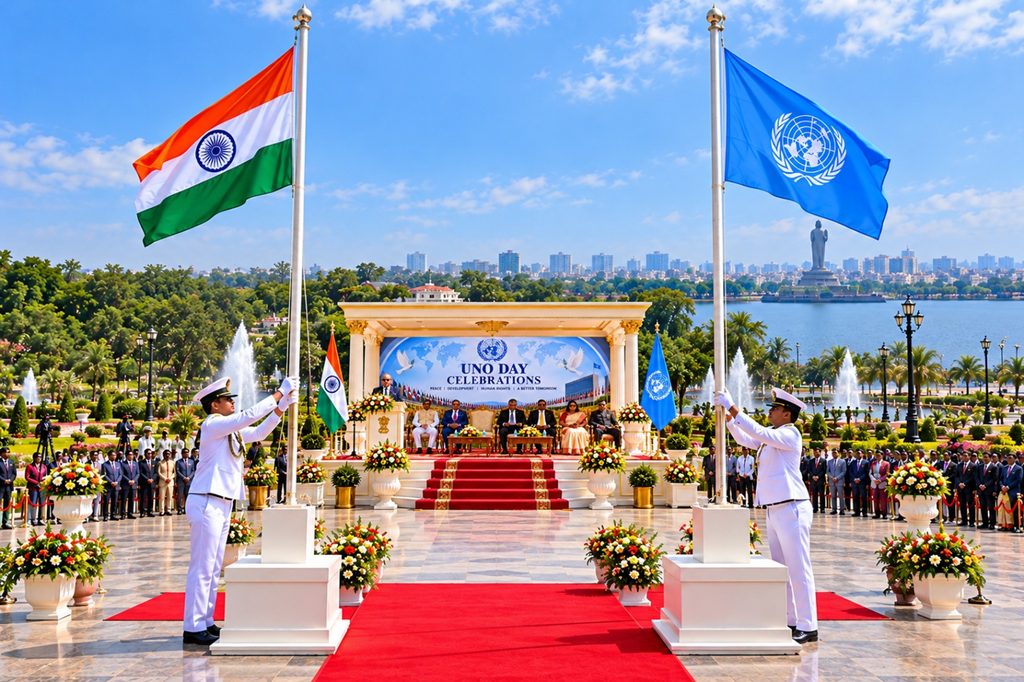
Prime Post: Who helped in your initial journey? How did the Telangana government recognize your work and entrust you with making and installing the giant National Flag at Sanjeevaiah Park where the Historic United Nations Day Celebrations & 193-Nation Flag Raising Ceremony to be Held on October 24, 2026?
Sanjeeva Rao: Initially, District Collectors of Khammam—A. Giridhar, Aravind Kumar, R. N. Nimje, and Sasibhushan Kumar—encouraged my work. Later, the Hyderabad Metropolitan Development Authority (HMDA) gave me the opportunity to make the large tri-colour flag installed at Sanjeevaiah Park, and they continue to support my work to this day. In particular, Jayesh Ranjan, Special Chief Secretary to the Government (MA&UD / HMDA limits), extended his full support for the historic United Nations Day Celebrations and the 193-Nation Flag Raising Ceremony held at Sanjeevaiah Park.
Prime Post: Can you explain the importance of UN Day and 193-Nation Flag Raising Ceremony at Sanjeevaiah Park?
Sanjeeva Rao: Under the guidance of Sri Jayesh Ranjan, IAS, Special Chief Secretary, and senior officials, the Philvex Hobby Society and the Indian Vexillological Association—in collaboration with ICCDR, Hyderabad—are hosting a historic UN Day Celebration and Flag Raising Ceremony on Saturday, 24th October 2026, from 9:00 AM onwards at Sanjeevaiah Park, Necklace Road. The event begins with the hoisting of the Indian National Flag, the UN Flag, and 193 national flags, followed by a panel discussion on “India’s Role in World Sustainable Development Goals (SDGs)” and an Award Ceremony at Jalavihar.
Prime Post: You aren’t just a flag-maker; you are also a vexillologist. How did that lead to founding the Indian Vexillological Association (IVA)?
Sanjeeva Rao: I am the founder. Vexillology is the scientific study of flags—their history, symbolism, and design. Over the years, I started communicating with fellow vexillologists around the world and even attended international flag conferences abroad. Decades ago, Michel Lupant—a Belgian vexillologist and the president of the International Federation of Vexillological Associations—encouraged me to share my love for flags with my fellow countrymen. Inspired by his advice, I founded the Indian Vexillological Association (IVA) in 1995.
Hardships and Financial Challenges
Prime Post: What were some of the major hardships you faced while sustaining your passion and running the IVA?
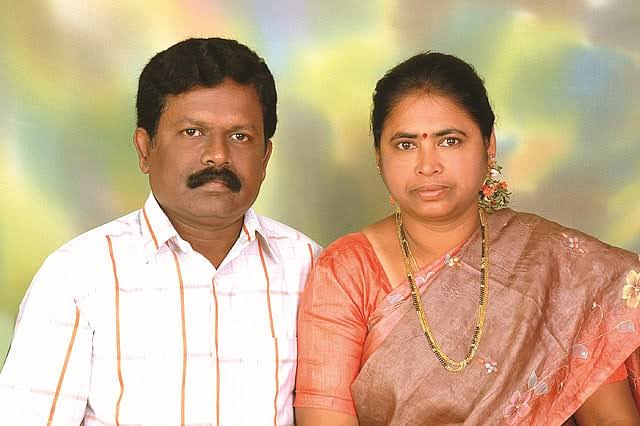
Sanjeeva Rao: Sustaining an association like the IVA has been a continuous personal struggle. Theoretically, anyone can pay a Rs 1,000 membership fee to join, but to this day, we only have ten members—all of whom are my own family members. My eldest son, Srikanth and Gautham, who currently serves as the president of the IVA, often points out that all expenses have to be borne personally, which is a significant expenditure for a middle-class family. Beyond finances, communication was a major hurdle. I had very modest educational qualifications and faced language barriers when corresponding with international scholars or responding to emails from across India. Furthermore, my primary occupation as an additional project director for the District Rural Development Agency in Khammam left me with limited time. To fund our activities, I hold exhibitions of my flag, stamp, and currency collections at schools across Andhra Pradesh and Telangana, using the modest fees received to keep the association going.
The Breakthrough: Sanjeeviah Park
Prime Post: Your major turning point came in 2016 with the Sanjeeviah Park flag project. How did that opportunity come about?
Sanjeeva Rao: It happened on a May morning in 2016. I was reading the newspaper and came across news that Telangana’s Chief Minister wanted to hoist the largest Indian flag on June 2nd to mark the second anniversary of the state’s creation. At that point, I had no professional experience in large-scale commercial flag-making, but I knew in my heart that I had to lead this project. As fate would have it, I happened to be in Hyderabad that day. I immediately put down the newspaper and ran to the secretariat—I just knew I had to meet them. I managed to get a meeting with Telangana’s principal secretary, who patiently listened to my plea and reviewed my credentials as a vexillologist and flag craftsman. The very next day, I was commissioned to stitch the massive flag. I was granted an advance of Rs1 lakh and a month’s paid leave from my government job to complete the project.
Prime Post: A flag measuring 108 x 72 – 80 kilo cloth weight-22 metres by 33 metres for an 88-metre flagpole is a colossal undertaking. How did you manage to stitch it in less than a month?
Sanjeeva Rao: I returned to Khammam immediately and hired a team of ten women to assist me. The physical scale of the task was immense: seven strips of cloth, each 35 metres long, had to be stitched alongside each other to create just one color band of the tricolour. The bundle of fabric becomes so heavy that I needed all the hands possible just to lift and align the cloth for precision stitching. Working tirelessly, we met the deadline, and the flag was successfully hoisted on June 2nd.
Maintenance, Recognition, and Beyond
Prime Post: How has life changed for you after the successful hoisting at Sanjeeviah Park?
Sanjeeva Rao: Making the tricolour for Sanjeeviah Park proved to be financially rewarding and opened many new doors. I was commissioned to deliver one giant tricolour each month to the Telangana state exchequer. Because of the heavy winds atop the 88-metre pole, the flag suffers severe wear and tear, frequently tearing every few days. It is repaired weekly by a team managed by my younger son, Goutham Kambhampati, and myself, and replaced entirely with a fresh flag every month. My wife Padmavathi and elder son Srikanth have been involving. Following this, I began receiving private commissions from across the country. I now run a separate team dedicated to private orders. Some of these flags are even larger than the Sanjeeviah Park flag, though they are usually created for display rather than hoisting.
Prime Post: Having researched the life of Pingali Venkayya, the designer of the Tricolour, could you walk us through the timeline of his work? What did delving into his history reveal to you about national recognition?
Sanjeeva Rao: Studying India’s flag history requires looking back to 1857, an era when regional rulers flew distinct banners over their kingdoms while the British administration maintained its own national ensign across colonial territories. A major milestone arrived during the All India Congress Committee (AICC) session at Bezwada (now Vijayawada) in March 1921, where scholar and freedom fighter Pingali Venkayya presented a flag draft to Mahatma Gandhi. By 1931, the Congress officially adopted the Swaraj Flag at its Karachi session with a navy-blue Charkha at its core. On July 22, 1947, the Constituent Assembly formally adopted this evolved design as sovereign India’s National Flag. Driven by a lifelong passion for vexillology, I set out to find the family of Pingali Venkayya in Andhra Pradesh. Finding them in Machilipatnam selling street food to make ends meet was a heartbreaking realization. Almost no one nearby recognized their connection to Venkayya, or even knew of his historic contribution. While I am proud of my own work, moments like these serve as a poignant reminder that my path honors these unsung heroes whose immense contributions were left forgotten by time.

With a journalistic long journey, we bring you https://primepost.news, a dynamic platform committed to unraveling the intricate tapestry of Indian politics, particularly delving deep into the heart of Telangana and Andhra Pradesh. Our blog is not just a source of news; it’s a reservoir of insights, analysis, and thought-provoking reviews.