A Satirical Exposition on the Grandeur, Vanity and Hollow Triumph of Telugu Weddings
When the sacred strains of matrimonial bliss are drowned by the cacophony of conspicuous consumption, the wedding ceases to be a solemn covenant of hearts and degenerates into a carnival of vanity.
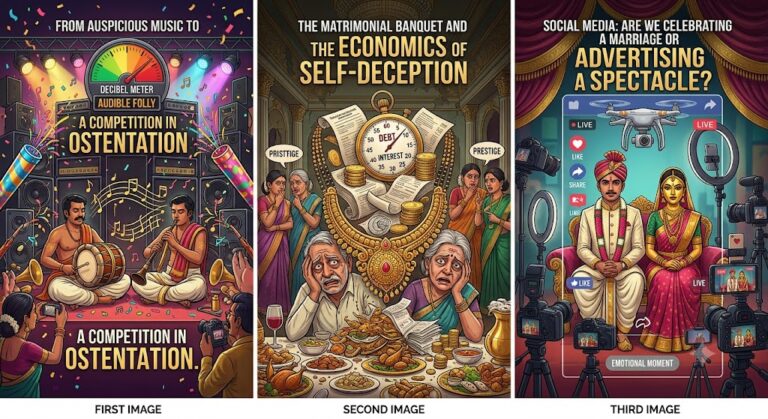
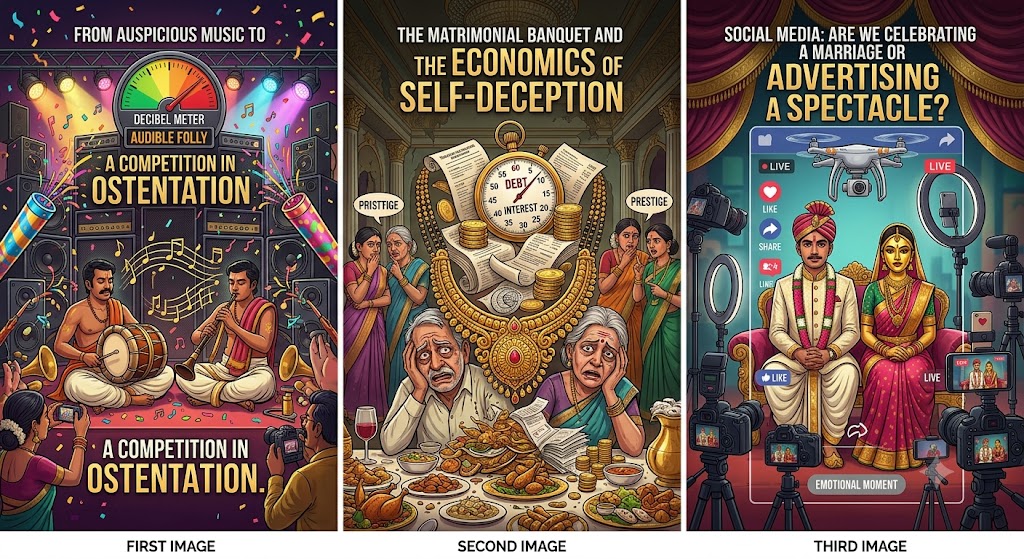
FROM AUSPICIOUS MUSIC TO A COMPETITION IN OSTENTATION
In the rich and resplendent tapestry of Telugu culture, Gatti Melam occupies a distinctive place in the solemnity of marriage. As the priest intones sacred mantras, as the bride and bridegroom approach the hallowed moment of the mangalya dharana, the sonorous orchestra of traditional instruments erupts into a crescendo of auspicious sound. The drums thunder, the ceremonial music swells, and the gathering witnesses the symbolic commencement of a new conjugal journey.
Tradition lends this moment its sanctity; music lends it its majesty.
Yet, one is irresistibly impelled to ask: Has Gatti Melam remained the auspicious music of matrimonial consecration, or has it metamorphosed into the deafening soundtrack of social vanity, financial exhibitionism and competitive extravagance?
The question itself furnishes the satirist with an inexhaustible arsenal.
Once upon a time, a wedding was principally a confluence of families, an affectionate assembly of relatives, and a solemn affirmation of companionship. Today, in certain circles, it has become an elaborate exhibition of purchasing power, social standing and ostentatious affluence.
How magnificent is the wedding hall? How extravagant the floral arrangements? How dazzling the illumination? How sumptuous the banquet? How many sovereigns of gold adorn the bride? How many dignitaries grace the occasion? How spectacular the cinematography? And, above all, how many photographs will proclaim the family’s magnificence to a mesmerised—or perhaps merely indifferent—world?
Amid this bewildering inventory of extravagance, one elementary question is conspicuously conspicuous by its absence:
Are the two individuals entering matrimony emotionally mature, mutually understanding, and genuinely prepared to shoulder the responsibilities of a shared life?
To answer that question requires neither a fleet of cameras nor an army of event managers. Yet, to exhibit the splendour of the occasion, an entire photographic regiment appears indispensable!
Thus unfolds the exquisite paradox of the contemporary wedding: the apparatus for documenting the ceremony grows ever more sophisticated, while the preparation for sustaining the marriage remains lamentably rudimentary.
MUST THE MELODY BE LOUDER FOR THE MARRIAGE TO BE GRANDER?
The ceremonial crescendo of Gatti Melam traditionally accompanies the auspicious moment when the mangalyasutra is tied around the bride’s neck. Its purpose is celebratory, not competitive; its spirit is sacred, not commercial.
Yet, in the theatre of contemporary matrimonial extravagance, decibels appear to have acquired an importance disproportionate to their significance.
The illumination aspires to rival the firmament. Floral decorations assume the dimensions of botanical extravaganzas. Banquets resemble gastronomic exhibitions. Professional photographers pursue every gesture, every smile and every fleeting expression with almost forensic determination.
Marriage, once a deeply personal milestone, increasingly becomes a meticulously choreographed public spectacle.
Affection yields precedence to aesthetics; intimacy is subordinated to ornamentation; and the intrinsic dignity of the occasion is overshadowed by the relentless urge to impress.
When the splendour of the spectacle eclipses the sanctity of the union, Gatti Melam ceases to be merely an auspicious melody and becomes the triumphant soundtrack of social vanity.
Let it be understood, however, that grandeur is not inherently vulgar, nor is every expensive wedding an exercise in wastefulness. Families may legitimately celebrate within their means, share their prosperity, and extend generous hospitality to their loved ones.
The objection arises when celebration becomes compulsion, when imitation masquerades as prestige, and when families mortgage their financial tranquillity to purchase a single day of public admiration.
The tragedy is not that some weddings are magnificent. It is that others feel compelled to become magnificent at any cost.
THE MATRIMONIAL BANQUET AND THE ECONOMICS OF SELF-DECEPTION
In Telugu society, the marriage of a son or daughter is often cherished as the culmination of a parent’s lifelong aspirations. The emotional investment is profound, the expectations immense, and the desire to provide an unforgettable celebration entirely understandable. But when parental affection is held hostage to social expectations, sentiment becomes an unwitting accomplice to financial imprudence.
A neighbour’s daughter is married in a palatial convention centre. A relative arranges a banquet of bewildering proportions. Another family spends a fortune on jewellery, floral installations and ceremonial grandeur.
Immediately, the invisible tribunal of society convenes.
Why should our wedding be less magnificent? What will the relatives say? How shall we preserve our prestige? Will people mistake our restraint for poverty?
And thus begins the costly pilgrimage from affection to anxiety, from celebration to competition, and from parental sacrifice to financial self-immolation.
Savings accumulated over decades are depleted in a day. Assets intended to secure the children’s future are liquidated to finance ephemeral magnificence. Loans are contracted, liabilities multiply, and the parents who smile before the assembled guests return home to confront the arithmetic of their own extravagance.
What an exquisite irony!
The guests depart with their memories and photographs. The flowers wither. The lights are extinguished. The orchestra falls silent.
But the debt remains gloriously alive, faithfully accruing interest long after the last guest has disappeared!
What, then, is the wisdom of purchasing one day’s applause at the cost of years of anxiety?
A wedding should inaugurate a life together, not inaugurate a financial crisis. To sacrifice long-term security at the altar of short-lived admiration is not the preservation of tradition; it is capitulation to the tyranny of social conformity.
CASTE, STATUS AND THE THEATRE OF SOCIAL PRESTIGE
Marriage ought to unite two individuals and, through them, two families. Yet, on certain occasions, the wedding pavilion becomes an elaborate theatre in which caste consciousness, economic hierarchy and political influence compete for prominence.
Who occupies the front row? Who receives a ceremonial welcome? Which dignitary has arrived? Who is entitled to special hospitality? Whose presence commands deference, and whose presence is treated as inconsequential?
The guest list, ostensibly an instrument of hospitality, can become an unofficial register of social importance.
The wealthy receive conspicuous attention; the influential command elaborate courtesies; the less privileged may find themselves relegated to the periphery of an occasion supposedly dedicated to human togetherness.
What an irony that a ceremony proclaiming the union of hearts should sometimes reproduce the very divisions that fragment society!
Hospitality derives its nobility from sincerity, not discrimination. Respect should be bestowed upon the human being, not calculated according to wealth, caste, office or political proximity.
If social hierarchy occupies the place of honour at the wedding, where, one must ask, does the equality of the newly married couple find its rightful seat?
The sacred thread should bind two lives together. It should not become an ornamental pretext for dividing humanity into graded categories of prestige.
THE SILENCE OF THE BRIDE AMID THE THUNDER OF CELEBRATION
Amid the tumultuous festivities, an uncomfortable question deserves attention: does the voice of the bride receive as much consideration as the splendour of her wedding?
Months may be devoted to selecting the jewellery, the attire, the venue and the floral arrangements. Elaborate consultations may determine the menu, the guest list and the ceremonial schedule.
But how much time is devoted to understanding the aspirations of the two individuals whose lives are about to be irrevocably intertwined?
The weight of the bride’s gold ornaments may become a subject of public admiration. The weight of the responsibilities she may shoulder thereafter rarely receives equivalent scrutiny.
Thousands may be spent on wedding attire, while scarcely sufficient attention is paid to financial independence, mutual respect, domestic responsibilities, emotional maturity and the practical realities of married life.
The ceremony is rehearsed with meticulous precision; the life that follows is too often entrusted to improvisation.
The wedding is planned for months. The marriage itself is expected to manage somehow.
Here lies one of the most consequential contradictions of our matrimonial culture.
The splendour of the occasion cannot compensate for the absence of understanding. Ritual cannot substitute for respect. Nor can the blessings of an assembled multitude guarantee the happiness of two individuals who have not been adequately prepared for the responsibilities of companionship.
A marriage deserves more than a magnificent beginning. It deserves the wisdom to endure.
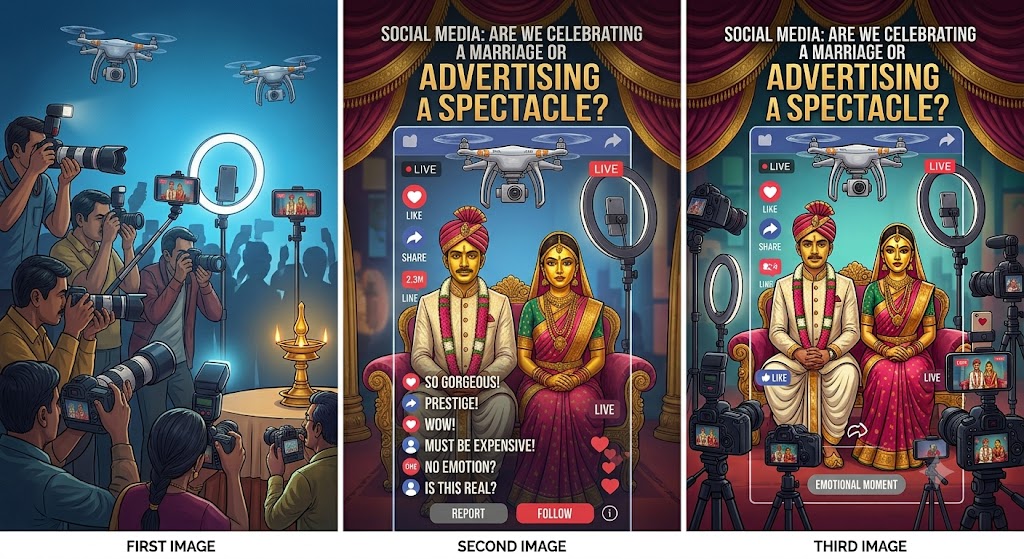
SOCIAL MEDIA: ARE WE CELEBRATING A MARRIAGE OR ADVERTISING A SPECTACLE?
The digital age has introduced a new and fascinating protagonist into the matrimonial drama: the camera-conscious guest.
Every moment is a potential photograph; every gesture, a prospective reel; every ceremonial movement, an opportunity for digital exhibition.
The couple may be surrounded by hundreds of guests, yet the question occasionally arises whether they are fully inhabiting their own celebration or merely performing for its eventual digital reproduction.
The photographer seeks the perfect angle. The videographer pursues the perfect sequence. The social-media enthusiast anticipates the perfect upload.
And somewhere amid this elaborate machinery of documentation, the unrecorded experience of the moment risks becoming an afterthought.
There is, of course, nothing objectionable about preserving cherished memories. Photography and cinematography can beautifully immortalise an occasion of profound personal significance.
The absurdity begins when the representation of happiness becomes more important than happiness itself.
Once, elders blessed newly married couples with the heartfelt wish that they should enjoy a long and harmonious life together.
Today, amid the tyranny of the instantaneous image, one might imagine a more urgent enquiry:
Were the photographs satisfactory? Did the lighting enhance the jewellery? Has the video been uploaded? How many people have admired the spectacle?
What a remarkable evolution—from the enduring blessing to the fleeting notification!
A photograph can capture a smile, but it cannot certify affection. A video can preserve a ritual, but it cannot guarantee fidelity. A million digital impressions cannot manufacture the mutual trust that a marriage requires. The camera can immortalise the ceremony; only the couple can give immortality to its meaning.
TRADITION MUST BE PRESERVED; EXTRAVAGANCE NEED NOT BE WORSHIPPED
To satirise the excesses associated with Gatti Melam is not to denigrate Telugu culture or disparage the sanctity of marriage.
The traditional wedding possesses an enduring aesthetic and emotional richness. The sonorous music, the sacred mantras, the blessings of elders, the affectionate participation of relatives and the joyous reunion of families are integral to a cultural inheritance worthy of preservation.
But tradition must not become a convenient alibi for extravagance without restraint.
Culture is not measured by the capacity to spend. Its worth is revealed by the values it transmits from one generation to another.
A wedding may be resplendent without being ruinous. Hospitality may be generous without becoming wasteful. Jewellery may adorn the bride without becoming an instrument for measuring her family’s worth.
Above all, the ceremony must not degenerate into a contest of economic superiority.
The foundations of a successful marriage are affection, fidelity, trust, mutual respect, shared responsibility and the willingness to stand together through adversity.
None of these virtues can be purchased from a wedding planner. No decorator can supply them. No caterer can place them upon a silver platter. And no orchestra, however accomplished, can produce them merely by increasing the volume.
The most valuable inheritance a couple can receive is not a mountain of gold, an extravagant reception or a gallery of magnificent photographs.
It is the example of parents who have demonstrated that dignity does not require ostentation, that love does not demand indebtedness, and that responsibility is more enduring than applause.
EPILOGUE: LET THE MUSIC RESOUND, BUT LET HUMANITY BE HEARD
Let Gatti Melam reverberate through the wedding pavilion. Let the sacred moment of mangalya dharana be celebrated with the dignity it deserves. Let the blessings of elders illuminate the path of the newly married. Let families rejoice, friends participate, and cherished traditions flourish.
But let the music not drown the anguished arithmetic of indebted households.
Let ornamentation not eclipse affection. Let opulence not humiliate simplicity. Let caste, wealth and political influence not arrogate to themselves a prominence that belongs to the sanctity of the marital bond.
Thousands of lamps may illuminate the wedding hall. But what is the worth of that radiance if the lamp of understanding remains unlit in the hearts of the newly married?
Hundreds of delicacies may grace the banquet. But what meaning does such abundance possess if the couple has not learnt to share the inevitable hardships of life?
An ocean of guests may assemble to witness the ceremony. But what significance does that multitude possess if the two individuals at its centre lack the resolve to remain steadfast companions through prosperity and adversity?
The wedding may be remembered for its grandeur. The marriage must be judged by its endurance.
And now, a final question for the connoisseurs of matrimonial magnificence:
Everyone may remember how thunderously Gatti Melam resounded when the mangalsutra was tied. But will the couple remember, throughout their lives, to hold one another with equal steadfastness when the music has ceased and the realities of life have begun?
For the drums will eventually fall silent. The banquet will be consumed. The flowers will wither. The lights will fade. The photographs will yellow with age, and the applause of society will find newer spectacles to admire.
But the marriage must continue.
Let Gatti Melam remain the music of auspicious beginnings, not the deafening proclamation of financial folly; the celebration of enduring companionship, not the triumph of conspicuous consumption.
For when the last drumbeat fades, when the final guest departs, and when the ceremonial splendour dissolves into the ordinariness of everyday life, only one question remains:
Was it a magnificent wedding, or did it inaugurate a truly magnificent marriage?
Therein lies the ultimate distinction between spectacle and substance, between ostentation and dignity, and between the transient thunder of Gatti Melam and the enduring music of human affection.
The orchestra may command the evening. Only love, understanding and responsibility can command a lifetime.

M. Shiva Prasad, IPS (Rtd.) is a dedicated law enforcement professional who served the combined Andhra Pradesh cadre before opting for the Telangana cadre. Though a native of Andhra Pradesh, he considers himself a true Hyderabadi with an abiding love for the Telugu people. Driven by sincerity, fearlessness, and a lifelong fight against inequality and injustice, his ultimate strengths remain his goodwill and deep affection for the public and the police force. Today, he continues his mission by writing snippets and articles true to his conscience.
Email: Shivareach@yahoo.com
Mobile: 98480 38774